
Same-Day Water Tank Cleaning in Delhi
Raj Babbar · 8 min read
Home › Water Tank Cleaning › Underground Sump Cleaning › Keshavpuram
Keshavpuram’s DDA wings and rebuilt plots sit beside Lawrence Road’s flour and food units — whose fine organic dust does something different inside water storage: it feeds growth. KaamGenie cleans and disinfects the ground tanks and sumps it settles into, from ₹1,499.
Strung along the Red Line between Ashok Vihar and Lawrence Road, Keshavpuram is settled DDA territory — lettered blocks of flats with stairwell-shared tanks, plotted lanes toward Tri Nagar rebuilding into per-floor stacks over compact stilt sumps. Its particular neighbour matters: the Lawrence Road industrial area’s flour mills and food units shed a fine organic dust that behaves differently from mineral grit once it reaches water — it is nutrient, not just dirt.
That is why disinfection carries extra weight here, and why our routine runs full length on every Keshavpuram job: ventilated entry where the tank is enclosed, pump-out, wet-vacuum of the sediment and film, jet-wash, hand-scrub of corners and waterline, then a thorough anti-bacterial disinfectant rinse before refill — with photos. Rooftop storage is covered at water tank cleaning in Keshavpuram; this page is for the tanks at and below ground.
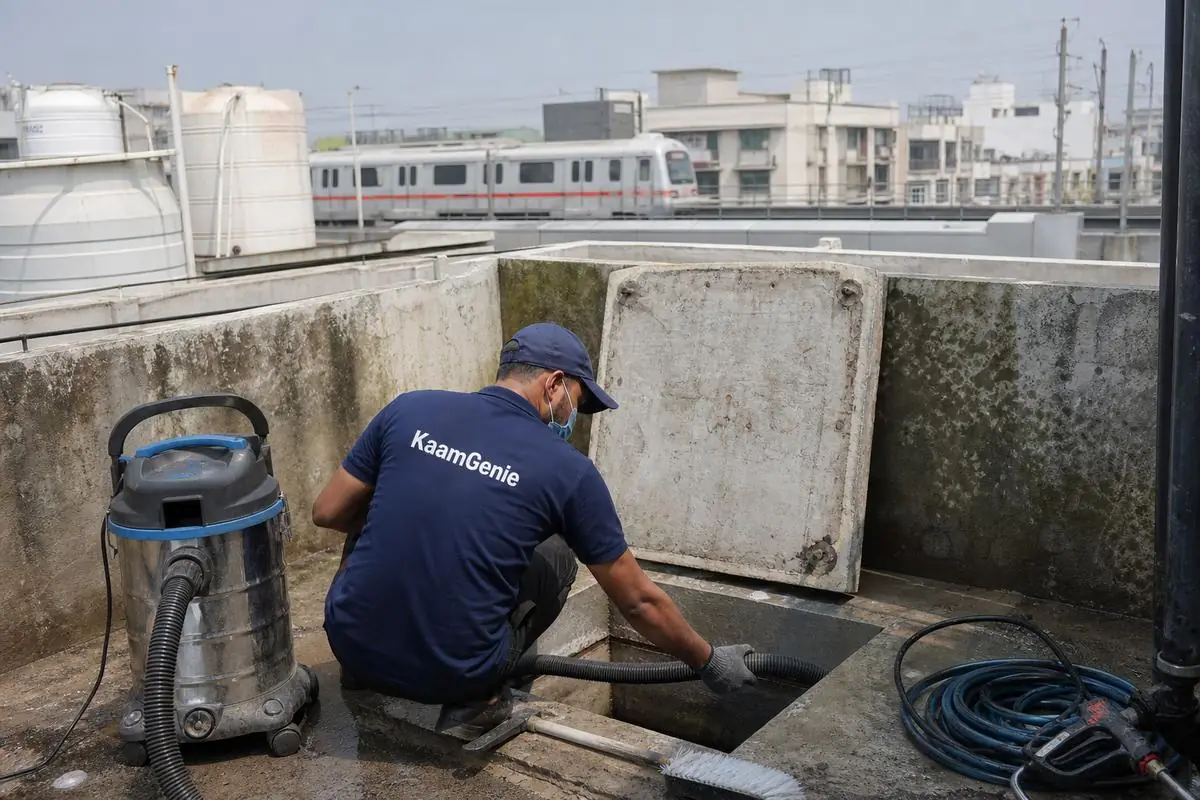
Mineral dust sinks and sits; organic dust dissolves and feeds. Flour and food-processing fines drifting off Lawrence Road carry starch and protein that, once through a cover gap and into standing water, become nutrients for bacterial and algal growth — which is why storage on this side of the colony develops slippery film, greenish tints in light-exposed tanks and a sour edge to the smell faster than plain silt ever causes. The visible sediment may look modest while the biological activity runs well ahead of it.
The colony’s two tank types share the problem differently: stairwell-shared DDA tanks cycle constantly, keeping nutrients suspended and film growing at the waterline, while the compact stilt sumps under Tri Nagar-side rebuilds hold water longer between cycles, giving growth quiet hours to establish. In both, physical cleaning alone is half a job — the disinfection step is what resets the biology, and the yearly cycle (six-monthly for tanks nearest Lawrence Road) is what keeps it reset.
No travel charge anywhere in Keshavpuram. The final price is confirmed on the call before we come — it depends only on tank size and access.
See it done in 45 seconds
Watch our web story on how a tank is really cleaned — drain, de-sludge, jet-wash, disinfect.
We reach every pocket of Keshavpuram — and there’s no travel charge to any of them:
Every locality in Delhi stores different water, and that decides how fast a tank fouls. This is Keshavpuram’s profile from The Delhi Water Index, built from our field observations across 250+ localities.
Indicative field characterisation, not a certified lab test. BIS IS 10500: TDS 500 mg/L acceptable, 2,000 permissible. Check any Delhi area →
“Our tank walls feel slippery when we touch them. What is that?” Biofilm — a bacterial layer that organic nutrients feed, and the Lawrence Road side’s flour-dust drift accelerates it. It will not scrub off with a casual rinse; our jet-wash and hand-scrub strip it physically and the anti-bacterial disinfectant rinse resets the surfaces. If your tank catches sunlight too, expect green algal tinting with it — same treatment removes both.
“Is the disinfectant safe with children in the house?” Yes — it is a hygienic product formulated for drinking-water storage, applied after cleaning and rinsed fully before your tank refills. Nothing harsh remains in the water. It is precisely the biological load in this area that makes skipping disinfection the riskier choice for a household.
“Do you clean the stairwell tanks our DDA wing shares?” Yes — the wing books as one, the families split the bill, and we do the shared ground storage and stair-tower tanks in a single visit so the whole chain is clean at once. A morning covers a typical wing. Call 95603 66362 and we will coordinate with whoever manages the block; single-home sumps booked before 10 AM can usually be cleaned the same day.
“What does the service cost here?” ₹1,499 for storage up to 1,000 litres — which covers most compact stilt sumps in the rebuilt lanes — and by capacity above that for the larger shared tanks. Biofilm removal and full disinfection are part of the standard job in Keshavpuram, not add-ons. Photos every time.
“How often should tanks near Lawrence Road be cleaned?” The blocks nearest the industrial side should run six-monthly — the organic dust load simply feeds regrowth faster there. The metro-side and Tri Nagar-side lanes hold a yearly cycle well. Whichever side you are on, a tight lid or cover seal between cleans slows the nutrient supply dramatically.
See our complete water tank cleaning services in Delhi NCR — pricing, process, tank types and full city coverage.
Beyond water tank cleaning, KaamGenie is rolling out a full lineup of home services across Delhi NCR — see our complete list of 12 home services we offer or will be launching through 2026. New to tank cleaning? Read our guide on how to pick the right water tank cleaning service in Delhi — what to look for, what to avoid, and the questions that separate trustworthy crews from quick-job operators.
Rooftop plastic tanks
₹699+ →Kothi sumps & underground tanks
₹1,499+ →Apartments & RWAs
Bulk pricing →FSSAI-compliant cleaning
₹2,500+ →टंकी साफ़ करने वाले
हिन्दी पढ़ें →View all water tank cleaning guides →
All pockets and lanes of Keshavpuram covered. If your specific block or society isn’t named in the sub-areas above, just call — we almost certainly cover it.
Same crew, same 6-step process, same-day where possible. Pick any locality below for local pricing and the tanks we typically find there.
Book a slot — we can usually fit you in today or tomorrow.