
What’s Included in a Water Tank Cleaning Service?
Raj Babbar · 8 min read
Home › Water Tank Cleaning › Underground Sump Cleaning › Masjid Moth
Underground sump cleaning in Masjid Moth — the shared society sumps under the DDA flats (Phase 1–3) and the smaller buried tanks in the village lanes, where 40-year-old rusting pipework keeps feeding sediment downstream. Confined-space safe, hygienic finish. From ₹1,499.
Masjid Moth is really two water systems wedged between GK-1 and South Extension. The DDA flats of Phases 1, 2 and 3 run shared society infrastructure — a buried sump per block pumping up to tanks on the stair towers — while the old village core around the Moth ki Masjid monument has rebuilt builder floors with their own small sumps and per-floor plastic tanks. DJB supply here is actually reliable; the trouble is what the water travels through.
The DDA plumbing is pushing forty years old, and the GI lines shed rust flakes and iron sediment into every fill, which settles in the block sump before the pumps lift water upward. KaamGenie cleans both kinds of sump — ventilate and air-test, pump out, scoop and wet-vacuum the rusty silt, jet-wash and hygienic disinfect. For the stair-tower and rooftop tanks above, see our water tank cleaning in Masjid Moth; this page covers the buried tank at the bottom of the chain.
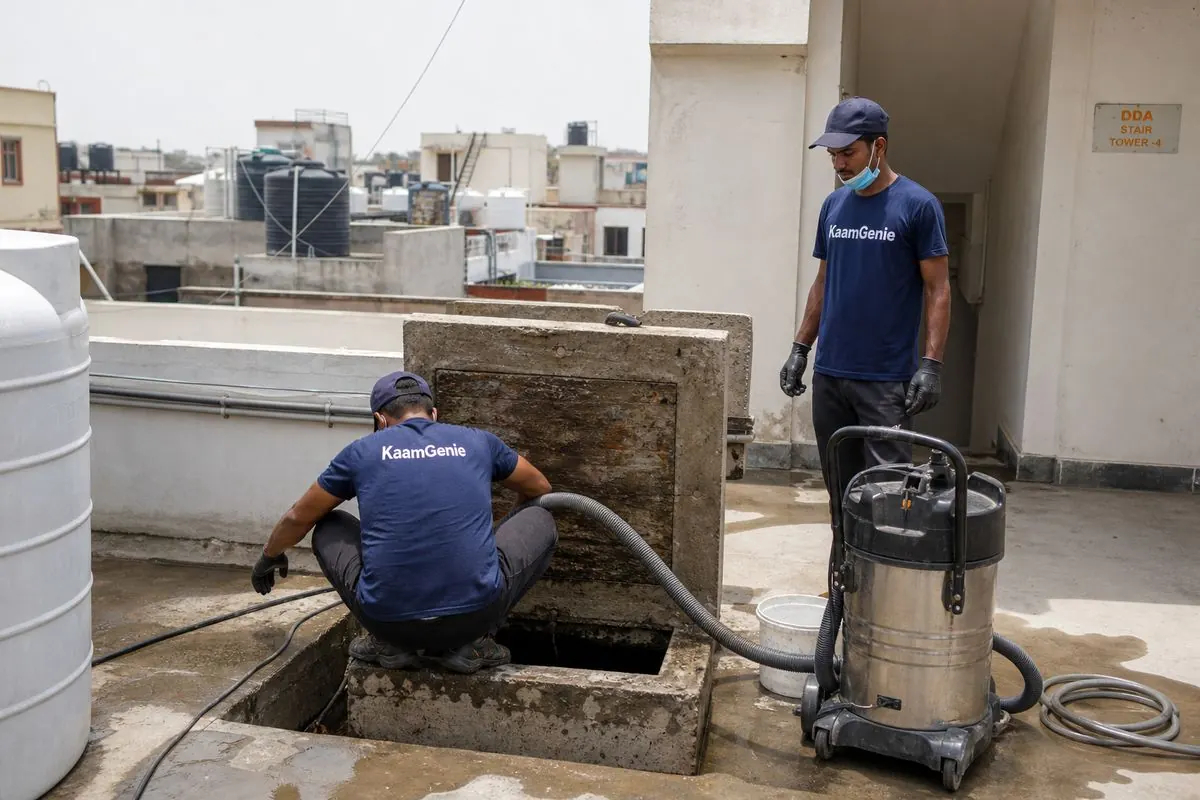
In the DDA phases the sump is the collection point for everything the ageing pipes shed — iron flakes, rust-tinted silt and the fine grit that rides in with mains supply. Because one sump serves a whole block of flats, volume is high and the sediment bed builds quickly, often with a distinct orange tint when we open the cover. Residents usually notice it as stained water after the pump has run, not as a sump problem.
In the village lanes the sumps are newer but smaller, squeezed under stairs in rebuilt floors, and they suffer from the opposite issue: nobody remembers they exist until the booster starts pulling in grit. Either way the pattern is the same — a buried tank holding standing water over sludge, opened rarely, feeding taps daily. We treat every entry as confined-space work, air-testing first, and we check the old RCC walls for cracks and seepage while inside.
No travel charge anywhere in Masjid Moth. The final price is confirmed on the call before we come — it depends only on tank size and access.
See it done in 45 seconds
Watch our web story on how a tank is really cleaned — drain, de-sludge, jet-wash, disinfect.
We reach every pocket of Masjid Moth — and there’s no travel charge to any of them:
Every locality in Delhi stores different water, and that decides how fast a tank fouls. This is Masjid Moth’s profile from The Delhi Water Index, built from our field observations across 250+ localities.
Indicative field characterisation, not a certified lab test. BIS IS 10500: TDS 500 mg/L acceptable, 2,000 permissible. Check any Delhi area →
“Do you clean the shared sumps in the Masjid Moth DDA phases?” Yes, all three phases. These block sumps are shared society assets, so we usually coordinate with the RWA or block representative for access and a pump-shutdown window, clean the sump, and hand over dated before-after documentation the society can file.
“Why does our water look orange after the pump runs?” That is classic Masjid Moth — the 40-year-old GI risers shed rust, which settles as an orange-tinted sediment bed in the block sump. When the pump kicks in it stirs that bed up. Cleaning the sump removes the accumulated layer; if it returns quickly, the pipework itself needs attention and we will tell you honestly.
“What does it cost for a village-lane builder floor sump?” Cleaning starts at ₹1,499 for sumps up to 1,000 litres, which covers most village-core builder floor sumps. The larger DDA block sumps are priced by capacity, typically ₹1,799–2,200 for the 1,001–2,000 litre range, with quotes for anything bigger after we see it.
“How long is the water off during the clean?” Two to four hours for a typical sump. We schedule DDA block jobs for late morning after peak use, and the overhead tanks on the stair towers keep flats supplied while the sump is empty, so most residents never notice the downtime.
“Can you do the sump and the stair-tower tanks together?” Yes, and for the DDA phases we recommend it — a clean sump feeding dirty overhead tanks defeats the purpose. Combined sump-plus-tank visits get a package rate, one access window and a single quality report covering the whole chain.
See our complete water tank cleaning services in Delhi NCR — pricing, process, tank types and full city coverage.
Beyond water tank cleaning, KaamGenie is rolling out a full lineup of home services across Delhi NCR — see our complete list of 12 home services we offer or will be launching through 2026. New to tank cleaning? Read our guide on how to pick the right water tank cleaning service in Delhi — what to look for, what to avoid, and the questions that separate trustworthy crews from quick-job operators.
Rooftop plastic tanks
₹699+ →Kothi sumps & underground tanks
₹1,499+ →Apartments & RWAs
Bulk pricing →FSSAI-compliant cleaning
₹2,500+ →टंकी साफ़ करने वाले
हिन्दी पढ़ें →View all water tank cleaning guides →
All pockets and lanes of Masjid Moth covered. If your specific block or society isn’t named in the sub-areas above, just call — we almost certainly cover it.
Same crew, same 6-step process, same-day where possible. Pick any locality below for local pricing and the tanks we typically find there.
Book a slot — we can usually fit you in today or tomorrow.