Water Tank Cleaning Cost in Delhi (2026)
Real Delhi tank cleaning prices, no surge, no hidden charges.
 KaamGenie
Home › Services › Hospital & Clinic Tank Cleaning
For Hospitals & HealthcareHospitals, nursing homes, dialysis units and clinics can’t treat water storage like a home tank. We clean overhead tanks and underground reservoirs to potable-water standards with food-grade disinfection, staged shutdowns and a signed cleaning report for your records. Quoted per visit by capacity — documented every time.
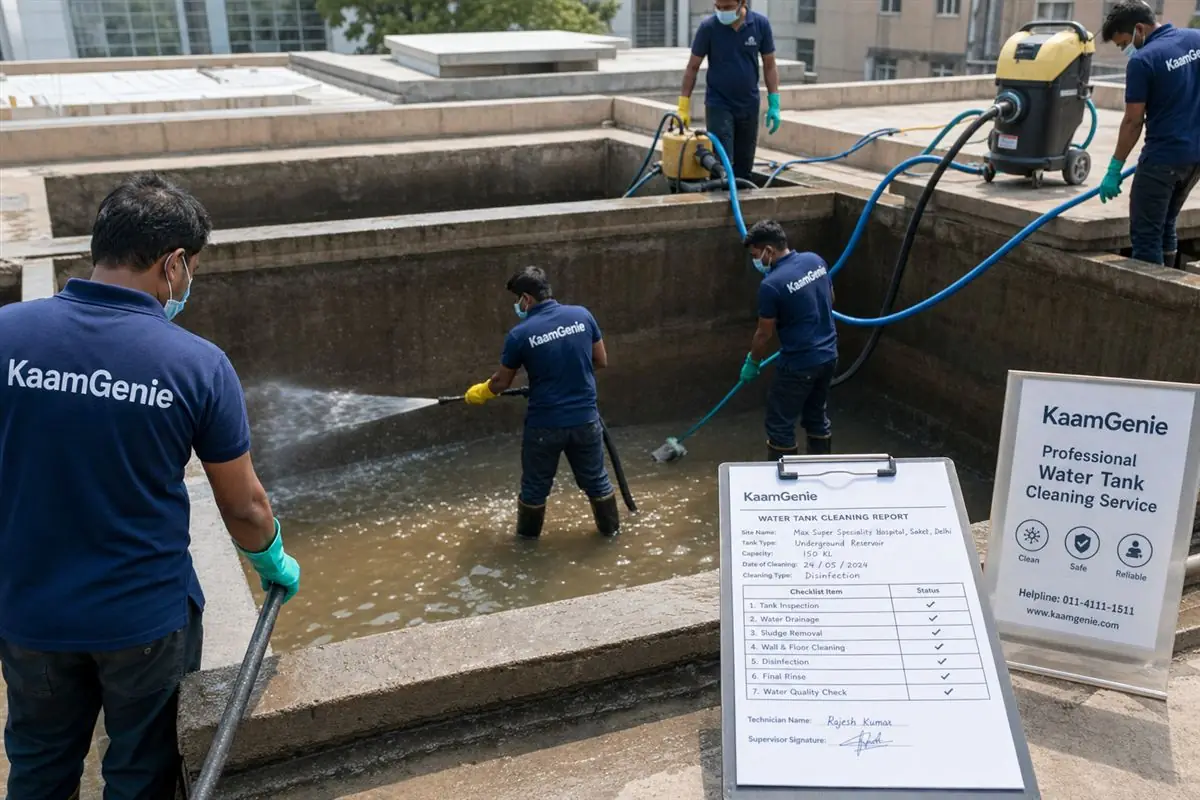
Hospital water tank cleaning is a documented, potable-focused clean of every storage point that feeds wards, OTs, kitchens, laundry and dialysis lines — from the underground raw reservoir to each rooftop overhead tank. It goes beyond a normal home clean because the water contacts patients, sterile equipment and food prep, so contamination risk is measured in infection control terms, not just taste or smell. Every step is logged.
It’s essential for hospitals, nursing homes, maternity centres, dialysis units, path labs and busy clinics across Delhi — especially those preparing for NABH assessment or internal infection-control audits. Facility managers who need a paper trail, a chlorine-residual reading and optional lab water testing after the job book this instead of an unlogged residential clean. It suits multi-tank campuses where downtime must be staged ward by ward.
Same thorough process for every job — no shortcuts.
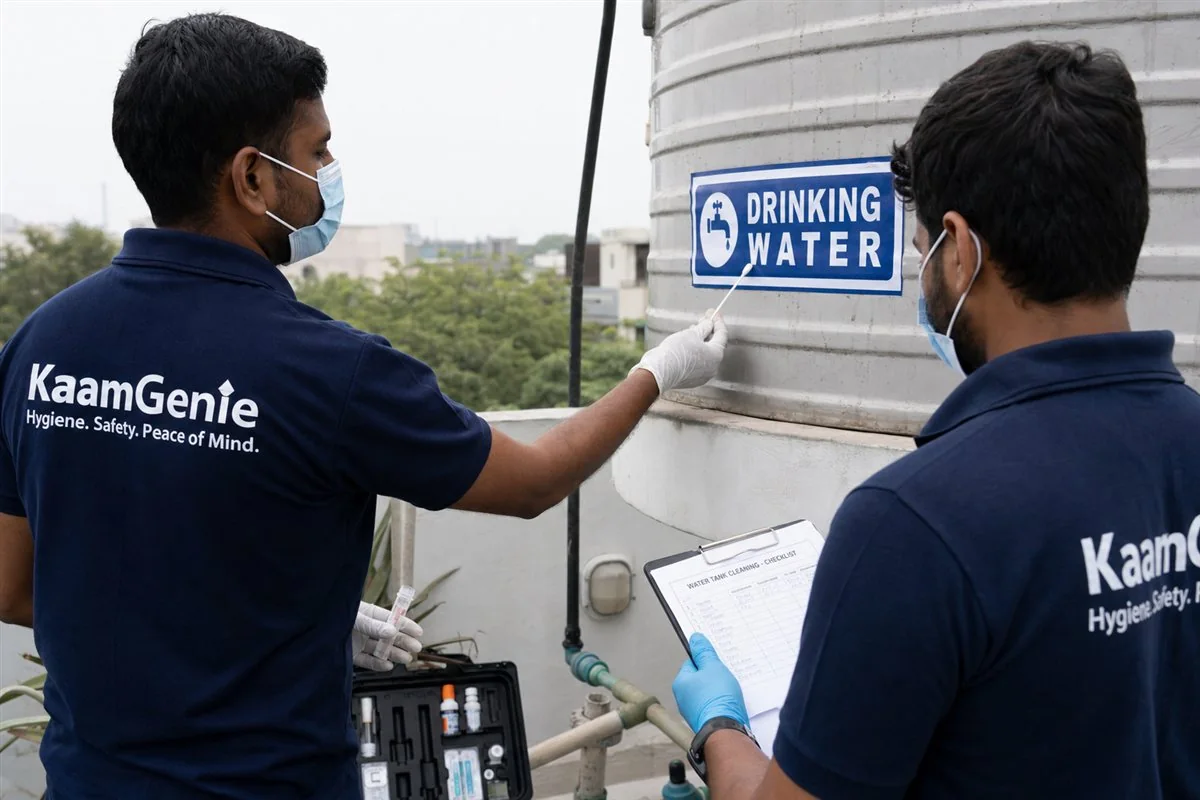
Hospital jobs are quoted per visit because capacity, tank count and downtime windows vary widely across a campus. We give a fixed written quote after the survey — no surprises when the crew arrives.
| Plan / scope | Price |
|---|---|
| Single clinic / nursing-home overhead tank (up to 2000L) | Quoted per visit — from ₹1,999 |
| Underground reservoir clean (per tank, by capacity) | Quoted per visit |
| Multi-tank hospital campus (staged, per visit) | Quoted — volume-based |
| Documented report + free-chlorine residual check | Included |
| Lab water testing (potability panel) | Add-on, quoted |
| Annual contract (quarterly cleans + records) | Discounted vs per-visit |
Prices include GST for residential customers; commercial premises get a separate GST invoice. Call 95603 66362 for an exact quote.
In a hospital, the same stored water reaches immunocompromised patients, surgical hand-scrub stations, kitchen prep and instrument pre-cleaning. A biofilm layer that would only cause an “off” smell in a home tank becomes an infection-control liability here — which is why documented, scheduled cleaning matters far more than for a residence.
Delhi’s supply mix works against you. DJB water carries monsoon silt, borewell-fed campuses in the outer belt add mineral load and higher TDS, and large underground reservoirs sit warm and dark — ideal for bacterial regrowth. Big storage also means water can sit longer between turnovers, so residual chlorine drops and organisms recover between cleans.
The healthcare answer is frequency plus proof. We recommend cleaning hospital tanks every 3 months, keeping a dated record for each tank, and checking free-chlorine residual after every job so infection-control teams and NABH assessors can see the storage system is actively managed, not just occasionally scrubbed.
For assessment and audit, a clean without a record barely counts. Every KaamGenie hospital job ends with a signed report listing each tank cleaned, the date, the disinfectant and dose used, the free-chlorine residual reading and before/after photos. Facility managers file this directly into their water-safety and infection-control documentation, and can add a lab potability panel when the committee wants third-party confirmation.
Downtime is planned, not forced. We survey which tanks feed OTs, ICUs, dialysis and kitchens, then stage the work so critical areas keep supply from an alternate or already-cleaned tank while we handle the rest. Underground reservoir cleans are usually scheduled for low-occupancy windows, and confined-space entries follow a safety check. See our underground sump cleaning and tank disinfection pages for the reservoir and sanitisation detail.
“Do you provide a cleaning certificate or report for NABH?” Yes. Every hospital job ends with a signed cleaning report listing each tank, the date, disinfectant and dose, before/after photos and a free-chlorine residual reading. It slots straight into your water-safety and infection-control file, and we add a third-party lab potability panel on request for assessment evidence.
“How often should a hospital or nursing home clean its water tanks?” Every 3 months for patient-contact storage in Delhi, versus 6 months for a typical home. High turnover, large reservoirs and infection-control stakes justify the tighter cycle. An annual contract with quarterly cleans keeps the record continuous and costs less than four separate one-off visits.
“Can you clean without shutting the whole hospital’s water?” Yes. During the survey we map which tank feeds which wards, then stage the work so OTs, ICUs, dialysis and kitchens keep supply from an alternate or already-cleaned tank while we handle the rest. Underground reservoirs are usually scheduled for low-occupancy windows to minimise disruption.
“Is the disinfection safe for patient-contact water?” We use food-grade chlorine or hydrogen peroxide at a controlled potable dose with full contact time, then a clean-water final rinse and a residual check before the tank returns to service. It targets E. coli, coliforms, algae and biofilm to a standard fit for kitchen, ward and hand-scrub water.
“How much does hospital water tank cleaning cost in Delhi?” It’s quoted per visit because capacity, tank count and downtime windows vary. A single clinic overhead tank starts around ₹1,999; multi-tank campuses and underground reservoirs are priced by volume after a site survey. You get a fixed written quote first. Call 95603 66362 to arrange the survey.
Call +91 95603 66362, WhatsApp here, or use the booking button at the top. Same-day where possible across Delhi NCR.