
The short version — what separates the best from the rest
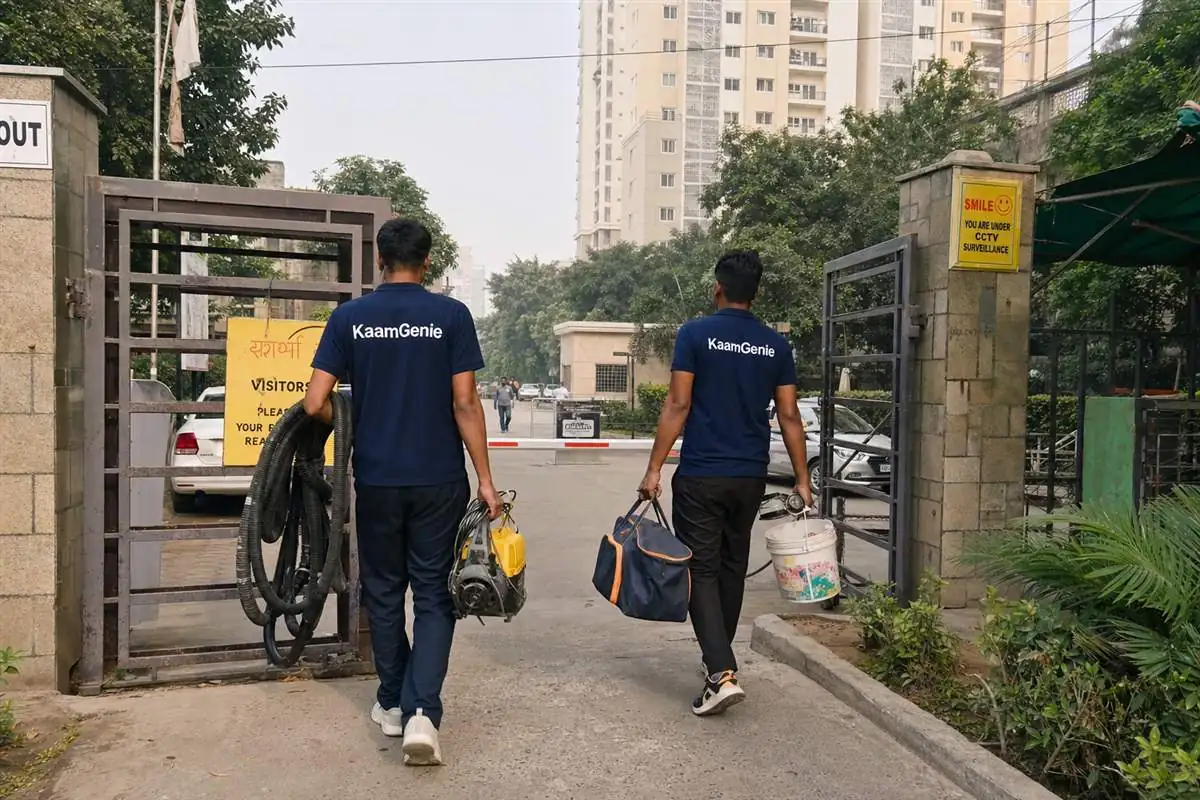
- Proper kit: wet vacuum, pressure jet, food-grade brushes — not a bucket and a bottle
- Food-grade disinfectant (FSSAI-acceptable), named openly — never hardware-shop bleach
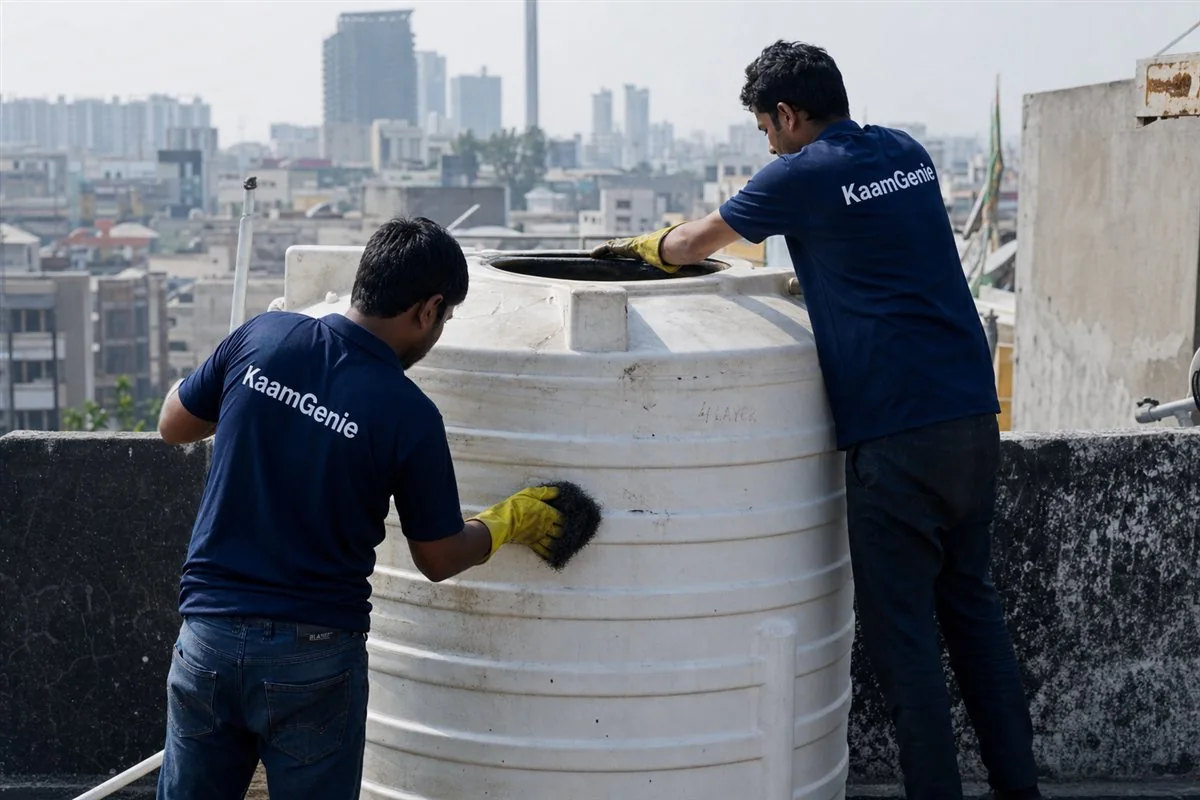
- Someone physically enters and scrubs — not a rinse sprayed from the top
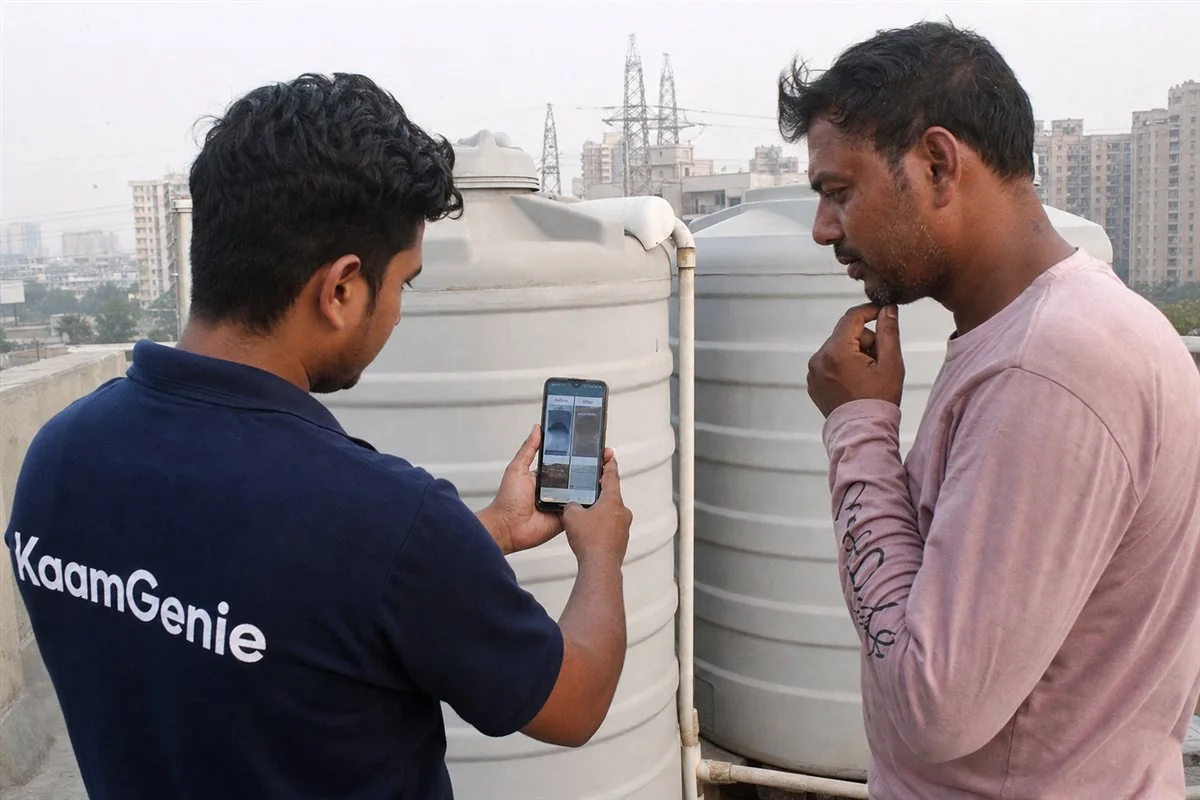
- Before-and-after photos sent to you, every time
- A dated certificate plus a GST bill from a registered business
- A fixed price for your tank confirmed before arrival — no on-site surprises
- Experience with your tank type — high-rise UGR, plotted house, or society reservoir
Tick all seven and you’ve found a real crew. Miss three or more — especially the chemical and the certificate — and you’re paying for a rinse.
Noida is not one kind of building, and that matters more than people realise when they’re hiring. A plotted Authority house in Sector 18 has a small rooftop tank you can practically clean standing on a ladder. A glass tower on the Noida Expressway in Sector 137 runs a huge underground reservoir feeding rooftop tower tanks twenty floors up — a confined-space job that needs safety gear and a pump truck. The IT and corporate belt around Sector 62 has office blocks and PG-style tenant housing with shared sumps. The “best” service for one of these may be wrong for another. So the first rule is simple: judge the crew against your tank, not against a generic flyer.
The second thing to understand is Noida’s water itself. Much of the city runs on hard borewell groundwater, topped up by Ganga Jal piped supply, and the newer townships of Greater Noida West / Noida Extension are heavily tanker-fed. Hard water leaves scale; tanker water carries whatever the tanker carried before. Both demand a real scrub-and-disinfect cycle, not a quick swill. That’s the backdrop for everything below.
| What to check | A proper crew | A quick-job operator |
|---|---|---|
| Time on site | 75–90 min (home tank); hours for sumps | 20–30 min, then gone |
| Equipment | Wet vacuum, pressure jet, food-grade brushes | Bucket, mug, bottle of bleach |
| Disinfectant | Food-grade sodium hypochlorite (50–100 PPM) | Hardware-shop / pool bleach, unnamed |
| Inside the tank | Crew enters, scrubs walls & floor | Sprays water from the lid |
| Proof of work | Before/after photos + certificate | None — “trust me” |
| Paperwork | GST bill from a registered firm | Cash, no bill, untraceable |
| Pricing | Fixed price confirmed before arrival | Low teaser that rises on your roof |
Want the crew that ticks all seven?
Documented, food-grade, photos and certificate every job — across Noida and Greater Noida. Standard residential cleaning ₹699 onwards.
The seven questions to ask before you book
You don’t need to be a water engineer to vet a cleaner. You need seven questions and the confidence to walk away from bad answers. Ask these on the phone, before anyone is standing on your terrace:
- “Do you drain and hand-scrub, or rinse from the top?” The only right answer involves draining the tank, removing sludge, and someone physically scrubbing the walls and floor.
- “What disinfectant do you use, and is it food-grade?” A real crew names it instantly — food-grade sodium hypochlorite, around 50–100 PPM. Hesitation here is the tell.
- “Do you carry a wet vacuum and a pressure jet?” These cost money to own. Operators who skip the documentation usually skip the equipment too.
- “Will I get before-and-after photos?” Photos are free to take and impossible to fake convincingly. A no here tells you plenty.
- “Do you give a dated certificate and a GST bill?” Both prove you’re dealing with an accountable, registered business.
- “Have you cleaned tanks in my sector or society?” Local familiarity with Noida’s UGR-to-tower-tank plumbing genuinely speeds the job and avoids mistakes.
- “What’s the fixed price for my tank size?” You want a number, not a “starting from” that mutates once they see your roof.
For the deeper detail on chemicals, contact times and documentation, our FSSAI water tank cleaning guide for Noida goes into the food-safety side, and the Noida tank cleaning checklist is a printable version of the questions above.
Red flags that mean “keep looking”
Some signals should end the conversation. None of these is a maybe — each one, on its own, is a reason to call someone else:
- A ₹200–300 quote. Real cleaning costs more than that in labour and chemical alone. A price that low is a rinse with a markup.
- “Done in twenty minutes.” You physically cannot drain, de-sludge, scrub, jet, vacuum and disinfect a tank in twenty minutes. Speed here means steps were skipped.
- They can’t name the chemical. If “some cleaning powder” or “bleach” is the best answer you get, assume hardware-shop bleach in your drinking water.
- No one goes inside the tank. Spraying water down from the lid is not cleaning — the contamination lives on the floor and walls.
- No photos, no certificate, no bill. No record means no proof and no recourse if the water’s still cloudy next week.
- The price changes on site. A crew that quotes ₹299 on the phone and ₹900 on your roof was never quoting honestly.
The cheapest end of the Noida market survives precisely by cutting the steps you can’t see. If you want to understand what a fair, transparent number actually looks like for different tank sizes, our water tank cleaning cost guide for Noida breaks it down without the sales spin.
Food-grade chemicals — the single biggest differentiator
If you remember only one thing from this guide, make it this: your tank stores drinking water, so the disinfectant has to be safe for drinking water. That sounds obvious, and yet it’s the most common corner cut in Noida. Food-grade sodium hypochlorite is certified for potable contact — no fragrances, no stabilizers, no heavy-metal contaminants — and it’s the same family of chemical that municipal water treatment uses. The Food Safety and Standards Authority of India (FSSAI) sets the expectation that water in food and domestic systems be disinfected with acceptable agents, and BIS IS 10500:2012 defines the drinking-water quality you’re trying to achieve.
Industrial or pool chlorine is cheaper and easy to buy, but it carries additives that are fine for a swimming pool and unsafe in a glass of water. A proper crew will tell you the chemical and the concentration without being pushed. They’ll also let it dwell — disinfection needs 15–30 minutes of contact time to actually kill bacteria, so a cleaner who pours, swirls and immediately refills hasn’t disinfected anything. This is exactly why a real cleaning takes the better part of an hour and a half, and why the “twenty-minute job” is impossible to do right.
The paperwork that proves it: certificate, GST bill, insurance
The difference between a memory and a maintenance record is paper. After a proper cleaning you should walk away with two documents, and for larger jobs, proof of a third thing:
- A dated cleaning certificate listing tank type and capacity, the chemicals used, the crew names and the service date. This is what you show an RWA or AOA when they ask whether your flat’s tank is on schedule, and what a restaurant or clinic shows during an FSSAI inspection.
- A GST bill from a registered company. It’s not just for tax — it means there’s an accountable business behind the work, not an untraceable individual who vanishes if something’s wrong.
- Liability insurance and a safety protocol for high-rise and underground jobs. A large UGR in a Sector 137 tower or a Greater Noida West township is a confined space — a serious safety hazard. Reputable crews use a harness, a standby person and a gas check, and carry cover. If your society is hiring, ask to see it.
For society and AOA committees specifically, the documentation and contract side is worth its own read — our guide to society water tank cleaning in Noida covers how to structure a recurring contract and what records to keep on file.
How to weight your decision — what actually predicts a good outcome
Our recommended weighting when comparing Noida quotes (price is real, but it’s not the whole story)
Illustrative weighting, not a survey — the point is that method and proof matter far more than the headline price. A cheap rinse you repeat every quarter is the most expensive option of all.
Match the service to your kind of building
One last filter, because Noida rewards it. The best provider for your neighbour may be average for you:
- Plotted Authority houses & builder floors (e.g. Sector 18, Sector 15): usually a single overhead tank, sometimes a shared sump on builder floors. A standard residential crew is perfect; the job is quick but should still be fully documented.
- IT / corporate & PG belt (e.g. Sector 62): office blocks and tenant housing with large shared sumps and heavy daily usage. You want a crew comfortable with commercial scheduling and after-hours work.
- Expressway high-rise belt (e.g. Sector 137, 150, 168, 75–78, 100): big underground reservoirs feeding rooftop tower tanks. Confined-space safety, pumps and insurance are non-negotiable here.
- Greater Noida West / Noida Extension towers: heavily tanker-fed new townships where tank hygiene matters even more, because the water arrives by tanker rather than treated pipe.
If you want to see how the whole market and every service tier fits together, the city-wide Noida water tank cleaning guide is the broader companion to this buyer’s checklist.
Not sure which crew your tank needs?
Tell us your sector and tank type — we’ll confirm a fixed price and the right crew before anyone arrives. ₹699 onwards for homes; sumps and societies quoted on size.
The bottom line for Noida
The “best” water tank cleaning service in Noida isn’t a brand — it’s a checklist. Proper equipment, food-grade chemical named openly, someone scrubbing inside the tank, photos and a certificate at the end, a GST bill from a registered firm, and a fixed price you agreed before they arrived. Tick those and the water in your tank is genuinely safe; miss them and you’ve paid for theatre. Use this guide as your filter, compare two or three crews against it, and choose the one that answers every question without flinching. When you’re ready, you can see service tiers and book water tank cleaning in Noida directly, or read more about KaamGenie’s NCR-wide water tank cleaning services.
Frequently asked questions
How do I choose the best water tank cleaning service in Noida?
Look past the price first. The best service shows up with proper equipment (wet vacuum, pressure jet, food-grade brushes), uses FSSAI-acceptable food-grade disinfectant, sends one crew member physically into the tank to scrub, takes before-and-after photos, and hands you a dated cleaning certificate plus a GST bill. In Noida specifically, also check they have done your kind of tank — a tanker-fed high-rise UGR in Sector 137 is a very different job from a plotted house tank in Sector 18.
What questions should I ask a tank cleaner before booking in Noida?
Ask seven things: Do you drain and hand-scrub or just rinse from the top? What disinfectant do you use and is it food-grade? Do you carry a wet vacuum and pressure jet? Will I get before-and-after photos? Do you provide a dated certificate and a GST bill? Have you cleaned tanks in my sector or society before? And what is the fixed price for my tank size — not a starting price that changes on site. Clear, confident answers are a good sign; vague or defensive ones are not.
What are the red flags of a cheap or fake tank cleaning service?
A ₹200–300 quote, a job that finishes in 20–30 minutes, no equipment beyond a bucket and a bottle of bleach, nobody physically entering the tank, no before-and-after photos, no certificate, no GST bill, and a price that jumps once the crew is on your roof. Hardware-shop bleach instead of food-grade disinfectant is the biggest red flag of all — it can leave residue in water you drink.
Why do food-grade chemicals matter when choosing a cleaner?
Your tank stores drinking water, so the disinfectant must be safe for potable contact. Food-grade sodium hypochlorite is certified for that — no fragrances, no stabilizers, no heavy-metal contaminants. Industrial or pool chlorine is cheaper but carries additives that are unsafe in drinking water. A proper Noida crew will tell you exactly what they use and at what concentration (50–100 PPM). If they cannot name the chemical, assume it is hardware-shop bleach.
Should a Noida tank cleaning service give a certificate and GST bill?
Yes. A dated cleaning certificate lists the tank type and capacity, chemicals used, crew names and the service date — it is your proof of maintenance for an RWA or AOA, and essential if a food business faces an FSSAI inspection. A GST bill means you are dealing with a registered business that can be held accountable, not an untraceable individual. A service that refuses both is a service with nothing to stand behind.
Is the cheapest water tank cleaning quote in Noida worth it?
Rarely. The cheapest quotes win by skipping the steps that cost time and equipment — sludge removal, hand-scrubbing, jet wash, vacuum and proper food-grade disinfection. You pay for a rinse, the contamination stays, and you book again in three months. A fair fixed price for a real, fully documented cleaning is better value than two cheap rinses that achieve nothing.
Does the service need insurance for cleaning high-rise or underground tanks?
For high-rise rooftop tanks and large underground reservoirs in Noida and Greater Noida West, yes — reputable crews carry liability cover and use confined-space safety gear (harness, gas check, standby person). Underground sumps are a genuine confined-space hazard. If a society is hiring, ask for proof of insurance and a safety protocol; for a single home tank it matters less, but the crew should still work safely.
How can I tell if a tank cleaning was actually done properly?
Check the evidence: did they take before-photos when the lid came off, did someone physically go inside to scrub, did you see a bucket of sludge carried away, did you hear the jet wash and vacuum, did they apply disinfectant and wait 15–30 minutes, and did they hand you photos plus a certificate at the end? If most of those happened, it was a real cleaning. If the job was silent and over in half an hour, it was a rinse.
How much should a trustworthy tank cleaning cost in Noida?
A standard residential overhead tank starts around ₹699 onwards for a full, documented cleaning. Underground sumps, society reservoirs and commercial or high-rise jobs are quoted on capacity and access because the work scales with size. The honest signal is a clear fixed price for your tank confirmed before the crew arrives — not a low teaser that rises once they are on your roof.
Sources & references
- Bureau of Indian Standards (BIS) — IS 10500:2012 is the canonical Indian Standard for drinking water specification, defining acceptable limits for physical, chemical, and biological parameters.
- WHO Guidelines for Drinking-water Quality, 4th edition — the global reference for water quality standards, including guidance on storage and disinfection.
- Food Safety and Standards Authority of India (FSSAI) — defines water quality requirements for food businesses, including hygiene standards for stored water and acceptable disinfection chemicals.
- WHO Fact Sheet on Drinking Water — overview of safe drinking water requirements and contamination risks.
- CPHEEO — Manual on Water Supply and Treatment — the Government of India’s engineering manual covering tank design, cleaning protocols, and disinfection practices.
Last verified: 30 June 2026. If you find any of these links broken, please let us know.