
The short version
- Tanker water is not dirtier by definition — but its quality is variable, and it almost always carries more suspended sediment than treated piped supply.
- Tankers fill big underground sumps, where water sits still long enough for that sediment to settle into a sludge layer on the floor.
- Summer makes it worse — more fills, longer storage, warmer water, faster bacterial growth.
- Tanker-dependent buildings should clean every 3 months, not every 6 — and the sump is the priority.
- You can slow the buildup with a consistent supplier, an inlet strainer, and sealed lids — but you can’t skip cleaning.
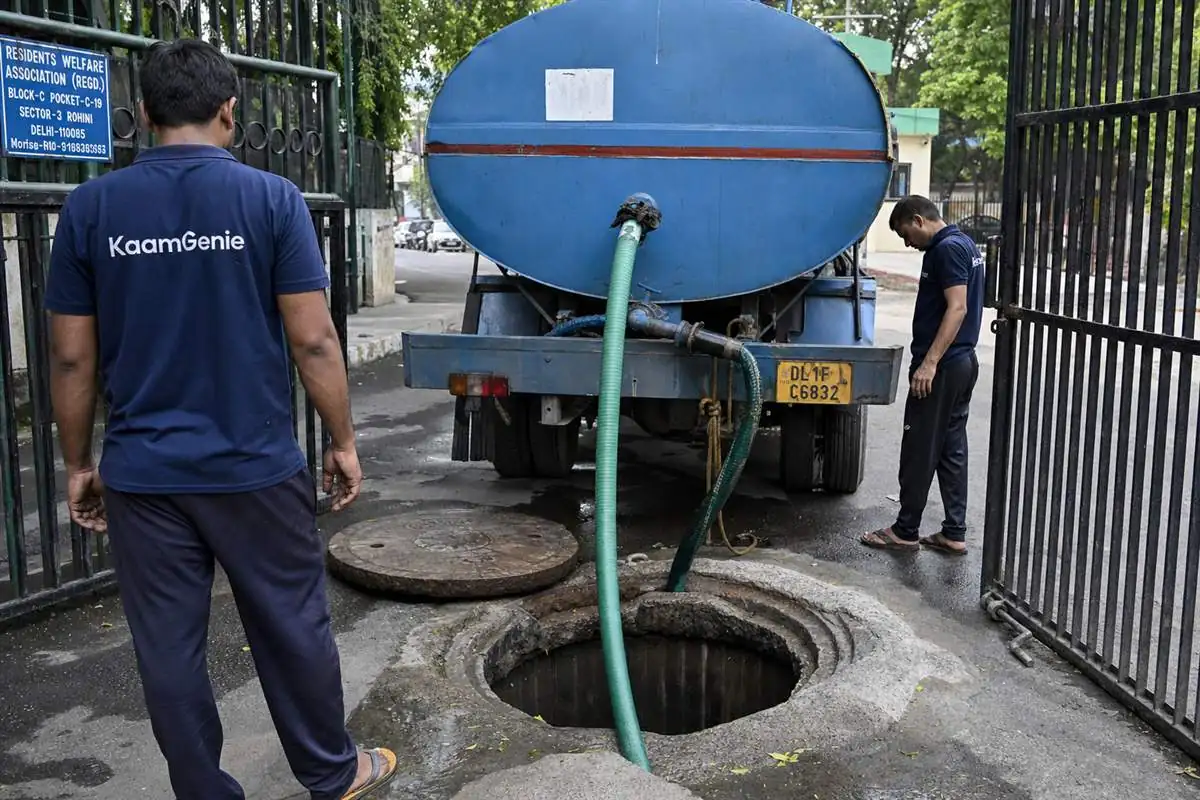
If your colony in Najafgarh, outer Dwarka or Mahipalpur runs on tankers through the summer, the bottom of your sump is doing more work than you think.
Delhi’s water comes from three places, and most outer-area homes touch all three over a year: Delhi Jal Board (DJB) piped supply where the network reaches, borewell groundwater in the unauthorised and outer colonies, and private water tankers to bridge the gap — especially in the brutal April-to-July window when supply gets squeezed. If you live in an area where the DJB line is thin or non-existent, the tanker isn’t a backup; it’s the main artery. And that changes everything about how your storage tank behaves.
This is the part most people miss. You can pay for tanker water, store it carefully, and still end up with a sump that looks like a pond by July — not because anyone did anything wrong, but because of what tanker water is and where it goes. If you want the broader picture of how the city’s sources stack up, our guide to borewell water tank cleaning in outer Delhi covers the groundwater side; this article is about the tanker.
| Source | What it carries | What it does in the tank | Suggested cleaning cycle |
|---|---|---|---|
| DJB piped supply | Treated, low sediment, faint chlorine | Slow, thin sediment layer | Every 6 months |
| Borewell groundwater | High dissolved minerals (hard water) | Scale and crust on walls | Every 4 months |
| Private tanker water | Variable quality, suspended silt, transport residue | Fast sludge settling in the sump floor | Every 3 months |
| Mixed (tanker + borewell) | Both silt and minerals | Sludge and scale together | Every 3 months |
On tankers this summer? Clean the sump first
We time the job to your tanker schedule so you lose no usable water. Before/after photos and a cleaning record every visit. ₹699 onwards.
Why tanker water carries more sediment and variable quality
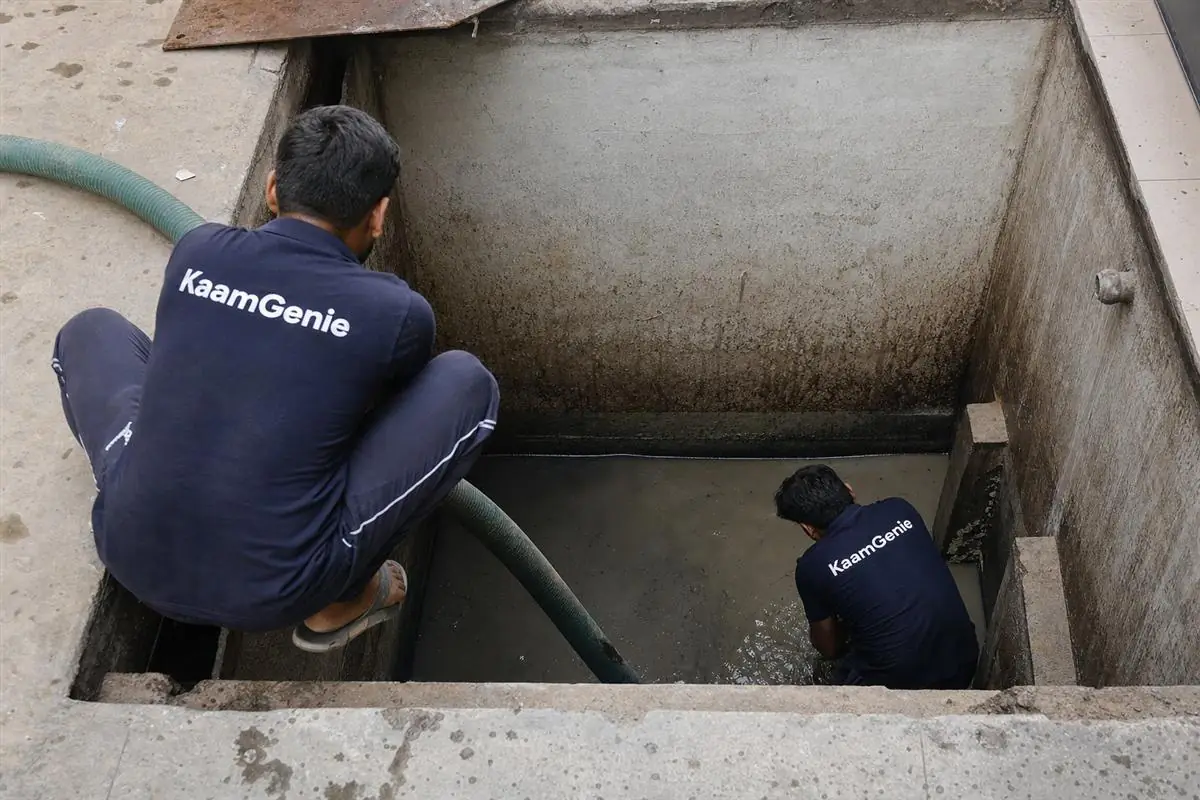
There’s a common assumption that tanker water is automatically “dirty.” That’s not quite right, and it’s worth being precise, because it changes what you do about it. A tanker run by a reputable, DJB-licensed operator drawing from a treated filling point can deliver perfectly acceptable water. The problem is variability — you rarely control, or even know, the source.
Most private tankers in the outer-Delhi belt draw from borewells, which means the starting water already has higher dissolved minerals and more suspended solids than treated DJB supply. On top of that source quality, the water then goes on a journey it never takes in a piped network:
- The barrel itself. Tanker barrels — steel or plastic — are often not cleaned between loads. Rust, biofilm and leftover residue from the previous fill get mixed into yours.
- The sloshing. Water moving through a half-full barrel on Delhi roads keeps any settled sediment stirred up and suspended, so it pours into your tank cloudy rather than clear.
- The hose. The discharge hose frequently sits on the ground between jobs. If it’s dropped in dirt or a drain and then put straight into your sump, that goes in too.
- Pumping pressure. Filling is fast and forceful, which churns the bottom of your existing tank and keeps old and new sediment mixed.
None of this is exotic. It’s just the ordinary reality of trucked water. The result is that every tanker fill adds a measurable load of fine silt — and an unknown microbial quality — that treated piped water simply doesn’t bring. For the deeper science on why hard, mineral-heavy input behaves the way it does once it’s in your tank, our piece on hard water tank cleaning in Delhi is the companion read.
Where it all collects: the big sump that settles sludge
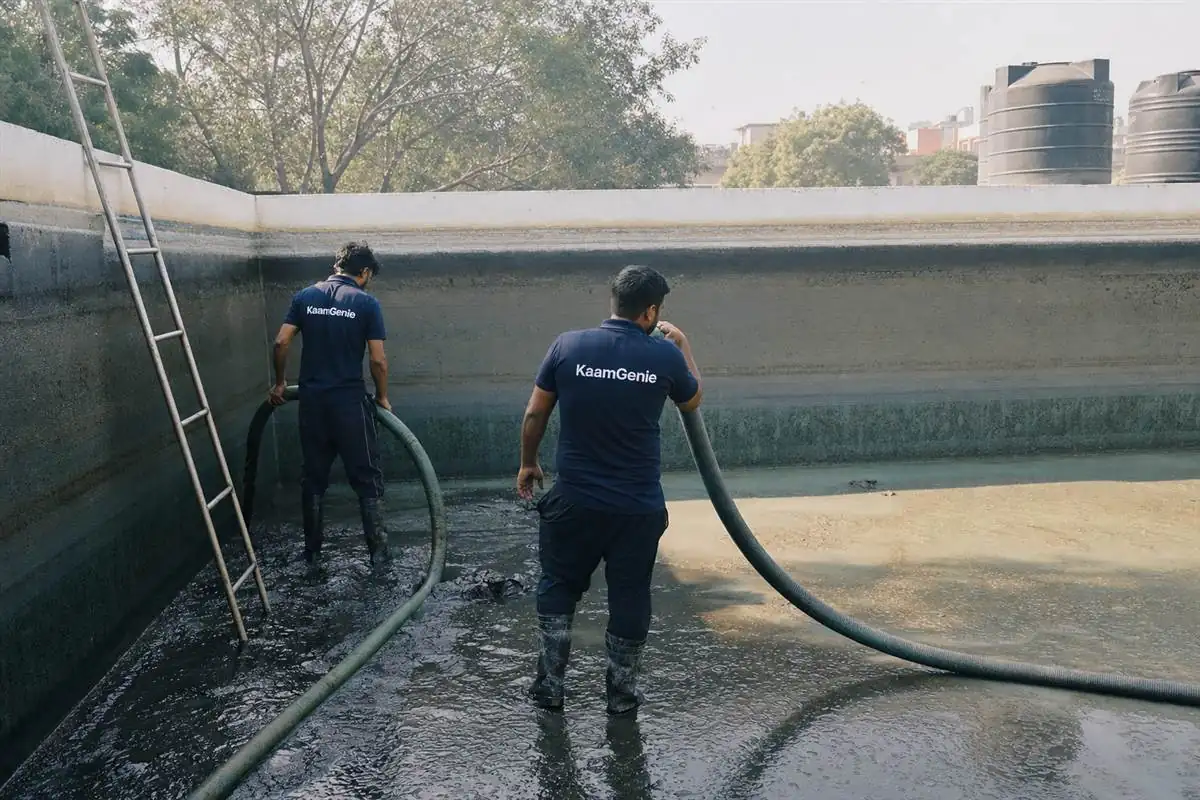
Here’s the part that ties it together. A single tanker is typically 5,000 to 10,000 litres. You can’t put that on the roof — it goes into a ground-level underground reservoir (UGR), or sump. From there a pump lifts it to the overhead tanks as needed.
The sump is exactly the wrong shape for keeping tanker water clean. It’s large, it’s dark, and water sits in it relatively still. That stillness is what lets suspended sediment do what physics wants it to do: settle. Every fill drops another fine layer onto the floor, and over a summer of weekly tankers that builds into a soft sludge bed several millimetres — sometimes a centimetre or more — thick. Because the outlet pump usually draws from slightly above the floor, the sludge isn’t pushed up to your taps day to day. It just accumulates. Quietly. Until someone opens the sump and sees it.
This is the core reason a tanker-fed building needs a different mindset from a DJB-fed one. On piped supply, the overhead tank is the focus and the sediment is thin. On tanker supply, the sump is the focus and the sediment is heavy. If you’re weighing how the two storage points differ, our overhead vs underground tank cleaning guide breaks down why sumps are harder, slower, and need confined-space safety that rooftop tanks don’t.
Why summer makes it worse, not just busier
People assume summer is about cleaning more simply because there’s more demand. The real reason is sharper than that. Three things compound during the Delhi summer water crisis:
- More fills. When DJB supply drops, a tanker-dependent building might go from two fills a month to two a week. Every fill is another sediment deposit. The sludge that took six months to build now builds in two.
- Longer storage. Because the next tanker is never guaranteed, families hoard — they keep the sump fuller for longer and turn the water over more slowly. Standing water grows bacteria and bio-film.
- Heat. A sump and especially a rooftop tank in 44°C heat warms the water. Warm, stored, sediment-rich water is close to ideal conditions for microbial growth. This is the bit that turns a sediment problem into a health problem.
So the worst-case tank in Delhi isn’t the neglected DJB one — it’s the heavily-used, tanker-fed summer sump that hasn’t been opened since winter. That’s the one we most often find with a genuine sludge floor and a smell. If you want the specifics on cadence for your situation, our note on how often to clean a water tank in Delhi lays out schedules by source and usage.
Sludge buildup by water source — relative sediment depth after 6 months
Illustrative, based on typical outer-Delhi tanks our crews open
The summer tanker-fed sump is consistently the dirtiest tank we open — more fills, longer storage and heat all push the same way.
What this looks like across the outer-Delhi belt
The tanker pattern isn’t spread evenly across Delhi — it clusters where the piped network is thin and the population is dense. In practice, that’s the outer and peripheral colonies, the unauthorised colonies, and the newer high-rise pockets that grew faster than the supply infrastructure.
- Najafgarh and the south-west fringe — large stretches lean heavily on tankers and borewells through summer. If you’re here, the sump is doing the heavy lifting; see our local page for water tank cleaning in Najafgarh.
- Dwarka — the cooperative group-housing societies and towers store enormous volumes in shared underground reservoirs, and many top up with tankers when sub-city supply dips. Society sumps here are exactly the still, large reservoirs that settle sludge fastest. We cover the sub-city on our Dwarka water tank cleaning page.
- Mahipalpur — the hotel, guest-house and dense-housing belt near the airport runs high water turnover and frequent tanker fills, which makes regular sump cleaning non-negotiable. Details on our Mahipalpur tank cleaning page.
Whatever your pocket of the city, you can book the same trained crew and fixed pricing through the main water tank cleaning in Delhi hub, or read about our broader water tank cleaning services across Delhi NCR.
How to reduce the risk (without cleaning every fortnight)
You can’t change the fact that you depend on tankers, and you can’t skip cleaning. But you can slow how fast the sludge builds and cut the contamination each fill brings. The practical, no-cost-to-low-cost steps:
- Stick to one regular supplier. A consistent source means consistent quality. Switching between random tankers means you never know what you’re getting. Ask whether the tanker is DJB-licensed.
- Fit an inlet strainer. A simple mesh or strainer where the tanker hose discharges into the sump catches coarse grit and leaves before it ever settles on your floor.
- Don’t let the hose touch the ground. Insist the discharge hose goes from barrel to inlet without dragging through dirt or a drain. This one habit removes a major contamination route.
- Keep every lid sealed. Open or broken sump and tank lids let dust, insects and lizards add to the load. A tight lid is the cheapest hygiene upgrade there is.
- Don’t hoard beyond a few days. The longer tanker water stands in summer heat, the more it grows. Turning water over faster keeps it fresher.
- Clean on a schedule, before summer peaks. A March clean sets you up for the season; a July clean clears the worst of the buildup. Don’t wait for the water to look bad — by then the sludge is already established.
None of these replace a proper cleaning. They buy you time and lower the baseline. When the cleaning does happen, it has to be the real thing — drain, hand-scoop and vacuum the sludge off the floor, scrub and jet-wash the walls, then disinfect with food-grade chemical. A rinse from the top does nothing for a tanker-fed sump, because the whole problem is sitting on the floor.
Get the sludge off the floor, not just the walls rinsed
Full drain, sludge vacuum, scrub, jet wash and food-grade disinfection — the only cleaning that works on a tanker-fed sump. Residential ₹699 onwards; society/UGR custom.
Tanker-fed and want it sorted before peak summer?
If your building in the outer-Delhi belt runs on tankers, the smartest move is a pre-summer clean and a quarterly schedule that lines up with your heaviest fill months. We’ll time the job around your tanker so you lose no usable water, vacuum the sludge off the sump floor properly, disinfect with food-grade chemical, and hand you photos and a cleaning record at the end. Compare pricing and book on the water tank cleaning in Delhi page, call +91 95603 66362, or message us on WhatsApp.
Frequently asked questions
Is private tanker water in Delhi safe to drink straight from the tap?
Treat it as not safe for drinking until it passes through your RO/UV purifier. Tanker water quality is variable — a DJB-licensed tanker drawing from a treated source is very different from an unregulated private tanker drawing from an unknown borewell. Even good tanker water collects sediment during transport and pumping. For bathing and washing, clean-tank tanker water is fine; for drinking, always filter.
Why does tanker water leave more sediment in my tank than DJB piped water?
Two reasons. First, the source — many Delhi tankers draw from borewells with higher dissolved minerals and suspended solids than treated DJB supply. Second, the journey — water sloshes through a steel or plastic tanker barrel, picks up rust and residue, and gets pumped under pressure into your sump. That stirred-up load settles to the bottom of your tank as a fine silt layer within days of every fill.
How often should a tanker-fed building in Delhi clean its tank?
If your building runs mainly on tankers — common in parts of Najafgarh, outer Dwarka pockets, Mahipalpur and unauthorised colonies — clean every 3 months instead of the usual 6. Heavy summer tanker use (April to July) deposits sediment fastest, so a pre-summer clean in March and a follow-up around July is the practical schedule. Buildings that only use tankers occasionally as backup can stay closer to the standard 4 to 6 month cycle.
We just took a tanker fill from an unknown source — should we clean the tank?
If the water looked cloudy, smelled off, or left a film, yes — schedule a cleaning within 2 to 3 weeks. A single fill from a questionable tanker can introduce biological contamination and a fresh sediment load. If the water looked and smelled clean and your tank was cleaned recently, you can usually wait for your normal schedule. When in doubt, a quick inspection visit tells you whether the bottom needs attention.
Why do underground sumps fed by tankers get dirtier than rooftop tanks?
Tankers almost always discharge into a ground-level underground reservoir (UGR/sump) because that is where the volume goes — a single tanker is 5,000 to 10,000 litres. A big sump holds water still for longer, so suspended sediment has time to settle to the floor as sludge. Rooftop tanks turn over faster and hold less. That is why the sump is where tanker sediment concentrates, and why sump cleaning is the priority for tanker-dependent buildings.
Does the summer water crisis actually make tank cleaning more important?
Yes. In the peak summer crunch, buildings take more tanker loads, store water longer because supply is uncertain, and the heat warms tank water — which speeds up bacterial growth and bio-film. More fills means more sediment; longer storage and higher temperature means more microbial risk. The combination is exactly why tanker-dependent Delhi homes should clean before and during summer, not after.
Can you clean our sump on the same day if we are out of water before a tanker arrives?
Often yes — the best window is when the sump is already low or empty, because draining takes minutes instead of an hour. If you can tell us the gap between your current water running out and the next tanker, we can usually slot the cleaning into that window so you lose no usable water. Coordinate the timing on call and we will plan the crew around your tanker schedule.
How can we reduce contamination from tanker water without cleaning constantly?
A few practical steps: insist on the same regular tanker supplier so quality is consistent; ask whether the tanker is DJB-licensed; fit a simple inlet mesh or strainer where the tanker hose discharges into the sump to catch coarse grit; keep the sump and tank lids sealed so dust and insects do not add to the load; and never let the tanker hose sit on the dirty ground before going into your tank. None of these replace cleaning, but together they slow how fast sludge builds up.
Is tanker water cheaper to deal with than installing a borewell?
That is a building-level decision and depends on your colony’s groundwater and legality, but from a tank-hygiene view the trade-off is real: borewell water scales your tank with minerals, tanker water sediments it with silt and carries more variable biological quality. Many outer-Delhi buildings use both — borewell for daily needs and tankers to bridge summer shortfalls. Whichever mix you run, the cleaning frequency should match the dirtier of the two sources.
Do you provide a cleaning record we can show our RWA or society?
Yes — every job ends with before/after photos and a dated cleaning record listing tank type, capacity, chemicals used and crew names. For tanker-dependent societies running shared sumps, this record is useful for RWA documentation and for setting a visible maintenance schedule that residents can trust. We can also set up a recurring quarterly plan so the cleaning lines up with your peak summer tanker months.
Sources & references
- Bureau of Indian Standards (BIS) — IS 10500:2012 is the canonical Indian Standard for drinking water specification, defining acceptable limits for physical, chemical, and biological parameters.
- WHO Guidelines for Drinking-water Quality, 4th edition — the global reference for water quality standards, including guidance on storage and disinfection.
- Food Safety and Standards Authority of India (FSSAI) — defines water quality requirements for food businesses, including hygiene standards for stored water and acceptable disinfection chemicals.
- WHO Fact Sheet on Drinking Water — overview of safe drinking water requirements and contamination risks.
- CPHEEO — Manual on Water Supply and Treatment — the Government of India’s engineering manual covering tank design, cleaning protocols, and disinfection practices.
Last verified: 30 June 2026. If you find any of these links broken, please let us know.