
The short version
- You almost never know the last-clean date — new, resale or rented, the tank’s history is a blank.
- Empty flats go stagnant fast in Gurgaon’s heat — a locked resale or unsold unit can sit with the same water for months.
- New flats are full of construction residue — cement slurry, sand, paint flakes. A builder’s “rinse” is not a cleaning.
- It’s the cheapest move-in task you’ll do — ₹699 onwards, about 90 minutes, photos and a certificate.
- Do it before the taps go into daily use — ideally a day or two before shifting, after handover.
One unknown you can close completely, for the price of a couple of restaurant meals.
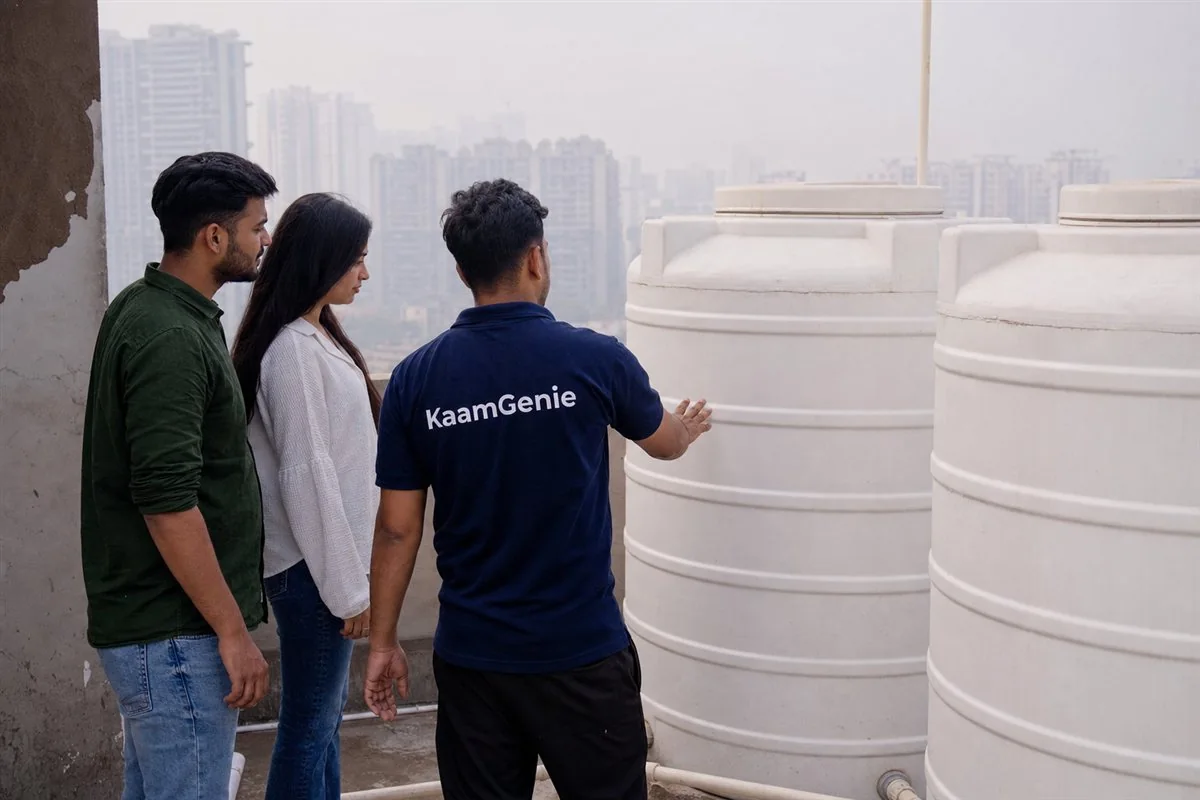
Moving into a flat in Gurgaon (Gurugram) is a long checklist — the deep clean, the painting, the pest control, the gas connection, the broadband. Somewhere on that list, almost always missing, is the one thing that affects your family every single day from move-in: the water tank. Whether you’re taking possession of a new tower flat on Dwarka Expressway, a resale builder floor in a DLF colony, or a rental in a condominium off Sohna Road, the tank that feeds your taps has a history you know nothing about. This guide is the “before you move in” angle for any flat. If yours is specifically brand-new from the builder, read our companion piece on water tank cleaning in a new Gurgaon flat as well — this one covers all three cases.
Why the last-clean date is almost always a blank
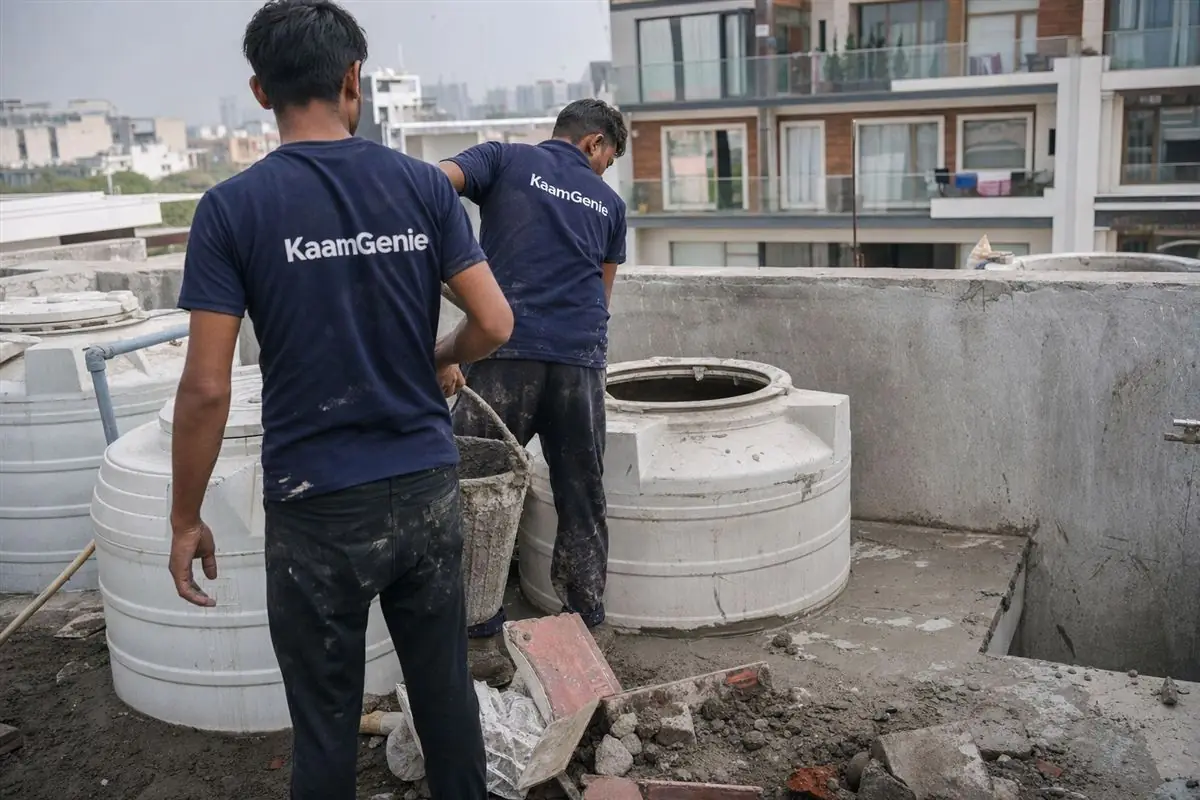
Think about who owned the tank before you, in each of the three common cases:
- Resale flat. The previous family may have cleaned it once a year, or never. Worse, between their move-out and your move-in, the flat often sits locked and empty for weeks or months with the same water standing in the tank. Stagnant water in a sealed plastic tank, on a Gurgaon rooftop hitting 45°C in summer, is a perfect breeding ground for algae and bacteria.
- Rental flat. Landlords rarely clean tanks between tenants, and outgoing tenants almost never do. You could be inheriting years of neglect from people who had no incentive to maintain a tank they didn’t own.
- Brand-new flat. No previous occupant, but plenty of contamination — the tank filled during construction and collected cement slurry, sand, plaster dust, paint flakes and packaging debris. Builders, at handover, give it a quick hose-down at best.
In all three, the honest answer to “when was this last properly cleaned?” is: you don’t know. And water is not something you want to guess about. The simplest way to close that gap is to book water tank cleaning in Gurgaon once, on your terms, before you settle in.
Gurgaon’s water set-up makes this worse, not better
Gurgaon is a tanker-and-borewell city. Large stretches of the Millennium City — the new-tower belt along Southern Peripheral Road (SPR) and Dwarka Expressway, much of New Gurgaon, and many independent builder-floor pockets — rely heavily on water tankers and hard borewell groundwater, not a clean piped municipal supply. That water is high in dissolved minerals and sediment, and it lands first in a big underground reservoir (UGR) before a pump lifts it to the rooftop tank feeding your flat.
What that means practically: tanks in Gurgaon collect sediment and hard-water scale faster than in many other cities, and there are usually two tanks in the chain — the sump below and the overhead tank above. If you only clean the one on the roof and ignore a dirty sump, the freshly cleaned tank is re-contaminated within weeks. A proper move-in cleaning does both. We see this constantly across area after area, from New Gurgaon high-rises to Sector 82 towers and the older condominiums of DLF Phase 5.
| Flat type | The unknown | Likely contamination | Move-in cleaning? |
|---|---|---|---|
| New (builder handover) | No cleaning record; “rinsed” at best | Cement slurry, sand, paint, dust | Strongly recommended |
| Resale (owner-occupied) | Last clean date unknown; sat empty pre-sale | Stagnant water, algae, sediment | Strongly recommended |
| Resale (was rented out) | Likely years of tenant neglect | Heavy sludge, scale, bio-film | Essential |
| Rental | Owner & outgoing tenant both skipped it | Sediment, scale, possible bio-film | Essential |
Clean it once, before you settle in
Book a move-in tank cleaning a day or two before you shift. Both tanks if you have a sump, food-grade disinfection, before/after photos and a certificate. ₹699 onwards.
What to check yourself before you commit
Before you book — or even before you finalise a rental — spend two minutes at the tank. You don’t need to be an expert. Climb up (or ask the caretaker to open it) and look for the obvious tells:
- The lid. Is it intact and sealing flush? An open, cracked or missing lid means dust, birds, lizards and insects have had free access. This is the single most common problem we find.
- The water surface. A film, floating particles, a green tinge, or a musty smell when you lift the lid all point to a tank that needs cleaning now.
- The first tap water. Run a tap for a few seconds and catch the first water in a clear glass. Yellow, cloudy, gritty or smelly water is a red flag — our guide to signs your tank needs cleaning walks through what each symptom means.
- The sump. If there’s an underground reservoir, peek in there too. Sumps collect the heaviest sediment because that’s where tanker water lands first.
One honest caveat: even a tank that looks clean can be hiding bio-film on the walls and a sludge layer on the floor you can’t see from the lid. A visual check tells you when a cleaning is urgent; it doesn’t tell you the tank is safe. For an unknown tank you’re about to drink from daily, the safe default is one proper cleaning.
The move-in cleaning — what actually happens
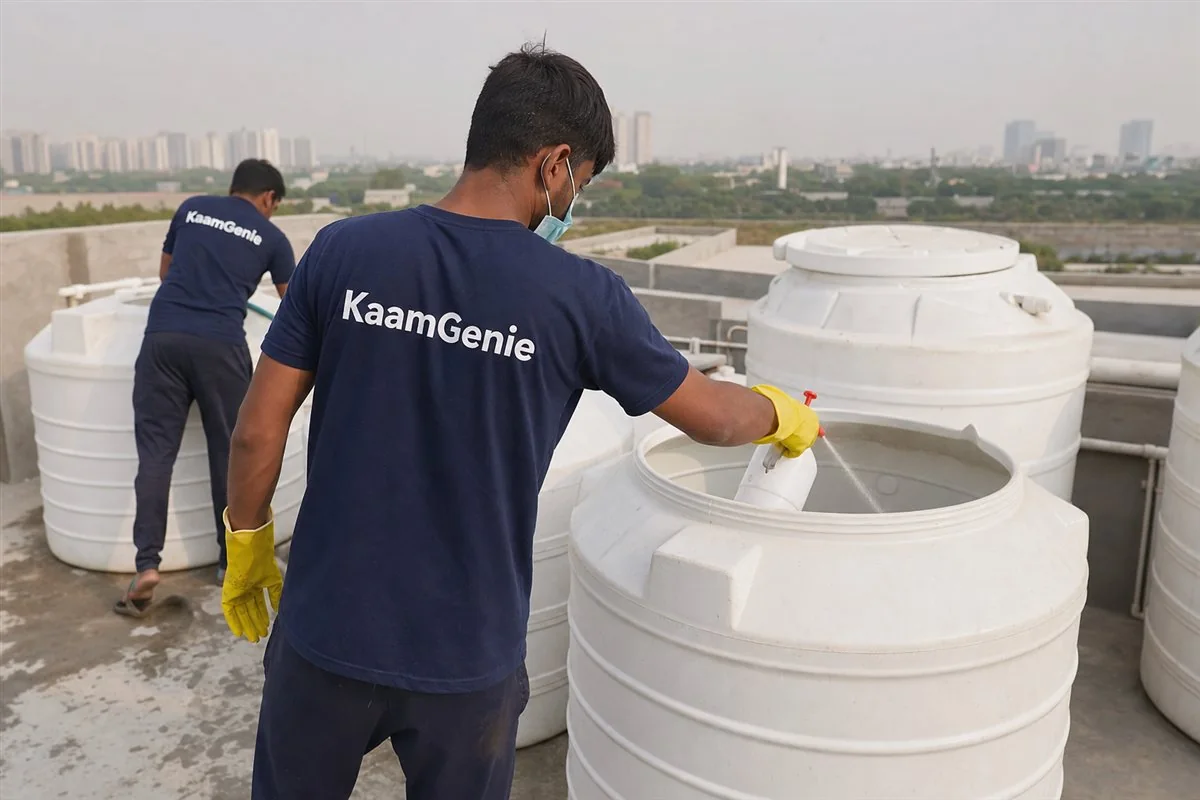
A move-in cleaning is the same thorough job we do anywhere, sized to your flat. In short: we inspect and photograph the tank, drain it, hand-scoop the sludge and construction debris off the floor, scrub every wall with food-grade brushes, jet-wash the corners and fittings, wet-vacuum the residue, then disinfect with food-grade sodium hypochlorite and let it dwell before a final rinse and refill. You get before/after photos and a dated certificate — useful if you’re renting and want a record, or simply for your own peace of mind. If you want the full step-by-step, our 8-step water tank cleaning process breaks down every stage.
For a flat with both a sump and a rooftop tank, both are done in one visit — there’s no point cleaning one and leaving the other to re-contaminate it. This is standard across the residential water tank cleaning services we run in Gurgaon, and it’s exactly the order we recommend: shift-day minus one or two, after the flat is handed over to you, before the taps go into daily use.
Move-in to-do list — cost vs. how much it protects your family’s health
Tank cleaning is near the bottom on cost, near the top on daily impact
Indicative relative spend, not exact quotes. Tank cleaning is one of the smallest line items in a move — and the only one that touches every glass of water from day one.
Renting? Make it part of the deal
If you’re a tenant, you have a window of leverage you won’t get later: before you sign. A reasonable, low-cost ask — “please get the tank cleaned before handover, or reimburse one cleaning” — is something many Gurgaon landlords agree to, because a clean tank protects their plumbing and fittings too. If the owner won’t, ₹699 is a small price for clean water across an 11-month lease rather than living with an unknown. We cover how to raise this without friction in our dedicated tenant water tank cleaning guide for Gurgaon. And once you’ve done the first clean, our how-often guide tells you when to repeat it — in Gurgaon’s hard-water conditions, that’s typically every three to six months.
Book your move-in cleaning — water tank cleaning in Gurgaon
A new home should start clean — and the water is the one part you can’t see but use the most. Whether you’re moving into a new tower, a resale builder floor, or a rented condominium, booking water tank cleaning in Gurgaon before you shift closes one big unknown for ₹699 onwards. Tell us the flat type and whether there’s a sump as well as a rooftop tank, and we’ll quote on the spot and slot you in before your shifting date. For a fuller picture of options and pricing across the city, our complete Gurgaon water tank cleaning guide and cost guide have the detail.
Starting fresh in a new Gurgaon home?
Get the tank cleaned and disinfected before you drink the first glass. Both tanks, food-grade, photos and certificate. ₹699 onwards.
Frequently asked questions
Why should I clean the water tank before moving into a Gurgaon flat?
Because in almost every case you have no idea when it was last cleaned. A resale flat may have sat locked and stagnant for months; a rental may have had years of tenant neglect; a new flat is full of construction dust and cement slurry. The tank feeds every tap you and your family will drink, cook and bathe with from day one. Cleaning it before you shift costs ₹699 onwards and takes about 90 minutes — the cheapest single thing you can do for a healthy home.
Does a brand-new flat from the builder really need the tank cleaned?
Yes, often more than a resale one. During construction the rooftop and underground tanks collect cement slurry, sand, paint flakes, plaster dust and bits of packaging. Builders rarely do a proper food-grade cleaning at handover — at best a quick rinse. A first move-in cleaning removes the construction residue and disinfects the surfaces. We cover the new-construction angle in detail in our guide to water tank cleaning in a new Gurgaon flat.
I’m renting in Gurgaon — should the tenant or owner pay for tank cleaning?
It is usually a small, reasonable ask to put in the agreement that the tank be cleaned before you move in, or that the owner reimburses one cleaning. Many landlords agree because it protects their plumbing too. If the owner declines, ₹699 is a small price to pay for clean water from day one rather than living with an unknown tank for the length of your lease. Our tenant tank-cleaning guide explains how to raise it without friction.
How much does it cost to clean a flat’s tank before moving in?
A standard residential overhead tank in a builder floor or apartment starts at ₹699. If the flat has both an underground sump and a rooftop tank, both can be done in one visit at a combined rate. Society reservoirs (UGR) and large condominium systems are quoted separately. See our Gurgaon cost guide for the full breakdown by tank type and size.
How long does the cleaning take, and can it be done before my shifting date?
A typical home tank takes 75-90 minutes; an underground sump 2-2.5 hours. We can usually schedule it a day or two before your shifting date, or on the same day before the furniture arrives. The ideal time is after the flat is handed over to you but before you start drinking from the taps. Booking 2-3 days ahead gives the best slot choice.
What should I check in the tank myself before I move in?
Open the lid and look: is there sediment, slime, discolouration or a musty smell? Is the lid intact and sealing (an open or broken lid means birds, dust and lizards have had access)? Run a tap and check the first water for colour and smell. Even if it looks fine, a tank that has been sitting unused goes stagnant fast in Gurgaon’s heat, so a visual check is not a substitute for a proper cleaning.
We have a baby and young kids — is this really necessary?
Children and infants are the most vulnerable to water-borne stomach and skin problems, and they have the least say in it. If you are setting up a home for a young family, starting with a tank you have personally had cleaned and disinfected to a food-grade standard removes one big unknown. It is genuinely the cheapest peace-of-mind purchase in the whole move.
The previous owner said the tank was “recently cleaned” — can I trust that?
Trust but verify. Ask for a dated cleaning certificate or photos. With no record, “recently cleaned” often means a hose rinse from the top, or a cleaning done months ago before the flat sat empty. If you cannot see proof and a before/after record, treat the tank as unknown and have it done properly once — it is your family drinking from it now, not theirs.
Do I need to clean both the underground tank and the rooftop tank?
If the flat has both, yes. In most Gurgaon buildings the municipal or tanker water first fills an underground reservoir (UGR), then a pump lifts it to the rooftop tank that feeds your taps. Contamination in the sump travels straight up. Cleaning only the overhead tank while leaving a dirty sump below means it is re-contaminated within weeks. We clean both in a single visit.
Sources & references
- Bureau of Indian Standards (BIS) — IS 10500:2012 is the canonical Indian Standard for drinking water specification, defining acceptable limits for physical, chemical, and biological parameters.
- WHO Guidelines for Drinking-water Quality, 4th edition — the global reference for water quality standards, including guidance on storage and disinfection.
- Food Safety and Standards Authority of India (FSSAI) — defines water quality requirements for food businesses, including hygiene standards for stored water and acceptable disinfection chemicals.
- WHO Fact Sheet on Drinking Water — overview of safe drinking water requirements and contamination risks.
- CPHEEO — Manual on Water Supply and Treatment — the Government of India’s engineering manual covering tank design, cleaning protocols, and disinfection practices.
Last verified: 30 June 2026. If you find any of these links broken, please let us know.