
Key takeaways
- A 2,000-litre tank clean in Delhi typically costs ₹1,100–1,500.
- It’s a clear step above the 1,000-litre tier — twice the water, bigger surface, more sludge.
- Bigger tanks trap more monsoon silt; a post-monsoon clean is the year’s most valuable service.
- Clean every 3–4 months; every 3 for borewell, open lids or joint-family use.
- The vacuum-extraction step is what a cheap hand-wipe skips at this volume.
- Bundle a sump or multiple society tanks into one visit for a lower per-tank rate.
This guide gives you the 2026 cost for a 2,000-litre clean in Delhi and the reasoning behind it. We walk through what a professional service includes at this size, why the price sits above the 1,000-litre tier, the monsoon-silt problem that hits larger tanks harder, the right cleaning frequency for a busy household, and the access and bundling factors that shape the final quote for a kothi or small society.
What a 2000-litre clean costs in 2026
A single 2,000-litre overhead tank in Delhi typically costs ₹1,100 to ₹1,500 for a full professional clean. It sits a clear step above the 1,000-litre tier because there’s twice the water to drain and a much larger surface to scrub and vacuum. KaamGenie gives a fixed quote for this size once we know your access and water source — no vague on-the-day pricing. Cheap local labour might quote ₹600–800, but at 2,000 litres a hand-wipe leaves a real layer of sludge on the base untouched. The vacuum-extraction step is exactly what justifies the professional rate at this volume.
What’s included at this size
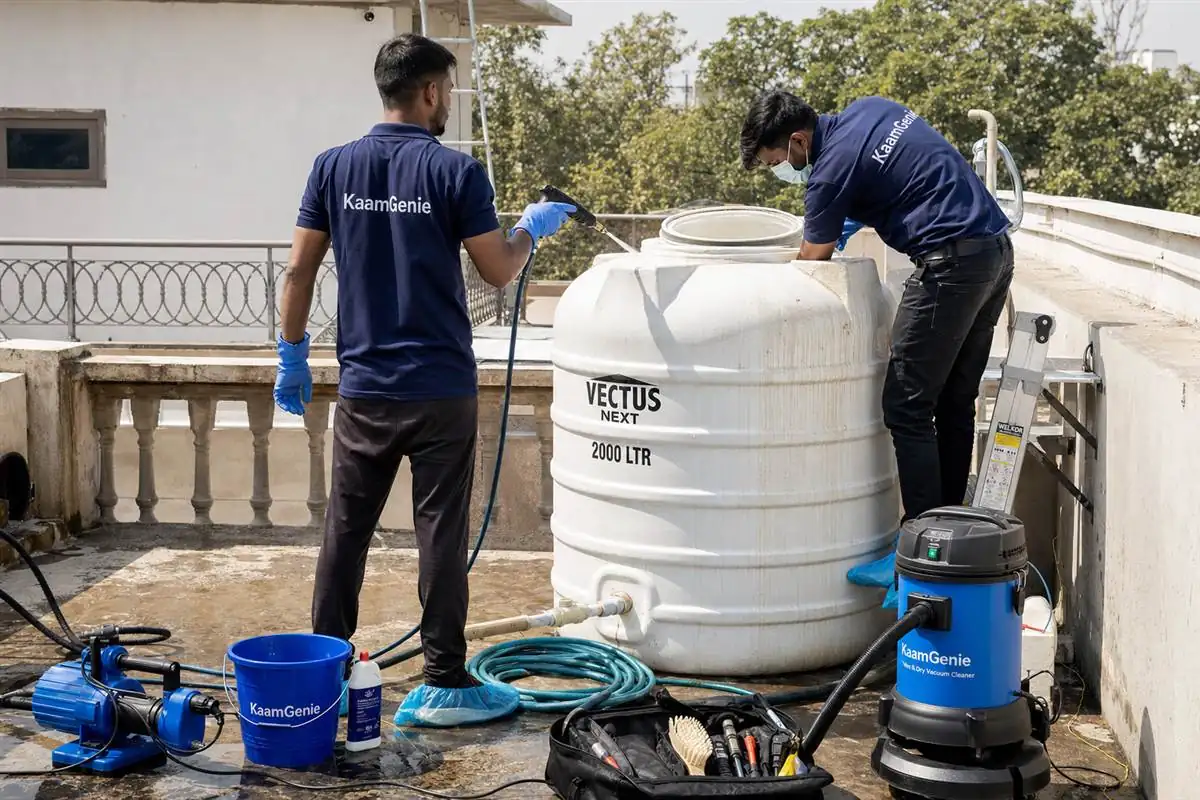
The process for a 2,000-litre tank clean is the same disciplined sequence used on smaller tanks, just scaled up and often run by a two-person crew for speed. It covers draining the residual water, thorough manual scrubbing of the larger wall and base area, wet-vacuum extraction of the loosened sludge, a high-pressure rinse into every corner, and a final anti-bacterial disinfection so the tank is safe for drinking water. You get timestamped before-and-after photos at the end. On a standard 2,000-litre job you should not pay extra for:
- The two-person crew needed for the volume
- Anti-bacterial disinfection of the interior
- Before-and-after photos for your or your RWA’s records
The monsoon-silt problem on bigger tanks
Larger tanks hold water longer between refills, which gives suspended silt more time to settle out. During Delhi’s monsoon, DJB supply carries a heavier sediment load, and a 2,000-litre tank can accumulate a surprisingly thick soft layer across its base by season’s end. That layer is exactly what a cloth wipe misses and a vacuum removes. If your tank sits under an open or poorly sealed lid, wind-blown dust and leaves add to it. A post-monsoon clean in September or October is the single most valuable service of the year for a 2,000-litre tank — it clears the season’s accumulated silt before it hardens.
Book your water tank cleaning
Trained crew, food-grade process, before/after photos and a service record every job. ₹699 onwards, same-day where possible across Delhi NCR.
Cleaning frequency for a busy household
A 2,000-litre tank usually serves a larger or busier household, so hygiene matters just as much despite the bigger buffer. Clean every three to four months as a baseline. Adjust for your situation:
- Borewell or hard-water homes — lean towards every three months for scale control
- Open or ill-fitting lid — clean more often, and fix the lid to slow build-up
- Joint families or home-based tiffin/catering use — keep a strict quarterly schedule
Kothi and small-society access factors
At 2,000 litres, access shapes the quote more than at smaller sizes because the equipment is heavier and the job longer. A kothi terrace with a proper staircase is straightforward. Complications that add time include a tank on a high mumty roof, a bolted or seized lid, or no nearby tap and power point for the pump and vacuum. For a small society or a shared building with several tanks, the smart move is a single visit covering all of them — the per-tank rate drops sharply when a crew does four or five in one trip. Flag your setup when booking so the right crew size and equipment arrive.
Getting a fixed quote and booking
Call or WhatsApp 95603 66362 with your area, water source, tank access and how many tanks you have. You’ll get a firm quote before the crew arrives. A single 2,000-litre clean runs roughly 60 to 90 minutes depending on access and how much sludge has built up. Expect a longer water interruption than a small tank while it drains and refills, so store water accordingly. Once disinfected and refilled the water is safe to use. If you also run an underground sump, add it to the same visit for a better combined price.
Frequently asked questions
What is the cost of cleaning a 2000-litre water tank in Delhi?
A single 2,000-litre overhead tank typically costs ₹1,100 to ₹1,500 for a full professional clean. That covers draining, scrubbing the large interior, wet-vacuum extraction, pressure rinsing and disinfection. Access difficulty, heavy borewell scaling or a long-overdue tank can raise it; bundling multiple tanks lowers the per-unit price.
Why is a 2000-litre clean more expensive than a 1000-litre?
Double the volume means twice the water to drain, a much larger wall and base area to scrub, and more settled sludge to vacuum out. It often needs a two-person crew and takes 60 to 90 minutes versus around an hour. Pricing scales with volume because volume drives labour time and equipment use.
When is the best time to clean a large 2000-litre tank?
Post-monsoon, around September or October, is the most valuable clean of the year. Larger tanks hold water longer, so monsoon silt settles into a thick base layer that a wipe can’t remove. Clearing it before it hardens keeps your water clean and protects the tank. Also do a pre-summer clean around February to March.
Do I need to be home for the full 2000-litre job?
It helps to be reachable, but you don’t have to watch the whole 60 to 90 minutes. The crew needs access to the tank, a nearby tap and a power point. Expect a longer water interruption than a small tank while it drains and refills, so store water beforehand and let the crew know of any access quirks.
Can I add my sump to a 2000-litre tank booking?
Yes, and it’s the economical way to do it. Adding your underground sump to the same visit costs less than two separate jobs. For a small society or shared building, book all the tanks in one trip for the best per-tank rate. Ask for a combined quote on 95603 66362.
Is a 2000-litre clean safe if I have young kids or pets at home?
Yes. We use food-grade, non-toxic cleaning agents — no strong acids or bleach fumes that linger. The crew keeps tools and the drained water away from play areas. Once we refill and rinse, the water is safe for the whole family. If anyone in the house is sensitive to smells, tell us and we’ll ventilate the space while we work.
How much water do I lose when a 2000-litre tank is drained for cleaning?
We only drain what’s left sitting in the tank at cleaning time, so book it when the tank is naturally low — early morning after overnight use, or just before the next fill. That way you waste very little. The sludge and dirty water at the bottom isn’t drinkable anyway, so draining it is no real loss.
Do you give a guarantee or free re-clean if I’m not happy with a 2000-litre job?
We show you before-and-after photos before we leave, so you can point out anything you’re unhappy with on the spot and the crew will redo it. If a genuine issue surfaces within a day or two, call 95603 66362 and we’ll come back. Standing behind the finish is why we document every 2000-litre clean with photos.
My 2000-litre tank sits on an open terrace — does sun and dust mean I should clean more often?
Yes. Open, sun-exposed tanks warm up and encourage algae, and Delhi’s dust settles in through any gap in the lid. If yours is uncovered or the lid is cracked, aim for every four months instead of six. Getting a proper fitted lid, which we’ll flag if missing, cuts the dust and slows regrowth noticeably.
Can you clean a 2000-litre tank while my building’s motor keeps running, or must supply stop?
We ask you to switch the motor off during the clean so no dirty water is pumped up or the tank refills mid-scrub. For a single household 2000-litre tank that’s only a two-hour pause. Store a couple of buckets beforehand for essential use, and supply resumes as soon as we refill and switch the motor back on.
Sources & references
- Bureau of Indian Standards (BIS) — IS 10500:2012 is the canonical Indian Standard for drinking water specification, defining acceptable limits for physical, chemical and biological parameters.
- WHO Guidelines for Drinking-water Quality, 4th edition — the global reference for water quality standards, including guidance on safe storage and disinfection.
- Food Safety and Standards Authority of India (FSSAI) — defines water quality requirements for food businesses, including hygiene standards for stored water and acceptable disinfection chemicals.
- WHO Fact Sheet on Drinking Water — overview of safe drinking water requirements and contamination risks.
- CPHEEO — Manual on Water Supply and Treatment — the Government of India’s engineering manual covering tank design, cleaning protocols and disinfection practices.
Last verified: 6 July 2026. If you find any of these links broken, please let us know.