
Key takeaways
- A single 5,000-litre tank clean in Delhi generally costs ₹2,000–3,000.
- Society and commercial jobs are quoted per-visit; more tanks means a lower per-tank rate.
- It needs a two-person crew and heavier vacuum equipment for the sludge load.
- Shared supply raises the hygiene stakes — a neglected tank can affect a whole block.
- An AMC’s 15–25% per-visit saving is most valuable at this high base rate.
- Coordinate the water interruption and brief residents before a society clean.
This guide sets out the 2026 cost for cleaning a 5,000-litre tank in Delhi and why it lands where it does. We cover what a professional service includes at commercial scale, why society and large-property jobs are usually quoted rather than fixed-listed, the shared-supply hygiene stakes, how an AMC changes the economics, and the access and coordination factors that matter when many families depend on one tank.
What a 5000-litre clean costs in Delhi
A single 5,000-litre overhead tank in Delhi generally costs ₹2,000 to ₹3,000 for a full professional clean, depending on access, water source and how long it’s been since the last service. It sits well above the 2,000-litre tier because the volume, surface area and sludge load are all much larger, and the job needs a two-person crew and heavier vacuum equipment. For societies and commercial buildings, KaamGenie quotes the job after understanding tank count and access — a block of several tanks is priced per-visit, which brings the per-tank cost down considerably versus one-off bookings.
What’s included at commercial scale
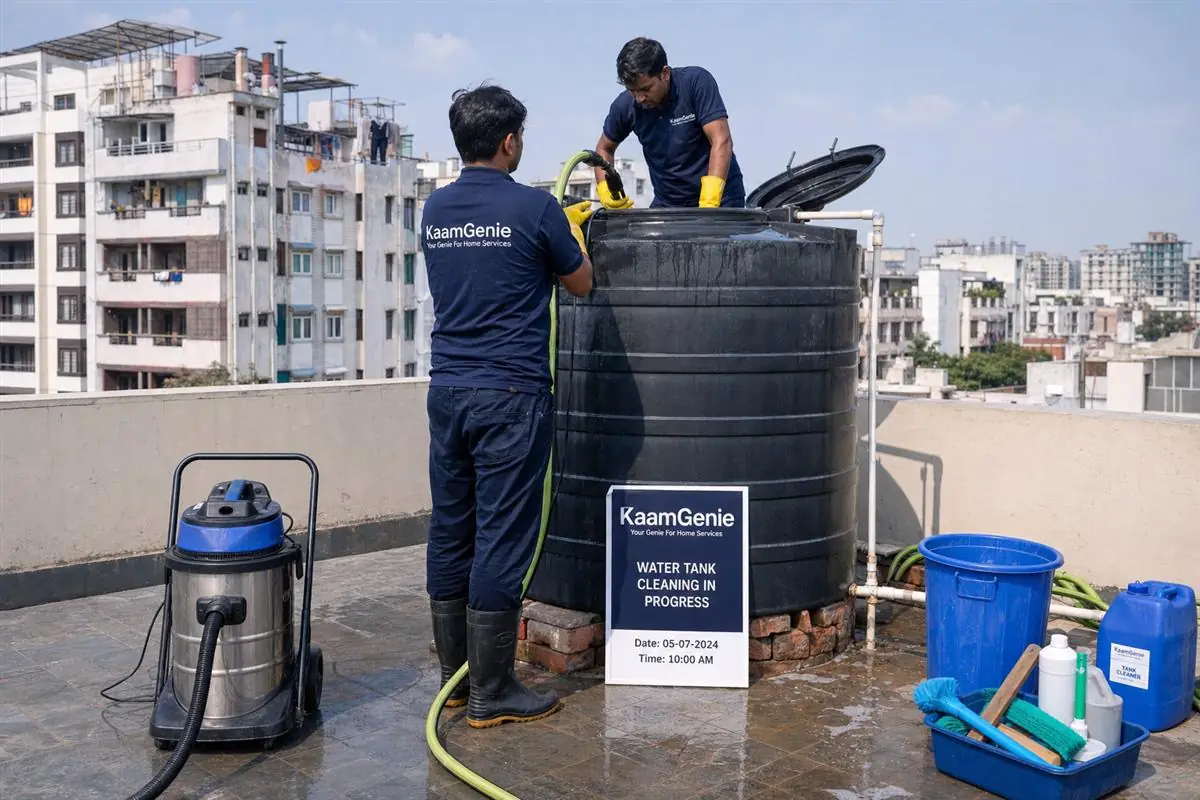
A 5,000-litre tank clean follows the same proven method as smaller tanks, run by a crew and with equipment sized for the volume. It includes draining the tank, thorough manual scrubbing of the large walls and base, powerful wet-vacuum extraction of the heavy settled sludge, a high-pressure rinse, and a final anti-bacterial disinfection rated for drinking water. For societies we provide timestamped before-and-after photos and can supply a simple service record for the RWA or managing committee. On a standard job the quoted price already covers:
- The full two-person crew and heavier vacuum equipment
- Anti-bacterial disinfection rated for drinking water
- A service record and photos for the RWA or committee
Why society and commercial jobs are quoted
Unlike a single household tank, large-property work rarely fits a flat rate, so it’s quoted. The variables are real: how many tanks, whether they’re on one roof or spread across blocks, borewell versus DJB supply, and how accessible each tank is. A society with five 5,000-litre tanks on a single accessible terrace gets a far better per-tank rate than one tank on a hard-to-reach mumty. Quoting lets us price fairly for the actual work rather than padding a flat rate to cover worst cases. Share your tank count and a photo of the setup on 95603 66362 and you’ll get a clear, itemised figure — not a number invented on the day.
Book your water tank cleaning
Trained crew, food-grade process, before/after photos and a service record every job. ₹699 onwards, same-day where possible across Delhi NCR.
Shared supply, shared hygiene risk
When one 5,000-litre tank feeds many families, a neglected tank multiplies the risk. Sediment, algae and biofilm at this volume don’t just cloud the water — they can seed the kind of bacterial growth that causes stomach upsets across an entire block, and everyone blames the “water” without realising the tank is the source. Warning signs a society should never ignore:
- Residents reporting an earthy smell or off taste at the same time
- Visible particles or a yellow tinge in stored water
- No record of the tank being cleaned in the past six months
How an AMC changes the maths
At the 5,000-litre level, an annual maintenance contract is where the economics turn in your favour. Because the base rate is high, the 15–25% AMC discount on each visit is a meaningful saving across a year of quarterly cleans. An AMC also removes the coordination headache for an RWA — the schedule is fixed, the crew turns up on cadence, and there’s a documented record for the committee and any residents who ask. For a society running several large tanks, an AMC covering all of them, cleaned on the same visits, is comfortably the lowest total cost per litre of clean water delivered.
Access, coordination and booking
Large-tank jobs need a little coordination. The crew needs roof access, a nearby tap and a power point strong enough for the vacuum. For societies, brief residents in advance about the water interruption, since draining and refilling a 5,000-litre tank takes longer than a household unit — store enough for the window. To book, call or WhatsApp 95603 66362 with your tank count, water source, access details and any RWA contact. You’ll get a firm quote and a scheduled slot. If the building also runs an underground sump, fold it into the same visit for a better combined figure.
Frequently asked questions
How much does it cost to clean a 5000-litre water tank in Delhi?
A single 5,000-litre tank generally costs ₹2,000 to ₹3,000 for a full professional clean, depending on access, water source and time since the last service. It needs a two-person crew and heavier equipment. Societies and commercial buildings are quoted per-visit, and booking several tanks together lowers the per-tank cost.
Why are large society tanks quoted instead of a fixed price?
Because the variables are real: tank count, whether they’re on one roof or across blocks, borewell versus DJB water, and access to each. A fair quote prices the actual work rather than padding a flat rate for worst cases. Share your tank count and a setup photo on 95603 66362 for a clear, itemised figure.
How often should a 5000-litre society tank be cleaned?
Every three months. When one tank feeds many families, a neglected tank can cause stomach upsets across a whole block. A strict quarterly schedule is basic duty of care. Clean sooner if residents report an earthy smell, off taste, visible particles or a yellow tinge in stored water at the same time.
Is an AMC worth it for a large 5000-litre tank?
Yes, more so than for small tanks. Because the base rate is high, the 15 to 25 percent per-visit AMC discount is a real saving across a year of quarterly cleans. An AMC also fixes the schedule and gives the RWA a documented record, removing the coordination burden of booking each clean separately.
Do residents need to store water during a society tank clean?
Yes. Draining and refilling a 5,000-litre tank takes longer than a household unit, so brief residents in advance and ask them to store enough for the interruption window. The crew needs roof access, a nearby tap and a strong power point. Once disinfected and refilled, the water is safe to use.
How long does a 5000-litre society or commercial tank clean take?
A single 5000-litre tank usually takes two to three hours, depending on how much sludge has built up and how easy the access is. Multiple tanks or a combined sump-and-overhead job runs longer, so we schedule those across a morning. We’ll give you a realistic time when we survey the site and share the quote.
Do you provide a GST invoice and service record for a 5000-litre society clean?
Yes. For societies and commercial clients we provide a proper invoice the RWA or facility manager can file, plus a service record with before-and-after photos of each tank. This paperwork is useful for AMC audits and for showing residents the work was done. Ask for it when you confirm the booking on 95603 66362.
Will your crew coordinate directly with our RWA or security, or does one owner have to manage it?
Our supervisor coordinates with whoever you nominate — the RWA secretary, facility manager or security in-charge. We confirm access times, motor shut-off and a notice for residents in advance. You don’t need one person babysitting the whole clean; just give us a point of contact and gate clearance for the crew and equipment.
Is the crew police-verified — our society needs that for outside workers?
Yes. Our cleaning crew is trained and police-verified, which is exactly what most Delhi RWAs require before allowing vendors past the gate. We can share ID details in advance for your security register. This is a common ask for 5000-litre society jobs, so it’s built into how we work — just request the documents when booking.
Our 5000-litre tank has never been cleaned — will one visit be enough?
Usually yes, but a tank neglected for years can hold thick sludge and heavy scale that takes extra time and labour, which is why large tanks are quoted after a look. One thorough visit gets it food-grade clean; we’ll then recommend a sensible schedule or AMC so it never reaches that state again.
Sources & references
- Bureau of Indian Standards (BIS) — IS 10500:2012 is the canonical Indian Standard for drinking water specification, defining acceptable limits for physical, chemical and biological parameters.
- WHO Guidelines for Drinking-water Quality, 4th edition — the global reference for water quality standards, including guidance on safe storage and disinfection.
- Food Safety and Standards Authority of India (FSSAI) — defines water quality requirements for food businesses, including hygiene standards for stored water and acceptable disinfection chemicals.
- WHO Fact Sheet on Drinking Water — overview of safe drinking water requirements and contamination risks.
- CPHEEO — Manual on Water Supply and Treatment — the Government of India’s engineering manual covering tank design, cleaning protocols and disinfection practices.
Last verified: 6 July 2026. If you find any of these links broken, please let us know.