
What’s Included in a Water Tank Cleaning Service?
Raj Babbar · 8 min read
Home › Water Tank Cleaning › Overhead Tank Cleaning › Burari
Burari grew faster than the water pipes could follow, so most homes here run on borewell, and borewell water lays down thick scale and gritty sediment inside a rooftop tank within months. KaamGenie cleans and descales those tanks across the colony. From ₹699.
Burari is a fast-growing outer North Delhi belt of unplanned colonies and tightly packed builder floors that expanded well ahead of full municipal piping. Because the DJB network never fully caught up, most buildings here lean on borewell water drawn straight from the ground. That groundwater runs hard and mineral-heavy, and inside an overhead tank it deposits thick scale on the walls and a gritty sediment on the floor within a few short months of use. New floors keep going up all the time, and the tanks that come with them are usually installed cheaply and treated as an afterthought. Cleaning almost never features in the routine here. Left unattended, the hard-water deposits and silt accumulate until they start to clog the outlet and cloud the water at the tap.
We clean and descale these borewell-fed rooftop tanks in one thorough visit. The crew drains the tank, clears the gritty sediment, jet-washes and hand-scrubs the scale off the walls and outlet, then applies an anti-bacterial disinfectant wash before refilling. You get dated before-and-after photos on WhatsApp. This page is part of our wider water tank cleaning in Burari service and focuses specifically on the overhead (rooftop) tanks that feed your home.
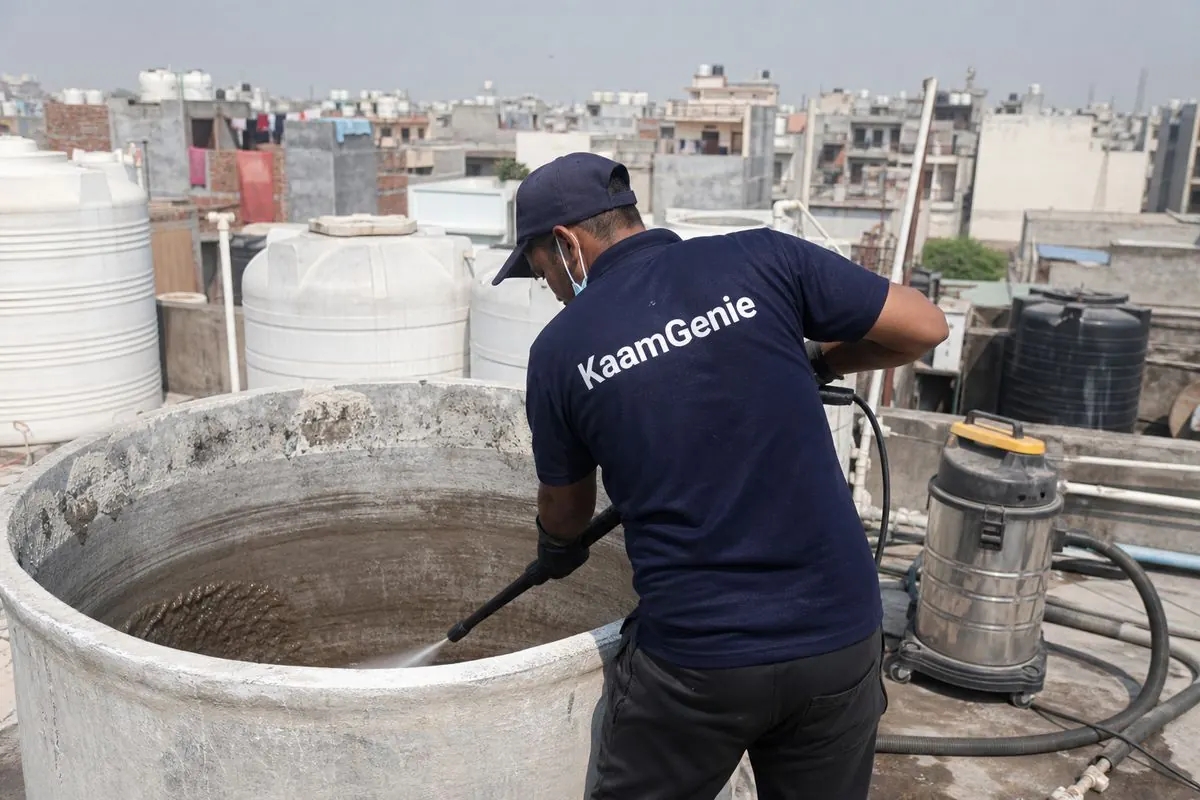
Borewell hardness is the whole story here. Straight groundwater is high in dissolved minerals, and in a warm rooftop tank those minerals precipitate out fast, coating the walls in scale and settling as grit on the floor. Where a piped-water home might go a year before buildup shows, a Burari borewell tank can look furred within a few months. The scale also narrows outlets over time, which is why residents sometimes notice the flow weakening before they notice the water.
The pace of construction compounds it. Cheap tanks fitted quickly on new floors often have poor lids and thin walls, so they take in dust and heat up faster, both of which speed the buildup. With owners focused on finishing and renting the next floor, the tank is rarely opened. In a colony like Burari the honest advice is a clean every eight to ten months, because the hard water simply does not give a tank the year that piped-water areas can stretch to.
No travel charge anywhere in Burari. The final price is confirmed on the call before we come — it depends only on tank size and access.
See it done in 45 seconds
Watch our web story on how a tank is really cleaned — drain, de-sludge, jet-wash, disinfect.
We reach every pocket of Burari — and there’s no travel charge to any of them:
Every locality in Delhi stores different water, and that decides how fast a tank fouls. This is Burari’s profile from The Delhi Water Index, built from our field observations across 250+ localities.
Indicative field characterisation, not a certified lab test. BIS IS 10500: TDS 500 mg/L acceptable, 2,000 permissible. Check any Delhi area →
“The flow from my tap has weakened. Could the tank be the cause?” Often, yes. Borewell scale builds up around the tank outlet and slowly narrows it, so the flow drops before the water even looks dirty. When we descale the tank we clear the outlet too, which usually restores the flow. If it does not fully return, the blockage may be further down the line and we will point you to it.
“My tank is only a year old. Does it really need cleaning already?” With borewell water, yes. Age matters less than the hardness of what goes in, and a year of straight groundwater is enough to lay down real scale and sediment. A new tank on a new Burari floor is exactly the one people skip, and it is often the one that has quietly furred up the most. We will show you inside so you can judge for yourself.
“Do you handle the tanks on newly built rented floors?” We do, and it is a common booking here. Landlords call us before letting a fresh floor so the first tenant gets clean water, and we can put the building on a repeat cycle after that. For several tanks on one new building we quote a bulk building rate rather than charging each separately.
“How often should a borewell tank in Burari be cleaned?” Every eight to ten months is the honest interval for a hard borewell supply, sooner than the yearly clean that suits piped-water areas. The minerals build fast here. We can check your walls on the first visit and give you a straight answer for your own tank, then set a reminder so it does not lapse.
“What will it cost for a standard Burari rooftop tank?” A single 500-litre tank starts at ₹699 and a 1,000-litre one is ₹899, with the descaling included. Larger 1,001 to 2,000-litre tanks are ₹1,299 to ₹1,499. A whole building's tanks cleaned together run ₹2,400 to ₹3,000 depending on how many and their sizes.
See our complete water tank cleaning services in Delhi NCR — pricing, process, tank types and full city coverage.
Beyond water tank cleaning, KaamGenie is rolling out a full lineup of home services across Delhi NCR — see our complete list of 12 home services we offer or will be launching through 2026. New to tank cleaning? Read our guide on how to pick the right water tank cleaning service in Delhi — what to look for, what to avoid, and the questions that separate trustworthy crews from quick-job operators.
Rooftop plastic tanks
₹699+ →Kothi sumps & underground tanks
₹1,499+ →Apartments & RWAs
Bulk pricing →FSSAI-compliant cleaning
₹2,500+ →टंकी साफ़ करने वाले
हिन्दी पढ़ें →View all water tank cleaning guides →
All pockets and lanes of Burari covered. If your specific block or society isn’t named in the sub-areas above, just call — we almost certainly cover it.
Same crew, same 6-step process, same-day where possible. Pick any locality below for local pricing and the tanks we typically find there.
Book a slot — we can usually fit you in today or tomorrow.