
Signs Your Water Tank Needs Cleaning
Raj Babbar · 8 min read
Home › Water Tank Cleaning › Overhead Tank Cleaning › Shriram Colony (Rajeev Nagar)
Walk the narrow lanes off Karawal Nagar Road and the rooftops of Shriram Colony (Rajeev Nagar) tell one story: builder floor stacked on builder floor, each capped by a small plastic tank baking in the sun. Those shared rooftop tanks take the full load of a very hard, iron-heavy borewell, and they scale faster than anyone expects. Our overhead tank cleaning here starts from ₹699.
On these tight Rajeev Nagar lanes there is barely a metre between one building and the next, and the water tanks sit shoulder to shoulder across the terraces. Most are 500 to 1000 litre plastic tanks feeding several floors of tenants at once. The supply is almost entirely private borewell, and in this belt that water runs very hard with a heavy iron content. Inside the tank that iron settles as a gritty red-brown sediment and a scale crust creeps up the walls within a few months. Because the tanks are shared and used hard, nobody notices until the water has already turned cloudy. We drain the tank fully, scrub down the walls and base by hand, vacuum out the sludge, and finish with an anti-bacterial disinfectant wash.
This page is about the rooftop and overhead tanks that sit on your terrace, the plastic Sintex-style tanks that most buildings here run. If you want the full picture of our wider service, including sumps and underground tanks, see our main page on water tank cleaning in Shriram Colony (Rajeev Nagar). For overhead work we come with our own ladder access, pump and vacuum, so a single terrace tank is done in well under an hour. Buildings with several tanks on one roof get a bulk discount when we clean them together. We send before-and-after photos so you can see the base go from red-brown grit to clean plastic.
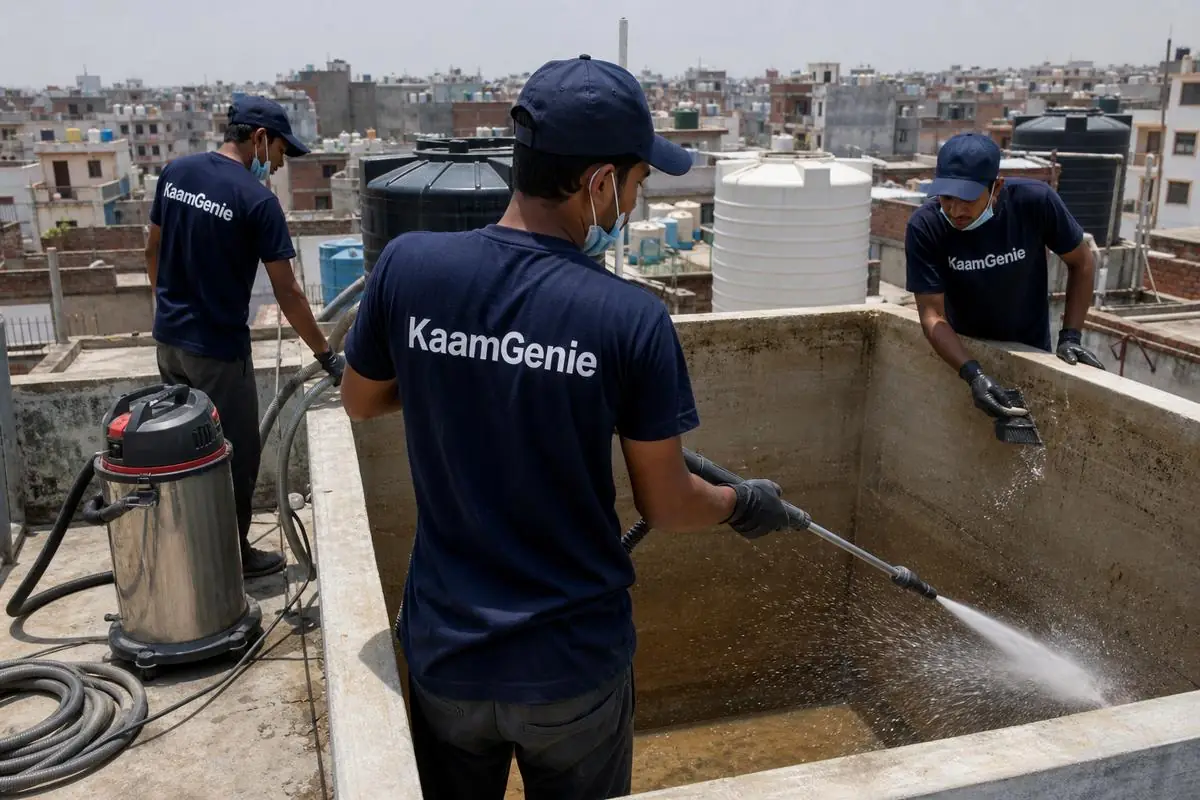
The root of it is the borewell water. Across the Rajeev Nagar and Karawal Nagar side the groundwater is very hard and carries a lot of dissolved iron, so every fill leaves a little more mineral behind. Over months that builds into a chalky-to-rusty scale on the walls and a sediment layer on the base. A rooftop tank that looks fine from the manhole can hold two fingers of grit underneath.
The other half of the problem is how hard these tanks work. One shared tank often feeds ten or more rooms, so it empties and refills constantly and the sediment never gets a chance to settle out and be noticed. Left alone, that layer feeds bacteria and gives the first bucket of the morning a cloudy, off look. A clean every three to four months keeps the water in this belt clear and safe to use.
No travel charge anywhere in Shriram Colony (Rajeev Nagar). The final price is confirmed on the call before we come — it depends only on tank size and access.
See it done in 45 seconds
Watch our web story on how a tank is really cleaned — drain, de-sludge, jet-wash, disinfect.
We reach every pocket of Shriram Colony (Rajeev Nagar) — and there’s no travel charge to any of them:
Every locality in Delhi stores different water, and that decides how fast a tank fouls. This is Shriram Colony (Rajeev Nagar)’s profile from The Delhi Water Index, built from our field observations across 250+ localities.
Indicative field characterisation, not a certified lab test. BIS IS 10500: TDS 500 mg/L acceptable, 2,000 permissible. Check any Delhi area →
“Can you reach tanks on the narrow Rajeev Nagar lanes?” Yes. Our crew works these Karawal Nagar side lanes every week and carries portable ladder access, so we do not need vehicle space right at your door. We reach rooftop tanks on foot with our own equipment.
“How often should an overhead tank here be cleaned?” With the very hard iron-heavy borewell in this belt, every three to four months is sensible. If a single tank feeds many tenants, keep to the shorter end. We can remind you when the next clean is due.
“Who usually pays when one tank feeds several floors?” That is up to the building. Most shared-tank buildings here split the cost evenly between the flats using it, which keeps each floor’s share small. We give one clear price for the tank and you can divide it however suits you.
“How long is the water off during a clean?” For a single rooftop tank, plan for about an hour of water off while we drain, scrub and refill. We time it so the tank is back in use quickly. Most families barely notice the gap.
“Is there a discount for cleaning all the tanks in one building?” Yes. When several tanks on one roof are done in the same visit we apply a bulk discount rather than charging each tank at the single rate. Tell us how many tanks and floors and we will quote the whole building.
See our complete water tank cleaning services in Delhi NCR — pricing, process, tank types and full city coverage.
Beyond water tank cleaning, KaamGenie is rolling out a full lineup of home services across Delhi NCR — see our complete list of 12 home services we offer or will be launching through 2026. New to tank cleaning? Read our guide on how to pick the right water tank cleaning service in Delhi — what to look for, what to avoid, and the questions that separate trustworthy crews from quick-job operators.
Rooftop plastic tanks
₹699+ →Kothi sumps & underground tanks
₹1,499+ →Apartments & RWAs
Bulk pricing →FSSAI-compliant cleaning
₹2,500+ →टंकी साफ़ करने वाले
हिनà¥à¤¦à¥€ पढ़ें →View all water tank cleaning guides →
All pockets and lanes of Shriram Colony (Rajeev Nagar) covered. If your specific block or society isn’t named in the sub-areas above, just call — we almost certainly cover it.
Same crew, same 6-step process, same-day where possible. Pick any locality below for local pricing and the tanks we typically find there.
Book a slot — we can usually fit you in today or tomorrow.