
How Long Does Tank Cleaning Take?
Raj Babbar · 8 min read
Home › Water Tank Cleaning › Sintex / Plastic Tank Cleaning › Sant Nagar (Burari)
The groundwater across the Burari belt runs hard and high in minerals, so the unlined Sintex tanks on Sant Nagar's fast-built floors crust with scale and green under the sun. KaamGenie cleans them gently and hygienically. From ₹699.
Start with what comes out of the borewell in Sant Nagar. Across the Burari belt the groundwater is hard and heavy with minerals, so it leaves a thick calcium scale on anything it stands in for long. On the fast-built floors that have filled this outer colony, the rooftop store is often a plastic or Sintex tank, and frequently an unlined one, which the scale grips readily. The plastic itself adds the second problem: being translucent, it lets the rooftop sun through to warm the water, and warm water feeds algae and biofilm. Grit off the developing fringe drifts in through loose lids to thicken the deposit. A concrete tank would keep the light out, but the plastic ones invite it in, so scale and green film build together fast. With cleaning seldom on a routine here, the deposits harden over months.
We clean these plastic tanks gently but thoroughly: check the body and lid, drain, hand-scoop the slimy and gritty sediment, wet-vacuum the base and jet-wash at a plastic-safe pressure to break up the scale. The algae film comes off with soft pads rather than wire brushes, and we finish with an anti-bacterial disinfectant wash and share before-and-after photos. If the building also has an underground sump to clear, see our full water tank cleaning in Sant Nagar (Burari). This page focuses specifically on Sintex and plastic tanks.
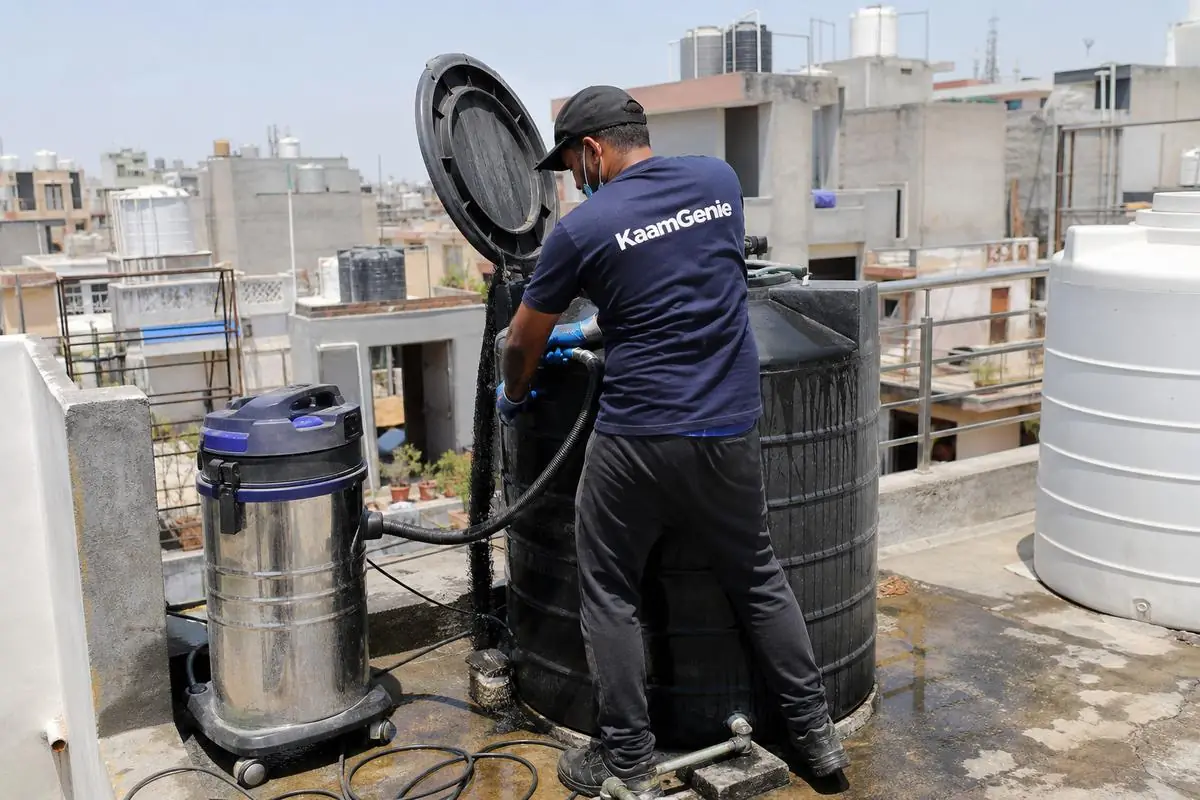
The mineral load is the first driver. Sant Nagar's borewell water is hard and high in calcium, so a heavy scale builds on the plastic floor and around the outlet of a Sintex tank wherever the water stands. The translucent plastic wall is the second driver, letting the rooftop sun through to warm the water, which is what algae and biofilm feed on. A concrete tank would block the light and scale less visibly, so the exposed plastic tank on these new floors combines a warm, lit interior with a rough crusted floor, and it fouls quicker than owners of a new block expect.
The unlined plastic makes the deposit stubborn. Without a smooth lining the floor holds the scale and grit firmly, and the algae film anchors into that rough surface hard. Fringe dust drifting in through loose lids adds to it. Because the colony is still growing and cleaning is seldom on a routine, the scale and film harden together over many months until a rinse cannot shift them. A full drain and a plastic-safe scale lift is what actually clears a Sant Nagar tank, and starting early keeps the crust from ever setting hard.
No travel charge anywhere in Sant Nagar (Burari). The final price is confirmed on the call before we come — it depends only on tank size and access.
See it done in 45 seconds
Watch our web story on how a tank is really cleaned — drain, de-sludge, jet-wash, disinfect.
We reach every pocket of Sant Nagar (Burari) — and there’s no travel charge to any of them:
Every locality in Delhi stores different water, and that decides how fast a tank fouls. This is Sant Nagar (Burari)’s profile from The Delhi Water Index, built from our field observations across 250+ localities.
Indicative field characterisation, not a certified lab test. BIS IS 10500: TDS 500 mg/L acceptable, 2,000 permissible. Check any Delhi area →
“Why does my Sant Nagar tank crust up so quickly?” Because the Burari borewell water is hard and high in calcium, which lays a heavy scale on the plastic floor and outlet. We break that scale up with a jet-wash set for plastic, scrub the algae off the roughened surface with soft pads, and finish with an anti-bacterial disinfectant wash.
“The block is newly built. Does the plastic tank really need cleaning yet?” Yes. On this hard water a new unlined tank starts scaling from the first months, and the crust traps algae early. Cleaning it now stops that first layer setting hard, which is far easier than clearing a built-up crust later.
“How much for a plastic tank in Sant Nagar Burari?” A Sintex up to 500 litres starts at ₹699 and a standard 1000L is ₹899. Larger 1000 to 2000L tanks are ₹1,299 to ₹1,499, with a bulk per-tank rate for more than one tank.
“With water this hard, how often should the tank be cleaned?” We suggest every three to four months across the Burari belt. The borewell water lays down scale continuously, so a regular clean keeps both the crust and the algae that grips it from hardening on the floor.
“Do you reach the newer lanes on the northern edge of Burari?” Yes, Sant Nagar Burari is on our North Delhi round. Our crew reaches the narrow-lane floors on the fringe with compact equipment, so a newer or outer address is no problem. Just give us the lane and the floor.
See our complete water tank cleaning services in Delhi NCR — pricing, process, tank types and full city coverage.
Beyond water tank cleaning, KaamGenie is rolling out a full lineup of home services across Delhi NCR — see our complete list of 12 home services we offer or will be launching through 2026. New to tank cleaning? Read our guide on how to pick the right water tank cleaning service in Delhi — what to look for, what to avoid, and the questions that separate trustworthy crews from quick-job operators.
Rooftop plastic tanks
₹699+ →Kothi sumps & underground tanks
₹1,499+ →Apartments & RWAs
Bulk pricing →FSSAI-compliant cleaning
₹2,500+ →टंकी साफ़ करने वाले
हिन्दी पढ़ें →View all water tank cleaning guides →
All pockets and lanes of Sant Nagar (Burari) covered. If your specific block or society isn’t named in the sub-areas above, just call — we almost certainly cover it.
Same crew, same 6-step process, same-day where possible. Pick any locality below for local pricing and the tanks we typically find there.
Book a slot — we can usually fit you in today or tomorrow.