
How Long Does Tank Cleaning Take?
Raj Babbar · 8 min read
Home › Water Tank Cleaning › Sintex / Plastic Tank Cleaning › Malka Ganj
In Malka Ganj’s narrow old lanes, a small Sintex tank sits on the terrace under constant road dust, greening in the daylight above the market. KaamGenie cleans it gently and hygienically. From ₹699.
Turn into Malka Ganj and the lanes narrow between ageing havelis and small shopfronts giving way to compact builder floors near the university. The cramped rooftops carry small terrace tanks, many of them Sintex or plastic, sitting fully exposed to the road dust and market grime that hang over these congested streets. Supply is intermittent DJB, so the tanks fill only at set hours and the water sits between fills. In a translucent plastic tank that standing water warms in the daylight through the walls, and an algae film grows, while the dust drifting up from the lanes settles in through lids nobody thinks to seal. Because the tanks are little and hard to reach on tight terraces, owners seldom open them. A fine layer of dust-laden sediment and scale settles inside and lingers between rare cleanings. By the time the water looks or smells off, the small tank is already coated.
The plastic-safe clean is quick on these small terrace tanks: we open and check the tank and lid, drain it, scoop the dust-laden slimy sediment off the bottom, wet-vacuum the rest, jet-wash at a plastic-safe pressure and scrub the film with soft pads, then an anti-bacterial disinfectant wash and photos before and after. Where a Malka Ganj building also has a sump or a larger tank, our full water tank cleaning in Malka Ganj covers it. This page is about Sintex and plastic tanks.
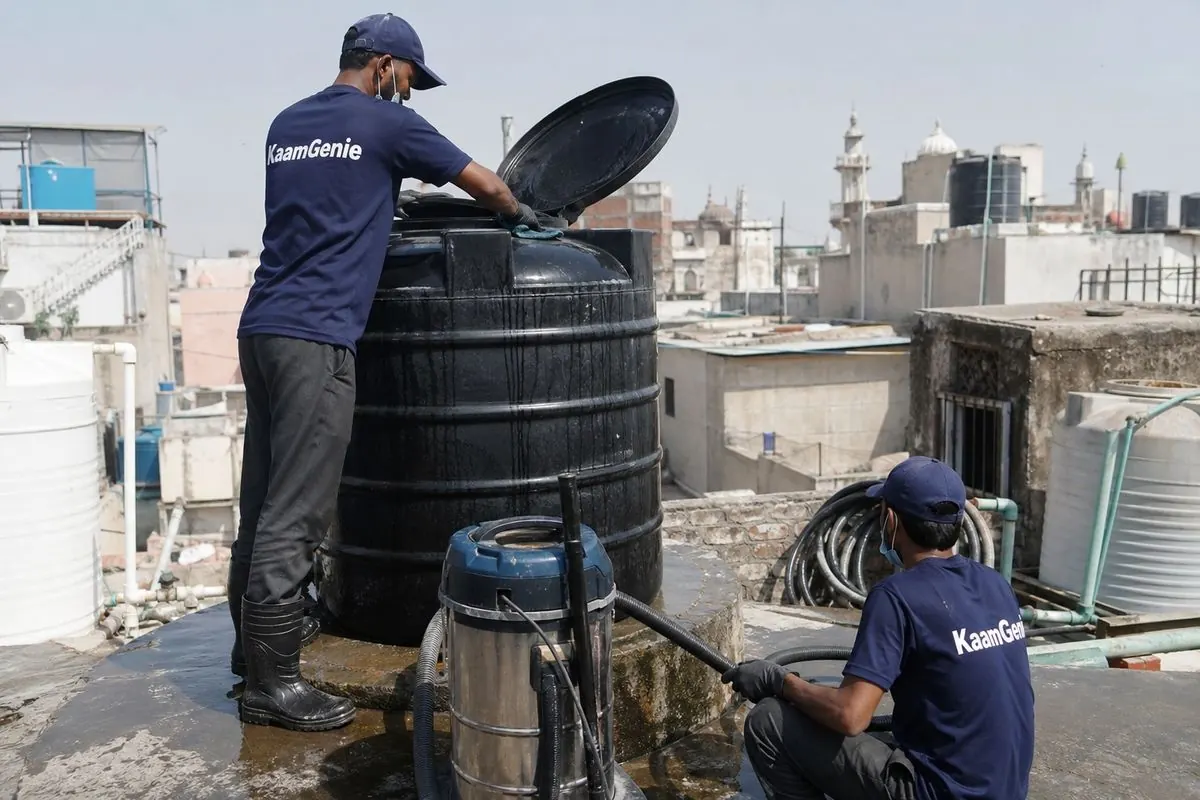
The daylight is the quiet culprit. A small Sintex tank on a Malka Ganj terrace sits exposed, and its translucent wall lets the sun straight into the water, warming it and feeding algae even though the tank is little and often half-full between the intermittent fills. Small plastic tanks warm through completely, so they film over faster than a big tank would, and standing water between DJB supply hours gives the algae time to take hold.
The market air adds the grit. Malka Ganj’s congested lanes throw up constant road dust and grime, and it settles into the tank through lids left loose on cramped terraces. That dust-laden sediment gives the algae a rough footing and clouds the water on its own. Because the tanks are small and awkward to reach, owners rarely climb up to open them, so the dust and film build together and linger until the water is visibly off, which is usually the first sign anyone gets.
No travel charge anywhere in Malka Ganj. The final price is confirmed on the call before we come — it depends only on tank size and access.
See it done in 45 seconds
Watch our web story on how a tank is really cleaned — drain, de-sludge, jet-wash, disinfect.
We reach every pocket of Malka Ganj — and there’s no travel charge to any of them:
Every locality in Delhi stores different water, and that decides how fast a tank fouls. This is Malka Ganj’s profile from The Delhi Water Index, built from our field observations across 250+ localities.
Indicative field characterisation, not a certified lab test. BIS IS 10500: TDS 500 mg/L acceptable, 2,000 permissible. Check any Delhi area →
“Our terrace is cramped and the tank is small, can you still do it?” Yes, small tanks on tight terraces are the norm in Malka Ganj and our crew works them regularly. The plastic-safe method needs only room to open, drain and reach inside the tank. A small Sintex up to 500 litres is our lowest tier at ₹699, so an awkward little terrace tank is both easy and affordable to clean.
“So much road dust settles here, will it just come back?” Some dust will always drift in, but sealing the lid properly, which we do before leaving, keeps most of it out. The bulk of what fouls the tank is the settled sediment and algae we scoop and jet-wash away, and with the lid seated the tank stays clear far longer between cleans despite the market air.
“We only get water at set hours, how do you work around that?” We plan the visit around your DJB timing so the tank drains and refills on your supply cycle and is not left empty when you need it. Tell us your fill hours when you book and we slot the clean so the small terrace tank is ready again by the next supply.
“How often should a small dust-exposed terrace tank be cleaned?” Because these little tanks warm fast and sit under constant market dust, twice a year at least, and more if the water clouds sooner. The first clean after a long gap usually lifts a lot of dust-laden sediment, after which a regular schedule keeps the small tank clear.
“Will cleaning stop the water looking cloudy?” Usually, yes. The cloudiness in a Malka Ganj tank is mostly the dust-laden sediment stirred up from the bottom. Once we scoop, vacuum and jet-wash that out and disinfect the tank, the standing water stops picking it up, so it runs clearer. Sealing the lid afterwards keeps fresh dust from clouding it again quickly.
See our complete water tank cleaning services in Delhi NCR — pricing, process, tank types and full city coverage.
Beyond water tank cleaning, KaamGenie is rolling out a full lineup of home services across Delhi NCR — see our complete list of 12 home services we offer or will be launching through 2026. New to tank cleaning? Read our guide on how to pick the right water tank cleaning service in Delhi — what to look for, what to avoid, and the questions that separate trustworthy crews from quick-job operators.
Rooftop plastic tanks
₹699+ →Kothi sumps & underground tanks
₹1,499+ →Apartments & RWAs
Bulk pricing →FSSAI-compliant cleaning
₹2,500+ →टंकी साफ़ करने वाले
हिन्दी पढ़ें →View all water tank cleaning guides →
All pockets and lanes of Malka Ganj covered. If your specific block or society isn’t named in the sub-areas above, just call — we almost certainly cover it.
Same crew, same 6-step process, same-day where possible. Pick any locality below for local pricing and the tanks we typically find there.
Book a slot — we can usually fit you in today or tomorrow.