
Underground Sump Cleaning: Cost & Safety
Raj Babbar · 9 min read
Home › Water Tank Cleaning › Sintex / Plastic Tank Cleaning › Samaipur
Samaipur’s timber saws and steel workshops fill the air with sawdust and grinding grit, and an open tank on this stretch of GT Road is visibly dirty within weeks. KaamGenie cleans the shared plastic tanks that serve shop floors and the rental homes stacked above them. From ₹699.
Samaipur is Badli’s twin on the GT Road industrial stretch — the Samaipur Badli units, timber and steel businesses, and dense worker-housing lanes tucked behind the road-facing godowns. The dust here is a distinctive two-part mix: fine sawdust from the timber trade that floats, soaks and rots in water, and abrasive steel-grinding grit that sinks and scours. Buildings characteristically stack commercial ground floors with rental floors above on one shared plastic tank, so a single fouled tank serves both the business and the families over it.
KaamGenie’s clean takes out both layers — drain, skim and vacuum the organic sawdust sludge, wet-vacuum the gritty base layer, plastic-safe jet wash, hand-scrub, then a anti-bacterial disinfectant rinse with before-after photos. On this corridor we finish every job by checking that the lid seats, because the fastest cleaning schedule in Delhi cannot outrun an open tank in Samaipur’s air. For drums and sumps, see water tank cleaning in Samaipur; this page is for the Sintex and plastic tanks.
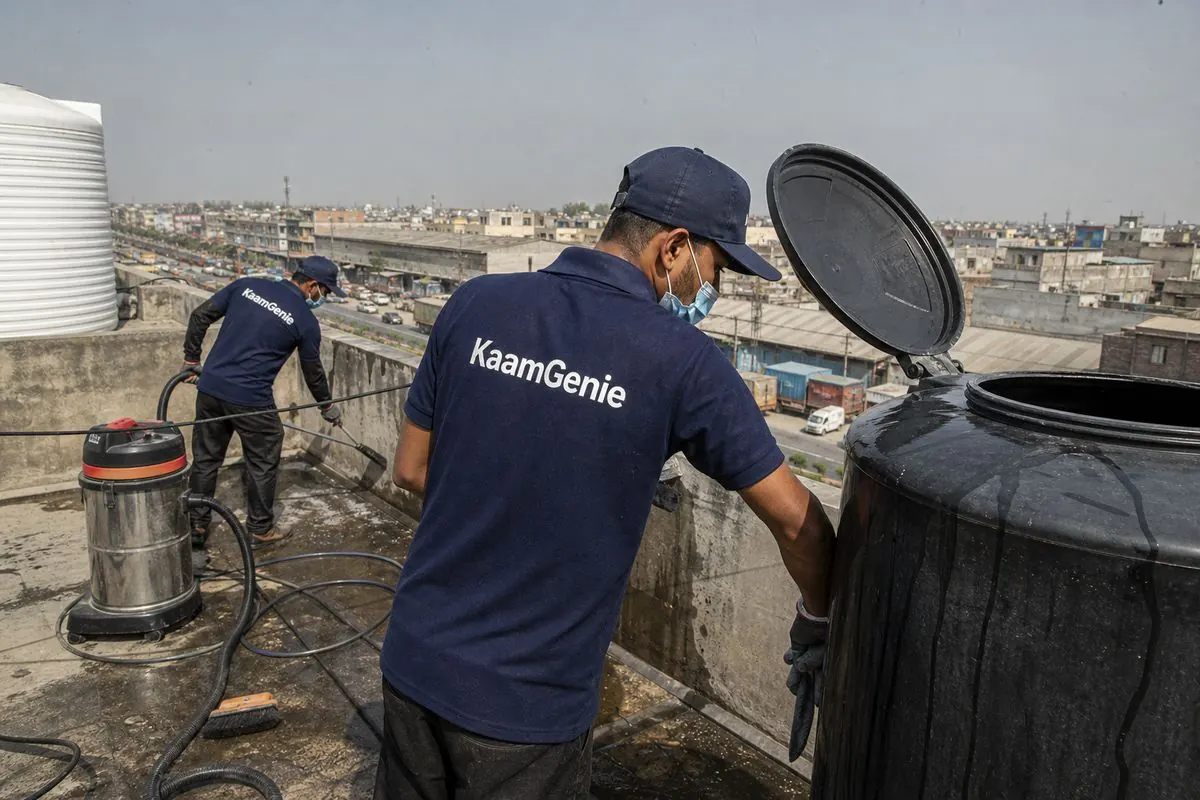
Sawdust is organic — when it drifts into a tank it floats for a while, soaks, sinks and then decays, giving the water a musty edge and feeding bacterial film along the waterline of the translucent wall. Steel grit does the opposite: it drops straight to the floor and grinds against the plastic under the fill’s turbulence, roughening the ribbed floor so every later deposit anchors faster. One tank on this road collects both, layered, and each layer needs its own removal step — skimming and vacuuming for the organic sludge, hard scrubbing for the embedded grit.
The shop-below, family-above building pattern means these tanks also never rest — the business draws water all day and the households draw morning and night, on supply that mixes truck-corridor borewell hardness into the equation. Everyone uses the tank; the question of who cleans it falls between the shop tenant, the floor tenants and the owner. Our practical answer: any of them can book, the cost splits naturally, and the photos give everyone in the building the same evidence of what was in there.
No travel charge anywhere in Samaipur. The final price is confirmed on the call before we come — it depends only on tank size and access.
See it done in 45 seconds
Watch our web story on how a tank is really cleaned — drain, de-sludge, jet-wash, disinfect.
We reach every pocket of Samaipur — and there’s no travel charge to any of them:
Every locality in Delhi stores different water, and that decides how fast a tank fouls. This is Samaipur’s profile from The Delhi Water Index, built from our field observations across 250+ localities.
Indicative field characterisation, not a certified lab test. BIS IS 10500: TDS 500 mg/L acceptable, 2,000 permissible. Check any Delhi area →
“Our building has a shop below and rented floors above. Who should book the clean?” Whoever moves first — shop tenant, floor tenant or owner. One shared tank serves everyone, so the ₹699-899 cost splits naturally across the floors. We coordinate timing so the shop is not disrupted during business hours, and every party can get the before-after photos and dated quality report on WhatsApp.
“The water smells woody or musty. Is that the timber dust?” Very likely. Sawdust drifts in through loose lids, soaks, sinks and decays — the musty smell is the decay, and it flavours water long before it looks dirty. The clean removes the organic sludge and disinfects hygienic; keeping the smell away then depends on a lid that actually seats, which we check and tell you about honestly.
“What does the service cost in Samaipur?” ₹699 for tanks up to 500 litres and ₹899 for 501-1,000L, the same on the godown front and in the housing lanes behind. Both removal steps — the sawdust skim and the grit scrub — are part of the standard clean here, not extras. Multiple tanks on one building get a per-tank quote.
“How often should a tank on this road be cleaned?” For road-facing and unit-adjacent buildings, every four months is realistic — the dust load is simply higher than a residential colony’s. Lanes further back can stretch to six. A sealed, well-seated lid buys you the difference, which is why we treat the lid check as part of every Samaipur job.
“Can you come the same day?” Usually — call before 10 AM on 95603 66362. Samaipur is on our GT Road run with Badli, so morning bookings generally land a same-day slot. Tell us whether the tank serves a shop, homes or both, and the crew will time the visit so nobody downstairs or upstairs is left dry at a bad hour.
See our complete water tank cleaning services in Delhi NCR — pricing, process, tank types and full city coverage.
Beyond water tank cleaning, KaamGenie is rolling out a full lineup of home services across Delhi NCR — see our complete list of 12 home services we offer or will be launching through 2026. New to tank cleaning? Read our guide on how to pick the right water tank cleaning service in Delhi — what to look for, what to avoid, and the questions that separate trustworthy crews from quick-job operators.
Rooftop plastic tanks
₹699+ →Kothi sumps & underground tanks
₹1,499+ →Apartments & RWAs
Bulk pricing →FSSAI-compliant cleaning
₹2,500+ →टंकी साफ़ करने वाले
हिन्दी पढ़ें →View all water tank cleaning guides →
All pockets and lanes of Samaipur covered. If your specific block or society isn’t named in the sub-areas above, just call — we almost certainly cover it.
Same crew, same 6-step process, same-day where possible. Pick any locality below for local pricing and the tanks we typically find there.
Book a slot — we can usually fit you in today or tomorrow.