
RWA Annual Tank Cleaning Contracts
Raj Babbar · 11 min read
Home › Water Tank Cleaning › Sintex / Plastic Tank Cleaning › Burari
Burari’s new builder floors mostly run on hard borewell water, and the cheap Sintex tanks feeding them scale and green within months. KaamGenie cleans them gently, hygienically and with photos. From ₹699.
Burari grew as an outer North Delhi belt of unplanned colonies and tightly packed builder floors, expanding well ahead of full municipal piping, so most buildings lean on borewell water. That groundwater runs hard and mineral-heavy, and in the Sintex and plastic tanks that top nearly every new floor here it lays down thick scale and a gritty sediment layer within months of installation. The tanks themselves are usually put in cheaply as an afterthought and left exposed on flat roofs, where the translucent walls pass sunlight into the water and warm it. That light and warmth grow an algae film that clings to the fresh mineral crust the borewell keeps depositing. With new floors going up constantly and no cleaning routine established, the deposits build unchecked until they clog outlets and cloud the supply. A tank barely a year old in Burari can already be scaled and slimy inside.
Our plastic-safe clean is built for exactly this: we check the tank and lid, drain it, scoop and wet-vacuum the gritty sediment, jet-wash at a plastic-safe pressure that lifts the hardness scale without cutting the wall, scrub the algae with soft pads, then apply an anti-bacterial disinfectant wash and send photos before and after. For a Burari building that also has a borewell sump caked with the same scale, our full water tank cleaning in Burari handles it. This page is about the Sintex and plastic tanks.
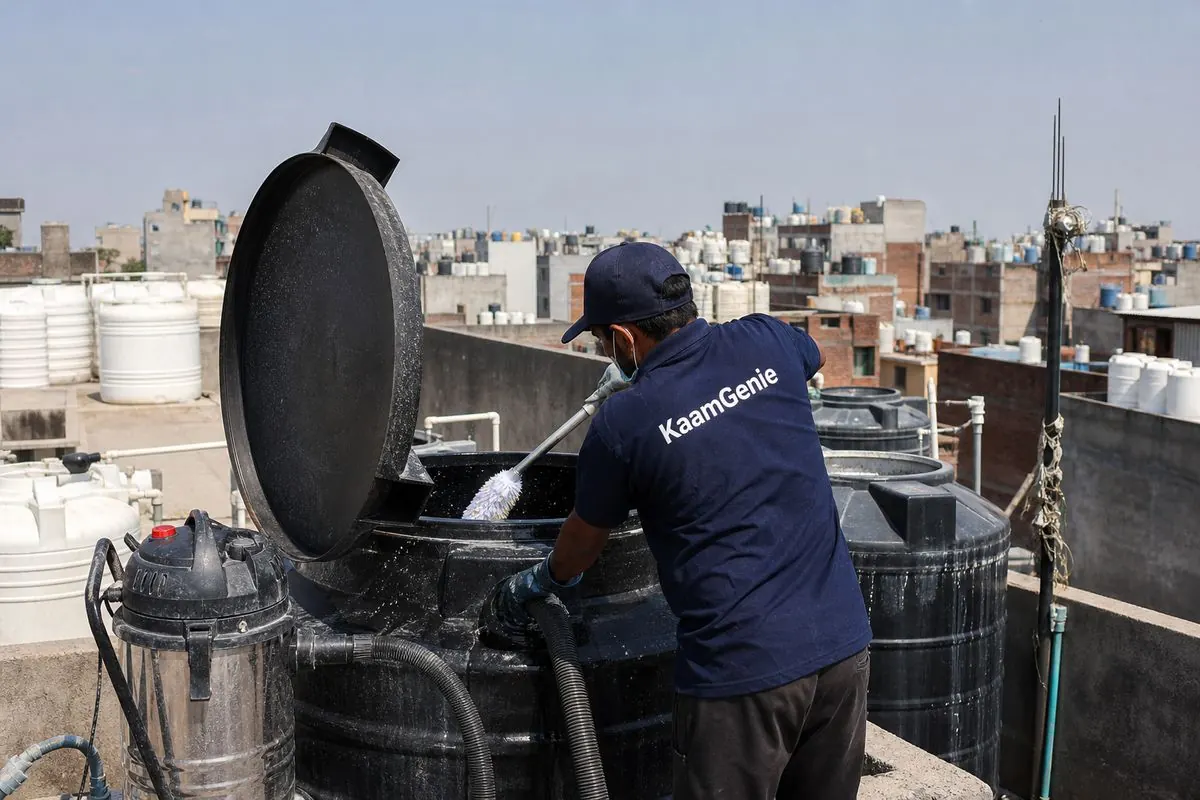
Burari’s borewell water is hard and mineral-heavy, and that is the root of the trouble. In a plastic tank it leaves thick calcium scale and a gritty sediment across the floor and walls within a few months, far faster than a piped-only area would see. Newly installed tanks scale up almost from the start here, so even recent builds carry a mineral crust that no amount of ordinary rinsing shifts.
The plastic tank then amplifies it. A translucent Sintex wall on an exposed Burari roof lets sunlight straight into the water, and the warmth feeds an algae film that anchors onto the rough scale already down. Because these tanks are installed cheaply and treated as an afterthought, they are rarely opened or cleaned, so scale and film compound together. Left long enough the deposits narrow the outlet and cloud the water, which is when most residents finally notice something is wrong.
No travel charge anywhere in Burari. The final price is confirmed on the call before we come — it depends only on tank size and access.
See it done in 45 seconds
Watch our web story on how a tank is really cleaned — drain, de-sludge, jet-wash, disinfect.
We reach every pocket of Burari — and there’s no travel charge to any of them:
Every locality in Delhi stores different water, and that decides how fast a tank fouls. This is Burari’s profile from The Delhi Water Index, built from our field observations across 250+ localities.
Indicative field characterisation, not a certified lab test. BIS IS 10500: TDS 500 mg/L acceptable, 2,000 permissible. Check any Delhi area →
“Our tank is nearly new but already has deposits inside, is that normal here?” Unfortunately yes. Burari’s hard borewell water scales a plastic tank within months, so even a tank under a year old can carry a mineral crust and the start of an algae film. A first clean lifts all of it, and a regular schedule after that stops it building back to the point of clogging the outlet.
“The water sometimes comes out cloudy, will cleaning fix that?” Usually, yes. Cloudy borewell-fed water often carries the gritty sediment and scale stirred up from inside the tank. Once we scoop, vacuum and jet-wash that out and disinfect the tank, the standing water stops picking up deposits, so it runs clearer. If the borewell itself is heavy, cleaning more often keeps it that way.
“How often should a borewell-fed Sintex tank in Burari be cleaned?” Because the hardness builds so fast, every three to four months is sensible here, more frequent than in piped areas. Keeping the scale thin also protects the outlet and float valve from clogging, so the closer schedule pays off in flow as well as water quality.
“We have several builder floors, each with its own tank, is there a deal?” Yes. Each plastic tank is priced by size, from ₹699 for a 500 litre up to ₹1,499 for a larger one, but four or more tanks on a building get a bulk per-tank rate. So doing every floor in Burari together is noticeably cheaper than booking them one at a time.
“Can the scale really block the outlet?” It can, if left. Hard-water scale slowly narrows the outlet and coats the float valve until flow drops and the cut-off stops seating. Clearing the tank on a regular schedule keeps the outlet open, which matters more in Burari than most places because the borewell keeps feeding fresh scale in.
See our complete water tank cleaning services in Delhi NCR — pricing, process, tank types and full city coverage.
Beyond water tank cleaning, KaamGenie is rolling out a full lineup of home services across Delhi NCR — see our complete list of 12 home services we offer or will be launching through 2026. New to tank cleaning? Read our guide on how to pick the right water tank cleaning service in Delhi — what to look for, what to avoid, and the questions that separate trustworthy crews from quick-job operators.
Rooftop plastic tanks
₹699+ →Kothi sumps & underground tanks
₹1,499+ →Apartments & RWAs
Bulk pricing →FSSAI-compliant cleaning
₹2,500+ →टंकी साफ़ करने वाले
हिन्दी पढ़ें →View all water tank cleaning guides →
All pockets and lanes of Burari covered. If your specific block or society isn’t named in the sub-areas above, just call — we almost certainly cover it.
Same crew, same 6-step process, same-day where possible. Pick any locality below for local pricing and the tanks we typically find there.
Book a slot — we can usually fit you in today or tomorrow.