
Tank Cleaning Before Moving In
Raj Babbar · 10 min read
Home › Water Tank Cleaning › Society / RWA Tank Cleaning › Ashok Vihar
Society and RWA tank cleaning in Ashok Vihar — phase-wise programmes for the societies and DDA wings, sump-to-rooftop cleaning around Deep Market’s blocks, and Wazirpur’s fallout scrubbed off Phase I roofs. From ₹1,500 per tank.
Ashok Vihar is a large DDA-planned colony in Phases I to IV, mixing plotted homes, DDA flats and group-housing societies around the Deep Market hub. The society pockets run proper sump-plus-rooftop-bank systems under active RWAs; the DDA wings share stair tanks whose insides show decades of layering; and the plotted rebuilds stack per-floor tanks. Phase I carries an extra burden its neighbours escape: industrial fallout drifting across from Wazirpur’s steel units settles on its roofs and works into its tanks.
KaamGenie runs Ashok Vihar phase-aware. Societies get the full programme — sump with confined-space procedure, pump line, rooftop bank compartment by compartment, one quality report set for the RWA file; DDA wings pool stair tanks with opt-in flat tanks; and Phase I buildings get shorter recommended intervals with the fallout staining photographed so residents can see why. Deep Market’s commercial blocks book shared tanks through their associations. For a single tank, see water tank cleaning in Ashok Vihar; this page is for society, wing and whole-building work.
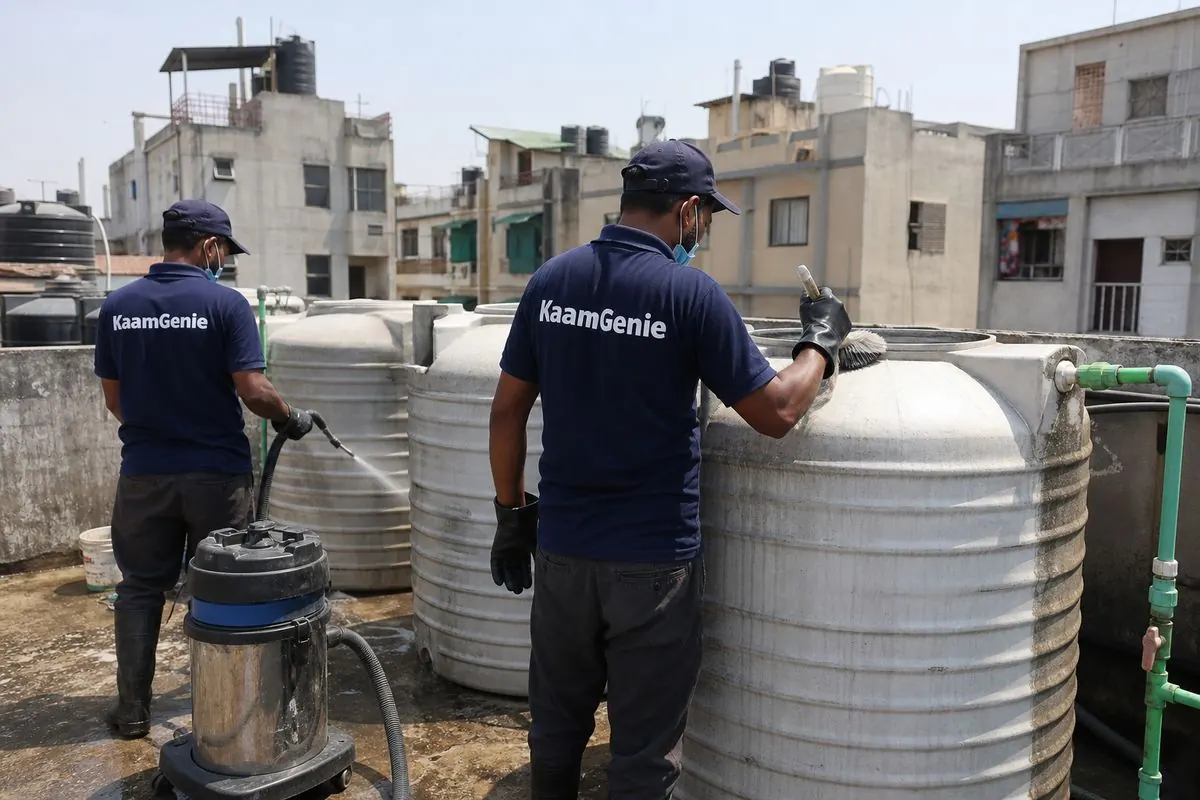
Treating the colony as one place misses what the tanks actually show. Phase I roofs facing Wazirpur collect a metallic dust that oxidises in water and binds into tank sediment — those tanks need attention every four months or so. The older DDA wings’ stair tanks carry the deep layering of shared RCC storage cleaned irregularly for decades — their first proper clean is a restoration job, after which six-monthly holds. The society blocks with sumps face the classic chain problem: an unopened sump quietly re-seeding a well-kept rooftop bank.
An RWA that matches its calendar to its phase gets more water quality per rupee than one buying a uniform annual clean. That is the conversation we bring to committees: condition photos from the survey, an interval per tank type rather than a flat prescription, and a programme the AGM can approve once and forget — notices, sequencing and restored supply are our job thereafter. Wings and buildings outside formal societies get the same logic through pooled bookings, and Deep Market’s shared commercial tanks run on early-morning slots that never touch trading hours.
No travel charge anywhere in Ashok Vihar. The final price is confirmed on the call before we come — it depends only on tank size and access.
See it done in 45 seconds
Watch our web story on how a tank is really cleaned — drain, de-sludge, jet-wash, disinfect.
We reach every pocket of Ashok Vihar — and there’s no travel charge to any of them:
Every locality in Delhi stores different water, and that decides how fast a tank fouls. This is Ashok Vihar’s profile from The Delhi Water Index, built from our field observations across 250+ localities.
Indicative field characterisation, not a certified lab test. BIS IS 10500: TDS 500 mg/L acceptable, 2,000 permissible. Check any Delhi area →
“Our society is in Phase I near the Wazirpur side. How often should we clean?” Every four months for roof-exposed tanks, and we recommend it from evidence: the metallic fallout staining on Phase I tanks is visible in our survey photos, and it binds into sediment faster than ordinary dust. The sump can stay on a six-monthly cycle. We will show your committee the photos before asking for any commitment.
“What does a full society programme include?” Everything the society’s water touches: the sump cleaned under confined-space procedure, pumps checked at intake, every rooftop compartment jetted and hand-scrubbed, anti-bacterial disinfection throughout, and a quality report per tank plus a condition summary for the RWA file. Blocks are sequenced so no wing loses supply overnight.
“Can DDA flat residents book without waiting for the whole wing?” Yes. A stair can pool its shared tank with any flats that opt in — the shared cost splits among participants from ₹1,500, each flat’s own tank billed to that flat. One notice on the stair usually gathers enough households within a day or two.
“Do you clean the shared tanks over Deep Market’s shops?” Yes, through the market association or any authorised trader, in early-morning slots before opening. Shared commercial tanks get the same scrub-and-disinfect standard the establishments can keep on file — relevant for the food businesses among them.
“How soon can a society get its first survey?” Within a day or two of the committee’s call — and the survey is free, producing the tank map, condition photos and per-tank quote your RWA needs to decide. For urgent single-tank problems meanwhile, call 95603 66362 before 10 AM and same-day attendance is usually possible.
See our complete water tank cleaning services in Delhi NCR — pricing, process, tank types and full city coverage.
Beyond water tank cleaning, KaamGenie is rolling out a full lineup of home services across Delhi NCR — see our complete list of 12 home services we offer or will be launching through 2026. New to tank cleaning? Read our guide on how to pick the right water tank cleaning service in Delhi — what to look for, what to avoid, and the questions that separate trustworthy crews from quick-job operators.
Rooftop plastic tanks
₹699+ →Kothi sumps & underground tanks
₹1,499+ →Apartments & RWAs
Bulk pricing →FSSAI-compliant cleaning
₹2,500+ →टंकी साफ़ करने वाले
हिन्दी पढ़ें →View all water tank cleaning guides →
All pockets and lanes of Ashok Vihar covered. If your specific block or society isn’t named in the sub-areas above, just call — we almost certainly cover it.
Same crew, same 6-step process, same-day where possible. Pick any locality below for local pricing and the tanks we typically find there.
Book a slot — we can usually fit you in today or tomorrow.