
Underground Sump Cleaning: Cost & Safety
Raj Babbar · 9 min read
Home › Water Tank Cleaning › Society / RWA Tank Cleaning › Dwarka Sector 1
Society & RWA water tank cleaning in Dwarka Sector 1 — we desludge the shared overhead and underground tanks that feed the DDA blocks and group-housing pockets near Dwarka Mor, typically ₹1,500–2,000 per society water tank when we clean a full bank in one visit.
Sector 1 is one of Dwarka’s earliest-settled pockets, packed close to Dwarka Mor and Dashrathpuri with DDA LIG and Janta flats and a scatter of resale builder floors. Most blocks here are run by their own RWA or block committee, and the shared rooftop overhead tanks sit on low-rise DDA structures that were plumbed decades ago. Because supply is the standard Dwarka 50-50 of Sonia Vihar DJB water and DDA borewell draw, the water runs hard and high-TDS, and borewell sediment settles fast at the base of every tank.
When a block RWA calls us in, we start with a site survey, count every overhead and underground tank feeding the flats, and schedule the work so no line of homes loses supply mid-day. Sector 1’s older tanks are frequently the ones skipped for years, so a first clean often lifts out a surprising layer of scale and grit. Households that also want their individual storage done can add our water tank cleaning in Dwarka Sector 1 on the same day the crew is on site.
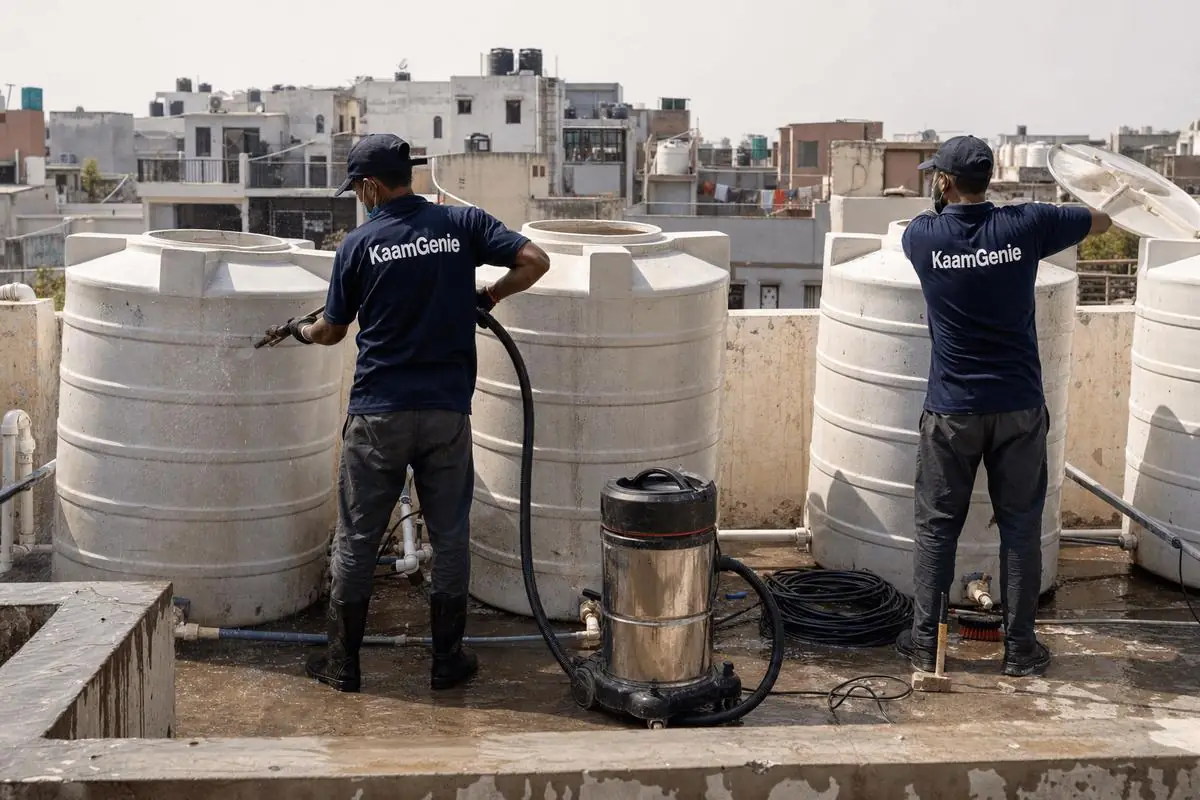
In an old DDA pocket like Sector 1, a single overhead tank can feed twenty or more flats, so anything that settles inside it reaches every kitchen and bathroom on that riser. The borewell share of Dwarka’s supply is heavy in calcium and iron, and in three to four months that mineral load builds into a firm scale crust plus a soft sludge blanket at the floor. Left alone, that layer breeds bacteria, discolours the water and slowly chokes the outlet, which residents feel as low pressure and off-colour supply.
Cleaning on a fixed 3–4 month cycle keeps the load manageable and cheap, because a maintained tank takes far less scrubbing than one opened after two or three years. For an RWA it also means one predictable line item instead of emergency call-outs when a tank finally fouls, and it produces a dated record the committee can show residents. We isolate and drain each tank in turn, remove the sludge, jet wash and hand-scrub the walls, apply a anti-bacterial disinfectant, then refill and confirm supply before moving to the next block.
No travel charge anywhere in Dwarka Sector 1. The final price is confirmed on the call before we come — it depends only on tank size and access.
See it done in 45 seconds
Watch our web story on how a tank is really cleaned — drain, de-sludge, jet-wash, disinfect.
We reach every pocket of Dwarka Sector 1 — and there’s no travel charge to any of them:
Every locality in Delhi stores different water, and that decides how fast a tank fouls. This is Dwarka Sector 1’s profile from The Delhi Water Index, built from our field observations across 250+ localities.
Indicative field characterisation, not a certified lab test. BIS IS 10500: TDS 500 mg/L acceptable, 2,000 permissible. Check any Delhi area →
“Can you clean all the shared tanks for a DDA block in Sector 1 in one visit?” Yes. On the survey we count every overhead and underground tank on the block and plan a running order so the crew moves from one riser to the next without leaving any set of flats dry for long. A typical low-rise DDA block near Dwarka Mor has a handful of tanks, and we usually finish the whole block in a single day. You get before and after photos of each tank and one quality report covering the block.
“Will water supply to the flats be cut while you clean?” Only the specific tank being worked on is taken offline, and only for the hour or two it takes to drain, scrub and disinfect it. We isolate that tank, refill and restore it, then move to the next, so the rest of the block keeps running normally. If a block wants zero interruption we schedule around the society’s pumping hours, usually cleaning after the morning fill.
“Do you give a quality report for our maintenance file?” Yes. After every society job the block RWA gets a dated cleaning quality report listing each tank cleaned, the disinfectant used and the crew, along with before and after photos of every tank. Committees in Sector 1 keep it in the maintenance file to show residents and auditors that the shared storage is being maintained on schedule. It is issued the same day the work is signed off.
“How often should an old DDA block near Dashrathpuri get this done?” We recommend every 3 to 4 months because Sector 1 runs on hard, high-TDS borewell-blended water that lays down scale quickly. Blocks that have skipped cleaning for years should start with one full desludge, then settle into the quarterly cycle. Many RWAs put it on an annual AMC with us so the visits are booked in advance and priced at a fixed rate.
“What would it cost to clean a whole pocket of 8 to 10 tanks?” Society tanks are priced at roughly ₹1,500–2,000 each, and for a full bank of 8 to 10 tanks done together we quote a bundled rate that comes in below the per-tank sum. The exact figure depends on tank sizes and how much sludge has built up, so we confirm it on the site survey. There are no per-visit call-out charges on top once the RWA books the job.
See our complete water tank cleaning services in Delhi NCR — pricing, process, tank types and full city coverage.
Beyond water tank cleaning, KaamGenie is rolling out a full lineup of home services across Delhi NCR — see our complete list of 12 home services we offer or will be launching through 2026. New to tank cleaning? Read our guide on how to pick the right water tank cleaning service in Delhi — what to look for, what to avoid, and the questions that separate trustworthy crews from quick-job operators.
Rooftop plastic tanks
₹699+ →Kothi sumps & underground tanks
₹1,499+ →Apartments & RWAs
Bulk pricing →FSSAI-compliant cleaning
₹2,500+ →टंकी साफ़ करने वाले
हिन्दी पढ़ें →View all water tank cleaning guides →
All pockets and lanes of Dwarka Sector 1 covered. If your specific block or society isn’t named in the sub-areas above, just call — we almost certainly cover it.
Same crew, same 6-step process, same-day where possible. Pick any locality below for local pricing and the tanks we typically find there.
Book a slot — we can usually fit you in today or tomorrow.