
Signs Your Water Tank Needs Cleaning
Raj Babbar · 8 min read
Home › Water Tank Cleaning › Society / RWA Tank Cleaning › Johripur
Johripur sits on the Yamuna floodplain edge of the Karawal Nagar belt, and after the monsoon its borewell can run muddy, loading the shared rooftop tanks the buildings depend on. Clearing that silt-heavy storage and logging the visit is the service here. From ₹1,500 per tank.
Johripur lies along the floodplain edge of the Yamuna within the Karawal Nagar belt, its builder floors packed onto lanes that feel the river's proximity. Buildings share small rooftop tanks among the floors, storing what is almost entirely borewell water. That borewell is hard and silt-prone at the best of times, and after the monsoon, with the water table high and disturbed, it can come up visibly muddy. The shared tanks then take in a heavier-than-usual silt load, and with slow turnover it settles thick at the bottom. Low DJB reach and high occupancy leave the tank rarely opened between seasons.
KaamGenie clears the shared building tank for Johripur owners and resident groups, and we often recommend the post-monsoon window when the silt is worst. We empty the tank, scoop out the settled mud and silt, hand-brush the walls, disinfect to hygienic and provide dated before-and-after photographs. A single household after its own tank can see water tank cleaning in Johripur. This page is about the shared tanks feeding a whole Johripur building.
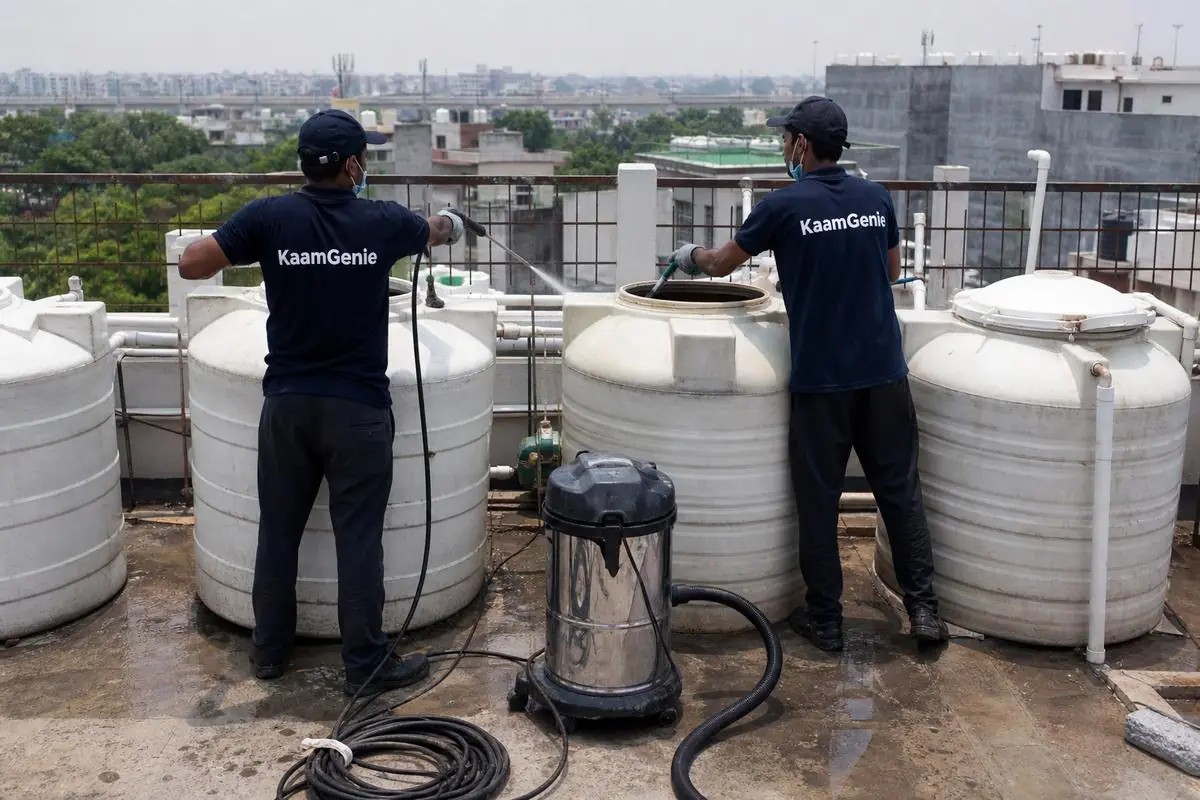
Johripur's position on the Yamuna floodplain shapes what its borewell brings up. The shallow, river-fed water table means the supply is silt-prone year round and outright muddy for weeks after the monsoon, when it is disturbed. A tank shared across several floors, filling all day on that water, gathers the extra silt fast and settles it into a thick bed. This is a different problem from the mineral scale of the drier belts; here it is sheer sediment volume. The wettest months leave the deepest deposit.
A thick silt bed is a ready home for bacteria and clouds the water for every floor on the tank, with the post-monsoon draws the murkiest of the year. The volume of settled mud also chokes the shared pump and the taps quickly, more than a lighter mineral grit would. On rented floors near the river, nobody claims the tank, so the monsoon silt sits until someone acts. A clean after the rains, and again mid-year, keeps a Johripur building's shared supply clear.
No travel charge anywhere in Johripur. The final price is confirmed on the call before we come — it depends only on tank size and access.
See it done in 45 seconds
Watch our web story on how a tank is really cleaned — drain, de-sludge, jet-wash, disinfect.
We reach every pocket of Johripur — and there’s no travel charge to any of them:
Every locality in Delhi stores different water, and that decides how fast a tank fouls. This is Johripur’s profile from The Delhi Water Index, built from our field observations across 250+ localities.
Indicative field characterisation, not a certified lab test. BIS IS 10500: TDS 500 mg/L acceptable, 2,000 permissible. Check any Delhi area →
“After the monsoon our water looks muddy. When should we clean the tank?” Right after the rains is the ideal time, once the muddiest borewell has passed through and settled in the tank. Cleaning then clears the season's heaviest silt load in one go, so we usually recommend a post-monsoon slot for Johripur buildings.
“Being near the river, is our silt worse than other colonies?” Yes. The shallow, river-fed water table under Johripur makes the borewell silt-prone all year and outright muddy after the monsoon, so the tanks here settle more sediment than a drier inland colony. It is volume of silt rather than mineral scale that is the issue.
“What does it cost for a shared tank in Johripur?” The shared tank is ₹1,500 to ₹2,000 by size. A heavy post-monsoon silt load is handled within the quote, and multiple tanks on one building earn a bulk rate.
“The pump keeps clogging. Is the monsoon silt the cause?” Most likely. The thick silt that settles from the muddy post-monsoon borewell is drawn into the pump and blocks it, more than a light mineral grit would. Clearing the tank of that mud at source usually stops the repeated clogging.
“How many cleans a year does a floodplain tank need?” Two work well for Johripur: one after the monsoon when the silt is heaviest, and one mid-year to keep the bed from building back. The riverside silt load makes a single annual clean fall behind between seasons.
See our complete water tank cleaning services in Delhi NCR — pricing, process, tank types and full city coverage.
Beyond water tank cleaning, KaamGenie is rolling out a full lineup of home services across Delhi NCR — see our complete list of 12 home services we offer or will be launching through 2026. New to tank cleaning? Read our guide on how to pick the right water tank cleaning service in Delhi — what to look for, what to avoid, and the questions that separate trustworthy crews from quick-job operators.
Rooftop plastic tanks
₹699+ →Kothi sumps & underground tanks
₹1,499+ →Apartments & RWAs
Bulk pricing →FSSAI-compliant cleaning
₹2,500+ →टंकी साफ़ करने वाले
हिन्दी पढ़ें →View all water tank cleaning guides →
All pockets and lanes of Johripur covered. If your specific block or society isn’t named in the sub-areas above, just call — we almost certainly cover it.
Same crew, same 6-step process, same-day where possible. Pick any locality below for local pricing and the tanks we typically find there.
Book a slot — we can usually fit you in today or tomorrow.