
Water Tank Disinfection Explained
Raj Babbar · 10 min read
Home › Water Tank Cleaning › Society / RWA Tank Cleaning › Kalkaji
Society and RWA tank cleaning for the DDA flats and cooperative societies of Kalkaji — high-occupancy shared overhead tanks and sumps cleaned in one coordinated visit. From ₹1,500 per tank.
Kalkaji is a dense mix of DDA flats, cooperative group housing societies and builder floors packed around the Kalkaji Mandir and Nehru Place. Supply is DJB with borewell backup, and most storage is in society overhead tanks and shared sumps that feed whole blocks. Occupancy here is high, so these shared tanks are drawn down and refilled hard every day, and the fast water turnover means sediment and biofilm rebuild quickly. It is the kind of society system that genuinely needs cleaning on a schedule.
KaamGenie cleans the full set of tanks a Kalkaji society or DDA block runs — the underground sump, the pumps, and every shared rooftop tank — in one visit coordinated with the RWA or caretaker. We isolate and drain tank by tank so the block stays supplied, scoop out sediment, jet and scrub the walls, disinfect, and issue before-and-after photos for the committee. For flat-level cleaning, see water tank cleaning in Kalkaji. This page is specifically about society and RWA whole-building tank cleaning.
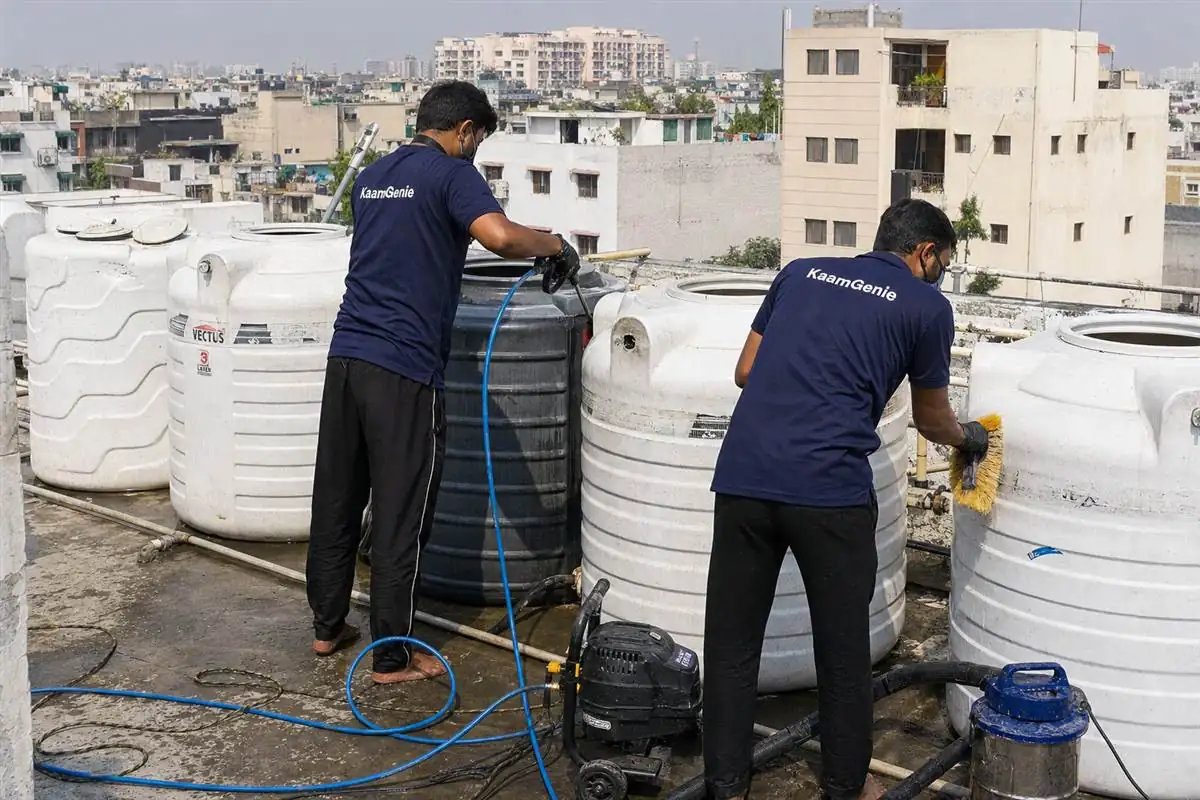
A Kalkaji society tank serves a densely occupied block, so the daily draw is heavy and the sediment load is correspondingly high. With borewell backup adding hardness and DJB water carrying silt, the shared sump and overhead tanks fill with settled muck faster than in a lower-density colony. That layer holds bacteria and, in a block where dozens of families share one supply, a dirty tank affects everyone’s kitchen at once. Cleaning every three to four months is the realistic interval for high-occupancy Kalkaji societies.
Kalkaji RWAs often skip cleaning for years because the committee changes, the budget is tight, and organising a dense block feels awkward. We make it a single line item: one survey, one visit that clears the whole building’s tanks, and one quality report for the maintenance file. Booking every tank together earns bulk pricing, which matters when the society is watching costs, and a four-visit annual AMC fixes the schedule so no incoming committee has to rediscover that the tanks were last cleaned years ago.
No travel charge anywhere in Kalkaji. The final price is confirmed on the call before we come — it depends only on tank size and access.
See it done in 45 seconds
Watch our web story on how a tank is really cleaned — drain, de-sludge, jet-wash, disinfect.
We reach every pocket of Kalkaji — and there’s no travel charge to any of them:
Every locality in Delhi stores different water, and that decides how fast a tank fouls. This is Kalkaji’s profile from The Delhi Water Index, built from our field observations across 250+ localities.
Indicative field characterisation, not a certified lab test. BIS IS 10500: TDS 500 mg/L acceptable, 2,000 permissible. Check any Delhi area →
“Do you clean society tanks in the Kalkaji DDA Flats?” Yes. We regularly clean cooperative societies and DDA blocks across Kalkaji, including the DDA Flats and Kalkaji Extension, covering the underground sump, the pumps and every shared rooftop tank. A quick survey confirms the tank count and access before we schedule one visit that works around the block’s water timing.
“What does whole-building tank cleaning cost in Kalkaji?” Each shared tank of 2,000 to 3,000 litres is ₹1,500 to ₹2,000, and the underground sump is quoted by capacity. Because a Kalkaji society usually has one sump plus several rooftop tanks, we bulk-quote the whole building together, typically 15 to 20 percent off the per-tank rate for a single-visit clean.
“Can a flat owner book if the Kalkaji RWA has not?” Yes. If your committee has not arranged a clean, an individual owner can book their own overhead tank, or a few families can club together. We provide before-and-after photos afterwards, which in a high-occupancy Kalkaji block often prompts the RWA to schedule the full building sooner rather than later.
“How do you work around our block’s water schedule?” During the survey we note the DJB fill window and pump timing, then isolate and drain one tank at a time so the rest of the dense block keeps supply. In most Kalkaji societies we finish the full set in a single day and confirm supply to every flat is restored before we leave the site.
“Do you offer an AMC for Kalkaji societies?” Yes. The whole-building AMC covers four visits a year for the sump, pumps and all rooftop tanks at 20 to 25 percent off the per-visit rate. In high-occupancy Kalkaji, where tanks dirty quickly, four cleans a year keep the water safe and give the committee before-and-after photos each time for the maintenance file.
See our complete water tank cleaning services in Delhi NCR — pricing, process, tank types and full city coverage.
Beyond water tank cleaning, KaamGenie is rolling out a full lineup of home services across Delhi NCR — see our complete list of 12 home services we offer or will be launching through 2026. New to tank cleaning? Read our guide on how to pick the right water tank cleaning service in Delhi — what to look for, what to avoid, and the questions that separate trustworthy crews from quick-job operators.
Rooftop plastic tanks
₹699+ →Kothi sumps & underground tanks
₹1,499+ →Apartments & RWAs
Bulk pricing →FSSAI-compliant cleaning
₹2,500+ →टंकी साफ़ करने वाले
हिन्दी पढ़ें →View all water tank cleaning guides →
All pockets and lanes of Kalkaji covered. If your specific block or society isn’t named in the sub-areas above, just call — we almost certainly cover it.
Same crew, same 6-step process, same-day where possible. Pick any locality below for local pricing and the tanks we typically find there.
Book a slot — we can usually fit you in today or tomorrow.