
Water Tank Disinfection Explained
Raj Babbar · 10 min read
Home › Water Tank Cleaning › Underground Sump Cleaning › Okhla Phase 1
In Okhla Phase 1, the big underground reservoir feeding your unit and canteen takes the first fill all day and banks a heavy load of industrial silt. We open, pump and sanitise it with full confined-space safety. From ₹1,499.
Okhla Phase 1 is an industrial area of factories, workshops and offices, running on borewell water topped with DJB. Units store their supply in large underground reservoirs that feed process lines, washrooms and canteens before pumping up to overhead tanks. Because these reservoirs serve heavy daily industrial and canteen use, they take fill after fill of hard, sandy water and drop a substantial load of sediment onto their floors far faster than any home tank would.
Facility teams here often arrange water tank cleaning in Okhla Phase 1 for the overhead tanks. But the underground reservoir is the tank taking the raw first fill, and under heavy industrial draw it collects sediment fastest — which matters most where the water reaches a canteen. A large reservoir is also the tank most easily deferred against production schedules. This page is specifically about that underground reservoir.
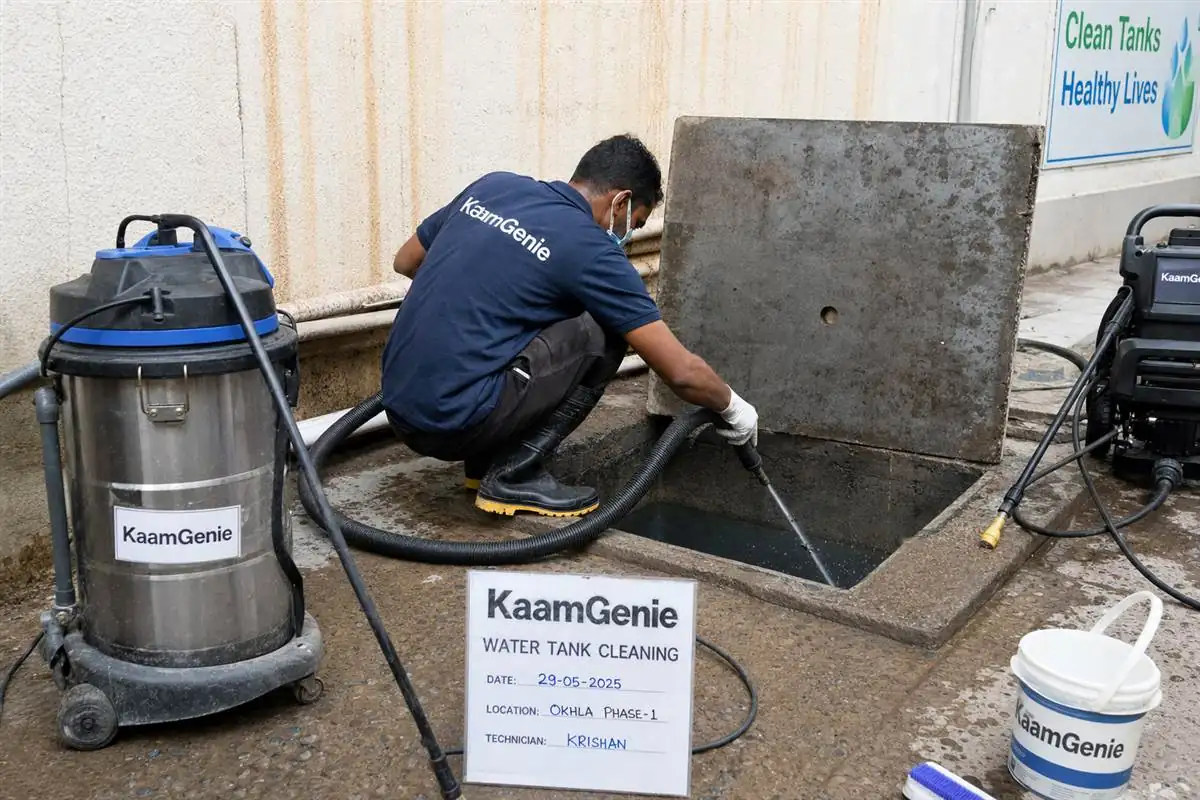
Okhla Phase 1 leans on borewell water, which here is hard and thick with sand and dissolved salts. A unit’s reservoir takes fill after fill of this raw water all day to keep up with process, washroom and canteen demand, so the volume passing through is large and the sediment it drops is heavy. The constant industrial draw keeps stirring the bed and lifting silt into the pumped water, while settled sand and mineral scale build a thick layer across the reservoir floor.
Against production schedules the underground reservoir is easy to defer, so it can go a long time between cleanings even where the water reaches a canteen. It is a large confined space with stale air, which no unit worker should enter without proper procedure, so it stays sealed. On this low-lying industrial land the heavy fill cycle and constant borewell draw stress the walls, and older Phase 1 reservoirs develop cracks that let groundwater seep in and contaminate the stored supply.
No travel charge anywhere in Okhla Phase 1. The final price is confirmed on the call before we come — it depends only on tank size and access.
See it done in 45 seconds
Watch our web story on how a tank is really cleaned — drain, de-sludge, jet-wash, disinfect.
We reach every pocket of Okhla Phase 1 — and there’s no travel charge to any of them:
Every locality in Delhi stores different water, and that decides how fast a tank fouls. This is Okhla Phase 1’s profile from The Delhi Water Index, built from our field observations across 250+ localities.
Indicative field characterisation, not a certified lab test. BIS IS 10500: TDS 500 mg/L acceptable, 2,000 permissible. Check any Delhi area →
“Do you clean large industrial reservoirs in the A and B blocks of Okhla Phase 1?” Yes. We clean the underground reservoirs of factories, workshops and offices across Okhla Phase 1, including the DSIDC sheds and the main-road units. We coordinate with your facility or admin team to schedule a slot, often outside production hours, so the unit’s water supply is disrupted as little as possible.
“What does it cost to clean a reservoir in Okhla Phase 1?” A small sump up to 1,000 litres starts at ₹1,499. A 1,001–2,000 litre tank is ₹1,799–2,200 and 2,001–5,000 litres is ₹2,500–3,500. Most industrial reservoirs here are larger and are quoted by measured capacity, with a discount when overhead tanks are cleaned in the same visit.
“Can you clean our unit’s reservoir the same day in Okhla Phase 1?” For a small unit, often yes if you call early. For a large reservoir feeding a canteen or process line we usually schedule a day ahead so your team can plan around production and the supply cut. Call in the morning and we will tell you honestly what is workable.
“Why does our reservoir collect so much silt here?” Because Okhla Phase 1 runs on hard, sandy borewell water, and an industrial reservoir takes fill after fill of it all day to meet process, washroom and canteen demand. The large volume passing through drops a heavy load of sand and mineral scale, and the constant draw keeps stirring it up, so it builds far faster than a home sump.
“Is the reservoir safe to enter, and do you check for cracks where it feeds a canteen?” We never enter casually, and canteen hygiene makes it important. A reservoir is a confined space with stale air, so we ventilate and test it first, then disinfect it hygienic before refill. While inside we check the walls, since older Phase 1 reservoirs crack and take in groundwater seepage. We photograph any damage and advise on sealing.
See our complete water tank cleaning services in Delhi NCR — pricing, process, tank types and full city coverage.
Beyond water tank cleaning, KaamGenie is rolling out a full lineup of home services across Delhi NCR — see our complete list of 12 home services we offer or will be launching through 2026. New to tank cleaning? Read our guide on how to pick the right water tank cleaning service in Delhi — what to look for, what to avoid, and the questions that separate trustworthy crews from quick-job operators.
Rooftop plastic tanks
₹699+ →Kothi sumps & underground tanks
₹1,499+ →Apartments & RWAs
Bulk pricing →FSSAI-compliant cleaning
₹2,500+ →टंकी साफ़ करने वाले
हिन्दी पढ़ें →View all water tank cleaning guides →
All pockets and lanes of Okhla Phase 1 covered. If your specific block or society isn’t named in the sub-areas above, just call — we almost certainly cover it.
Same crew, same 6-step process, same-day where possible. Pick any locality below for local pricing and the tanks we typically find there.
Book a slot — we can usually fit you in today or tomorrow.