Home › Services › Pest Control › Ant Control
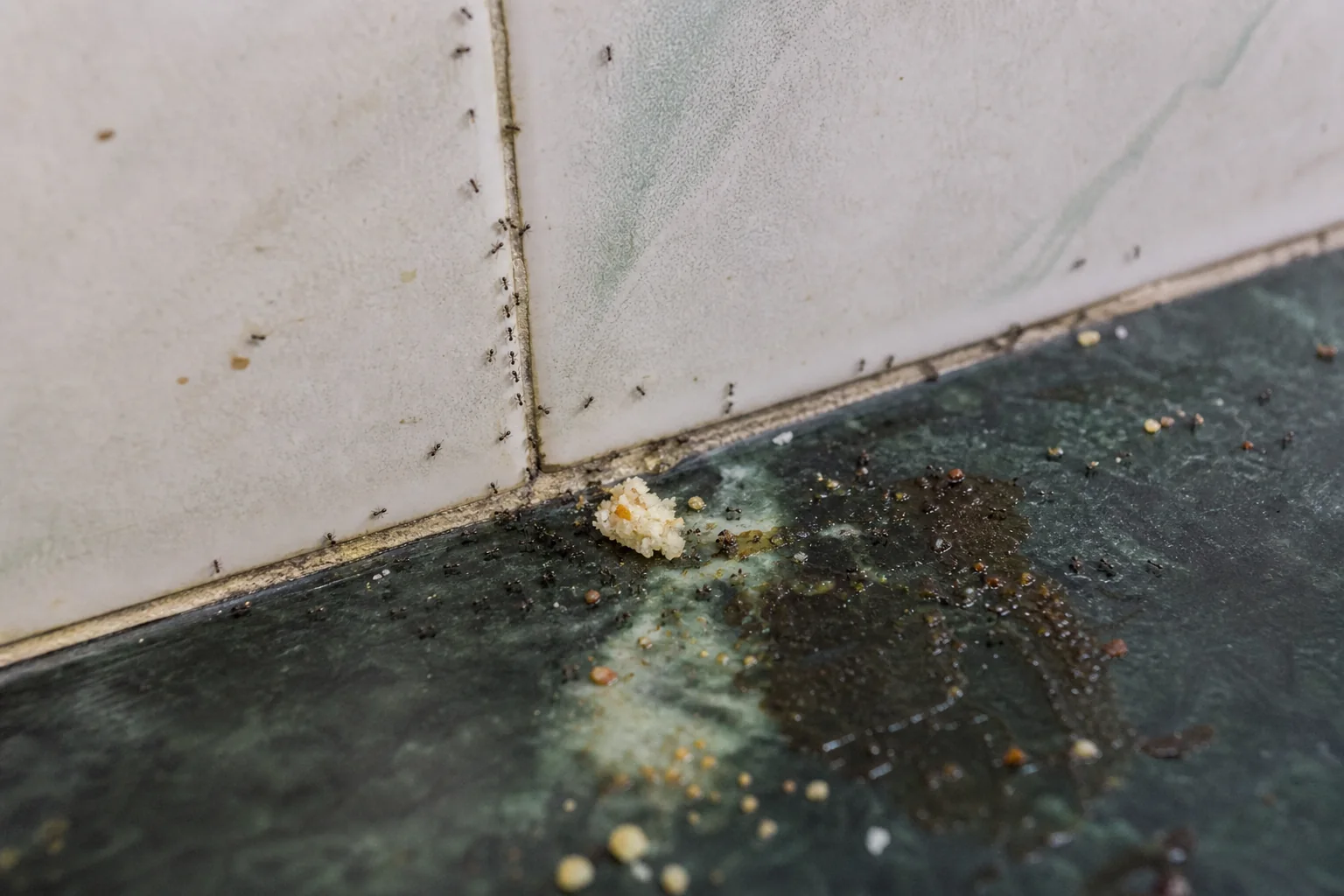
Service · Pest Control CategoryGet rid of ants for good, not just for a week. Those black sugar ants trailing across your kitchen counter, the red ants that bite on the balcony, and the carpenter ants tunnelling into a wooden door frame all share one thing: what you see is a tiny fraction of the nest. DIY spray kills the trail and leaves the colony and its queen untouched, so the line is back within a day. We treat ants the way they actually spread: CIB&RC-approved gel bait that the foragers carry back and feed to the whole colony, targeted treatment at every entry point, and sealing of the cracks they use to get in. The colony collapses in 7 to 14 days. Pet-safe, child-safe, odourless, government-approved, starting at ₹599 with a re-treatment warranty.
Pick the option that matches your home or premises. Fixed prices · GST 18% extra · Same-day available.
All prices: GST 18% extra · Cash / UPI / Card / Bank transfer · Same-day available · Free phone consultation before booking.
Every quote is confirmed on the phone after a 5-minute description of your home. We never quote without understanding the job, and we never change the price on arrival.
Ants are the most persistent household pest in Delhi, and the most misunderstood. Almost every home deals with them at some point, from DDA flats in Rohini and Mayur Vihar to kothis in Defence Colony and builder floors in Dwarka. The reason is simple: Delhi gives ants everything they need. Warm weather for most of the year, dry summers that push them indoors hunting for water, sweet food in every kitchen, and older buildings with countless cracks to nest in. When you see a line of ants on your counter, the colony feeding that line is usually inside a wall cavity, under the floor tiles, behind the skirting board, in a balcony planter, or in the garden soil just outside.
Summer water-hunting. In Delhi’s peak summer, outdoor ant colonies run short of water and send foragers indoors. This is why so many homeowners notice ants suddenly appearing in April and May around the kitchen sink, the water filter, and the bathroom, even in homes that were ant-free all winter. The ants are not attracted to dirt, they are attracted to moisture and sugar.
Sweet food and grease. Sugar ants, the small black ones, live on anything sweet or greasy: a drop of honey, a spilled soft drink, crumbs behind the toaster, the sticky rim of a jam jar, even pet food. Delhi kitchens with daily cooking always leave microscopic food traces, and that is all a foraging ant needs to lay a scent trail and call in the colony.
Older buildings and shared walls. Most Delhi colonies were built decades ago and have plenty of hairline cracks in plaster, gaps around pipe entries, and hollow skirting. These are perfect ant nesting spots. In apartment blocks, ants also travel between flats through shared wall cavities and plumbing chases, so you can clear your own kitchen and still get re-invaded from a neighbour’s wall.
Add these together and the honest conclusion is that a clean Delhi home still gets ants. The question is not how to keep every crumb off the floor forever, it is how to remove the colony that keeps sending foragers in.
Not all ants are the same problem, and the treatment differs by type. The crew identifies which species is active during inspection, because baiting the wrong way wastes the visit.
Black sugar ants (the trailing kind). The tiny 2 to 3 mm black or dark brown ants you see marching in a neat line across the kitchen counter, up the wall, and into a cabinet. These are the most common Delhi household ant. They are not dangerous, but they contaminate food and are relentless. They respond best to sweet gel bait placed directly on their trail, which the foragers carry back to the queen.
Red and fire ants (the biters). Reddish ants, often larger, that deliver a sharp sting or bite. You find them on balconies, near potted plants, in garden soil, and sometimes indoors near damp spots. Their bite leaves an itchy welt, which matters in homes with small children who play on the floor. Red ants nest outdoors more often, so treatment combines indoor bait with perimeter and entry-point treatment.
Carpenter ants (the wood-tunnellers). Larger black ants that excavate galleries inside wooden door frames, window frames, plywood furniture, and structural wood. Unlike termites they do not eat the wood, they hollow it out to nest, leaving small piles of sawdust-like debris. Carpenter ants signal a moisture problem in the wood and need targeted treatment at the nest galleries, not just surface bait.
Every Delhi homeowner has tried it: the can of spray, the kerosene line across the doorway, the chalk, the lemon and vinegar tricks from the internet. They give you a clean counter for a day and then the ants are back. There are three specific reasons, and once you see them the gel-bait approach makes obvious sense.
You kill the trail, not the colony. The ants marching across your counter are foragers, only 5 to 10 percent of the nest. The queen and the bulk of the colony never leave the nest. Spray wipes out the visible foragers, but the queen keeps laying and replacement foragers are back on the same trail within a day. You can spray every morning for a month and never touch the part that actually matters.
Spray is a repellent, which scatters the colony. Most retail ant sprays repel rather than attract. When ants sense the chemical they simply reroute, and a stressed colony often responds by splitting into multiple satellite nests (a process called budding). So heavy spraying can turn one ant problem into three, spread across different corners of the house.
Nothing reaches the queen. As long as the queen is alive and laying, the colony regenerates. No surface spray gets to her deep inside the wall or under the floor. This is the whole reason ants feel impossible to get rid of with shop-bought products: you are treating the symptom every day and never the source.
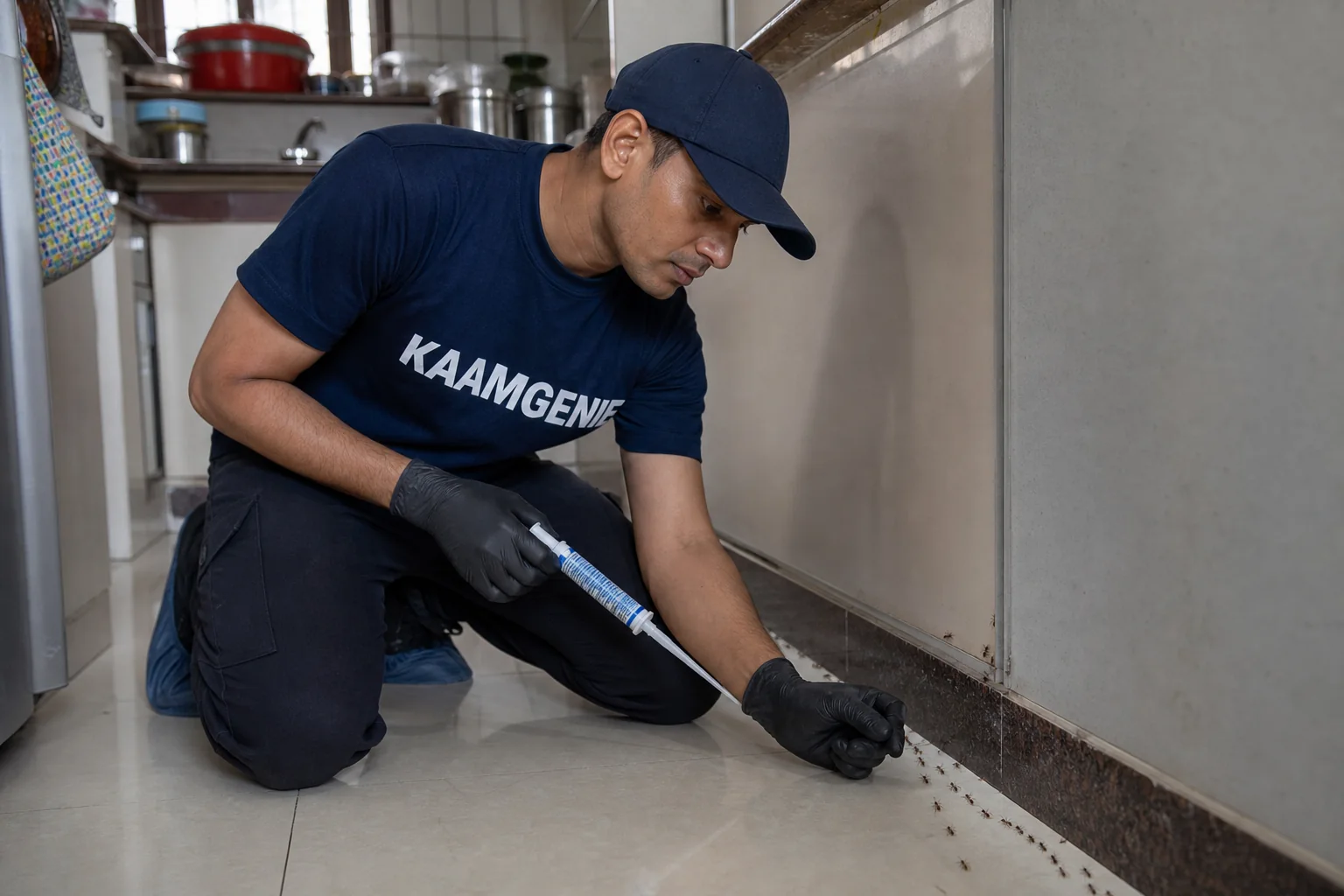
Gel bait beats all three. The bait is a food the ants want, so they walk to it voluntarily, eat it, and carry it back into the nest, where it is shared with the queen and the brood through mutual feeding. The active ingredient is slow-acting on purpose, so the foragers survive long enough to spread it through the whole colony before it takes effect. Over 7 to 14 days the colony, including the queen, collapses. There is no repellent effect to scatter them, and the source is destroyed, not just the trail. That is the entire case for switching from spray to bait. If you want the fuller picture of how we handle every household pest this way, see our pest control overview.
Ant treatment looks simple from the outside, the crew is in and out in under an hour, but there is a structured protocol behind it, and skipping a step means the ants come back. Same six steps every job:
Total time on site: 45 to 90 minutes for a Delhi flat. Bungalows with gardens and commercial kitchens take longer because there are outdoor nests and more entry points to treat.
The Central Insecticides Board & Registration Committee (CIB&RC), under the Ministry of Agriculture, is the Indian regulator that approves which pest-control chemicals can be used, at what concentration, and for which purpose. For ant gel bait we use only active ingredients from that approved list, typically imidacloprid or fipronil at low residential concentrations, combined with sweet and protein food attractants that ants find irresistible.
Why bait is safer than spray. Three reasons. First, the chemical is locked inside a sticky gel, so it does not evaporate, does not become airborne, and does not coat your counters or floors. Second, the total quantity is tiny, a few grams for a whole flat, versus half a litre of aerosol. Third, the placement is concealed inside hinge cavities, wall cracks, and skirting gaps, none of which a toddler or a pet can reach in normal use. The treatment is odourless, there is no wet residue on food surfaces, and you do not need to leave the house or empty the kitchen.
Because it is safe, it fits homes that can’t use spray. Families with infants who crawl on the floor, homes with cats and dogs, and kitchens that run all day are exactly where gel bait wins over spray. You can cook the same day. The only rule is to leave the bait dots and the ant trails undisturbed while the colony feeds.
CIB&RC-approved gel-bait protocol that reaches the queen, pet-safe, child-safe, odourless, no evacuation. Re-treatment warranty. Starting at ₹599. We can be at your home today.
This is the most important practical section on the page. Most ant treatment failures in Delhi are not because the bait did not work, they are because the customer disturbed it in the first two weeks. Read this list and follow it:
Do not wipe or clean the ant trails yet. This feels backwards, but the visible trail is the highway the foragers use to carry bait back to the queen. If you scrub away the scent trail and the bait dots, you cut off the delivery route and the colony survives. Let the ants keep walking their line to the bait for a full two weeks.
Do not spray any insecticide over the treated area. No shop spray, no chalk, no kerosene line, no natural repellents. All of these drive ants away from the bait, which is exactly the wrong outcome. If you see ants around the bait in the first week, leave them alone, that is the treatment working.
Do expect to see ants for several days. Gel bait is a food attractant, so in the first few days you may see more ants than before, gathered around the bait dots and moving along the trails. This is normal and necessary: they are ferrying the bait home. Activity drops sharply from about day 7, and by day 14 the trails should fade to nothing.
Do not seal the crack yourself before the colony is gone. If you block the entry point while ants are still inside feeding, you can trap an active nest in the wall and push it to find a new route indoors. The crew seals entry points as part of the protocol at the right stage, let that be the plan.
Do keep new food traces to a minimum. You do not need a spotless kitchen, but wiping up sugar spills and covering sweet food during the two-week window means the bait is the most attractive food source available, which speeds up colony collapse.
Every ant treatment carries a re-treatment warranty. The window is set to the gel-bait timeline: colonies collapse within 7 to 14 days, and a treated flat with sealed entry points usually stays clear for 4 to 6 months. If the ants return within the warranty window, we come back and re-bait at no extra cost.
What the warranty covers. Re-inspection of the treated zones, fresh gel-bait application on any active trails, and re-checking the sealed entry points. The re-treatment assumes you followed the do-not-disturb instructions above.
What it does not cover. A brand-new colony entering from outside, for example a garden nest that migrates in after a monsoon shower, or ants coming through a neighbour’s wall in a shared block, is treated as a fresh job rather than a warranty visit. The warranty also does not apply if spray or repellent was used over the bait during the two-week window.
For homes with constant outdoor ant pressure, ground-floor flats, houses with gardens, kitchens next to damp balconies, an annual contract makes more sense than repeated one-off visits. Our pest control AMC gives you scheduled visits through the year with free re-treatment between them, and it covers ants alongside cockroaches and other common pests. If you are dealing with several pests at once, the combined general pest control package treats ants as part of a single full-home visit and usually costs less than booking each pest separately. You can also compare package prices for your home size on our pest control cost calculator.
Ant control is not abstract, it solves specific problems. Here are three patterns we treat every week across Delhi:
Scenario 1: Rohini flat, black ants at the water filter. A family in a Rohini DDA flat had a permanent line of tiny black ants running from a plaster crack near the ceiling down to the kitchen water filter and the sink. They had been spraying every morning for weeks. Our crew traced the trail to a nest in the wall cavity, placed sweet gel bait along the full trail and at the crack, and sealed the entry once activity dropped. Heavy ant traffic for the first four days, then a steep fall, and by day 12 the trail was gone. Cleared for the season.
Scenario 2: Defence Colony kothi, biting red ants and a toddler. A ground-floor kothi in Defence Colony with a garden had red ants coming in from the lawn onto the balcony and living-room floor, biting a crawling toddler. The parents did not want spray near the child. We used concealed gel bait indoors plus targeted perimeter treatment at the garden nest and door thresholds, all placed out of the child’s reach. The biting stopped within a week, and a follow-up perimeter treatment before monsoon kept the garden colony from re-entering.
Scenario 3: Lajpat Nagar shop, carpenter ants in a wooden counter. A shop in Lajpat Nagar noticed small sawdust piles and larger black ants around a wooden billing counter and door frame. These were carpenter ants nesting in the wood, drawn by a slow water leak that had dampened it. We treated the galleries directly, baited the trails, and flagged the moisture source for repair. The ants cleared, and with the leak fixed the wood stayed ant-free. Now on a maintenance schedule.
Call us and describe what you have been seeing, the size of the ants, where they trail, whether they bite. We will tell you honestly whether you need full colony bait, a one-time treatment, or just entry-point sealing. No pressure to upsell: if a ₹599 fix is the right answer, that is what we quote.
Ant control is currently live across all of Delhi:
Coming soon: Gurgaon, Noida, Faridabad, Ghaziabad. We are onboarding pest control crews in these NCR zones over the next few months. If your ant problem in NCR outside Delhi is urgent, call us anyway, we may be able to arrange a one-off visit while permanent coverage is being set up.
You have to kill the colony, not the trail. The ants you see marching across the counter are only foragers, roughly 5 to 10 percent of the nest. Wiping them out changes nothing because the queen keeps laying and new foragers replace them within a day. Our gel-bait protocol works the opposite way: the foragers eat a slow-acting bait, carry it back, and feed it to the queen and brood through mutual feeding. The colony collapses over 7 to 14 days and the trails stop because there is no nest left to feed them. Sealing the entry cracks the ants were using stops re-invasion from outside. That combination, bait plus entry sealing, is what actually gets rid of ants for good rather than for a week.
Because cleaning removes the food, not the colony. Ants forage in trails marked with a chemical scent that other ants follow. When you wipe the counter you remove some ants and some scent, but the nest, usually in a wall cavity, under floor tiles, behind the skirting, or in a balcony planter, is untouched. As soon as the next crumb, sugar spill, or drop of sweet liquid appears, a new forager finds it and re-lays the scent trail, and within hours the line is back. Delhi kitchens are especially prone to this in summer, when ants come indoors hunting for water and sweet food. The permanent fix is to bait the colony out of existence and seal the entry points, which is what our treatment does.
Yes, and this is the main reason we use bait instead of open spray. The bait is placed in pinhead-sized dots inside cabinet hinges, along skirting gaps, behind appliances, and in wall cracks where ants travel but children and pets cannot reach. We use only CIB&RC-approved active ingredients (imidacloprid or fipronil gels) at the residential concentrations the Central Insecticides Board permits. Unlike aerosol spray there is no airborne mist, no smell, and no need to leave the house. You can cook the same day. There is no wet chemical coating on counters or floors for a toddler or a cat to touch.
Ant control starts at ₹599 for a single kitchen with the main entry points treated. A full 1 to 2 BHK flat is more because we treat the kitchen, bathrooms, balconies, and every ant entry crack. Independent houses and bungalows with gardens are quoted higher because ants nest in the boundary soil and re-enter. If you also have cockroaches, spiders, or other pests, our full-home general pest control from ₹999 covers ants as part of a combined treatment and usually works out cheaper than booking each pest separately. All prices are before 18 percent GST. We confirm the exact figure on a short phone call and never change it on arrival.
A single gel-bait treatment typically keeps a Delhi flat clear for 4 to 6 months, and often longer once the entry cracks are sealed. The colony takes 7 to 14 days to collapse fully after we leave, so the trails fade over the first two weeks rather than overnight. Homes near gardens, ground-floor flats, and kitchens next to damp balconies see more re-invasion pressure from outdoor colonies, so for those we recommend a treatment every 4 to 6 months, or an annual pest-control AMC with scheduled visits. Every treatment carries a re-treatment warranty: if the ants return within the warranty window, we come back and re-bait at no extra cost.
You do not need to live with ants trailing across your kitchen. The treatment is pet-safe, child-safe, odourless, no evacuation, takes under 90 minutes, and starts at ₹599. Call +91 95603 66362, WhatsApp here, or click the button below. Same-day visits available across Delhi.
Published by KaamGenie Private Limited, Delhi NCR’s trusted home services provider for water tank cleaning, pest control, and household maintenance. CIN: U74909DL2026PTC466750. Last updated 17 August 2026.
Every pest control service we offer across Delhi NCR — CIB&RC chemicals, photo documentation, GST invoice, transparent pricing.
Full overview of every pest control sub-service. Starting prices, process, CIB&RC chemicals, what each treatment covers.
Targeted gel-bait protocol for kitchen and bathroom cockroach infestations. Pet-safe, child-safe, no smell.
Combo cockroach, ant, spider, lizard, mosquito treatment for Delhi homes. Pet-safe and child-safe protocols.
Anti-termite chemical injection for Delhi wooden door frames, almirahs, plywood furniture and structural wood.
Two-visit protocol covering mattress seams, skirting, frame joints. Accounts for 10-14 day egg-hatching cycle.
Thermal fogging + larvae treatment + breeding-site elimination. Critical for dengue prevention pre/post monsoon.
Tamper-resistant bait stations + entry-point sealing + 30-day follow-up audit. Safe for kids and pets.
4 quarterly visits + free re-treatments + scheduled reminders. 20-25% off per-visit pricing.