
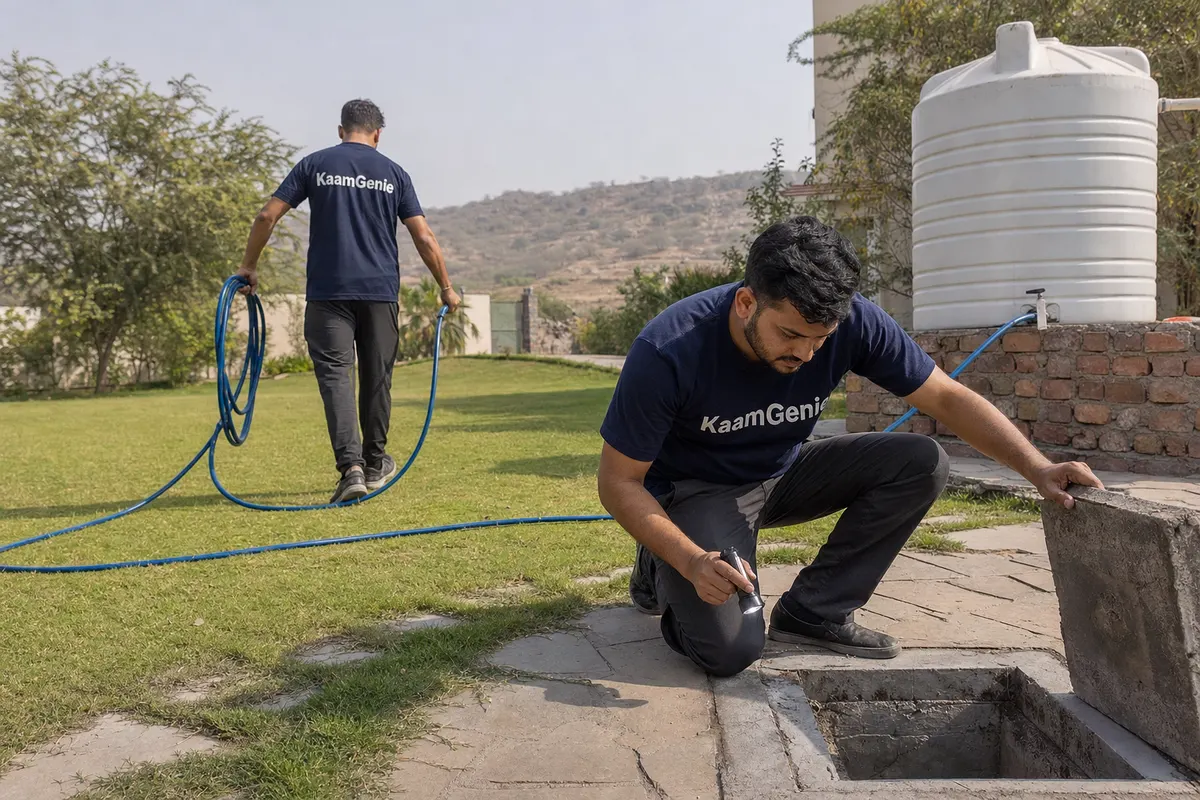
Quick answer
- Map your tanks first: most farmhouses have more than the owner remembers, and each one serves a different use (drinking, bathing, kitchen, staff quarters, pool top-up, irrigation).
- Drinking and bathing tanks come first. Irrigation and pool make-up tanks are a separate, lower-priority job and should never feed the house.
- Clean before reopening after a long empty spell, because water that has stood for weeks in summer heat grows slime and loses its freshness.
- Clean a few days before a big event, not on the morning of it, so the tanks are refilled and settled before guests arrive.
- Plan access: distant tanks, raised stands and deep sumps need long hoses, a ladder and a crew that knows to bring them.
For a farmhouse, each overhead or raised tank starts at ₹699 and each underground tank at ₹1,499, added up into one figure you approve before the crew drives out.
Opening the farmhouse after a long break?
We clean every tank on the property, from the borewell sump to the staff-quarter tank, usually in one visit; larger properties can take longer. Tanks from ₹699 each, priced together upfront, photos of every tank on WhatsApp, no chemicals unless you ask.
Farmhouses around Gurgaon have one thing in common: most rely on borewells and stored water rather than a dependable piped supply. That makes the tanks the most important part of the water system and, because the house is often empty, the most neglected one. If you are already sure it is time, our crews handle water tank cleaning across Gurgaon, including the outer belts.
Why farmhouse water behaves differently
Three things set a farmhouse apart from a city villa, which we cover separately in our villa tank cleaning guide.
The water source is underground
Borewell water in the Gurgaon district is usually hard and mineral-heavy, and in some pockets it carries iron. It arrives clear but drops scale and fine sediment into every tank it passes through. Over months, that builds a crust on the walls and a soft layer on the floor of the underground tank. Our borewell water tank guide explains the minerals in more depth.
The water stands still for weeks
A family that drives down two weekends a month leaves the tanks full and still for the rest of the time. In Gurgaon’s summer, a thin single-layer tank on a raised stand in full sun gets very hot. (A multi-layer tank with an opaque, light-blocking inner layer and a lighter outer layer blocks light and reflects heat far better, which is worth knowing when a tank is due for replacement.) Still, warm water is exactly what slime and bio-film like. In winter it is cooler, but leaves, dust and the odd bird still find their way into poorly covered tanks. Either way, the first water you run on arrival has been sitting there for a long time.
Then demand spikes all at once
A wedding function, a birthday or a corporate offsite can bring more people through a farmhouse in one evening than use it in a month. Every bathroom, the kitchen, the caterer’s wash area and the staff quarters all draw at once. The pump runs hard, the underground tank level drops low, and whatever sediment lies on the floor gets pulled up into the overhead tanks. That is often when owners first notice murky water, on the one day they least want it.
The tank map: list every tank before you book
This is the single most useful thing a farmhouse owner or caretaker can do. Walk the property with a notebook and a torch, and write down every tank you find. It takes half an hour and saves a wasted visit.
- Start at the borewell. Note where the pump delivers: straight to an underground tank, to a raised tank, or to the house roof.
- Find every underground tank. Lift each cover. Note its rough size, whether the lid seals, and whether you can see the floor.
- Count the rooftop and raised tanks. Main house, guest cottage, staff quarters, kitchen block, gazebo washroom. Many properties have a tank nobody has opened since construction.
- Mark what each tank feeds. Drinking and cooking, bathing, toilets, garden taps, pool top-up, drip irrigation. Follow the pipes if you are unsure.
- Check for cross-connections. An irrigation or pool tank should never be able to feed a house tap. If a single pump fills both, note it.
- Note the access. Distance from where a vehicle can park, height of each stand, ladder points, and where the nearest power socket is.
- Photograph each one. A photo of the open tank and its lid is enough for us to quote accurately.
Send that list on WhatsApp and the quote you get will cover every tank, with no surprises on the day.
Which tank needs what, and when
| Tank | What goes wrong | Priority | When to clean |
|---|---|---|---|
| Underground tank fed by the borewell | Scale crust and a soft sediment floor that gets sucked up when the level drops | Highest, it feeds everything else | Before reopening and before any big event |
| Main house rooftop tanks | Warm, stagnant water, slime on the walls | Highest, drinking and bathing | Same visit as the underground tank, after it |
| Guest cottage and kitchen block tanks | Rarely opened, sometimes no lid | High, used by guests and caterers | Before events |
| Staff quarter tank | Used daily while the house is empty, often forgotten | High, people drink from it every day | Every visit, never skipped |
| Pool make-up or balancing tank | Algae and debris, a separate system | Separate job | With pool servicing, never mixed with drinking tanks |
| Irrigation storage | Silt, algae and leaves | Low, not for people | When flow to the garden drops |
For general timing on the drinking tanks, see how often to clean a tank in Gurgaon. The farmhouse twist is that occupancy, not the calendar, should trigger the clean.
Weekend house, party venue or family home: how the use changes the plan
The same farmhouse can need a very different cleaning plan depending on how it is used. Three patterns cover most owners, and it is worth being honest about which one is yours before you book. For how ordinary city homes are handled, see the complete guide to water tank cleaning in Gurgaon.
A weekend house used a few times a month has a stagnation problem rather than a sediment one. The trigger for a clean is a long empty spell, and the most useful thing you can ask for is photos sent to you, because you are rarely there when the crew is.
A property let out for parties and functions has a draw-down problem. The underground tank is what matters, and the clean belongs a few days before a big booking, followed by the event-day pump routine below. If someone else takes the bookings, that person should own the tank list.
A farmhouse the family lives in full-time, often with staff on site, has a scale problem from constant borewell use. Here every tank, including the staff quarter, belongs on each visit, and a lab test of the borewell water tells you whether a filter or softener is needed alongside the cleaning. A newly built or renovated property is a special case of this: cement dust and construction water mean a first full clean before anyone drinks from the tanks.
We work across the Gurgaon farmhouse belts, including Sohna, Bhondsi, Badshahpur and Pataudi Road. On tree-shaded properties around Bhondsi, our crews often find leaves and twigs in raised tanks that sit under the canopy, and a hard, gritty floor in the borewell sump, because the hard groundwater drops its minerals as it stands. Owners on the Sohna side may also find our Sohna Road tank cleaning guide useful.
How KaamGenie cleans a farmhouse
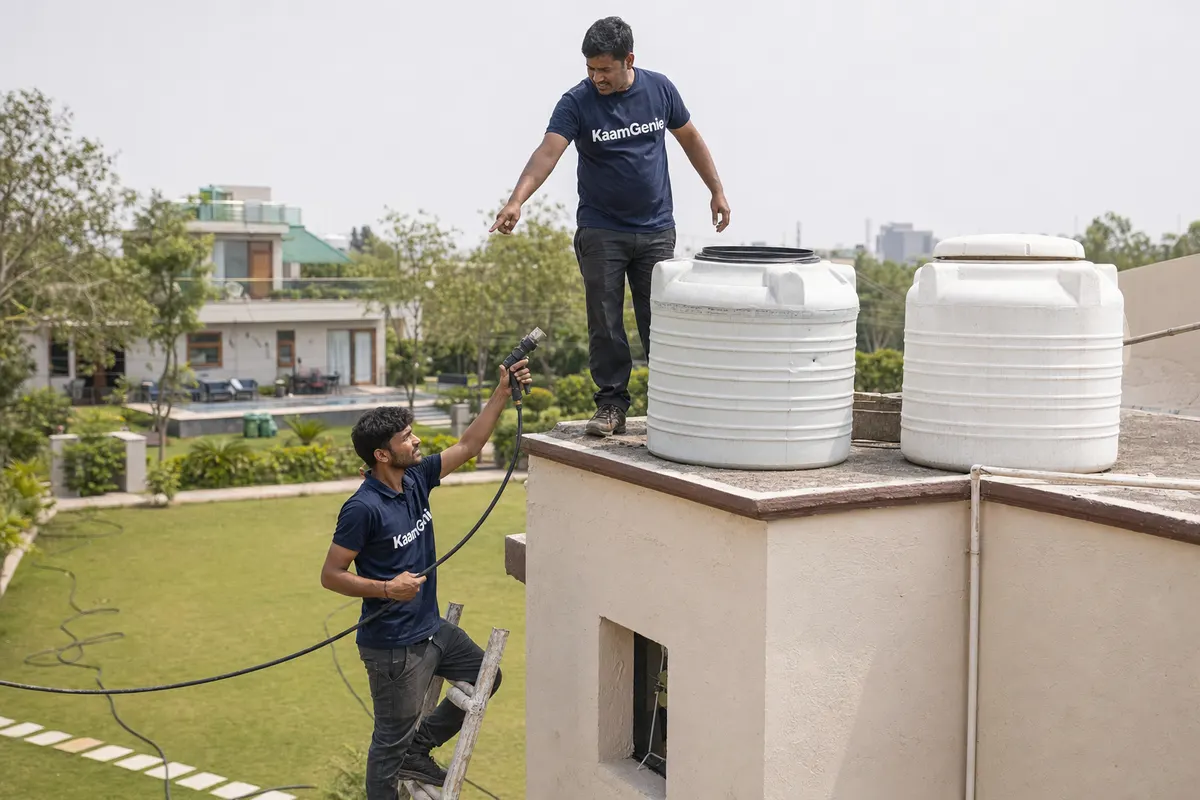
Our standard clean is the same on a farmhouse as anywhere else: inlet shut, drain, de-sludge, scrub, jet wash, wet-vacuum, fresh-water rinse and before/after photos on WhatsApp. The full sequence is in the Gurgaon cleaning process guide. What changes on a farmhouse is the order and the logistics, because one dirty underground tank can re-contaminate every rooftop tank within a day.
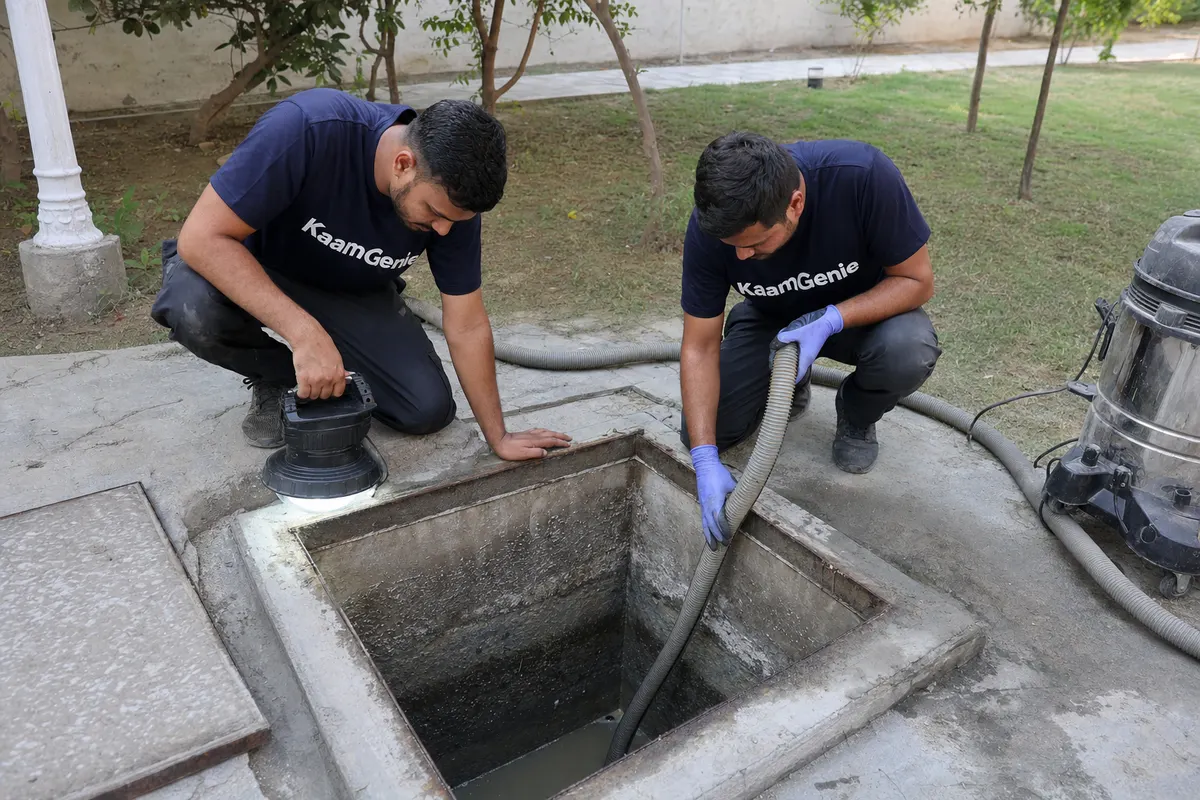
- Borewell pump off, underground tank first. With the pump off, the underground tank is drained and its sediment and scale floor de-sludged, with the sediment scooped and vacuumed out until the floor is clean. Only then are the walls scrubbed and jet-washed.
- Refill the underground tank and give it time. After the rinse, it is refilled from the borewell. Fresh borewell water carries fine sediment, so it needs to settle before anything is pumped up from it: about an hour is usually enough. While it settles, the crew cleans the rooftop tanks, which stay empty until the underground tank is ready. On a large property, the owner or caretaker can pump the rooftop tanks full later in the day instead.
- Rooftop and raised tanks, house first. Main house, then cottages, kitchen block and staff quarters, each drained, scrubbed and rinsed. Remote tanks get a lid and overflow check, because a missing lid or an open overflow pipe is how birds, rats and leaves get in. We photograph any problem and tell you. Out on a farm, a missing lid or torn mesh is priced as a part on its own, and the cleaning figure you approved for the property does not grow on the day.
We carry long hoses for tanks a long way from the parking point, and a ladder for raised stands. Deep underground tanks are entered only with a second crew member at the opening. Farm tanks are cleaned chemical-free as standard. If the property has been shut for a season, or a lab test of the water found bacteria, you can ask for disinfection, which we do only on request. Our underground sump guide covers the confined-space side.
Party or family function coming up?
Book the clean a few days ahead. Send us your tank list and photos on WhatsApp, and we will plan the crew, hoses and timing so the water is ready before the guests are.
Planning around an event
A common mistake is booking the clean on the morning of a function. The tanks then refill during setup, the underground tank has not settled, and the caterers arrive to cloudy water. A better plan:
- Three to five days before: all drinking and bathing tanks cleaned, underground tank first.
- The day before: run every tap in every building for a minute. Top up the underground tank from the borewell so it is full, not half-empty, when guests arrive.
- On the day: keep the pump running in short spells rather than letting the underground level drop very low, which pulls up whatever is on the floor.
- Drinking water: for a large function, have a separate drinking water arrangement for guests regardless of how clean the tanks are.
A simple caretaker routine for the empty weeks
Between cleans, a caretaker can keep the water far fresher with a few minutes a week. None of it needs tools or products.
- Turn the water over. Run the main house taps and flush the toilets once a week, so the rooftop tanks do not sit completely still.
- Check the lids. Walk past every tank and confirm each lid is in place and clamped, strapped or locked, never just held down with a brick or a weight. Farmhouses in open country take the full force of a dust storm, so secure lids and overflow mesh well before the season, and have the water checked after a bad storm.
- Watch the underground cover. Keep it closed, clear of garden soil, and above the level that rainwater runs across the paving.
- Note anything odd. A smell, a colour change, insects near a tank or a pump running longer than usual. A photo sent to the owner the same day is worth more than a report a month later.
What not to do
- Do not let the caretaker pour bleach or powders into the tanks. It is a common habit on farms. Doses are guessed, the sludge stays, and the smell ends up in the kitchen.
- Do not use the irrigation or pool tank as a backup for the house. If a pump fault forces it, nobody should drink or cook with that water.
- Do not clean only the tanks you can see from the house. The staff quarter tank and the cottage tanks are the ones most often forgotten, and people still drink from them.
- Do not ignore a missing lid on a raised stand. An open tank in a green, quiet property is an invitation to birds and insects.
- Do not pump straight from the borewell into the rooftop tanks to save time. Bypassing the underground tank sends fresh sediment to every tap and leaves the house with no settled reserve on an event day.
Getting a quote for the whole property
The tank map from earlier is your quote request. Send it, or simply a photo of each open tank and its lid, and tell us when the house is next being used. For a farmhouse with several tanks, we add each one up (from ₹699 for an overhead or raised tank, from ₹1,499 for an underground one) and send you a single total before anyone sets out. Most properties are done in one visit; larger ones with distant cottages can take longer, and we will tell you that upfront. You settle the bill after the job, once the photos of every tank have reached you. Check that your belt is listed on our Gurgaon tank cleaning page, or phone +91 95603 66362 with your caretaker’s number ready.
Frequently asked questions
How do I get my farmhouse tanks cleaned if I am not there?
Your caretaker only needs to open the gate, switch off the borewell pump and show the crew where each tank is. We send before and after photos of every tank, each one named, on WhatsApp as we finish, so you can check the work from anywhere and pay only after that. Share your tank list in advance and the total is agreed before anyone arrives, which removes any negotiation on the day.
Do you clean the pool or irrigation tanks too?
Our job is the water people drink and bathe in, so we focus on the underground tanks, rooftop tanks and raised tanks that feed the house, cottages and staff quarters. Pool make-up and irrigation tanks are a separate system and should be serviced separately. During the visit we do check whether any of those tanks can feed a house tap, and tell you if we find a cross-connection.
Why does my farmhouse water look cloudy during parties?
When many people use water at once, the pump runs hard and the underground tank level drops. Near the bottom, the pump pulls up the soft sediment and scale that has settled on the floor, and sends it to every overhead tank. Cleaning the underground tank a few days before the event, and keeping it topped up on the day, usually solves it.
Is stagnant farmhouse water safe after a few weeks?
Do not assume it is. Water that has stood still for weeks, especially in summer heat, can grow slime on the tank walls and lose its freshness, and you cannot judge it by looking. Run every tap for a few minutes on arrival, use separately stored water for drinking, and book a clean if the tanks have not been opened in a long time. A lab test is worthwhile if the family drinks this water.
How long does a farmhouse tank clean take?
It depends on how many tanks there are, how big the underground tank is and how far apart they sit. On a farm, one rooftop tank takes the crew around 60 to 90 minutes, and the borewell then needs its own time to fill it. A property with one underground tank and two or three rooftop tanks is usually finished within a working day. Larger properties with cottages, staff quarters and distant raised tanks can take longer. Your tank map lets us give you a realistic time along with the agreed total.
Should I test my borewell water as well?
Yes, if the family drinks it or you see staining, scale or a smell. Ask an NABL-accredited lab for TDS, hardness, iron, pH and coliform, and compare the results with IS 10500:2012. Cleaning removes what has settled in the tanks, but it cannot change what is dissolved in the borewell water itself, so the test tells you whether a filter or softener is needed too.
What does farmhouse tank cleaning cost in Gurgaon?
On a farmhouse, every overhead or raised tank is from ₹699 and every underground tank from ₹1,499. Because properties vary so much, we work out one total for all your tanks from your list and photos, and you approve it before work starts. That price includes de-sludging, scrubbing, jet washing and photos of each tank. Disinfection is optional on a farm, added only on request.
Sources & references
- Bureau of Indian Standards (BIS): IS 10500:2012, the Indian Standard for drinking water quality.
- Central Ground Water Board (CGWB): groundwater quality and levels for Haryana, including Gurugram district.
- CPHEEO Manual on Water Supply and Treatment: Government of India guidance on storage tanks and their upkeep.
- NABL: the accreditation body to check before choosing a water-testing lab.
Last verified: 22 November 2026. If you find any of these links broken, please let us know.