
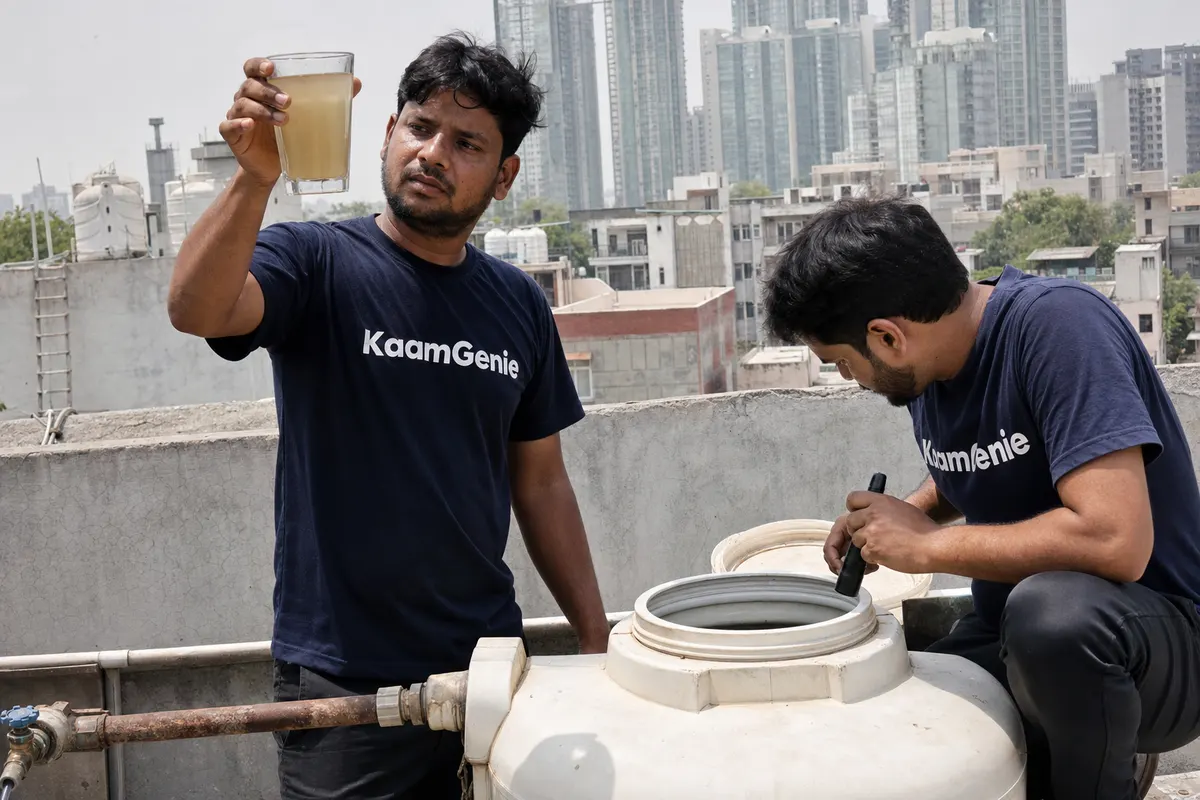
Quick answer
- Yellow or brown only in the first water of the morning: rust from old iron pipes, sitting overnight.
- Brown right after a tanker fill or after supply returns: sediment stirred up from the tank floor or the pipeline.
- Constant yellow or orange tint, worse on some days: iron in borewell water, or a thick rust and silt layer in the tank.
- Murky brown at every tap in a society: sludge being pumped up from a low underground reservoir.
- Pale yellow with a musty smell: organic matter and bio-film in an open or poorly covered tank.
Until you know which one it is, do not drink or cook with the coloured water.
Yellow water at the tap? Get the tank checked
Fixed price from ₹699, sludge and rust removed, before and after photos of your own tank. No chemicals unless you ask for them.
We wrote a general guide to yellow water from tanks in Delhi some time ago. Gurgaon is different enough to need its own: the city mixes canal water supplied by GMDA, private borewells and a lot of tanker water, and the building stock runs from 1970s plotted sectors with iron plumbing to new towers with huge underground reservoirs. Each of those leaves a different colour signature in the tank. If you would rather skip the detective work, our crews handle water tank cleaning across Gurgaon and will tell you on site what is causing it.
What the colour is telling you
Colour and timing together narrow it down quickly. Note when you see the tint, how dark it is, and whether every tap in the house shows it. Then match it against this table.
| What you see | Likely cause | Fix |
|---|---|---|
| Yellow-brown first flush, clears in 1–2 minutes | Rust from galvanised iron pipes standing overnight | Flush before use; plan pipe replacement |
| Brown and gritty after a tanker fill | Tanker silt plus sediment stirred off the tank floor | Tank cleaning; let tanker water settle before use |
| Muddy brown after a supply shutdown | Pipeline sediment pushed in when GMDA supply resumes | Run to waste, then clean the tank if it persists |
| Steady yellow or orange, orange stains on fittings | Dissolved iron in borewell water | Water test; iron filter on the borewell line |
| Dark brown at all taps in a society | Sludge drawn up from a low underground reservoir | Sump and overhead tank cleaning together |
| Pale yellow with a musty smell | Leaves, dust and bio-film in an open tank | Tank cleaning and a proper lid |
The 3-glass test: find the source in five minutes
This is the test our crew runs before they open a tank, and you can do it yourself with three clear glasses. Do it in the morning before anyone has used water.
- Glass 1, first flush: fill it from a tank-fed tap the moment you open it.
- Glass 2, after running: let the same tap run for two minutes, then fill the second glass.
- Glass 3, direct supply: fill it from a tap that does not go through the rooftop tank. In most Gurgaon builder floors this is the ground-floor kitchen tap or the outside tap on the GMDA line; in a borewell home, the tap on the pump outlet.
Hold all three up to daylight against a white sheet of paper and compare.
- Only Glass 1 is coloured: the water is picking up rust while it stands in your pipes overnight. The tank is probably not the main problem.
- Glasses 1 and 2 are coloured, Glass 3 is clear: the tank is the source. Sediment, sludge or rust flakes are sitting in it.
- All three are coloured: the water is arriving coloured, from the borewell, the tanker or the supply line. Cleaning the tank still matters, because that sediment settles in it, but you also need to deal with the source.
Let the glasses stand for half an hour as well. If a layer of fine brown particles settles at the bottom, it is silt or rust flakes, which a tank cleaning removes. If the colour stays evenly spread through the water, it is more likely dissolved iron, which needs a water test and possibly a filter.
What a basic water test checks
If the colour does not go away after cleaning, or you are on borewell water, a basic drinking-water test from an NABL-accredited lab is worth doing. Ask for these parameters and compare the results with IS 10500:2012, the Indian drinking water standard:
| Parameter | Why it matters for yellow water | IS 10500 limit |
|---|---|---|
| Iron | The main cause of yellow-orange tint and orange stains | 0.3 mg/l, no relaxation |
| Turbidity | Measures cloudiness from silt and rust particles | 1 NTU acceptable, 5 NTU permissible |
| Total dissolved solids (TDS) | High in much of Gurgaon’s groundwater | 500 mg/l acceptable, 2,000 mg/l permissible |
| Total hardness | Drives scale, which traps rust and silt in the tank | 200 mg/l acceptable, 600 mg/l permissible |
| pH | Acidic water corrodes iron pipes faster | 6.5 to 8.5 |
| Coliform bacteria | Shows whether the stored water is contaminated | Must not be detectable in 100 ml |
“Permissible” limits apply only where no better source is available. If your iron or turbidity is above the limit, fix the source; if coliform shows up, have the tank cleaned and ask for disinfection before using the water again.
Cause 1: old iron pipes in the older sectors
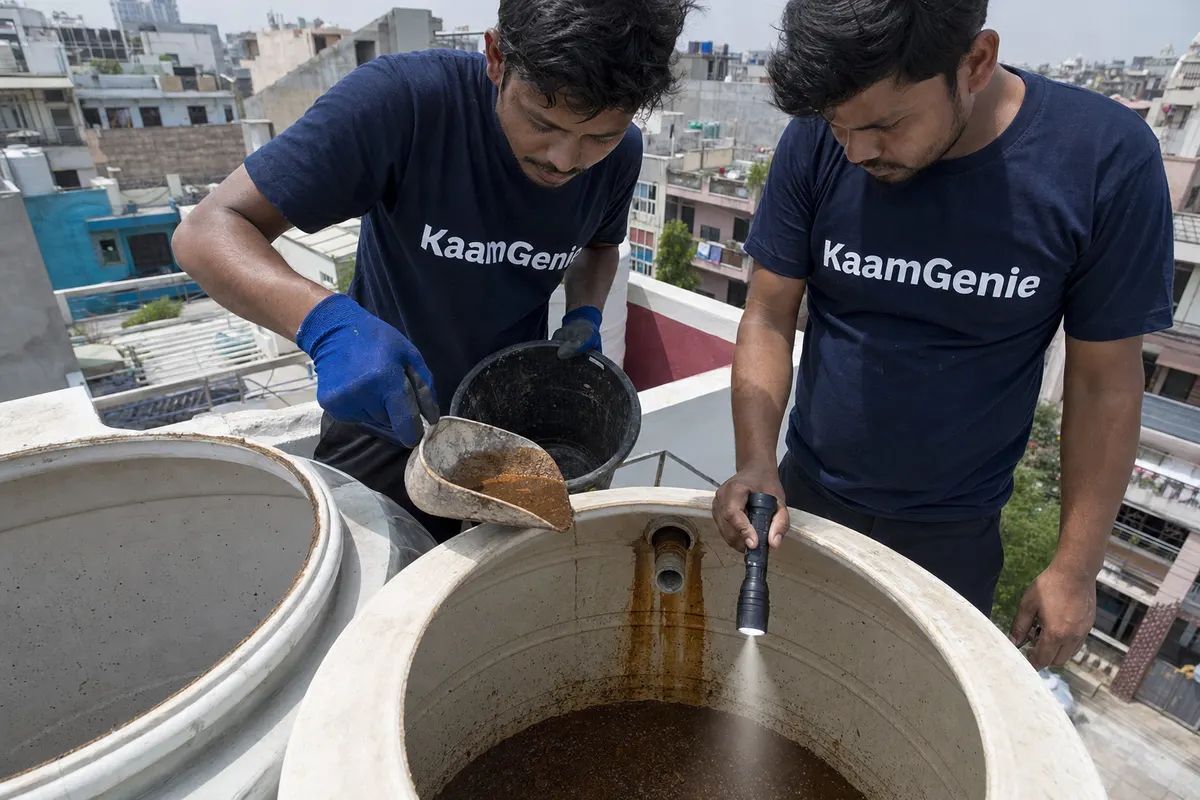
Much of Gurgaon's older housing was plumbed with galvanised iron (GI) pipes, which rust from the inside after 20 to 30 years. We see it constantly in the plotted sectors and colonies near the old city, such as Sector 14, Sector 23, Jacobpura and parts of Palam Vihar. The tell-tale sign is the first-flush pattern: brown in the morning, clearing after a minute or two of running.
Rust from the pipes also ends up in the tank. The rooftop inlet pipe, the float valve and old iron outlet fittings shed flakes that settle on the tank floor into a reddish layer. That is why many older homes have both problems at once: rusty pipes, and a tank full of rust sediment that keeps re-colouring the water.
What helps: a tank cleaning removes the settled rust immediately. Replacing the worst stretches of GI pipe with CPVC or PPR stops it at the source. During a cleaning our crew photographs any corroded inlet, outlet or float-valve fittings so you can show your plumber exactly what needs replacing.
Cause 2: iron in borewell water
Many Gurgaon homes, farmhouses and some societies top up from private borewells. Groundwater in parts of the district carries dissolved iron and manganese. It comes out of the ground clear, then turns yellow or orange once it meets air in the tank, and leaves orange stains on buckets, tiles and the bottom of the tank. Our guide to borewell water tank cleaning in Gurgaon covers that setup in detail.
What helps: regular tank cleaning keeps the settled iron from building up into a thick sludge, but it cannot remove iron that is still dissolved in fresh borewell water. For that you need a water test (a basic lab test for iron and TDS is inexpensive) and, if the iron is high, an iron-removal filter on the borewell line before the tank. The same hard, mineral-heavy groundwater is behind the white scale we cover in hard-water tank cleaning in Gurgaon.
Cause 3: tanker silt
In the new sectors along Dwarka Expressway, the Southern Peripheral Road belt and New Gurgaon, tanker water is still part of daily life for many buildings. Tanker water often carries fine yellowish clay and silt. Each delivery drops a little more on the tank floor, and the force of the inflow stirs up what is already there, which is why the water often looks worst in the hours after a fill.
What helps: after a tanker fill, give the water an hour to settle before running taps on the upper floors, and keep the tank on a tighter cleaning schedule. Our article on tanker water and your Gurgaon tank explains how often tanker-fed tanks need cleaning.
Cause 4: supply coming back after a shutdown
When GMDA supply is interrupted for pipeline work or a shortage and then restored, the first water through the mains often carries sediment loosened from the pipes. It fills your sump or tank muddy brown in one go. If it clears within a day once the sediment settles and is used up, nothing more is needed. If the brown colour lingers for days, that sediment has joined the sludge already on the tank floor, and the tank needs cleaning. We explain how the city's supply reaches your tank in Gurgaon water supply explained.
Cause 5: sludge in society underground reservoirs
Most Gurgaon societies and condominiums store water in a large underground reservoir and pump it up to rooftop tanks. Over months, silt and rust settle at the bottom of the reservoir. When the level drops very low, during a summer shortage or a pump fault, the pump starts drawing water from just above that sludge layer, and every flat in the tower suddenly gets brown water at the same time.
What helps: cleaning only the rooftop tanks does not fix this, because the source is the reservoir underneath. The sump and the overhead tanks need to be cleaned together, in the right order. If you are on an RWA or facility team, our guide to underground sump and reservoir cleaning in Gurgaon covers how we schedule this with minimal disruption to residents.
If you live in… what yellow water usually means for your building
Gurgaon’s housing is unusually mixed, and the same yellow tint points to different causes depending on where you live. Find your property type below to see the most likely source, who normally arranges the fix, and what to ask for. For how each type of building is cleaned in general, see the complete guide to water tank cleaning in Gurgaon.
| If you live in | Most likely cause | Who arranges the fix | What to ask for |
|---|---|---|---|
| A DLF or luxury condominium | Sludge drawn up from the common underground reservoir, so every flat sees it at once | Facility team or AOA | Reservoir and rooftop tower tanks cleaned together, reservoir first |
| An AOA or RWA society | Silt in the shared sump, sometimes one tower’s tank only | Society maintenance office | Tower-by-tower cleaning so residents are never left without water |
| An independent builder floor | Rust from old iron pipes, or sediment in your floor’s own tank | You, as owner or tenant | The 3-glass test on your floor, then your own tank cleaned |
| A plotted house or kothi in the older sectors | Corroded GI plumbing plus a silted underground sump | The owner | Sump and overhead tank done in one visit, rusty fittings photographed |
| A new tower on Dwarka Expressway or SPR | Tanker silt and construction dust left in tanks after handover | Facility team, or you for your flat’s tank | A first full clean of the reservoir and tower tanks after possession |
| A home that runs mostly on tanker or borewell water | Silt from tankers, dissolved iron from the borewell | Owner or tenant | A cleaning plus a lab test for iron, and a filter if it is high |
How a proper cleaning gets rid of the colour
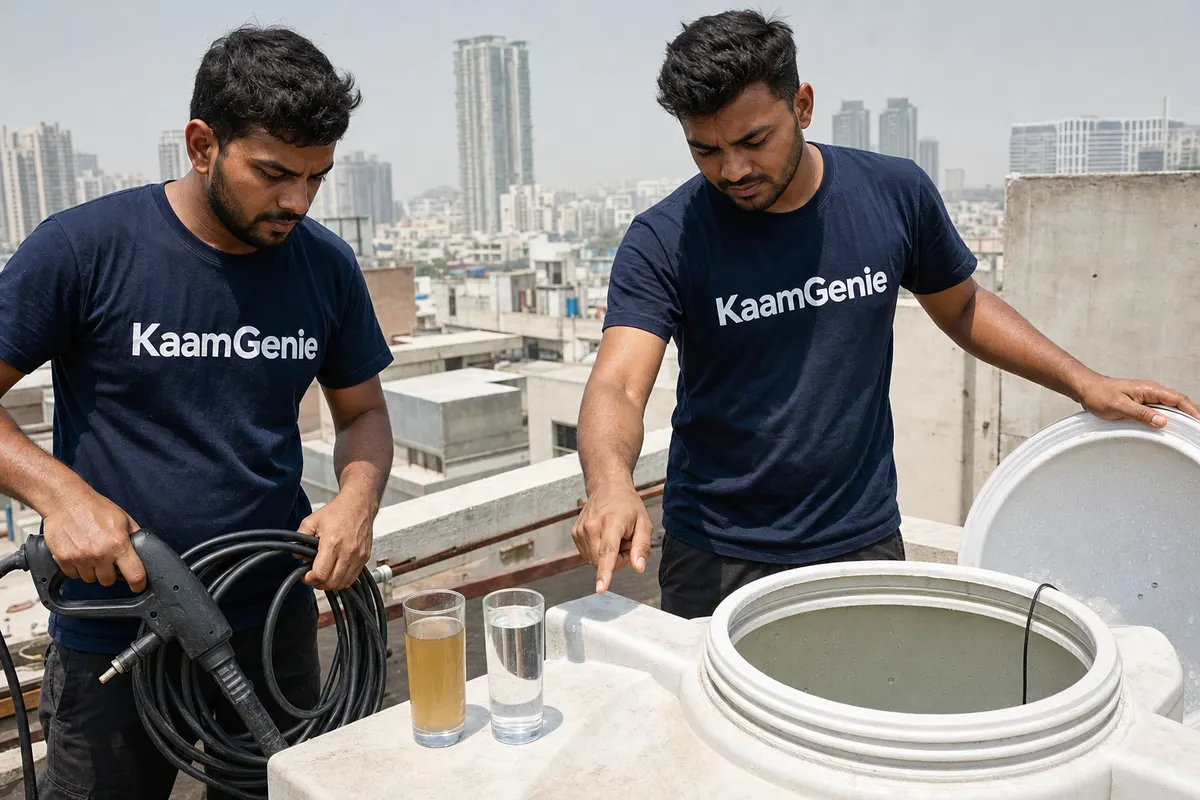
When the colour comes from inside the tank, a thorough clean removes it in a single visit. Our standard process, explained step by step in the Gurgaon cleaning process guide, is:
- Drain: the inlet is shut first so nothing refills mid-job, then the water is pumped out, and the last murky layer is not allowed to run down into your pipes.
- De-sludge: the rust and silt layer on the floor is scooped and vacuumed out, not just washed around, and carried away rather than flushed into the building’s drains.
- Scrub: walls and floor are scrubbed to lift stuck-on rust stains and bio-film.
- Jet wash and rinse: a high-pressure jet wash and a fresh-water rinse clear the loosened residue.
- Check the fittings: we photograph any corroded inlet, outlet or float-valve parts and tell you about them.
- Refill and show: you get before and after photos of your own tank on WhatsApp.
We do not use chemicals in a standard clean. Disinfection is available if you ask for it, for example after contamination or for a tank that has stood unused for a long time.
See the difference in your own glass
Send us a photo of your yellow water on WhatsApp. We will tell you honestly whether it is the tank, the pipes or the source, and quote a fixed price if it needs a clean.
What not to do
- Do not pour bleach, alum or potassium permanganate into the tank yourself. Getting the dose wrong is easy, and none of them remove the sludge that causes the colour.
- Do not rely on boiling. Boiling kills germs but does nothing for rust or iron.
- Do not just keep changing purifier filters. Silt and rust choke RO pre-filters within weeks. Clean the tank and the filters last far longer; we explain why in tank cleaning vs a water purifier.
- Do not fall for ₹200 to ₹300 “cleanings”. At that price there is no time for de-sludging or scrubbing: the tank is sprayed from the top and the rust layer stays on the floor, so the yellow water is back within weeks.
- Do not ignore it because it clears. Water that clears after a minute still means rust or sediment is building up somewhere.
Renting? Who fixes it
The tank and pipes belong to the building, so cleaning is normally the owner's or the RWA's responsibility. In practice, many tenants in Gurgaon builder floors and PGs book the clean themselves and settle up with the landlord, because waiting costs more in bottled water and ruined clothes. A photo of the three glasses makes the conversation easy. Our tenant's guide to tank cleaning in Gurgaon has more on who pays for what.
Book a tank cleaning in Gurgaon
If the 3-glass test points to your tank, or you simply want the colour gone, we clean overhead tanks from ₹699 and underground sumps from ₹1,499 across Gurgaon, from Sushant Lok and DLF Phase 1 to the new towers on Dwarka Expressway. See coverage and pricing on our Gurgaon water tank cleaning page, check the other signs your Gurgaon tank needs cleaning, or call +91 95603 66362. Prefer Hindi? Read tanki me peela paani kyu aata hai.
Frequently asked questions
Why is my tank water suddenly yellow in Gurgaon?
A sudden change usually means something was stirred up rather than a slow build-up. The most common triggers in Gurgaon are a tanker fill that churns up the sediment already lying on the tank floor, city supply coming back after a shutdown and pushing pipe sediment into the tank, or a society sump being pumped when its level is very low so the sludge at the bottom gets drawn up. If the water clears in a day or two it was disturbed sediment; if it stays tinted, the tank or pipes need attention.
Is yellow or brown water safe to drink?
Do not drink it or cook with it until you know the cause. Rust and iron are mainly a taste, staining and pipe problem, but the same sediment that colours the water also shelters bacteria, and you cannot tell the difference by looking. Use bottled or separately stored water for drinking, and get the tank cleaned or the water tested before going back to the tap.
Does boiling or an RO purifier fix yellow water?
Boiling does not remove iron or rust, it only kills germs, and can even make the colour look darker. An RO purifier can remove dissolved iron from the glass you drink, but heavy rust and silt choke its pre-filters within weeks, and it does nothing for the bath, kitchen and washing water. Fix the source, the tank or the pipes, and the purifier then lasts much longer.
How do I know if the problem is the tank or the pipes?
Use the 3-glass test: fill one glass with the first water of the morning, one after running the tap for two minutes, and one from a tap that comes straight from the supply without passing through the tank. If only the first glass is coloured, it is rust sitting in the pipes overnight. If the tank taps stay coloured but the direct-supply tap is clear, the tank is the source. If even the direct-supply water is coloured, the problem is the supply or borewell.
Can tank cleaning alone fix brown water?
If the colour comes from sludge, silt and rust flakes lying in the tank, yes: draining, de-sludging, scrubbing and a fresh-water rinse removes it, and the water runs clear afterwards. If it comes from corroded iron pipes or iron in the borewell water, cleaning helps but the colour will return, so we photograph and flag the rusty fittings during the job and tell you honestly what else needs doing.
Which parts of Gurgaon see yellow water most often?
We see it most in the older sectors and colonies where buildings still have galvanised iron plumbing, such as Sectors 4, 7, 9, 14, 15, 17, 22 and 23, Jacobpura and the Old Gurgaon belt, and in homes that depend heavily on borewell or tanker water. Newer towers mostly have plastic plumbing, so when their water turns yellow it is more often silt in the underground reservoir.
Who should pay to fix yellow water in a rented flat?
Cleaning the tank is usually the owner's or the RWA's job, because the tank and pipes belong to the building, not the tenant. In practice many Gurgaon tenants book the cleaning themselves and settle the cost with the landlord, since it is inexpensive. Send your landlord a photo of the coloured glass and the 3-glass test result; it makes the conversation much easier.
How much does it cost to clean a tank with yellow water in Gurgaon?
Standard overhead tank cleaning starts at ₹699, and underground sumps start at ₹1,499. Tanks with a heavy rust or silt layer take longer but are still quoted as a fixed price before the crew starts, with before and after photos of your tank. Chemical disinfection is not part of a standard clean; we add it only if you ask for it.
Sources & references
- Bureau of Indian Standards (BIS): IS 10500:2012, the Indian Standard for drinking water, sets limits for iron, turbidity, colour and other parameters.
- WHO Guidelines for Drinking-water Quality, 4th edition: guidance on iron, manganese and discolouration of stored water.
- Central Ground Water Board (CGWB): groundwater quality reports for Haryana, including Gurugram district.
- Gurugram Metropolitan Development Authority (GMDA): the agency responsible for bulk water supply in Gurugram.
- CPHEEO Manual on Water Supply and Treatment: the Government of India's engineering manual covering storage tanks and their maintenance.
Last verified: 21 November 2026. If you find any of these links broken, please let us know.