
The short version for facility managers
- Bigger tanks, longer jobs — a corporate UGR of 20,000–100,000+ litres takes 3–5 hours; a full building is a half- or full-day.
- After-hours by default — evenings, Sundays and long weekends so the working day isn’t disrupted.
- No full shutdown — twin-compartment reservoirs and pre-filled tower tanks keep taps running.
- Audit-ready paperwork — tank-wise certificates, before/after photos, chemicals and crew logged for HSE and ISO files.
- Quarterly is the norm — hard groundwater, tanker top-ups and high occupancy dirty an office tank fast.
- Best on an AMC — fixed price, fixed schedule, same vetted crew, one annual agreement.
Get the full picture of pricing and area coverage on our water tank cleaning in Gurgaon hub.
Gurgaon — Gurugram — runs on stored water more than almost any city in the NCR. The Millennium City’s corporate towers sit on hard borewell groundwater and lean heavily on water tankers to keep their reservoirs topped up. Every office in Cyber City, every industrial-turned-corporate plot in Udyog Vihar, and every glass tower along Golf Course Road draws its drinking and pantry water from a large underground reservoir before it’s pumped up to tower tanks and out to the floors. That water sits, and what sits, settles.
For an admin or facility manager, that makes the office tank a quiet liability. Hundreds of people drink, wash and make tea from it every day. If the reservoir hasn’t been opened in a year, the floor is carrying scale and sludge, the walls are growing biofilm, and a single complaint about a smell or a stomach bug puts the spotlight on water hygiene. This guide explains how corporate tank cleaning is done properly in Gurgaon, why it’s scheduled the way it is, and what documentation you should expect to file afterwards.
| Factor | Typical home tank | Gurgaon office / corporate |
|---|---|---|
| Storage | 500–2,000L rooftop tank | 20,000–100,000L+ UGR plus tower tanks |
| Duration | 75–90 minutes | Half-day to full-day, often two crews |
| Timing | Any daytime slot | After hours, Sundays, long weekends |
| Downtime | Tank off for an hour | Must keep water running for the building |
| Paperwork | Photos and a receipt | Tank-wise certificate for HSE / ISO audit |
| Frequency | Twice a year | Quarterly, usually on an AMC |
| Access | Householder opens the lid | Gate passes, permit-to-work, confined-space entry |
Book a corporate tank cleaning
After-hours scheduling, audit-ready certificates, and no working-day disruption for your Gurgaon office. Residential from ₹699 onwards; office UGR and tower jobs quoted on capacity.
What a corporate tank actually looks like in Gurgaon
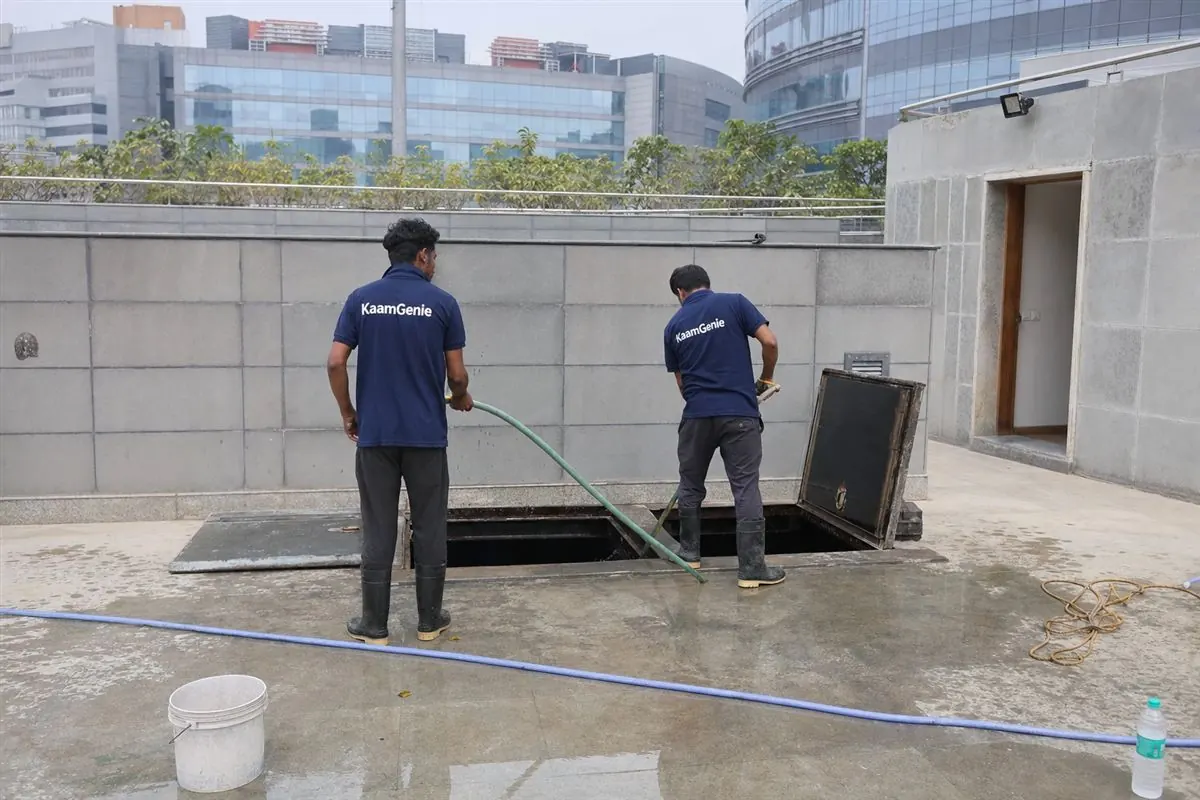
The standard setup in a Gurgaon office building is a large underground reservoir (UGR) sitting in the basement plant room, fed by a mix of municipal supply, a borewell, and tanker deliveries. Pumps lift water from the UGR to intermediate or rooftop tower tanks, which then gravity-feed the floors. A mid-sized tower in Sector 58 or along the Golf Course Extension belt might hold 40,000–80,000 litres underground, split across two compartments, plus several thousand litres in tower tanks.
Three things about that setup matter for cleaning. First, the UGR floor is where every bit of tanker sediment and hard-water scale collects, often out of sight for years. Second, because the building can never really stop drinking water, the job has to be planned around keeping supply live. Third, confined-space entry into a deep concrete reservoir is genuine safety work — it is not something a two-person crew with a bucket should be attempting.
Why office water in Gurgaon gets dirty fast
Gurgaon’s groundwater is hard, mineral-heavy and, in many corporate pockets, supplemented constantly by tankers. Each tanker load brings dissolved solids and fine suspended sediment that settle as the water sits. Hard water leaves a chalky scale on reservoir walls; the scale is rough, and rough surfaces hold biofilm. Add high daily occupancy — a single floor of a busy Cyber City office can draw thousands of litres a day for pantries, washrooms and the cafeteria — and the tank is in a constant cycle of draw-down and refill that keeps stirring sediment in.
The result is that an office reservoir that looked fine at handover is carrying a measurable sludge layer within a year. You don’t see it because nobody opens a basement UGR casually. What staff notice first is a faint smell at the pantry tap, cloudy water in the morning, or — worst case — a cluster of stomach complaints that HR traces back to the water cooler. If your building also depends on tankers, our deeper write-up on tanker-fed tank cleaning in Gurgaon explains why sediment loads run higher than on municipal-only supply.
How we schedule around your working day
The single biggest difference between home and corporate work is timing. You cannot drain a 60,000-litre reservoir at noon on a Tuesday and leave 800 people without washroom water. So almost every office job is run after hours: a late evening, a Sunday, or a long weekend when the building is at low occupancy.
To keep water live during the work, we use one of two approaches:
- Twin-compartment UGRs — most well-designed Gurgaon towers split the reservoir, or keep domestic and fire tanks separate. We clean one compartment while the other stays in service, then switch. Supply never fully stops.
- Pre-fill the tower tanks — for a single-compartment reservoir, we top up the rooftop tower tanks before draining the UGR, so the building runs on that buffer through the drain-and-clean window.
We plan which approach fits your plumbing with your facility or MEP team before the visit, and we sequence the work so water service is back to normal before staff arrive for the next working day.
The cleaning process, scaled up for corporate tanks
The method is the proven eight-step process — inspect, drain, remove sludge, scrub, jet wash, vacuum, disinfect, refill — the same one we detail in our step-by-step cleaning process guide. What changes for corporate tanks is scale and rigour:
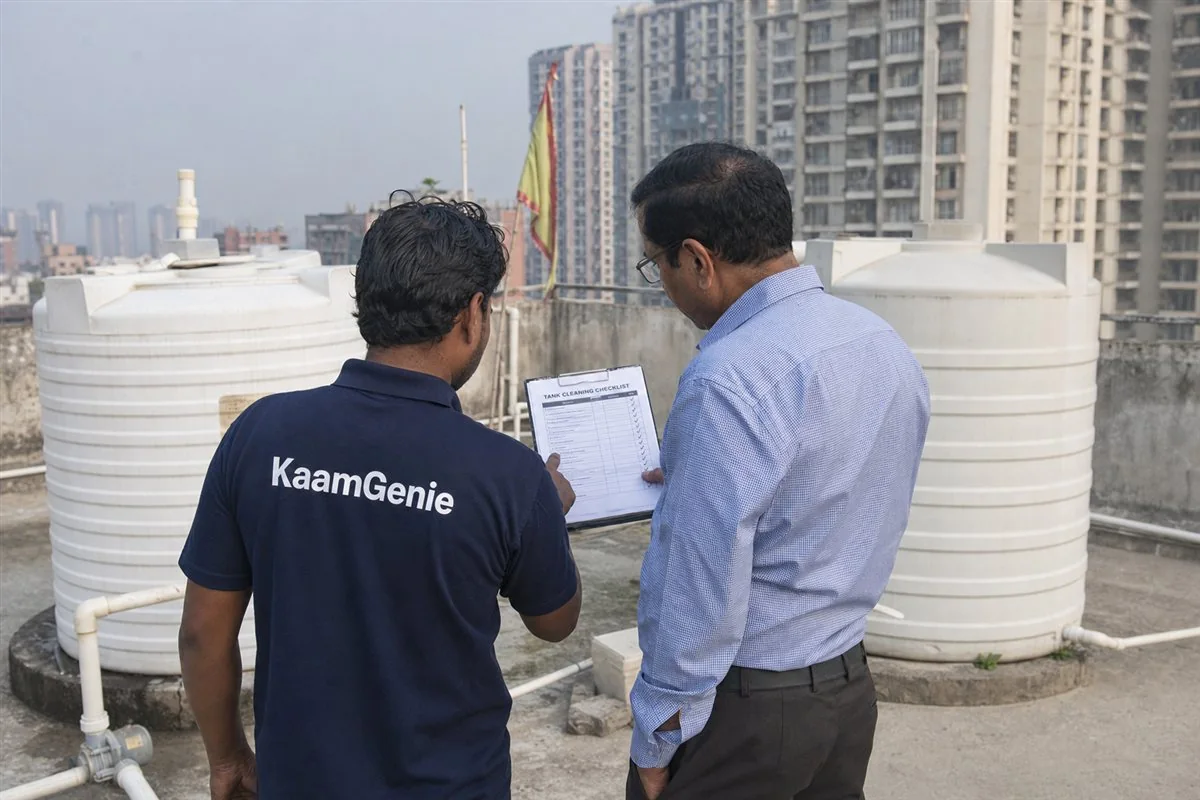
- Inspection with the facility supervisor present, photographing the pre-existing condition of the UGR floor and walls.
- Controlled drain-down using submersible pumps sized for the reservoir, preserving usable water where possible.
- Sludge and scale removal — the big one. A neglected UGR floor can carry a thick layer of hard-water scale and tanker silt that is hand-scooped, vacuumed and carried off-site, never flushed into the building drains.
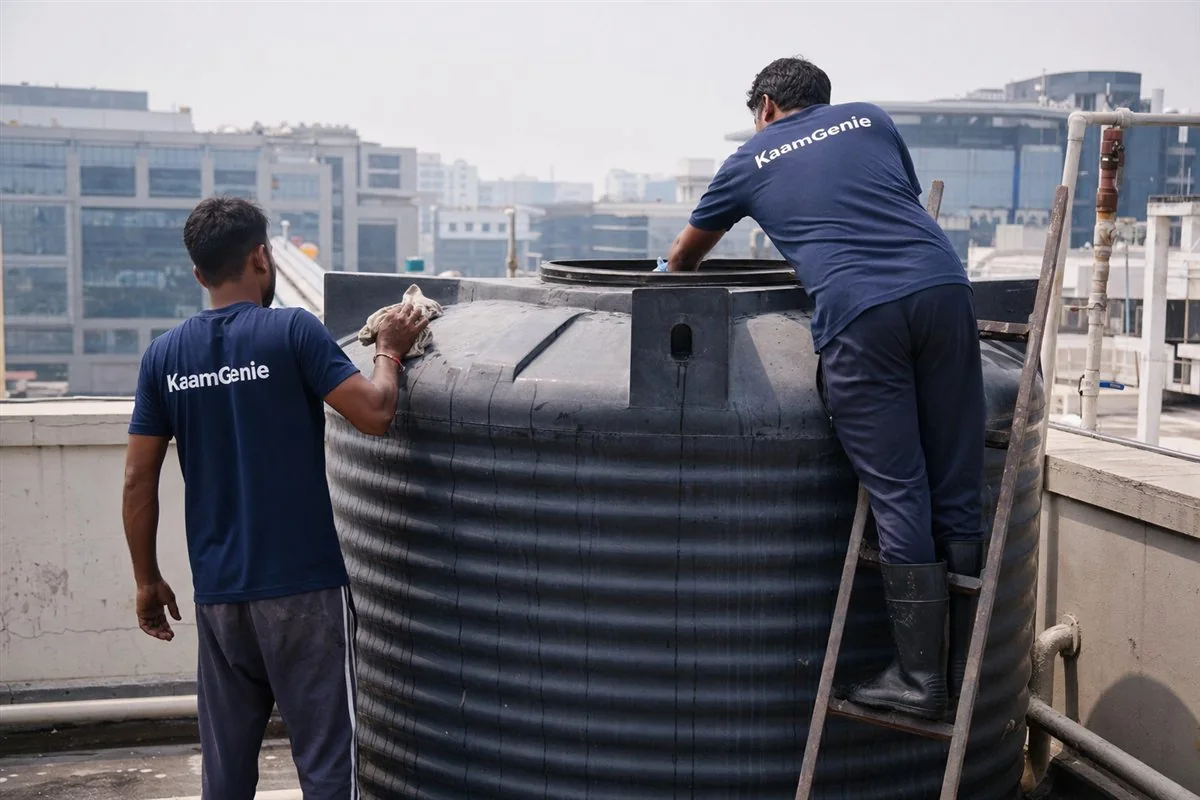
- Manual scrubbing and high-pressure jet wash of every wall, the floor and the corners, with extra attention to the textured concrete surfaces where biofilm clings.
- Disinfection with food-grade sodium hypochlorite at 50–100 PPM, accepted by FSSAI for potable systems, given proper contact time, then rinsed.
- Refill, final check and sign-off with the certificate completed on site.
Confined-space entry into a deep reservoir is treated as exactly that — proper safety gear, a standby person, and work that follows your building’s permit-to-work rules.
The documentation facility managers actually need
For a corporate client, the cleaning is only half the deliverable; the paper trail is the other half. After every visit we hand over a tank-wise cleaning certificate that records the date, each tank’s capacity, the chemicals and concentration used, the crew names, and before/after photographs. On request we add post-disinfection water-clarity readings.
That record isn’t bureaucracy for its own sake. It’s what goes into the HSE file, what satisfies an ISO or fire-and-safety audit, what a landlord or building-management company asks for, and what protects the admin team if water quality is ever questioned. Stored water is recognised as a contamination point in both BIS IS 10500 and WHO drinking-water guidance, so being able to show a documented quarterly cleaning schedule is the defensible position. If you also run a cafeteria or pantry that falls under food regulation, pair this with our note on FSSAI tank cleaning for Gurgaon food businesses.
Where the time goes — cleaning a 50,000L corporate UGR
Sludge removal and disinfection contact time dominate on large reservoirs
Roughly 4.5 hours for a single 50,000L compartment — within the typical 3–5 hour range. A twin-compartment UGR plus tower tanks usually runs a full after-hours shift, sometimes with two crews in parallel.
Where we work across the Gurgaon office belt
Our corporate crews cover the whole business map of the city: the IT parks and grade-A towers of Cyber City, the dense office plots of Udyog Vihar, the premium frontages along Golf Course Road, and the newer commercial clusters through Sector 58 and the Golf Course Extension corridor. We also handle the smaller managed-office and co-working buildings tucked into Sohna Road and SPR.
Whether it’s a single managed floor or a multi-tower campus, the model is the same: scope the tanks, agree the after-hours window, keep water live, document everything. For multi-building corporate parks with a shared facility team, an annual contract is almost always the cleaner arrangement — our guide to water tank cleaning AMCs in Gurgaon walks through how the scheduling and billing work. Larger campuses with multiple committees or a building-management company often run it through the same structure as a society tank-cleaning contract.
Why an AMC makes sense for offices
Most facility managers don’t want to raise a fresh purchase order, re-vet a vendor and re-explain their plumbing every quarter. An annual maintenance contract fixes the price, locks a quarterly schedule, and sends the same vetted crew back each time with consistent paperwork — which is exactly what an audit trail needs to look like. It also means the cleaning never quietly slips, because it’s already scheduled and budgeted.
For procurement, an AMC is a single annual agreement with GST invoicing rather than four separate transactions. For the admin team, it’s one less thing to chase. And for water hygiene, it’s the difference between a tank that’s reliably clean and one that gets attention only after a complaint. You can compare the AMC route against one-off bookings on our water tank cleaning services page.
Book office tank cleaning in Gurgaon
If you manage a corporate building anywhere across Gurgaon — Cyber City, Udyog Vihar, the DLF and Golf Course belt, or the newer SPR and Sohna Road clusters — we’ll scope your tanks, propose an after-hours window, and quote against capacity. Start from the water tank cleaning in Gurgaon hub for area coverage, then call or message to lock a slot.
Get a corporate cleaning quote
Tell us your tank count and capacities and we’ll send a fixed quote and a no-disruption schedule. Documentation included on every visit.
Frequently asked questions
Do you clean office water tanks after hours or on weekends in Gurgaon?
Yes — that is the standard for corporate work. Most Gurgaon offices in Cyber City and Udyog Vihar book us for late evenings, Sundays, or long weekends so that the underground reservoir can be taken offline without disrupting the working day. We confirm the slot in advance with your facility team and coordinate the pump-down so water service resumes before staff arrive Monday morning.
What documentation do you provide for facility audits and compliance?
Every corporate cleaning ends with a tank-wise cleaning certificate listing the date, tank capacity, chemicals used (food-grade sodium hypochlorite, 50-100 PPM), crew names, and before/after photos. On request we add post-disinfection water-clarity readings. Facility and admin managers file these for ISO, fire-and-safety, and internal HSE audits, and to satisfy building-management or landlord requirements.
How big are the tanks in a typical Gurgaon corporate building, and how long does cleaning take?
Office towers usually run a large underground reservoir (UGR) of 20,000 to 100,000+ litres feeding rooftop or intermediate tower tanks. A single UGR of that size takes 3-5 hours; a full building with UGR plus multiple tower tanks is typically a half-day or full-day job, sometimes with two crews working in parallel to fit a single after-hours window.
Can you clean our underground reservoir without shutting off water to the whole building?
If your building has a twin-compartment UGR or a separate domestic and fire tank, we clean one side while the other stays in service, so water never fully stops. For a single-compartment reservoir we schedule the work in the lowest-occupancy window and pre-fill the rooftop tower tanks beforehand so taps keep running during the drain-and-clean. We plan this with your facility team before the visit.
How often should an office water tank in Gurgaon be cleaned?
We recommend every three to four months for corporate buildings — more often than homes because offices have high daily draw, pantry and cafeteria use, and heavy reliance on tanker top-ups that carry sediment. BIS and WHO guidance both treat stored water as a contamination point that needs periodic cleaning and disinfection. Most facility managers put this on a quarterly AMC so it never gets forgotten.
Do you offer an annual maintenance contract (AMC) for corporate facilities?
Yes. A corporate AMC fixes the price, locks a quarterly schedule, and means the same vetted crew returns each visit with consistent paperwork — which is what audit trails need. It removes the scramble of raising a fresh purchase order every quarter. We size the contract to your tank count and capacity and bill against a single annual agreement with GST invoicing.
Why does Gurgaon office water get dirty so quickly?
Gurgaon sits on hard borewell groundwater and most buildings rely heavily on water tankers, both of which carry dissolved minerals and fine sediment into the reservoir. That settles as scale and sludge on the UGR floor. High daily occupancy means tanks are drawn down and refilled constantly, so fresh sediment keeps arriving. Without quarterly cleaning, biofilm and scale build on the walls within months.
Is your disinfectant safe for the office pantry and drinking water points?
Yes. We use food-grade sodium hypochlorite at 50-100 PPM, the same class of disinfectant used in municipal treatment and accepted by FSSAI for potable water systems. It is dosed, given proper contact time, then rinsed, so there is no harmful residue. Pantry taps, RO points and cafeteria water lines downstream of the tank are safe to use normally a short while after refill.
How do you handle building access, security passes and safety in a corporate tower?
We share crew ID and details in advance so your security desk can issue gate passes, and we work to your building’s permit-to-work and confined-space rules. Reservoir entry is treated as confined-space work with proper safety gear and a standby person. We coordinate with the facility supervisor or MEP team on site, and we leave the plant room clean and the paperwork signed off before we go.
Sources & references
- Bureau of Indian Standards (BIS) — IS 10500:2012 is the canonical Indian Standard for drinking water specification, defining acceptable limits for physical, chemical, and biological parameters.
- WHO Guidelines for Drinking-water Quality, 4th edition — the global reference for water quality standards, including guidance on storage and disinfection.
- Food Safety and Standards Authority of India (FSSAI) — defines water quality requirements for food businesses, including hygiene standards for stored water and acceptable disinfection chemicals.
- WHO Fact Sheet on Drinking Water — overview of safe drinking water requirements and contamination risks.
- CPHEEO — Manual on Water Supply and Treatment — the Government of India’s engineering manual covering tank design, cleaning protocols, and disinfection practices.
Last verified: 29 June 2026. If you find any of these links broken, please let us know.