
Quick answer
- When: desilt the pit and wash the filter bed in the weeks before the monsoon arrives, then check it again once the rains end.
- What gets cleaned: roof drains and gutters, the first-flush diverter, the silt trap, the gravel and sand filter, the recharge pit or well chamber, and any storage tank that holds harvested water.
- Warning signs: water standing in the pit days after rain, rainwater overflowing onto the road, a foul smell from the chamber, or mosquito larvae in the pit.
- Why it matters: a recharge well sends water straight down to the aquifer. Whatever silt, oil or rubbish reaches it goes down too, and a clogged bed stops recharging altogether.
- Who does it: KaamGenie cleans RWH pits, filters and tanks across Gurgaon. Structural repair of a cracked chamber or a collapsed bore stays with a mason or a borewell contractor.
Never climb into a recharge pit or a closed chamber yourself. Gases and soft silt make them dangerous.
Rainwater pit full of silt?
We desilt RWH pits, wash the filter bed and clean harvested-water tanks across Gurgaon. Send us a photo of the chamber and we quote a fixed price by size before anyone starts.
Gurgaon has a strange relationship with rain. For most of the year the city depends on canal water from GMDA, borewells and tankers, and the groundwater under many sectors has been falling for years, as the Central Ground Water Board has documented in its assessments of Gurugram district. Then for a few weeks in July and August, the same city floods at its underpasses. Rainwater harvesting sends roof water into the ground instead of the drains, but only if the system is clean. A choked recharge pit breeds mosquitoes and can send dirty water towards the aquifer you are trying to protect.
This post covers the rainwater-harvesting side only. For the tanks that hold your drinking and bathing water, see our Gurgaon water tank cleaning page and the complete Gurgaon tank cleaning guide.
The parts of an RWH system, from roof to aquifer
Most Gurgaon systems follow the same chain, though sizes and names vary by contractor.
- Catchment and roof drains: the terrace, its outlet grates and the vertical downpipes. Leaves, droppings and summer dust start here.
- First-flush diverter: a pipe section or small chamber that catches and discards the first few minutes of rain, which carries the dirtiest water off the roof. It has a cap, valve or small drain hole that must be opened and cleared.
- Silt trap or desilting chamber: a small chamber where heavy grit settles before the water reaches the filter.
- Filter bed: layers of boulders, gravel and coarse sand, sometimes with a mesh on top, that hold back fine silt.
- Recharge structure: a recharge pit, trench or shaft that lets water soak into the soil, or a recharge well (a bore) that carries it deeper, closer to the aquifer.
- Storage tank (in some buildings): a separate tank or sump that keeps harvested water for gardening, car washing or flushing instead of sending all of it into the ground.
In a large society there can be several recharge pits along the internal roads and parks, each with its own filter and silt trap, and the current committee may not know where all of them are. A walk around the campus with the original drawings is a good first step.
What goes wrong in each part
| What you notice | Where the problem usually is | What fixes it |
|---|---|---|
| Roof outlets overflow or water pours down the wall | Leaves and plastic jammed in terrace grates or downpipes | Clear the grates and rod the downpipes before the first rain |
| Dirty, grey water reaches the pit in the first shower | First-flush diverter blocked or its drain left shut | Open, flush and clear the diverter; check its cap or valve |
| Water stands in the pit for days after rain | Silt has sealed the sand layer of the filter bed | Desilt the chamber, remove and wash the sand and gravel |
| Rainwater floods the road or driveway beside the pit | Pit full of silt and debris, no room for inflow | Full desilting of the pit and silt trap |
| Rotten or sewage-like smell from the chamber | Organic sludge rotting, or a wrong connection from a drain | Desilt and clean; have a plumber check for drain cross-connections |
| Mosquito larvae in standing water | Water not soaking away and an open or broken grating | Clean the bed so it drains, fix the cover, mesh any openings |
| Green or smelly water in the harvested-water tank | Silt and organic matter settled in the storage tank | Drain, de-sludge and scrub the tank like a sump |
A blocked first-flush diverter is easy to miss because nothing looks wrong from the outside. The pit simply fills with roof dirt every time it rains, and the filter bed clogs a season sooner than it should. In tree-lined colonies such as DLF Phase 1 and Sushant Lok, our crews often find leaf mulch packed into diverters and silt traps, because the same trees that shade the roofs drop into the gutters all year.
Why a clean bed protects the aquifer
A recharge pit that soaks water into the soil gets a second round of natural filtering as the water moves down through the ground. A recharge well is different: it is a direct path. Whatever passes the filter bed goes down the bore, close to the water table that borewells in the area draw from. That includes fine clay, road dust, bird droppings, oil washed off a driveway, and anything that has rotted in a neglected chamber.
Two simple rules keep that path clean:
- Only roof water should go in. Surface runoff from roads, car parks and basements carries oil, rubber and rubbish. If your system collects from paved areas, the silt trap and filter need to be bigger and cleaned more often, and the design is worth checking with the original consultant.
- Never connect a drain or a septic overflow to the pit. It happens more often than people think, usually during a later renovation. If your pit smells of sewage, stop using it as a recharge point and have a plumber trace the lines before anything else.
A clogged filter also stops recharge altogether: silt seals the sand like a skin and the pit becomes a mosquito pond.
A pre-monsoon check you can do in twenty minutes
Before you call anyone, a short walk-round tells you how much work the system needs. Do it on a dry day in May or early June, from outside the chambers. Do not lean into a pit or lower your head into a chamber.
- Terrace: look at every roof outlet. If the grate is buried under leaves or dust, clear it and pour a bucket of water down. It should run freely.
- First-flush diverter: find its cap, valve or drain hole. Open it with a bucket underneath. If what comes out is black sludge, or nothing comes out at all, it needs clearing.
- Silt trap: lift the cover with a tool and shine a torch in. Note how deep the settled silt is compared with the outlet pipe.
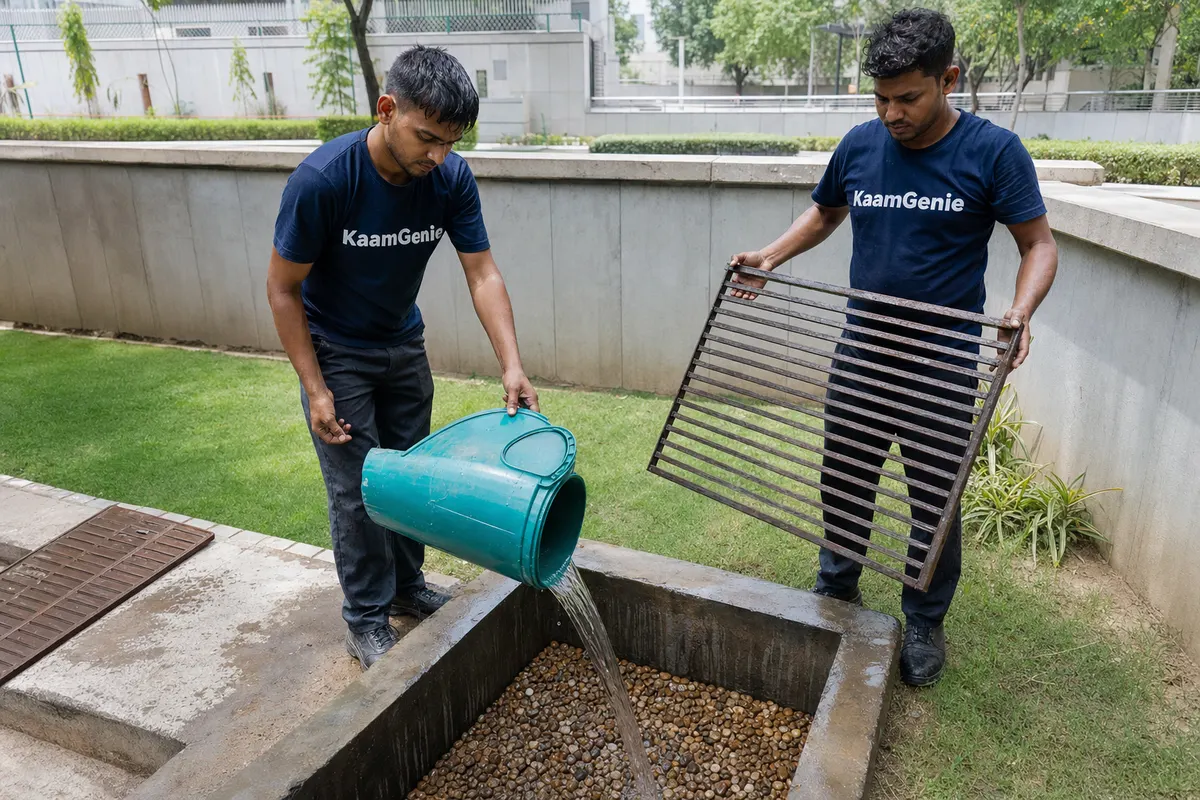
- Filter bed: pour two buckets of clean water onto the surface. On a healthy bed it disappears quickly. If it pools and stands, the sand layer is sealed.
- Covers and gratings: check every cover is intact and fits. A broken grating is a fall risk for children and an open door for mosquitoes.
- Storage tank, if you have one: look at the water and the floor with a torch. A thick layer of silt or a green tint means it needs a proper clean.
Photos of each step on WhatsApp let us tell you whether it is a quick clearing or a full desilting.
How KaamGenie cleans an RWH system
The work depends on what you have, but four steps matter most. The general way we clean tanks, from shutting the inlet to the final photos, is in our step-by-step process guide; here is how it changes for rainwater harvesting.
- Clear the inflow first. Roof outlets, downpipe bends and the first-flush diverter are cleared before the chamber is opened, so the next rain does not wash fresh debris onto a clean bed.
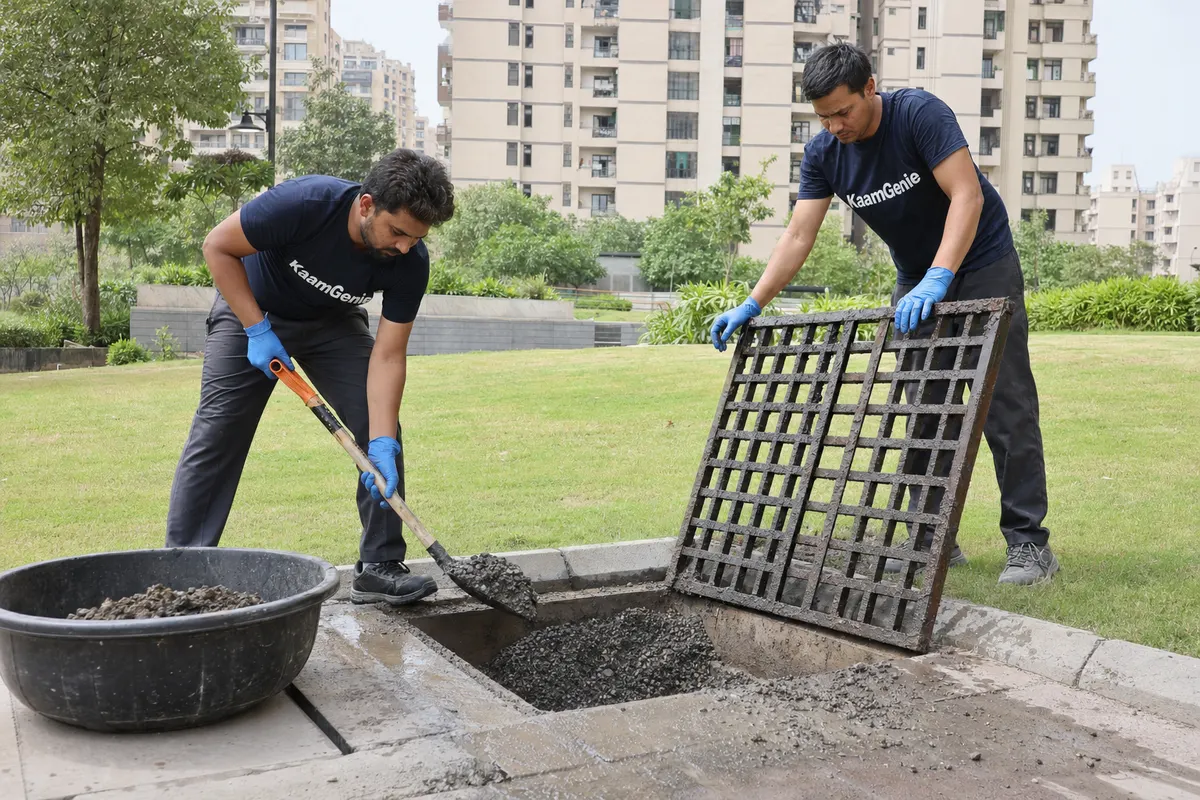
- Desilt the trap and the pit. Standing water is pumped out, then silt and sludge are lifted out by hand and by wet-vacuum until the floor is clear. It is never tipped into the storm drain or the neighbour’s plot.
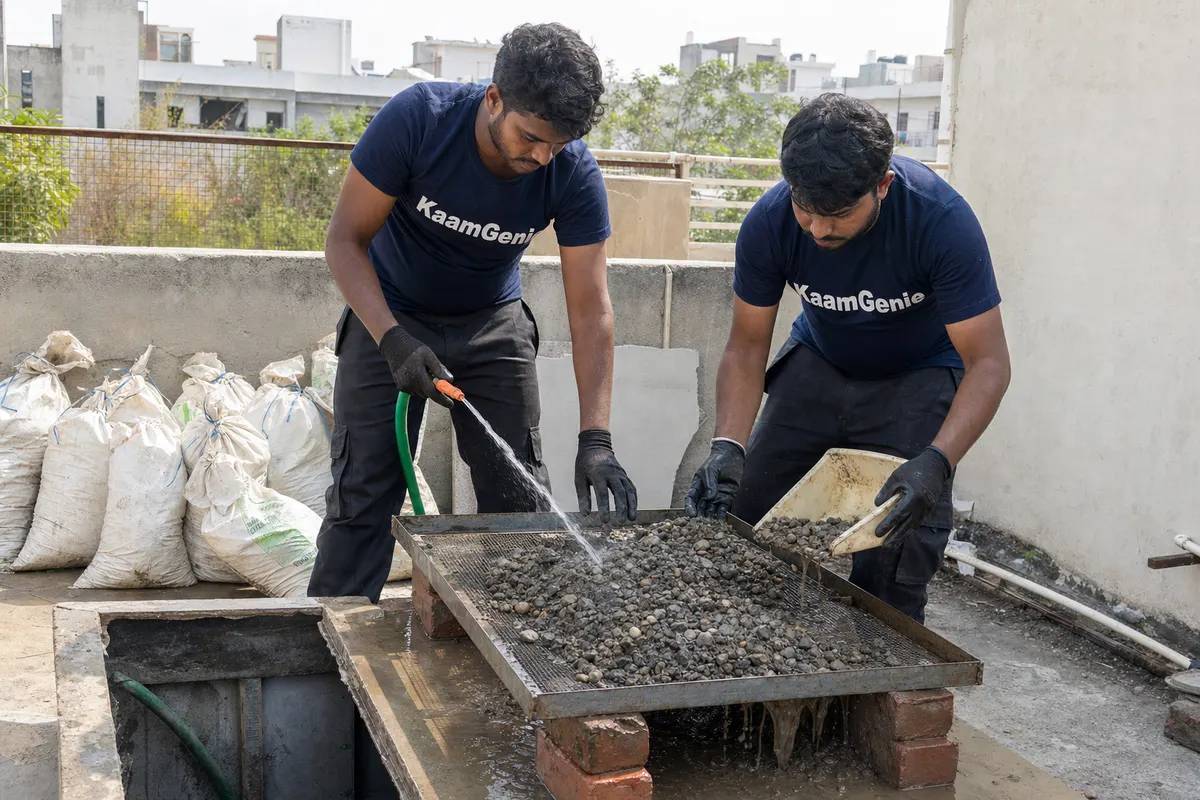
- Lift, wash and relay the filter media. The fouled top layer of sand is removed, the gravel is washed on a mesh until the water runs clear, and the layers go back in the right order. Sand that is too fouled to wash is replaced, and fresh media is quoted separately with your approval.
- Clean the storage tank, if there is one. A harvested-water tank or sump is drained, de-sludged, scrubbed and rinsed in the same way as any other tank.
Throughout, the crew works from outside deep chambers wherever possible, using long-handled tools and the wet-vacuum hose rather than climbing in. A standard clean uses no chemicals. Disinfection of a harvested-water storage tank is available only on request, for example if you plan to use that water for something more than gardening and flushing.
What a cleaning can and cannot do
| Cleaning can | Cleaning cannot | Who handles that |
|---|---|---|
| Remove silt, leaves and sludge from the pit, trap and diverter | Fix a cracked chamber wall or a sunken cover slab | A mason |
| Wash or replace clogged sand and gravel so water soaks away again | Revive a recharge bore that has collapsed or silted deep down | A borewell contractor |
| Clean the harvested-water storage tank | Make harvested water safe to drink | A lab test and proper treatment, set up by a water specialist |
| Show you where drains or paved runoff enter the system | Re-route a wrong drain connection | Your plumber |
| Restore the flow through a choked system | Redesign an undersized system or add more pits | The architect or RWH consultant |
Get the pit ready before the rains
Book a pre-monsoon RWH clean for your home or society. You see the before and after photos on WhatsApp, and you pay once the work is done.
Your setup by type of property
The building type changes who owns the system and how big the job is, so it is worth a short note on each.
- Plotted house or kothi: usually one pit or recharge well in the front or rear setback, fed by the terrace downpipes. The owner is responsible. It is a small job, often combined with cleaning the house’s own sump and overhead tank in the same visit. We work in plotted areas across the city, including Sector 15 and South City.
- Builder floor: the system belongs to the whole building, so agree among the floors who books the clean and how the cost is split, before the monsoon rather than after the driveway floods.
- Society or condominium: several pits and a facility team or AOA in charge. Pits along internal roads take surface runoff and silt up faster than roof-fed ones. Keep a simple record of each pit, its location and the date it was last cleaned. Our RWA and society tank guide covers how to schedule work across a campus.
The rules, briefly
Haryana’s building rules require rainwater harvesting on many plots and on most group housing, and the approved building plan usually shows the system. The exact thresholds and the design details depend on your plot, its category and the rules in force when it was approved, so check with HSVP, the town planning department or your RWA rather than relying on what a neighbour remembers.
Timing around the Gurgaon monsoon
The monsoon usually reaches Delhi NCR around the end of June, and the India Meteorological Department publishes the onset forecast every year. Pre-monsoon desilting works best from May into June, when the pits are dry and the silt is firm enough to lift. Leave it to the week of the first storm and you are bailing slurry out of a full pit.
Once the rains end, a second look is worth it: the heaviest storms carry the most silt, and a bed that coped in July may be sealed by September. If your building also had muddy water in its drinking tanks during the season, our monsoon tank cleaning guide for Gurgaon explains how to deal with those separately. For drinking-water tanks, our recommendation is a clean every 3 months, which is a different routine from the seasonal one for RWH pits; how often to clean your tank explains the reasoning.
Harvested water and the borewell
Recharge helps the local water table over time, but it is not a filter for your borewell, and a dirty recharge well close to a borewell is a real risk. Keep the recharge side clean and test the borewell water if it changes. Our guide to borewell tanks in Gurgaon covers the storage side, and hard water and scale explains why groundwater tanks need more attention.
What not to do
- Do not enter a pit or a closed chamber. Rotting organic matter can build up gases, and wet silt gives way under your feet. Work from above, or leave it to a crew with the right equipment.
- Do not pour bleach, kerosene or phenyl into the pit to kill mosquitoes. It goes straight towards the groundwater. Clean the bed so water drains, and fix the cover instead; our post on larvae in Gurgaon tanks explains how breeding starts.
- Do not fill the pit with soil or concrete because it smells. A smelly pit needs cleaning and a check for drain connections, not burying.
- Do not drink harvested water from the storage tank without a lab test and proper treatment, however clear it looks.
Book an RWH clean before the rains
Send a few photos of the pit, the filter chamber and any harvested-water tank on WhatsApp, or call +91 95603 66362. Rainwater-harvesting systems and large tanks are quoted by size once we have seen them, and the price is fixed before work begins. Our standard drinking-water prices stay as they are: ₹699 for an overhead tank and ₹1,499 for an underground sump, if you want those done in the same visit. You get before and after photos of every chamber we clean, and you pay after the job, once you have seen them. Sunday and weekend slots are available, which helps societies that need the facility team on site. See our Gurgaon service page for coverage, including Nirvana Country and the newer towers.
Frequently asked questions
How often should a rainwater-harvesting pit be cleaned in Gurgaon?
Plan for a proper desilting before each monsoon, ideally in May or June when the pit is dry and the silt can be lifted cleanly. Add a check once the rains end, because the heaviest storms carry the most silt and can seal a filter bed that coped earlier in the season. Pits that take runoff from roads or car parks silt up faster than roof-fed ones and may need clearing during the monsoon as well. If water stands in the pit for days after rain, it is due now, whatever the calendar says.
What is a first-flush diverter and why does it need cleaning?
It is a short pipe section or small chamber that catches the first few minutes of rain off the roof and dumps it, because that water carries most of the dust, droppings and leaf litter collected since the last shower. It fills with sludge and must be emptied through its cap, valve or drain hole. If it stays blocked, all of that dirt goes straight onto your filter bed, which then clogs a season early and lets fine silt through towards the recharge well.
Can a dirty recharge well contaminate groundwater?
It can. A recharge well is a direct path to the water table, without the natural filtering that a shallow soak pit gets from the soil. Silt, oil from paved areas and anything rotting in a neglected chamber can be carried down with the water. That is why the filter bed, silt trap and first-flush diverter matter so much, and why a pit that smells of sewage should be taken out of use until a plumber has checked for a wrong drain connection.
Do you replace the sand and gravel in the filter?
We lift out the fouled top layer, wash the gravel on a mesh until it runs clean, and relay the layers in the right order. Most gravel can be reused. Fine sand that is caked with silt often cannot be washed back to a useful state, and in that case we tell you on site and quote fresh media separately, so you approve it before it goes in. There are no surprise extras for the cleaning itself.
Is harvested rainwater safe to drink after the tank is cleaned?
Not automatically. Cleaning removes the silt and sludge in the storage tank, but rain picks up dust, droppings and pollutants from the roof, and the tank can still grow bacteria. Use harvested water for gardening, washing and flushing unless a lab test shows it meets IS 10500 and a water specialist has set up suitable treatment. Disinfecting the storage tank is something we do only on request, and even then it is not a substitute for testing.
Is rainwater harvesting compulsory for my Gurgaon house?
Haryana’s building rules require rainwater harvesting on many residential plots and on group housing, and your approved building plan usually shows the system. Whether your particular plot is covered depends on its size, category and the rules in force when the plan was sanctioned. Check with HSVP, the town planning office or your RWA for your case. Either way, an installed system only helps you, the aquifer and the street outside if it is kept clean and draining.
How much does it cost to clean an RWH pit in Gurgaon?
RWH pits, filter chambers and harvested-water tanks vary a lot in depth and size, so we quote them by size after seeing photos or a quick visit, and the price is fixed before work starts. If you want your drinking-water tanks done in the same visit, an overhead tank is ₹699 and an underground sump is ₹1,499. You pay after the work, once you have seen the before and after photos of each chamber.
Why is my rainwater pit breeding mosquitoes?
Mosquitoes need standing water and a way in. A pit that drains properly empties within hours of rain, so larvae never get the days they need. When silt seals the filter bed the water stays put, and a broken or missing grating lets mosquitoes reach it. The lasting fix is to clean the bed so it drains, repair the cover and mesh any gaps. Pouring kerosene or bleach in only sends it towards the groundwater.
Sources & references
- Central Ground Water Board (CGWB): groundwater level and resource assessments for Haryana, including Gurugram district, and guidance on artificial recharge.
- Haryana Shehri Vikas Pradhikaran (HSVP): building plan approvals and building rules for HSVP sectors, including rainwater-harvesting provisions.
- India Meteorological Department: monsoon onset forecasts and rainfall data for Delhi NCR.
- Bureau of Indian Standards (BIS): IS 10500:2012, the drinking water standard that harvested water must meet before anyone drinks it.
Last verified: 23 November 2026. If you find any of these links broken, please let us know.