
The short version
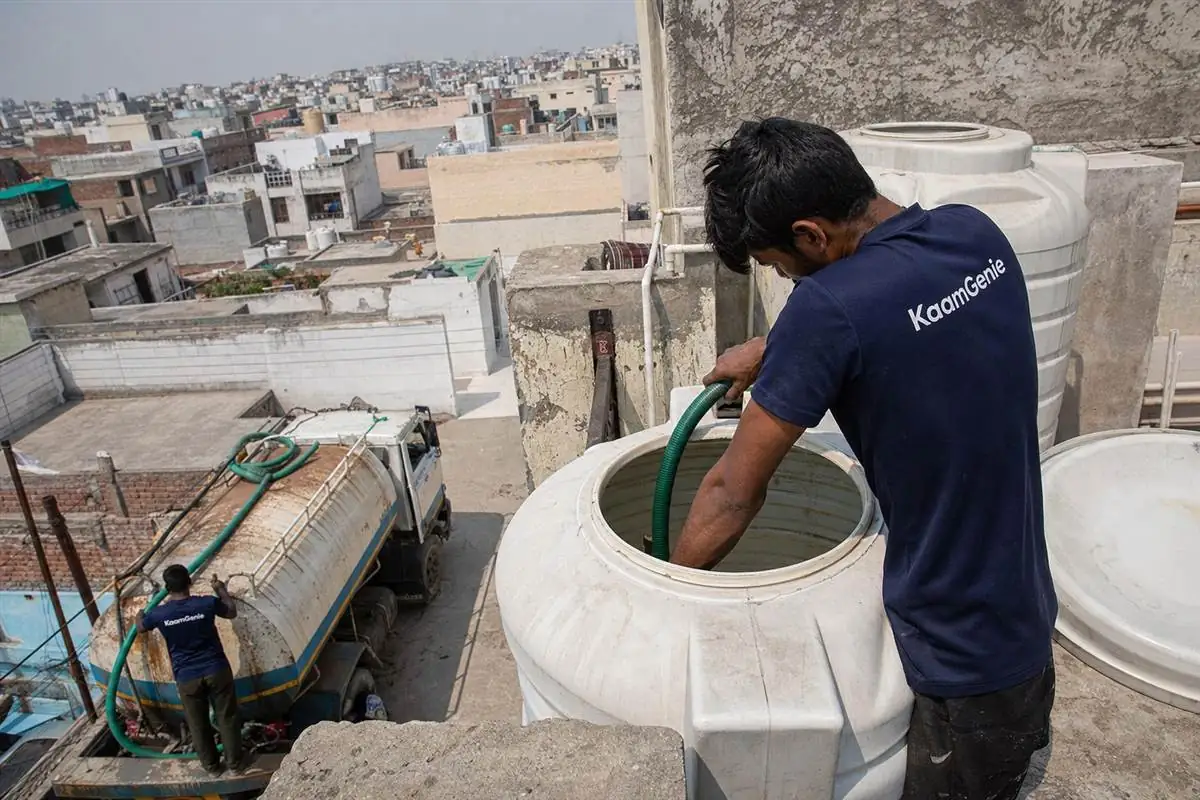
- Delhi’s April–July water crisis means low Delhi Jal Board (DJB) pressure, frequent dry tanks, and heavy reliance on private tankers and borewells.
- When a tank runs dry, scale and sediment bake hard onto the walls in the heat — far harder to remove than the same dirt in winter.
- Tanker and borewell refills carry more sediment and variable quality than treated piped supply, and warm stored water grows bacteria and algae faster.
- A pre-summer clean (March–early April) starts the season fresh; a mid-summer clean helps if you are tanker-dependent or your tank keeps emptying.
- Cleaning protects scarce water and family health exactly when both are under the most strain.
Bottom line: in a Delhi summer, a clean tank is not a luxury — it is how you make sure the water you fought to store is still worth storing.
| Summer condition | What it does to your tank | Why cleaning helps |
|---|---|---|
| Low DJB pressure / supply cuts | Tank empties fully, sediment dries onto floor and walls | Removes the dried crust before it rehydrates into fresh water |
| Tanker & borewell refills | Higher, more variable sediment load settles in the tank | Clears settled sludge so each refill starts from a clean base |
| Hard water + heat cycling | Calcium scale precipitates and bakes onto walls and fittings | Scrub + jet wash strip scale that shelters biofilm |
| Warm stored water | Bacteria and algae multiply faster in the heat | Disinfection resets the tank to a safe, low-growth state |
| Repeated dry-outs | Biofilm dries, cracks and re-seeds every refill | A full clean breaks the cycle for the rest of the season |
Beat the summer rush — book your tank clean now
Pre-summer and mid-summer slots fill fast across Delhi. Photos before and after, food-grade disinfection, fixed price. ₹699 onwards.
The Delhi summer is a stress test for stored water
If you live in Delhi, you already know the rhythm. From late March the heat builds; by May the city is running hot and dry; and somewhere in between the taps start to disappoint. The Delhi Jal Board piped supply, stretched across a population that keeps growing, loses pressure. In the outer and unauthorised colonies that lean on borewell groundwater, the water table drops and pumps strain. And everywhere, from Najafgarh to the high-rise towers of Dwarka, households top up the gap with private water tankers.
All of this lands in one place: your storage tank. The overhead drum on a builder-floor terrace, the shared rooftop tank on a DDA flat block, the big underground reservoir under a cooperative group-housing society in Dwarka — these are where Delhi’s summer water actually sits before it reaches your tap. And summer puts that stored water under more strain than any other season.
The instinct in a water crisis is to think only about quantity: how do I get enough water? But quantity without quality is a false economy. If you queue for a tanker, pay for it, pump it up two floors, and then store it in a tank coated with baked-on sludge and scale, you have spent money and effort to make decent water worse. Cleaning is how you protect the investment you have already made in every scarce litre.
Why tanks run dry — and why that is the real problem
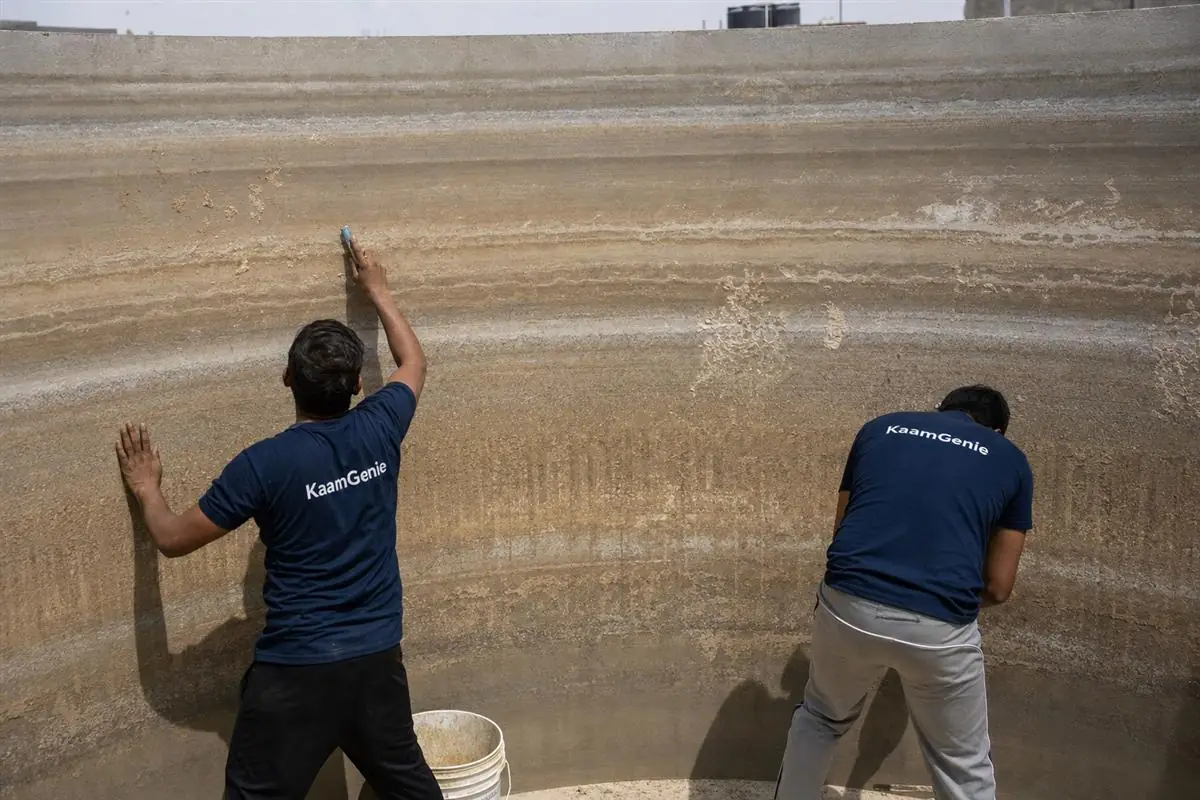
In winter, a tank rarely runs fully empty. There is almost always a layer of water at the bottom, keeping whatever sediment exists soft and suspended. Summer breaks that. When supply cuts out and you draw the tank right down to empty — which happens constantly in May and June — the floor and lower walls dry out in the heat.
Here is what that does. Any sediment that was floating in the water settles and dries into a hard crust. Any biofilm — the slimy bacterial layer that grows on tank walls — dries, cracks, and bakes on. Hard-water scale, which Delhi has in abundance in its borewell-fed pockets, precipitates out and sets like a thin layer of cement around fittings and along the waterline. A film that would have wiped off with a sponge in February becomes a deposit that needs a stiff food-grade brush and a high-pressure jet to remove.
Then you refill. The fresh water — or tanker water, or borewell water — rehydrates that baked-on layer, and a portion of it lifts straight back into the water you are about to drink, cook with and bathe in. The dry-out and refill cycle, repeated through a Delhi summer, quietly turns a manageable tank into a dirty one. This is why a tank that was perfectly fine in winter can need urgent attention by June. If you are seeing cloudy water or sediment at the tap, our guide on the signs your tank needs cleaning urgently walks through what to look for.
Tanker water is not tank-ready water
Private tankers are the backbone of Delhi’s summer survival, and there is nothing wrong with using them. But it helps to be honest about what they deliver. Tanker water is drawn from many sources — borewells, ranney wells, sometimes groundwater that has had little or no treatment — and quality swings from load to load and supplier to supplier. We cover the specifics of this in our companion piece on tanker water and tank cleaning in Delhi.
Even good tanker water arrives carrying more suspended sediment than treated DJB piped supply. That sediment does not vanish; it settles to the bottom of whatever tank receives it. In plotted homes and builder floors that is usually the underground sump first, then the overhead tank. In high-rise societies in Dwarka and outer Delhi it is the big underground reservoir where the tanker discharges. Either way, the sediment accumulates fastest exactly when you are relying on tankers most.
A clean tank cannot turn poor water into good water — no tank can, and anyone who claims otherwise is selling you something. What a clean tank does is stop the problem compounding. It gives each refill a clean base to sit in, instead of mixing fresh delivery into a reservoir of last month’s settled sludge. In a summer where you may be refilling from three different sources in a week, that clean base matters more, not less.
Heat, hard water and the speed of contamination
Two more things accelerate in a Delhi summer. The first is biological. Bacteria and algae multiply faster in warm water; a tank sitting in 45-degree heat on an exposed terrace is an incubator. Water that might stay acceptable for a week in winter can turn in a couple of days in peak summer, especially if the tank already has biofilm and sediment feeding the growth. This is also why summer is peak season for waterborne stomach complaints across the city.
The second is chemical. Much of Delhi — particularly the outer colonies, Najafgarh, and borewell-dependent stretches — has genuinely hard water, heavy in calcium and magnesium. As a tank heats through the day and the water level swings up and down with each fill and draw, that hardness keeps precipitating out as scale. Over a single summer the scale layer can thicken noticeably, and because scale is rough and porous, it gives biofilm extra surface to cling to. If your home is in a hard-water belt, our deep-dive on hard water tank cleaning in Delhi explains how this builds up and how it is removed.
The practical takeaway is simple: the same neglect costs you more in summer. A tank you could get away with cleaning once a year in milder months will, under summer conditions, drift from clean to questionable far faster.
Pre-summer cleaning: the single best-timed job of the year
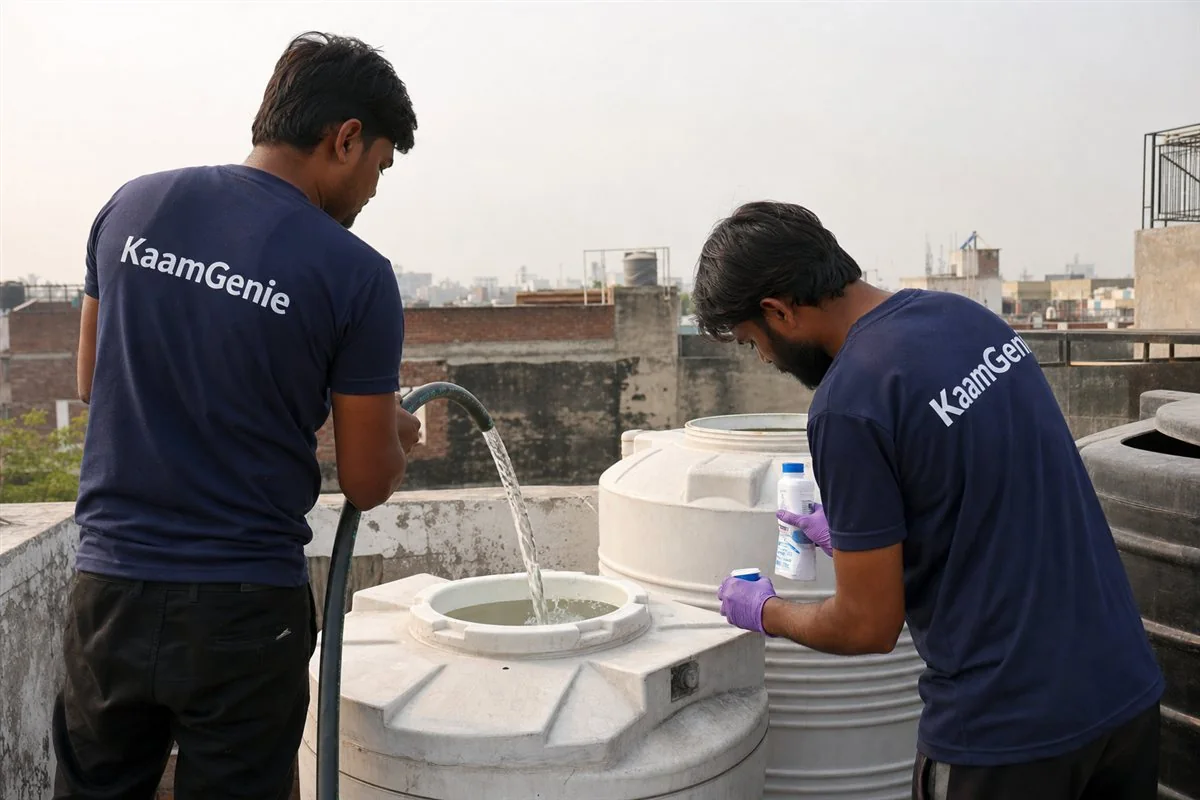
If we could give Delhi households one piece of timing advice, it would be this: clean the tank in March or early April, before the crisis bites. A pre-summer clean strips out the previous year’s sediment and biofilm while it is still soft, disinfects the tank to a safe baseline, and means the season’s scarce, hard-won water starts its journey in a clean container. There is no scale baked on yet, no sludge to concentrate as the tank cycles dry. We have written a full month-by-month guide to this in pre-monsoon water tank cleaning for Delhi (April–May), and a year-round view in our best time to clean your water tank in Delhi, month by month.
If you missed that window — and many people do, because the need only becomes obvious once the water already looks off — a mid-summer clean still earns its keep. It is especially worth it if you have been tanker-dependent, run a borewell, or your tank has been emptying and refilling on repeat. Households in heavy-use buildings such as PGs, tenant-packed builder floors, and large societies benefit most from a second clean, because their tanks turn over fast and dirty all season.
Why summer earns a clean — relative contamination risk by season for a Delhi tank
Illustrative, based on how Delhi conditions stack up — not lab figures
Heat, tanker dependence, dry-out cycles and faster microbial growth all peak together in the April–July window — which is exactly why a tank clean returns the most value then.
Tanker-dependent this summer? Get the sump and tank cleaned
We clean overhead tanks, underground sumps and society reservoirs across Delhi. Food-grade disinfection, documented job. Residential ₹699 onwards; society & UGR custom-quoted.
What a summer clean looks like — and how we save water doing it
People worry, reasonably, that cleaning a tank in a water crisis wastes water. We take that seriously, and our summer method is built around it. Before draining, we pump usable water into a temporary drum so it is not lost — you can still use it for non-drinking purposes like floor washing or plants. We bring our own water for the rinse, rather than emptying and refilling your tank an extra time. The small amount of water a clean uses is repaid many times over by the water that stays usable instead of turning sour in a dirty tank.
The job itself is the same thorough sequence we run year-round: inspect and photograph, drain, scoop out sludge by hand, scrub every wall and the floor with food-grade brushes, jet-wash the scale and biofilm that summer baked on, vacuum out the dirty residue, then disinfect with food-grade sodium hypochlorite and rinse. The disinfection step is what resets a warm, growth-prone summer tank to a safe baseline. We finish with after-photos and a record of the job. If you want to compare quotes sensibly before booking, our breakdown of water tank cleaning cost in Delhi shows what honest pricing looks like.
For the wider NCR — if your building, society or workplace sits outside Delhi proper — the same standards apply across our water tank cleaning services.
Book your summer tank cleaning in Delhi
Whether you are in a Najafgarh plotted home leaning on tankers, a high-rise flat in Dwarka with a shared underground reservoir, or a builder floor in Vivek Vihar where the rooftop drums empty by afternoon, the principle is the same: in a water crisis, protect every litre you store. Book through our water tank cleaning in Delhi hub, or jump straight to your area — tank cleaning in Najafgarh, water tank cleaning in Dwarka, or Vivek Vihar tank cleaning.
To book, call +91 95603 66362 or use the booking form on this site — we’ll confirm shortly, and we keep same-day slots open across Delhi for summer emergencies.
Frequently asked questions
When should I get my Delhi water tank cleaned for summer?
The best window is March to early April, before the worst heat and the worst of the supply crunch arrive. A clean tank starts the season with no sludge to concentrate and no scale to bake on. If you missed the pre-summer slot, a mid-summer clean in late May or June still helps, especially if you have been depending on tanker water.
Why does summer make tank cleaning more important, not less?
Three summer-specific things stack up: tanks often run dry, so scale and sediment dry out and bake hard onto the walls; refills come from mixed sources including private tankers and borewells that carry more sediment than DJB piped supply; and warmth speeds up bacterial and algal growth in stored water. A tank that was fine in winter can turn in a fortnight during a Delhi May.
Is tanker water dirtier than DJB piped water?
Not always, but it is far more variable. Private tanker water in Delhi is drawn from many sources — borewells, ranney wells, sometimes untreated groundwater — and quality swings load to load. Even good tanker water arrives with more suspended sediment than treated DJB supply, and that sediment settles into your tank. The tank cannot make bad water good, but a clean tank stops it from making decent water worse.
My tank ran completely dry in May. Does it need cleaning before I refill?
Ideally yes. When a tank runs dry, whatever sediment was suspended in the water dries onto the floor and walls as a hard crust, and any biofilm bakes on in the heat. Refilling on top of that just rehydrates the contamination into your fresh water. If you have had repeated dry-outs this summer, a clean is the single most useful thing you can do for your stored water.
How does Delhi’s hard water affect tanks in summer?
Many Delhi pockets, especially borewell-fed outer and unauthorised colonies, have hard water heavy in calcium and magnesium. As tanks heat up and water levels drop and rise repeatedly through summer, that hardness precipitates out as white-grey scale on the walls and around fittings. Once it sets hard it shelters biofilm and resists ordinary rinsing — it needs proper scrubbing and a jet wash to clear.
How often should I clean my tank during a Delhi summer?
For most homes on steady DJB supply, once before summer is enough. But if you are heavily tanker-dependent, run a borewell, or your tank empties and refills constantly, a second clean in mid-summer is worth it. High-footfall buildings — PGs, builder floors with many tenants, group-housing societies — benefit from a mid-season clean because their tanks turn over fast and dirty.
Will cleaning waste water when every drop is scarce?
We work to waste as little as possible, which matters more in summer than at any other time. Usable water is pumped into a temporary drum before draining so you can still use it for non-drinking purposes, and we bring our own water for the rinse rather than draining your tank twice. The small amount used in cleaning is repaid many times over by water that stays usable instead of turning.
Does a clean tank really protect health in summer?
Yes. Summer is peak season for waterborne stomach trouble in Delhi — warmth, contamination-prone tanker refills and stored water sitting in heat are a bad combination. A tank scrubbed and disinfected to BIS IS 10500 hygiene expectations removes the sediment and biofilm that bacteria live in, so the water you store has the best possible chance of staying safe even when supply quality is poor.
Do you clean society reservoirs and underground sumps in summer too?
Yes. Underground sumps actually matter most in summer because that is where tanker water lands first — the sediment settles in the sump before water is pumped up to overhead tanks. We clean overhead tanks, underground reservoirs and sumps for homes, builder floors, DDA flats, cooperative group-housing societies and commercial buildings across Delhi, with society and UGR jobs priced on a custom basis.
Sources & references
- Bureau of Indian Standards (BIS) — IS 10500:2012 is the canonical Indian Standard for drinking water specification, defining acceptable limits for physical, chemical, and biological parameters.
- WHO Guidelines for Drinking-water Quality, 4th edition — the global reference for water quality standards, including guidance on storage and disinfection.
- Food Safety and Standards Authority of India (FSSAI) — defines water quality requirements for food businesses, including hygiene standards for stored water and acceptable disinfection chemicals.
- WHO Fact Sheet on Drinking Water — overview of safe drinking water requirements and contamination risks.
- CPHEEO — Manual on Water Supply and Treatment — the Government of India’s engineering manual covering tank design, cleaning protocols, and disinfection practices.
Last verified: 30 June 2026. If you find any of these links broken, please let us know.