
Quick answer
- Three different vessels: the resin vessel does the softening, the brine tank holds salt water that recharges the resin, and the sump and overhead tanks only store water. Each needs different care.
- Salt bridging: a hard crust forms in the brine tank so it looks full of salt while no brine is made. The resin stops regenerating and hard water comes through.
- Salt sludge: impure salt leaves a grey mush at the bottom that can choke the brine pickup and starve regeneration.
- The sump matters: silt and iron from a dirty raw-water sump load the pre-filter and coat the resin, so the softener wears out sooner.
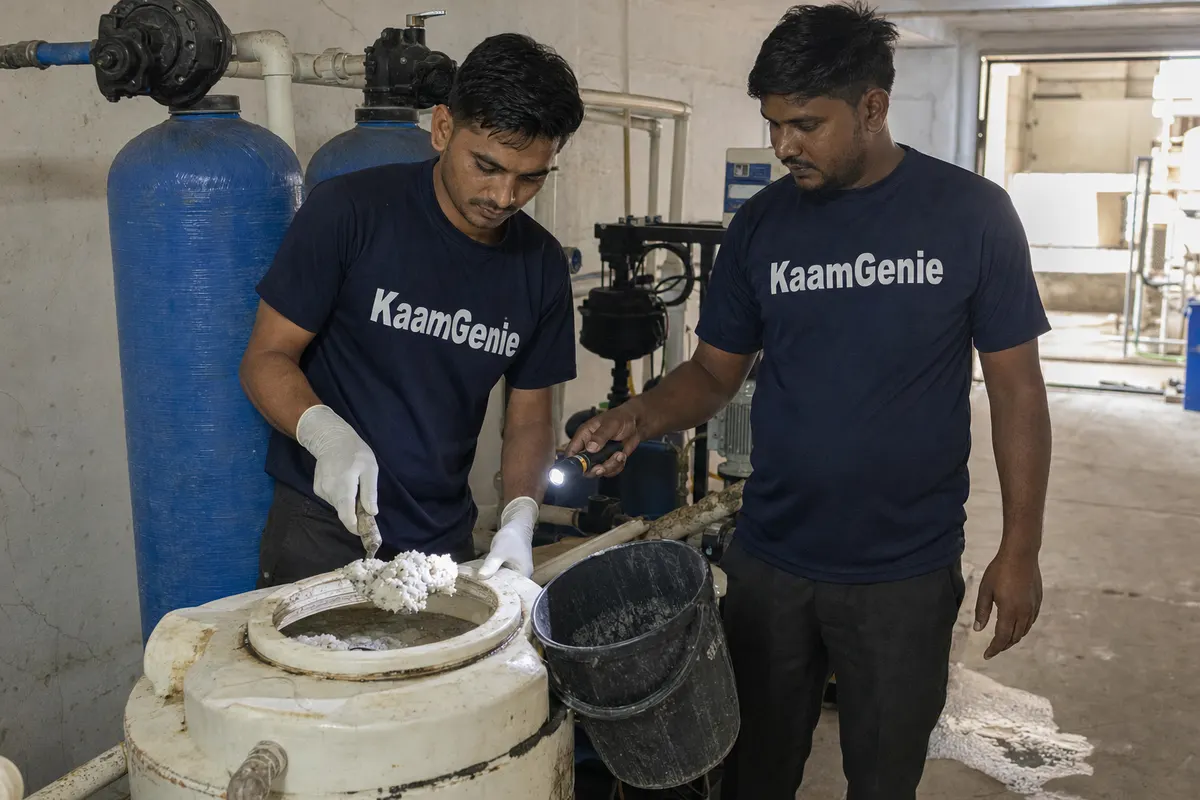
- Who does what: KaamGenie cleans the brine tank, the raw-water sump and the tanks downstream. Resin replacement, valve settings and plant repair stay with your softener vendor.
A softener swaps hardness minerals, it does not lower TDS or make water safe to drink by itself.
Softener plant struggling?
We clean the brine tank, the raw-water sump feeding the plant and the soft-water tanks after it. Society plants are quoted by size, with a fixed price agreed before the crew begins.
Groundwater in much of Gurugram district is hard. The Central Ground Water Board reports for the district show high mineral content in many blocks, and anyone who has lived in a borewell-fed tower knows the result: white crust on taps, geyser elements furred up, and showerheads that need soaking every few weeks. A central softener plant is the usual answer in group housing. It works well when it is looked after. When it is not, the society keeps paying for salt and service visits and still gets hard water. If you are new to the topic, our post on why Gurgaon’s hard water scales tanks covers the basics.
Three vessels that people confuse
In a typical society plant room you will see two or three tall blue or grey cylinders, a squat plastic tank full of salt, and pipes running to and from the underground sump. Facility staff and residents often call all of it “the softener tank”. They are very different things.
| Vessel | What it does | What goes wrong | Who looks after it |
|---|---|---|---|
| Resin vessel (pressure vessel) | Holds ion-exchange resin beads that swap calcium and magnesium for sodium as water passes through | Resin coated by iron and silt, worn out over time, or not regenerating | The softener vendor |
| Brine tank (salt tank) | Holds salt and water; the plant draws this brine through the resin to recharge it | Salt crust (bridging), grey sludge on the floor, dirt and debris dropped in with the salt | Facility team for salt; KaamGenie for cleaning |
| Pre-filter (if fitted) | Usually a sand or multigrade filter that holds back silt before the softener | Choked by sump silt, needs backwashing or new media | The vendor or plant operator |
| Raw-water sump | Stores borewell, tanker or GMDA water before treatment | Silt, iron sludge and debris on the floor, pumped straight into the plant | KaamGenie for cleaning |
| Soft-water and overhead tanks | Store softened water for the towers | Less scale, but silt, dust and bio-film still build up | KaamGenie for cleaning |
Layouts vary. Some societies soften everything, some soften only the borewell line, and some add carbon filters or an RO stage for the kitchen supply. Ask your vendor for a simple line diagram of your plant; it saves a lot of guesswork later.
How the softener actually works, in plain words
The resin beads hold sodium. As hard water runs through, they grab calcium and magnesium and let sodium go. After a set volume of water, the beads are full of hardness minerals and must be recharged. That is regeneration: the control valve backwashes the resin, draws strong salt water from the brine tank through it, then rinses it. The salt pushes the hardness minerals off the beads, they go to drain, and the beads are ready again.
Two things follow. First, the softener is only as good as the brine it gets: no brine, no regeneration, and the resin quietly stops softening. Second, softening swaps one mineral for another, so the total dissolved solids stay roughly where they were. A TDS meter will not show a softener working; a hardness test will. Our guide to TDS readings in Gurgaon explains why the two numbers tell different stories.
What goes wrong in the brine tank
Salt bridging
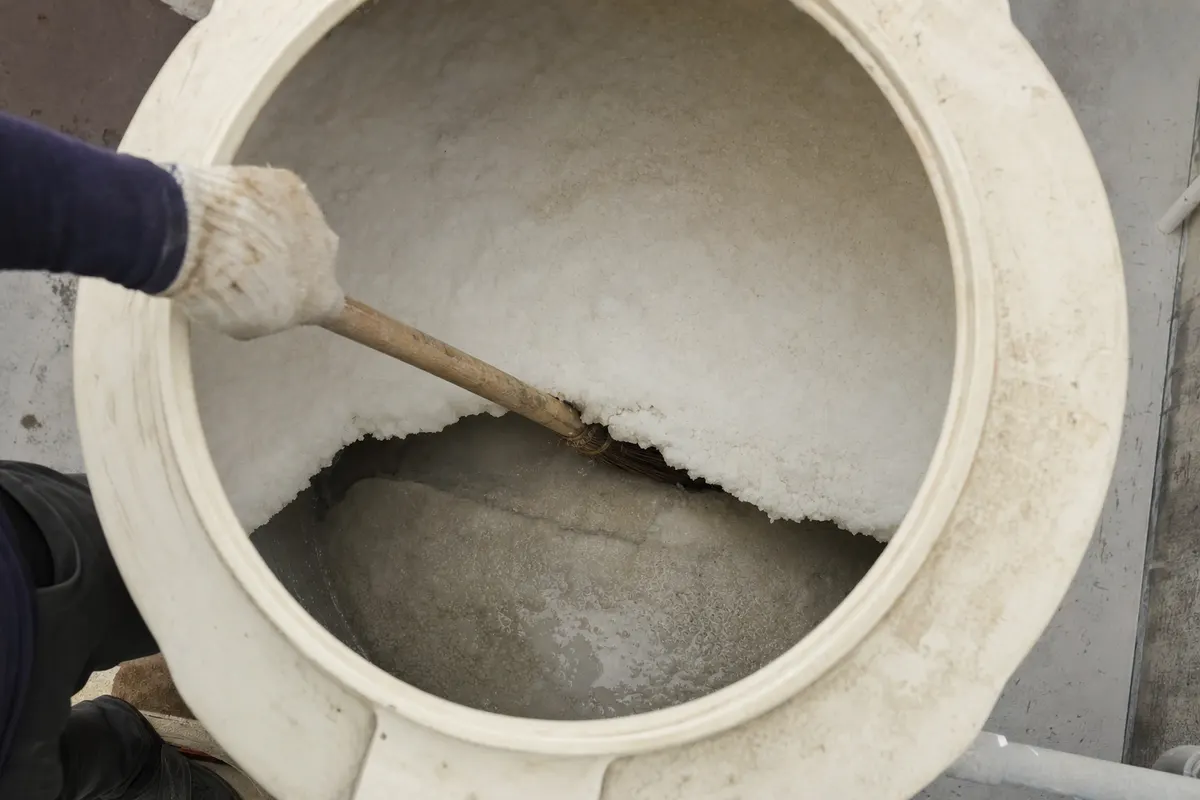
Salt sitting in a damp, warm plant room can fuse into a hard crust a little above the water line. The salt below dissolves and is used up, the crust stays put, and a hollow forms underneath. From the top, the tank looks full, so nobody adds salt and nobody suspects anything. Meanwhile the water under the crust is weak or plain, and each regeneration does little. The first sign is usually residents saying the scale is back. Gurgaon’s humid monsoon months and hot plant rooms in summer make bridging more likely.
Salt sludge, or mushing
Low-grade salt carries insoluble grit and clay. Over months it settles as a grey, pasty layer on the floor of the brine tank, and fine salt can recrystallise into a mush with it. That layer can block the brine well or the pickup at the bottom, so the plant cannot draw brine even when there is plenty of salt. Using the salt your vendor recommends, usually a purer softener-grade salt, reduces the problem but does not end the need to clean the tank.
Dirt dropped in with the salt
Salt bags are often opened on the plant-room floor and tipped in. Over time, bits of bag, dust, leaves from the doorway and the odd cockroach end up in the brine. Our crews regularly find this kind of debris when brine tanks in basement plant rooms are emptied, because the lid is lifted often and the room is rarely swept. None of it helps the brine pickup.
Clean the whole line in one visit
Brine tank, sump and overhead tanks done together, with before and after photos of each on WhatsApp. The society pays after the work, once the photos are in.
A ten-minute brine tank and softener check
Facility staff can do this on a weekday morning without opening any valve or touching the control head. If anything is unclear, stop and call the vendor.
- Lift the brine tank lid and look at the salt surface. It should be loose and grainy. A smooth, hard top is a warning.
- Press gently with a broom handle. If it meets a firm crust and then drops into a gap, you have a salt bridge. Break it gently from the top; never strike the tank wall or the brine well.
- Look for water. In most systems you should see or reach water some way below the salt. Your vendor will tell you the right level for your plant.
- Check the bottom with a torch. A thick grey layer or floating debris means the tank needs emptying and cleaning.
- Test hardness at two points. Use a hardness test kit on water straight from the sump and on water from a soft-water tap. If the two readings are close, the softener is not doing its job.
- Look at the raw-water sump. Torch from the manhole, never by leaning in. If you see silt, an orange iron layer or debris on the floor, the plant is being fed dirty water.
Write down what you find with the date. A one-page log helps the vendor and the committee see whether problems line up with salt deliveries, a tanker-heavy month or a skipped sump clean.
Why a dirty sump upstream ruins a good softener
The softener sits downstream of the raw-water sump, so it gets whatever the sump pump picks up. When the sump floor carries a layer of tanker silt, borewell iron and fine sand, three things happen.
- The pre-filter clogs faster. It needs more frequent backwashing, and fine silt can slip through to the softener.
- Iron coats the resin. Dissolved and settled iron from borewell water can foul resin beads, so they hold less hardness and regenerate less fully. The vendor then sees a resin that looks tired well before its time.
- Pressure drops across the plant. Silt packing the resin bed restricts flow, which shows up as weaker supply in the towers and longer pump hours.
Hard borewell water adds a further load. The harder the incoming water, the sooner the resin fills up and the more often it must regenerate, which means more salt and more chances for the brine tank problems above. In towers that mix borewell and tanker water, the hardness can also change from week to week; our guide to borewell water tanks in Gurgaon explains what borewell water leaves behind. Cleaning the raw-water sump will not soften anything, but it takes away the silt and settled iron that make the softener’s job harder. For how big society sumps are drained in sections, see our underground sump and reservoir guide.
How KaamGenie cleans around a softener plant
We work on the vessels that store water and brine, never on the resin vessel or the control valve. The sequence matters more than any single step.
- Raw-water sump first. The inlet is shut, the sump is drained, and the silt and iron sludge on the floor are scooped and vacuumed out, so none of it is pumped on into the softener plant. Then it is scrubbed, jet-washed, wet-vacuumed and rinsed.
- Brine tank, with the plant on bypass. Your vendor or plant operator puts the softener on bypass or pauses regeneration. We then empty the old salt and brine, lift out the sludge and debris, scrub and rinse the tank, and leave it ready for the operator to refill with salt and water to the vendor’s level.
- Soft-water and overhead tanks last. Softened water still leaves silt and bio-film over time, and once the upstream line is clean, the tower tanks are cleaned so they refill with better water.
The full process for each tank, from inlet shut-off to before and after photos, is in our Gurgaon cleaning process guide. A standard clean uses no chemicals; disinfection of the storage tanks is available on request. If the society needs a record of the work, a cleaning certificate is available on request.
What cleaning can and cannot do
| Symptom | Cleaning helps? | Also needed |
|---|---|---|
| Hard water returns, salt tank looks full | Yes, if a salt bridge or sludge is blocking brine | Vendor to check the regeneration cycle once the tank is clean |
| Grey mush or debris in the brine tank | Yes, emptied and cleaned | Switch to the salt grade your vendor recommends |
| Pre-filter choking every few days | Yes, cleaning the sump removes the silt load | Operator to backwash or renew filter media |
| Orange tint and stains, resin fouling suspected | Partly: settled iron removed from the sump | Water test for iron; vendor to clean or replace resin, iron filter if needed |
| Softener leaking, valve not cycling | No | The softener vendor or a plumber |
| Resin beads in the soft-water tank | We remove them from the tank | Vendor to check the resin vessel for a broken internal part |
| High TDS | No; a softener does not lower TDS either | RO for drinking water, or blending with a softer source |
Villas and kothis with their own softener
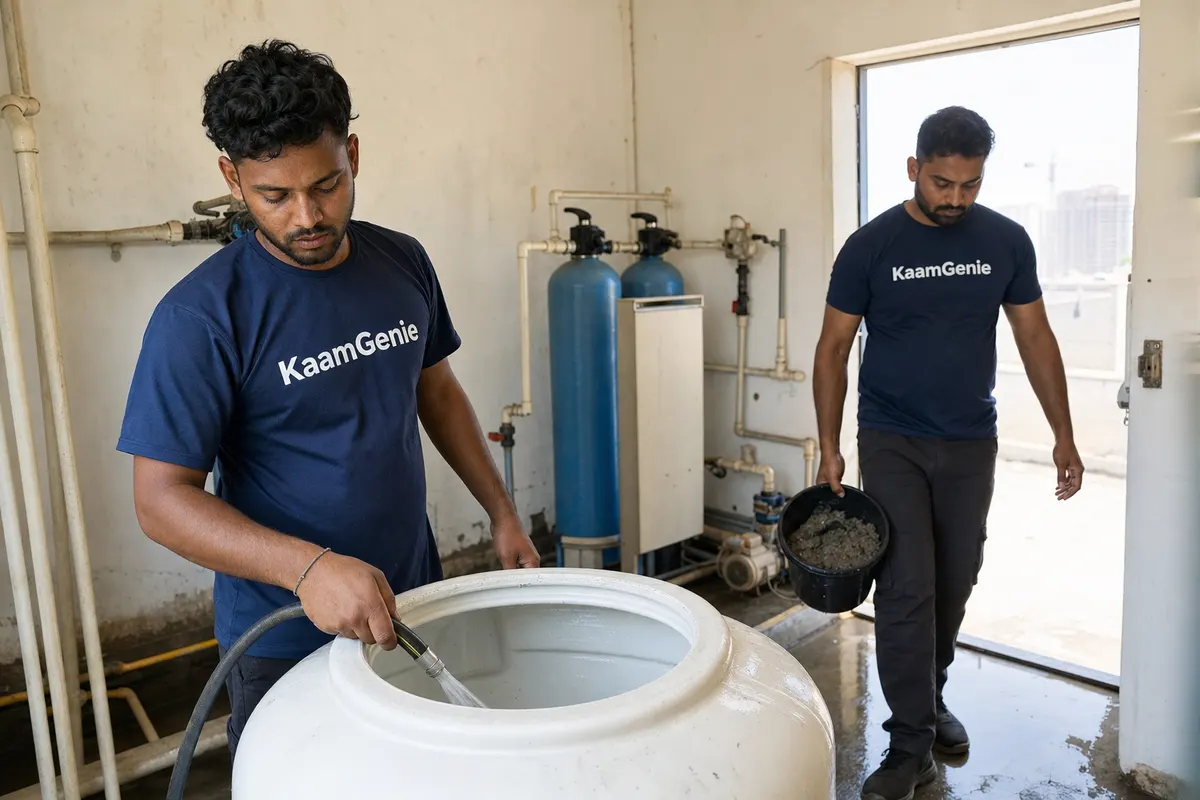
Large houses in plotted sectors and farmhouses often run a smaller softener on the borewell line, with its own brine tank. The same rules apply on a smaller scale: the brine tank bridges and sludges, and a silted underground sump shortens resin life. These setups are often forgotten because there is no facility team, so the owner only notices when the geyser starts scaling again. We clean the house sump, the brine tank and the rooftop tanks together; our villa tank cleaning guide covers the rest of the house.
Timing and the bigger schedule
For drinking and bathing water tanks, we recommend a clean every 3 months. Hard, borewell-heavy supply is one of the reasons: even softened water carries silt into the tower tanks, and the raw-water sump collects it fastest. How often to clean your tank explains the reasoning. The brine tank can be cleaned in the same visit as the sump, so the plant is offline only once. For planning across towers, the RWA and society guide and the complete Gurgaon tank cleaning guide are good starting points.
What not to do
- Do not add bleach or any other cleaning liquid to the brine tank. It goes straight through the resin and can damage it. Ask the vendor about resin cleaning products and how they are used.
- Do not hammer a salt bridge from the side. Brine tanks are thin plastic and the brine well inside cracks easily. Break the crust gently from the top.
- Do not use rock salt or table salt unless your vendor approves it. Grit and anti-caking additives add to the sludge.
- Do not let anyone open the control valve except the vendor or a trained operator. Wrong settings can waste salt or stop regeneration altogether.
- Do not judge the softener with a TDS meter. Use a hardness test before and after the plant.
- Do not clean the softened tanks and skip the sump. The silt comes back with the next pump cycle.
Book the brine tank and sump together
Society plants, brine tanks and large reservoirs are quoted by size, so send us photos of the plant room, the brine tank and the sump manhole on WhatsApp or call +91 95603 66362. For flats and villas, an overhead tank is ₹699 and an underground sump is ₹1,499, both fixed before work begins. Sunday and weekend slots are available, which makes it easier to line up the vendor for the bypass. You see before and after photos of every vessel we clean, and payment is made after the work, once you have seen them. Coverage and booking for the city are on our Gurgaon water tank cleaning page; we work in group housing across Gurgaon, including Golf Course Extension, Sector 82 and Sohna Road.
Frequently asked questions
What is the difference between the brine tank and the softener tank?
The tall pressure vessel, often blue or grey, is the resin vessel: it holds ion-exchange beads and does the actual softening. The squat plastic tank next to it is the brine tank: it holds salt and water, and the plant draws that salt water through the resin to recharge it during regeneration. Residents often call both “the softener”. KaamGenie cleans the brine tank and the storage tanks around the plant; the resin vessel and its valve belong with the softener vendor.
Why is hard water coming through even though the salt tank is full?
A common reason is a salt bridge, a hard crust that forms above the water line so the tank looks full while the salt below has been used up. Without brine, the resin cannot regenerate and hard water passes straight through. Another reason is grey sludge blocking the brine pickup at the bottom. Check by pressing the salt gently with a broom handle. If the brine tank is clean and hardness is still high, ask the vendor to check the regeneration settings and the resin.
How does a dirty sump affect our society’s softener?
The softener gets whatever the sump pump draws up. Silt from tankers and settled iron from borewell water load the pre-filter, slip into the resin bed and coat the beads, so they hold less hardness and regenerate less fully. Flow through the plant can drop as well. Cleaning the raw-water sump does not soften the water, but it removes the silt and iron sludge that make the softener wear out sooner and need more vendor visits.
Do you replace softener resin or repair the plant?
No. Resin replacement, resin cleaning, control-valve settings, leaks and any repair to the plant stay with your softener vendor, because they know the equipment and its warranty. We clean the brine tank, the raw-water sump that feeds the plant and the soft-water and overhead tanks after it. If we find resin beads in a storage tank or a leak at the plant during the visit, we photograph it and tell you so the vendor can take a look.
Does a water softener reduce TDS?
No. A softener swaps calcium and magnesium for sodium, so the total amount of dissolved solids stays roughly the same and a TDS meter shows little change. To see whether the softener is working, test hardness on the raw water and on the softened water; IS 10500 puts the acceptable limit for total hardness at 200 mg/l and the permissible limit at 600 mg/l. If TDS itself is the concern, RO for drinking water or a softer source is the answer.
Is softened water safe to drink?
Softening does not remove germs, silt or most other contaminants, and it adds some sodium, so softened water is not automatically drinking water. Many societies use softened water for bathing and washing, with an RO unit in each kitchen. If residents drink from the soft-water line, have it tested by an NABL-accredited lab against IS 10500, and keep the storage tanks clean. Anyone on a low-sodium diet should ask their doctor.
How long is the softener offline when you clean the brine tank?
Cleaning the brine tank itself is a short part of the visit, but the plant needs to be on bypass while it is empty, and the operator then refills salt and water and lets fresh brine form before the next regeneration. Most societies do it in the same visit as the raw-water sump, so the plant is disturbed only once. Agree the bypass time with your vendor beforehand; we can work on a Sunday or weekend slot if that suits the facility team.
How much does softener brine tank and sump cleaning cost in Gurgaon?
Society plants, brine tanks and large underground reservoirs are quoted by size after we see photos or visit, and the price is fixed before work starts. For a flat or villa, an overhead tank is ₹699 and an underground sump is ₹1,499. There are no surprise extras for the cleaning itself; parts such as mesh or a new lid are quoted separately. Payment is made after the cleaning, once you have seen the before and after photos.
Sources & references
- Bureau of Indian Standards (BIS): IS 10500:2012, the drinking water standard, including limits for total hardness and TDS.
- Central Ground Water Board (CGWB): groundwater quality reports for Haryana, including hardness and mineral content in Gurugram district.
- CPHEEO Manual on Water Supply and Treatment: the Government of India's engineering manual covering water treatment, softening and storage.
- NABL: the accreditation body for testing labs, useful for finding a lab to test hardness and other parameters.
Last verified: 23 November 2026. If you find any of these links broken, please let us know.