
Quick answer
- What TDS is: the total amount of minerals and salts dissolved in water, in mg/l (a meter shows ppm, which is roughly the same).
- The Indian standard: IS 10500:2012 puts the acceptable limit at 500 mg/l and the permissible limit, where no better source exists, at 2,000 mg/l.
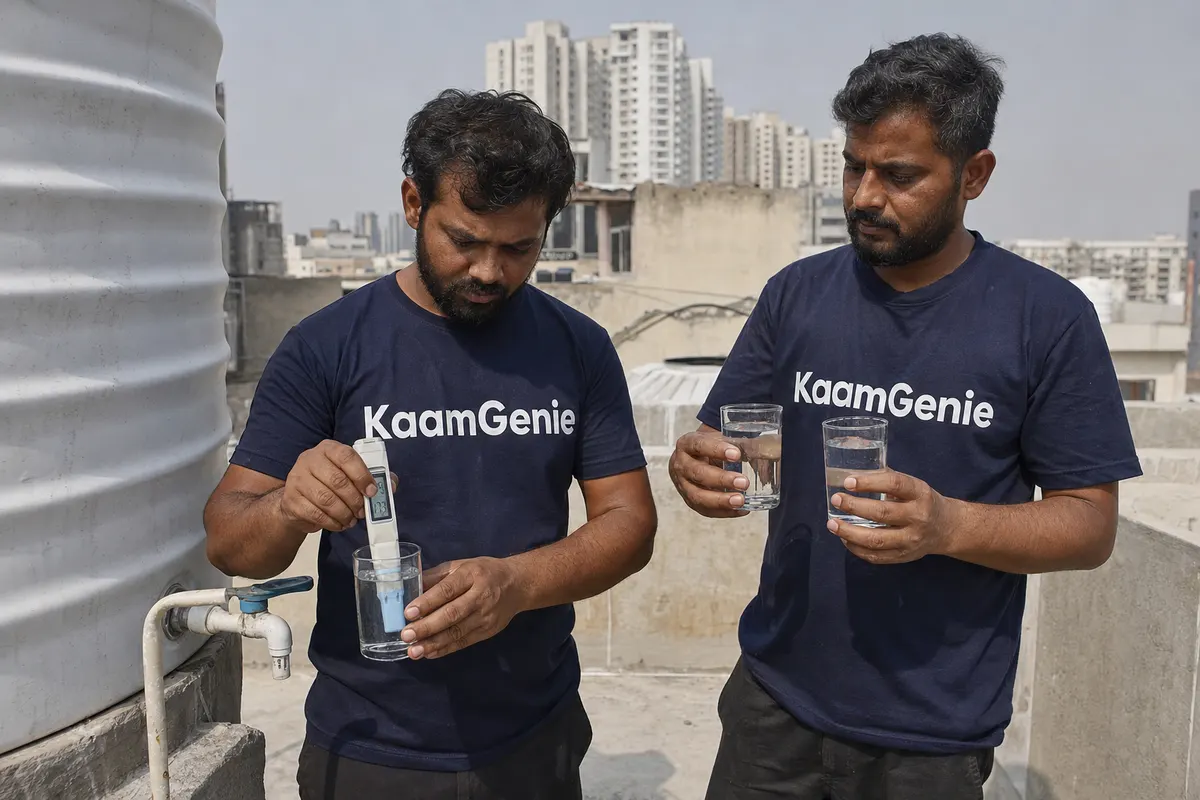
- Measure three taps: the direct supply or borewell, a tank-fed tap, and your RO output. The differences tell you more than any single number.
- What it does to your tank: high-TDS hard water leaves scale and mineral sludge, so tanks need cleaning sooner.
- What cleaning cannot do: lower the TDS of the water. Only RO, blending with a softer source, or a change of source does that.
A low TDS number does not mean water is safe: it says nothing about germs. Very low is not automatically better either.
High TDS leaving scale in your tank?
High-TDS scale scrubbed out of an overhead tank from a fixed ₹699, a sump from ₹1,499. You pay once the before and after photos show the crust gone.
Gurgaon homes get water from three very different sources: GMDA’s treated canal supply, private borewells, and tankers that are themselves usually filled from borewells. Groundwater in much of the district is hard and mineral-rich, so the TDS of your tap water depends heavily on which of those sources is filling your tank on a given week. That is why two neighbours can get very different readings, and why your own number can change. We explain the sources in Gurgaon’s water supply explained. This post is about the number itself and what it means for the tank on your roof. In newer sectors such as Sector 109, where tanker and borewell water often fill the gaps in piped supply, our crews often find a thick white scale crust on tank floors and walls.
What TDS measures, and what it does not
Total dissolved solids are everything dissolved in the water: calcium, magnesium, sodium, potassium, bicarbonates, sulphates and other minerals, mostly picked up from rock and soil. So deep groundwater reads higher than treated surface water.
A handheld TDS meter does not measure those substances directly. It measures how well the water conducts electricity, which rises with dissolved salts, and converts that into an estimate. That makes it useful for comparing samples, but it has limits you should know:
- It does not detect bacteria or viruses. Water with a perfect-looking TDS can still carry germs from a dirty tank.
- It does not see silt, rust flakes or sludge. Those are suspended, not dissolved, and are measured as turbidity in a lab.
- It does not identify which minerals are present. Two waters with the same TDS can have very different hardness, iron, fluoride or nitrate levels.
So TDS is a good indicator of how mineral-heavy your water is, and therefore how much scale it will leave. It is not a safety test. For safety you need a lab report.
How to measure TDS at home: three taps, three numbers
One reading from one tap is a common mistake. Take three on the same day to learn where your water’s minerals come from and whether the tank is changing anything.
- Prepare the meter and glasses. Calibrate the meter if it allows, test every sample at room temperature, and rinse each glass twice with its own sample first.
- Sample A, the source. Fill from a tap on the direct GMDA line, or on the borewell pump outlet if that is your source. Let it run for a minute first.
- Sample B, the tank. Fill from a tank-fed tap, ideally one close to the tank, such as a top-floor bathroom tap.
- Sample C, the purifier. Fill from your RO or purifier outlet, if you have one.
- Dip and wait. Hold the probe in the water without touching the glass, stir gently, and note the number once it stops changing. Rinse the probe each time.
- Write down the date and the source that filled the tank that week: GMDA, borewell, tanker or a mix. Readings mean more over time.
Reading the three numbers together
- Tank reading close to source reading: normal. Storage does not change TDS much.
- Tank reading clearly higher than today’s source: the tank still holds older, harder water, often from a tanker or borewell fill, mixed with today’s supply. It can also mean a mineral-heavy sludge layer is in contact with the water.
- Tank reading lower than the source: the tank was last filled from a softer source, such as GMDA water after a run of borewell or tanker water.
- Readings jumping around from week to week: your home is switching between sources.
What your reading means against IS 10500:2012
The Indian Standard for drinking water, IS 10500:2012, sets two TDS limits. The acceptable limit is 500 mg/l. The permissible limit, which applies only where no better source is available, is 2,000 mg/l. TDS above 500 is mostly a question of taste, scale and suitability rather than an immediate health danger, but the minerals behind it matter, so high readings deserve a proper test.
| Your reading | What it suggests | What to do |
|---|---|---|
| Up to 500 mg/l | Within the acceptable limit of IS 10500 | No treatment needed for TDS alone; keep the tank clean and test for germs if in doubt |
| 500 to 2,000 mg/l | Above acceptable, within permissible: hard taste, noticeable scale | Get a lab test for hardness and other minerals; consider RO for drinking water |
| Above 2,000 mg/l | Beyond the permissible limit | Do not use for drinking without treatment; get a full lab test and look for a better source |
| Very low RO output | Most minerals stripped out | Ask your purifier technician whether the mineral or TDS setting suits your family |
| Tank reading well above source | Old hard water or mineral sludge in the tank | Drain and clean the tank, then re-test after a fresh fill |
A meter reading is only a guide. If you are making a decision about health or about buying equipment, have a sample tested at an NABL-accredited lab and ask for TDS, total hardness, pH, iron, fluoride, nitrate and coliform. Compare the report with IS 10500 or ask the lab to do it for you.
Why high-TDS water fills your tank with scale and sludge
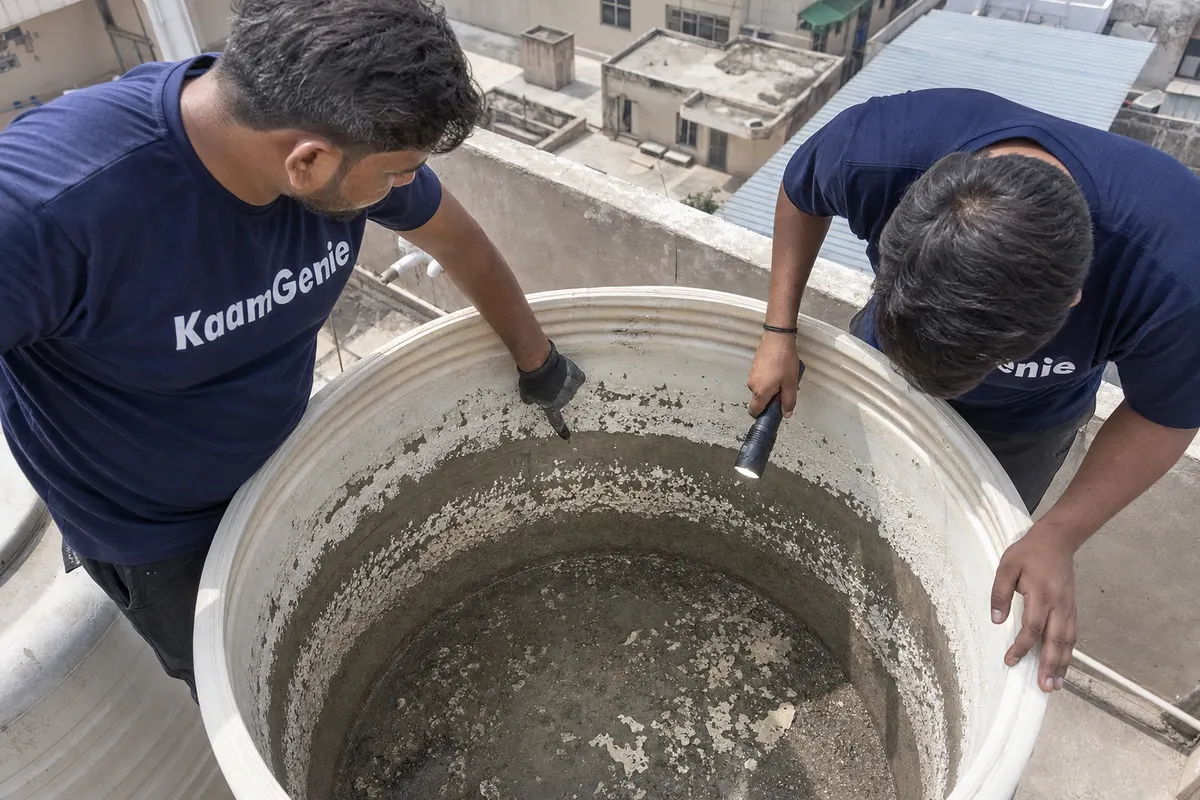
A large share of the TDS in Gurgaon’s groundwater is calcium and magnesium, the minerals that make water hard. When hard water sits in a tank in summer heat, and every time the level rises and falls, some of those minerals come out of solution and stick to the walls as scale, the white or grey crust you see near the waterline. More settles on the floor, where it binds with silt, rust and organic matter into a heavy grey sludge.
The higher the hardness, the faster this happens. Scale is rough, so it gives bio-film and bacteria a sheltered surface, and the sludge layer grows into the outlet and slows the flow. That is why borewell- and tanker-fed tanks usually look worse at cleaning time. Hardness and TDS are related but not identical; a lab test tells you which you have. Our guide to hard-water tank cleaning in Gurgaon goes deeper into scale, and if a borewell is your main source, see borewell water tank cleaning in Gurgaon.
What tank cleaning can and cannot do
People sometimes ask us to “bring the TDS down” with a cleaning. It cannot.
| Cleaning can | Cleaning cannot |
|---|---|
| Remove the scale crust from walls and floor | Lower the TDS of the water coming into the tank |
| Remove mineral sludge, silt and rust from the floor | Make hard water soft |
| Clear the outlet so flow and pressure recover | Remove dissolved fluoride, nitrate or salts |
| Remove the surfaces where bacteria shelter | Stop new scale from forming after the next fill |
| Usually bring the tank reading back in line with the source reading | Replace a lab test or a purifier |
So the right expectation is: after a cleaning, your tank water should usually read about the same as your source water, the tank is free of scale and sludge, and germs have far fewer places to live. The TDS itself is decided by your source. Timing depends on how hard your water is; see how often to clean a water tank in Gurgaon rather than a fixed rule.
When an RO or a softener actually matters
- RO for drinking and cooking water. If your drinking water is consistently above 500 mg/l, or a lab report shows high fluoride, nitrate or salts, a point-of-use RO purifier at the kitchen tap is the practical answer. It treats only the water you drink, not the whole house. Our comparison of tank cleaning and a water purifier explains why you need both.
- A softener for scale across the house. If scale on taps, geysers and bathroom tiles is the main problem, or the family links dry hair and skin to the bathing water (see tank water, hair fall and skin in Gurgaon), a whole-house softener on the inlet line reduces hardness. It swaps calcium and magnesium for sodium, so it does not lower TDS, and softened water is not meant to replace RO water for drinking.
- A better source. In homes that mix GMDA, borewell and tanker water, filling the tank from the softest available source whenever possible makes a bigger difference than any gadget.
TDS myths we hear in Gurgaon
- “Lower TDS is always better.” Not true. Water stripped of almost all minerals tastes flat, and the WHO has noted that very low-mineral water is not ideal as a long-term sole supply. Many RO purifiers have a mineral or TDS controller for this reason. There is no single ideal number; ask your purifier technician.
- “Low TDS means the water is safe.” No. TDS says nothing about bacteria. Water from a dirty tank can read low and still carry germs.
- “A high reading means the tank is dirty.” Usually it means the source is hard. Compare the tank reading with the source reading before blaming the tank.
- “Boiling reduces TDS.” Boiling kills germs, but the minerals stay behind, so TDS stays the same or rises slightly.
- “Adding something to the tank will fix the TDS.” Do not add powders, salts or tablets to a drinking-water tank yourself. Nothing poured into a tank removes dissolved solids.
Confused by your readings?
Send us your three TDS numbers and a photo inside your tank on WhatsApp. We will tell you honestly whether the tank needs cleaning or whether the answer lies elsewhere.
Who controls your source, and what to ask for
Your building type decides one thing here: who chooses the water that goes into the tank, and so who can change your TDS.
A shared reservoir (condominiums and societies). Your flat’s reading reflects whatever the facility or maintenance team pumped into the common underground reservoir that week: GMDA water, tanker top-ups, a society borewell, or a mix. You cannot change that from your flat, but you can ask the office for the most recent lab report on the reservoir water, ask whether a central softening plant exists and when it was last serviced, and ask to be told when the source changes.
Your own borewell (plotted houses and many builder floors). Here the owner controls the source, and a private borewell is often the hardest water in the house. A full lab test of the borewell, not just a meter reading, is the starting point for any decision on RO or a softener. If the floor also gets GMDA supply, filling the tank from it whenever it runs is the cheapest way to lower the tank reading. Our guide to borewell water and your tank covers the rest.
Tankers (newer towers and tanker-fed homes). Readings swing most where tankers do the filling, because each tanker may come from a different borewell. Note the reading after each delivery, and ask the supplier or the facility team where the water is drawn from. Our guide to tanker water and your Gurgaon tank explains why tanker-fed tanks also scale faster.
For how each kind of property is cleaned in general, see the complete guide to water tank cleaning in Gurgaon.
What changes in the clean when the water is hard
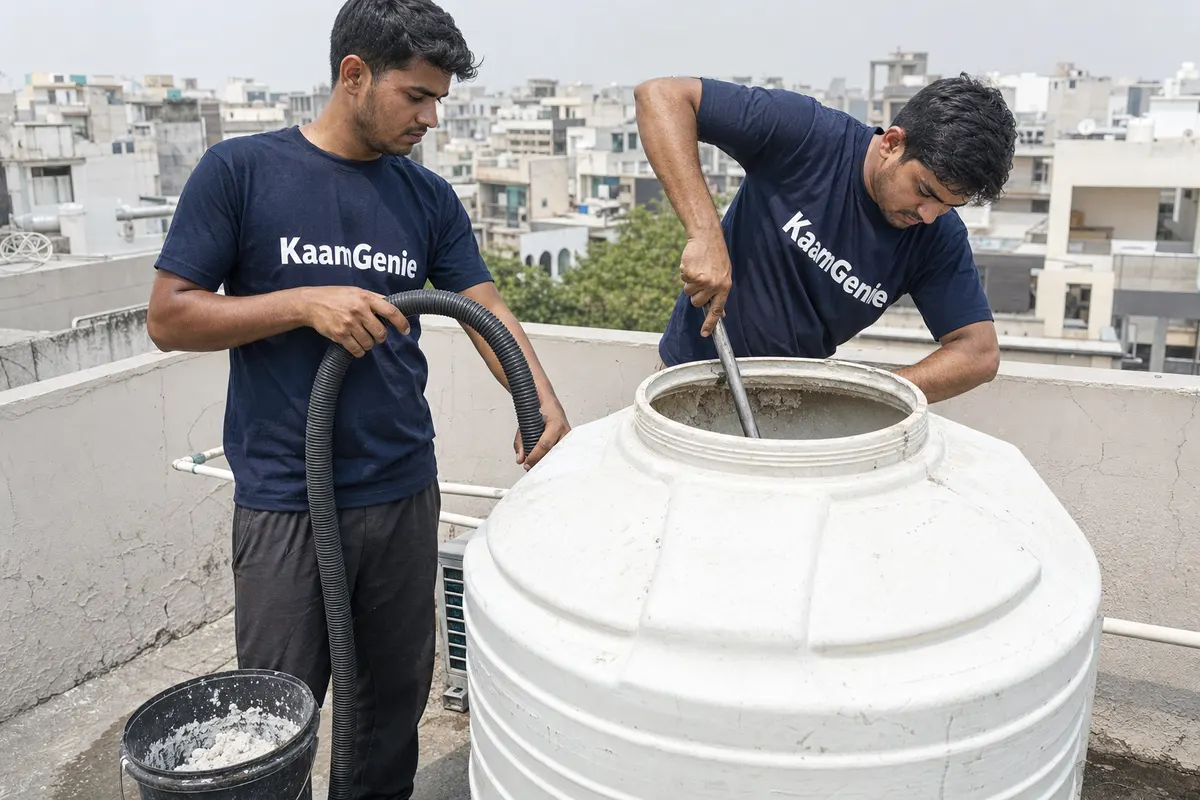
Our clean follows the same standard sequence on every tank, set out step by step in the Gurgaon cleaning process guide. On a tank fed by hard, high-TDS water, three parts of it do most of the work:
- Getting the mineral sludge out first. The heavy grey layer on the floor is scooped and wet-vacuumed out and carried away, never flushed into drains, before any scrubbing starts, so loosened scale does not mix back into it.
- Scrubbing the waterline band. Scale is thickest where the level rises and falls. That band gets the longest scrub, and the scrub removes loose scale; very old, rock-hard deposits may lighten rather than vanish completely.
- Rinsing until the floor runs clear. Fine white flakes hide in corners and around the outlet, so the jet wash and wet-vacuum continue until the rinse water carries no grit.
Scale from hard water comes off with brushes and scrapers, so no descaling agent goes in as standard; for very heavy scale a food-grade descaler, like disinfection, is used only if you ask. You get before and after photos on WhatsApp, and the useful check afterwards is your own: re-test the tank tap against the source tap once the tank has refilled. The two readings should now be close.
What not to do
- Do not judge your water’s safety by TDS alone. Get a lab test if anyone is unwell, and see a doctor.
- Do not set your RO to the lowest possible output on the belief that lower is healthier.
- Do not pour descaling powder, salt or acid into the tank yourself. It does not lower TDS and can make the water unsafe.
- Do not pay for a “TDS-reducing” tank cleaning. No cleaning does that, and anyone who promises it is not being straight with you.
Getting the scale out of your tank
If your three readings point to hard water rather than a dirty source, the tank is worth cleaning even when the meter shows a number inside the limit. Hard-water tank cleaning in Gurgaon reaches homes in Sector 57 and beyond. Scale removal from an overhead tank starts at ₹699 and from an underground sump at ₹1,499, fixed before work starts and paid after the clean, once you have seen the photos. Send your three readings on WhatsApp or call +91 95603 66362, and we will tell you whether the tank or the source is the real issue. Prefer Hindi? Read borewell ke hard water se tanki me scale.
Frequently asked questions
What is a good TDS level for drinking water in Gurgaon?
IS 10500:2012 sets 500 mg/l as the acceptable limit for TDS, and 2,000 mg/l as the permissible limit where no better source is available. Water within 500 mg/l is fine on TDS grounds, but that number says nothing about germs, so a clean tank and, if in doubt, a coliform test still matter. There is no single ideal figure below 500; very low-mineral water is not automatically better.
Why is my tank water TDS higher than my supply water?
Usually because the tank still holds older water from a harder source, such as a borewell or tanker fill, mixed with the newer supply. A thick layer of mineral sludge in contact with the water can also nudge the reading up. Drain and clean the tank, refill it from your usual source, and test again: the tank reading should then sit close to the source reading.
Will water tank cleaning reduce TDS?
No. TDS is the amount of minerals dissolved in the water, and cleaning the tank does not change what is dissolved in the water you put into it. What cleaning does is remove the scale and sludge those minerals have left behind, clear the outlet, and take away surfaces where bacteria live. To lower TDS for drinking, you need an RO purifier, a softer source, or a change of supply.
How accurate is a home TDS meter?
A handheld meter estimates TDS from electrical conductivity, so it is good for comparing samples and spotting changes, but not as precise as a lab. Keep the probe clean, rinse it in each sample, calibrate it if your meter allows, and test all samples at the same temperature. For decisions about health or buying equipment, have the water tested at an NABL-accredited lab and compare the report with IS 10500.
Is very low TDS water from an RO bad for health?
Water with almost all minerals removed tastes flat, and the WHO has noted that very low-mineral water is not ideal as a long-term sole drinking supply. That is why many RO purifiers include a mineral or TDS adjuster. If your RO output reads very low, ask your purifier technician whether the setting suits your family, and speak to a doctor about any specific health concern rather than chasing a number.
Does a water softener lower TDS?
No. A standard ion-exchange softener replaces the calcium and magnesium that cause hardness with sodium, so the total dissolved solids stay about the same. What it does is cut scale on taps, geysers, tiles and inside the tank. Softened water is not a substitute for RO water for drinking; many homes use a softener for the whole house and an RO only at the kitchen tap.
Why does high TDS water make my tank dirty faster?
Much of the TDS in Gurgaon groundwater is calcium and magnesium. As hard water sits and warms in the tank, some of these minerals come out of solution as scale on the walls and settle on the floor, where they combine with silt and rust into heavy sludge. That rough surface shelters bio-film, and the sludge creeps towards the outlet, which is why hard-water tanks need cleaning sooner.
How much does it cost to clean a hard-water tank in Gurgaon?
A hard-water clean is priced from ₹699 for an overhead tank and from ₹1,499 for an underground sump. A thick mineral crust takes longer to scrub, yet the figure agreed upfront does not move, and you pay only when the job is done and the before and after photos are on your WhatsApp. High-TDS tanks get no descaler or other chemicals as standard; a food-grade descaler or disinfection is used only if you ask.
Sources & references
- Bureau of Indian Standards (BIS): IS 10500:2012 sets TDS at 500 mg/l acceptable and 2,000 mg/l permissible, and total hardness at 200 and 600 mg/l.
- WHO Guidelines for Drinking-water Quality, 4th edition: guidance on total dissolved solids, hardness and the taste of drinking water.
- Central Ground Water Board (CGWB): groundwater quality information for Haryana, including salinity and hardness in Gurugram district.
- National Accreditation Board for Testing and Calibration Laboratories (NABL): directory of accredited labs for drinking-water testing.
Last verified: 22 November 2026. If you find any of these links broken, please let us know.