
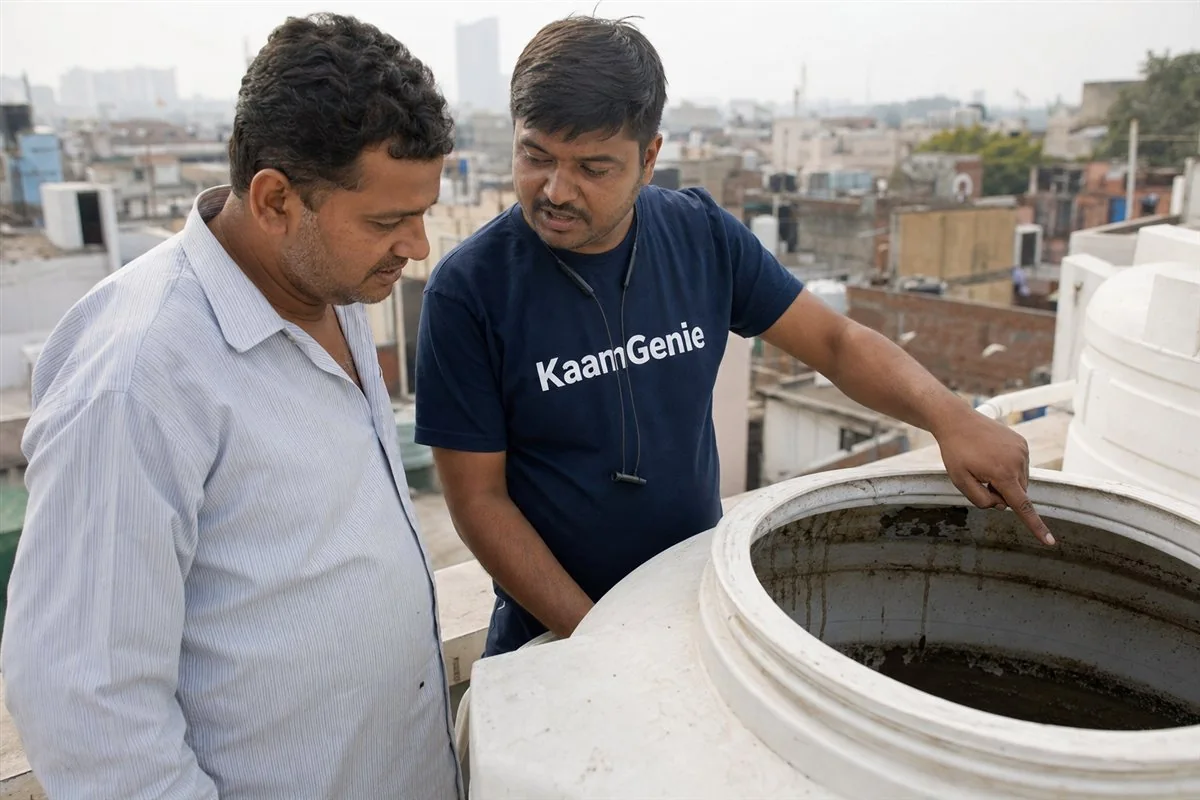
The 7 mistakes in plain English
- Top-rinse-only “cleaning” — spraying water down from the top instead of draining and scrubbing
- Skipping disinfection — a scrubbed tank that was never chlorinated is not a safe tank
- Using acid or washing powder — harsh, non-food-grade chemicals that damage the tank and your water
- Ignoring the underground sump — cleaning the rooftop tank while the dirty reservoir below re-contaminates it
- Unsafe confined-space entry — sending an untrained person into a sump with no checks
- Cleaning too rarely — once in two or three years instead of every six months
- Hiring an uninsured corner-cutter — no equipment, no certificate, no recourse
Avoid these seven and you’ve avoided 90% of the bad outcomes. The rest of this guide explains each one and the right way to handle it.
| # | The mistake | Why it’s risky | The right way |
|---|---|---|---|
| 1 | Top-rinse only | Leaves bottom sludge and bio-film untouched | Full drain, hand-scoop sludge, scrub all walls |
| 2 | No disinfection | Invisible bacteria survive a scrub-only job | Food-grade chlorine, 15–30 min contact time |
| 3 | Acid / washing powder | Damages tank, leaves residue in drinking water | Mild food-grade detergent only |
| 4 | Skipping the sump | Dirty reservoir re-pollutes the rooftop tank | Clean sump and overhead tank together |
| 5 | Unsafe entry | Low oxygen / gas in deep sumps can be fatal | Ventilation, harness, two-person crew |
| 6 | Cleaning too rarely | Half an inch of sludge builds before anyone looks | Every 6 months; 3–4 for tanker/borewell users |
| 7 | Uninsured corner-cutter | No equipment, no certificate, no recourse | Insured crew, photos and a written record |
Skip the guesswork — book a real cleaning
Full drain, scrub, jet wash, food-grade disinfection, before/after photos and a certificate. Anything short of this is a rinse. ₹699 onwards.
Mistake 1 — The top-rinse passed off as a “cleaning”
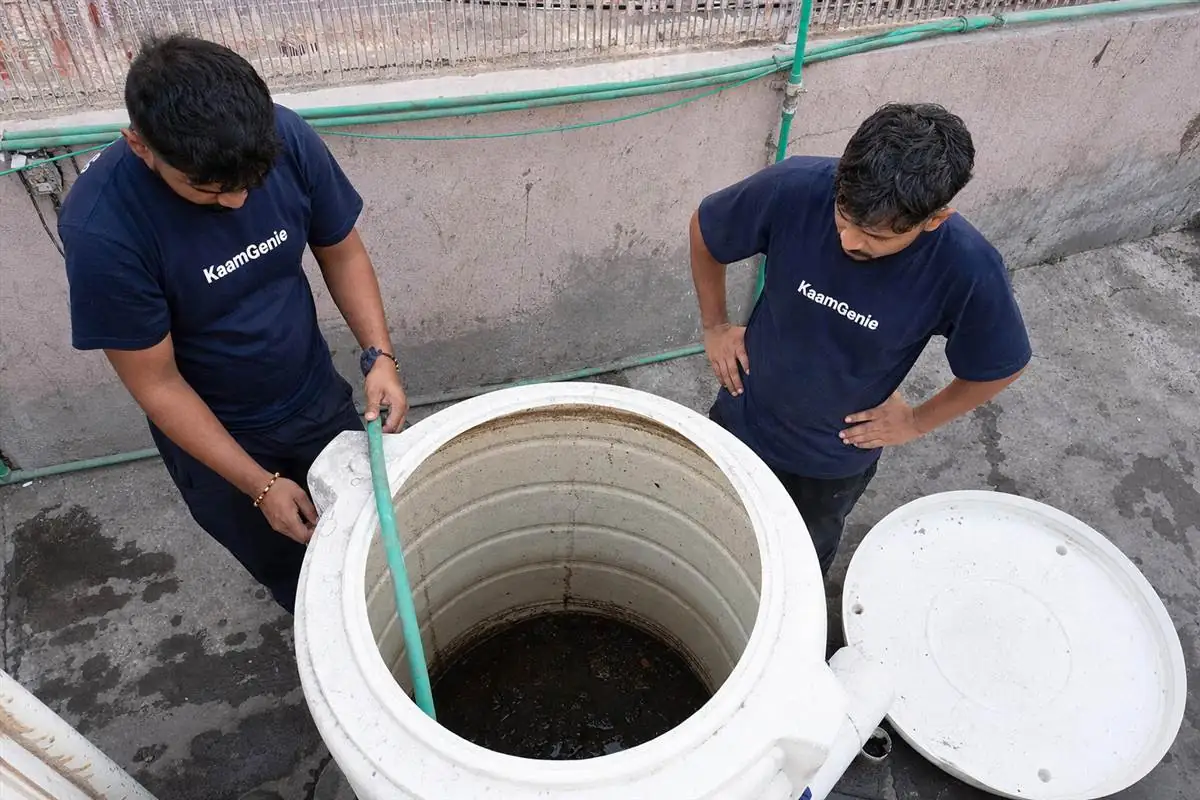
This is the most common mistake in Delhi, and the most expensive in disguise. A cheap operator turns up, opens the lid, sprays water down from above for a few minutes, swirls it around, drains it and declares the job done. Fifteen minutes, ₹200–300, off to the next house. It looks like cleaning because the inside is wet and the operator is sweating. It is not cleaning.
The contamination in a Delhi tank doesn’t float — it settles. Sand and grit from DJB pipes, rust, dead insects, dried algae and calcium scale form a bottom layer that a spray from the top never lifts. The slimy bio-film clinging to the walls survives untouched. So the water looks clear for a week, then the smell and the yellow tinge come back, and the family assumes the tank “gets dirty fast” when in truth it was never cleaned.
The right way: drain the tank fully, hand-scoop the bottom sludge into a bucket and carry it away, scrub every wall, the floor and the corners with food-grade brushes, jet wash, then wet-vacuum the residue out before refilling. If you want the stage-by-stage detail, we wrote a full breakdown of the water tank cleaning process. The test is simple: a real residential cleaning takes 75–90 minutes, not fifteen.
Mistake 2 — Skipping disinfection entirely
Even crews that do scrub often stop one step too early. They scrub the walls, the tank looks visibly clean, and they refill it — no disinfection. The problem is that the things which make stored water unsafe are invisible. Bacteria, coliform, and the bio-film that regrows within days don’t show up to the eye. A tank can sparkle and still make your family sick.
Disinfection is the step that actually kills those organisms. After scrubbing and vacuuming, food-grade sodium hypochlorite at roughly 50–100 PPM is applied to every interior surface and left in contact for 15–30 minutes before a final rinse. That contact time is non-negotiable — chlorine needs minutes, not seconds, to work. Skip it and you have a clean-looking tank that is microbiologically no safer than before. This is why a scrub-only job and a complete job can look identical at handover but behave very differently a week later.
A purifier at the kitchen tap does not rescue you here either: it treats the last litre, not the hundreds of litres sitting in a tank that bathes the whole family. Disinfection at the storage stage is what the WHO guidance on safe drinking water is built around.
Mistake 3 — Acid, washing powder and other harsh chemicals
Somewhere along the way the idea spread that a really dirty tank needs a really strong chemical — so out comes the hydrochloric (muriatic) acid, or a scoop of washing powder, or dish soap. All three are mistakes, and one is dangerous.
Acid does strip scale, but it also eats into RCC (concrete) walls and corrodes tank fittings, shortening the life of the tank. Handling it in a confined, poorly ventilated space is a genuine hazard. Washing powder and dish soap are not food-grade: they foam endlessly, are hard to rinse out, and leave a perfumed residue that lingers in your drinking water for days. None of these belong anywhere near a potable-water tank.
The correct chemistry is boring on purpose. Scrub with a mild food-grade detergent, disinfect with food-grade sodium hypochlorite, rinse, done. That’s it. We go deeper into safe versus unsafe products in our guide to water tank cleaning chemicals in Delhi, but the one-line rule is: if it came off a general hardware-shop shelf and isn’t certified for potable water, it doesn’t go in your tank. The acceptable standards are the ones set out in BIS IS 10500 and by FSSAI.
Mistake 4 — Cleaning the overhead tank but ignoring the sump
Most Delhi buildings store water twice: an underground sump or reservoir that fills from the DJB line or a tanker, and an overhead tank that a pump lifts it into. People remember the rooftop tank because they can see it. The sump — dark, underground, out of sight — gets forgotten for years.
That’s a problem, because the sump is where water lands first and where the heaviest sediment settles. If you clean only the rooftop tank, the next pump cycle lifts dirty water straight out of a filthy sump and re-contaminates the tank you just paid to clean. You’ve treated the symptom and left the source. This is especially true across outer and unauthorised colonies where tanker water and borewell groundwater carry far more grit than treated DJB supply.
A complete job cleans both, in the right order — sump first, then the overhead tank, so the tank refills from a clean reservoir. Sumps are bigger, slower and riskier than rooftop tanks, which is exactly why corner-cutters skip them; we cover the real cost and safety considerations in our note on sump cleaning in Delhi.
Where a 15-minute “rinse” spends zero time — the steps that actually clean a tank
Minutes a real cleaning spends on a 1,000L overhead tank — the bars a corner-cutter skips entirely
A top-rinse spends close to zero minutes on every bar above — which is how the whole “job” fits into fifteen minutes. The contact time on disinfection is the step most often dropped first.
Mistake 5 — Unsafe confined-space entry into the sump
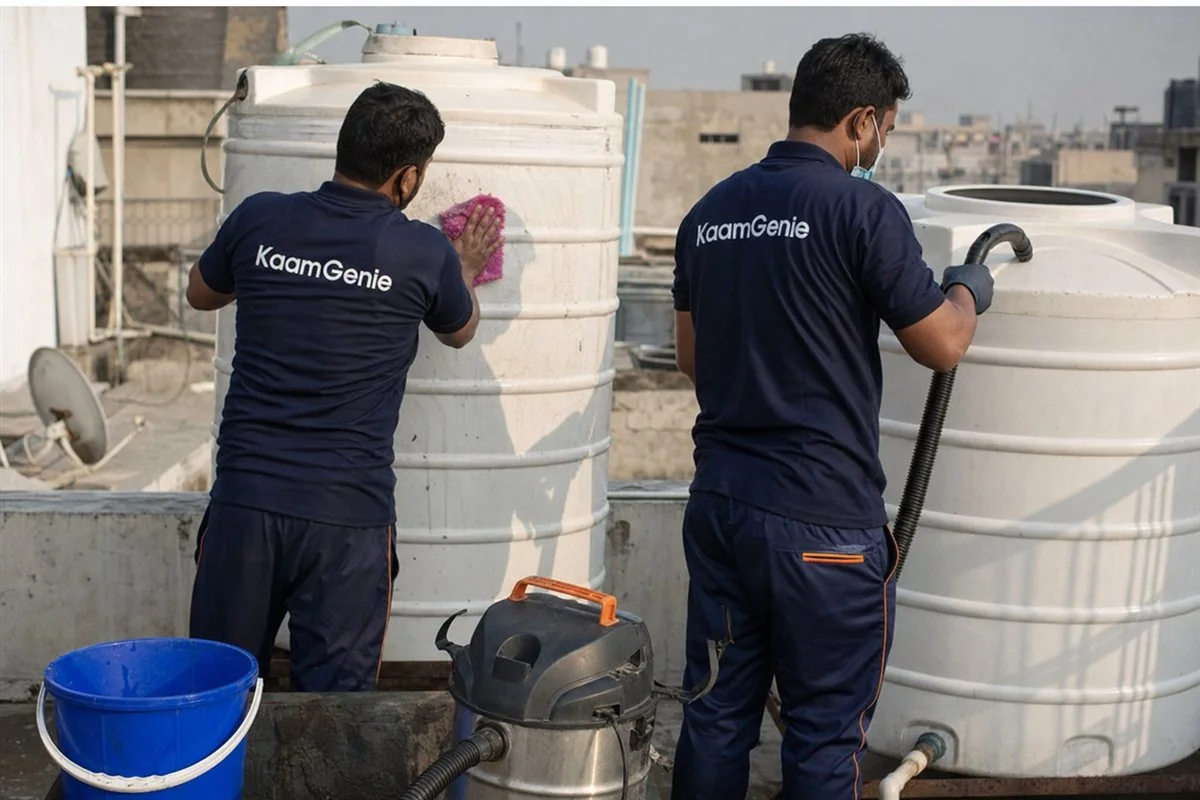
This one isn’t about water quality — it’s about a life. An underground sump that has been sealed and full for months can hold low oxygen or pockets of toxic gas at the bottom. People have died in India cleaning tanks and septic pits unsafely, often the “helper” sent down first with no checks. It is heartbreaking precisely because it is preventable.
A trained crew treats a sump as the confined space it is: ventilate it before anyone enters, never let one person work alone, keep a second person at the opening at all times, and use a safety harness for deep reservoirs. An untrained labourer with a bucket and no backup is not a saving — it’s a serious risk you’re carrying on your property. If a cleaner is casual about sending someone down a deep sump, that casualness tells you everything about the rest of their work.
Mistake 6 — Cleaning far too rarely
The cheapest mistake to fix and the easiest to make: leaving it too long. We routinely open Delhi tanks that haven’t been touched in two or three years and find half an inch of black sludge across the floor. By the time water looks or smells wrong, the build-up is already heavy, and one delayed cleaning can’t fully reverse what regular cleaning would have prevented.
For most Delhi homes, every six months is the sensible rhythm. Go more often — every three to four months — if you rely on tanker water during the summer crisis, draw borewell groundwater in an outer colony, live in a hard-water pocket, run a PG with heavy usage, or store water in a dark RCC underground tank where bio-film thrives. We lay out the full schedule in our guide to how often to clean a water tank in Delhi. The principle is simple: cleaning is cheap maintenance, not emergency repair — treat it that way and you never meet the half-inch of sludge.
Mistake 7 — Hiring an uninsured corner-cutter (and accepting no certificate)
The final mistake ties the rest together: choosing purely on the lowest quote. The operator who quotes ₹200 and finishes in fifteen minutes can only do so by skipping the very steps that matter — no equipment, no food-grade chemicals, no insurance, and no record at the end. If they crack an old plastic tank, damage a fitting, or someone is hurt in your sump, the liability lands on you.
The single best protection is to insist on a written cleaning record or certificate. It should list the date, the tank type and capacity, the chemicals used and the crew. For an RWA, that record is how you show flat owners the building is genuinely on a maintenance schedule; for a restaurant or food business, it’s what an FSSAI inspector expects to see. A cleaner who won’t hand over any record is usually a cleaner whose work wouldn’t survive one. To compare quotes properly — and spot the red flags — see our guide to choosing the best water tank cleaning service in Delhi.
Booking through a verified provider rather than an anonymous number also means the crew is insured and accountable. Our water tank cleaning services across Delhi NCR come with that backing as standard — trained crews, food-grade chemistry and a record every job.
Get it done properly the first time
One honest crew, all seven mistakes avoided, photos and a certificate at the end. Residential cleaning ₹699 onwards; society, UGR and commercial quoted to size.
Getting it right across Delhi
None of this is complicated — it just requires a crew that doesn’t cut the steps that don’t show. Whether you’re in a South Delhi bungalow or farmhouse around Chattarpur and Sainik Farms, a builder floor in Pitampura, a cooperative group-housing society or high-rise in Dwarka, or a DDA flat anywhere across South Delhi, the same seven mistakes show up and the same fixes apply. You can book the full, no-shortcuts service on our water tank cleaning in Delhi page — trained crews, food-grade chemistry, before/after photos and a certificate every single job.
To book, call +91 95603 66362 or use the booking form on this site — we’ll confirm shortly.
Frequently asked questions
What is the most common water tank cleaning mistake in Delhi?
A top rinse passed off as a cleaning. The cleaner opens the lid, sprays water down from above for a few minutes, and leaves — without draining the tank, scooping out the sludge, scrubbing the walls, or disinfecting. The worst contamination sits in the bottom layer, exactly where a top rinse never reaches. A 15-20 minute job on a residential tank is almost always a rinse, not a clean.
Is a top rinse the same as a proper tank cleaning?
No. A real cleaning drains the tank fully, removes the bottom sludge by hand, scrubs every wall and corner with food-grade brushes, jet washes, vacuums out the dirty water, and disinfects with a contact time before refilling. A top rinse skips all of that. It looks like work for ten minutes but leaves the bio-film, scale and sediment in place.
Can I use acid or washing powder to clean my water tank?
No. Hydrochloric (muriatic) acid eats into concrete and tank fittings and is dangerous to handle in a confined space. Washing powder and dish soap are not food-grade and leave a perfumed residue that lingers in your drinking water. A water tank should be scrubbed with a mild food-grade detergent and disinfected with food-grade sodium hypochlorite at 50-100 PPM — nothing from the general hardware shop shelf.
Why does disinfection matter if the tank looks clean?
Because bacteria, bio-film and pathogens are invisible. A tank can look spotless after scrubbing and still carry E. coli, coliform or the slimy bio-film that regrows within days. Disinfection with food-grade chlorine, left in contact for 15-30 minutes, is the step that actually makes the stored water safe. Skipping it is the single most common reason a cleaned tank still causes stomach trouble.
How often should I get my Delhi water tank cleaned?
Every six months is the sensible default for most Delhi homes. Go more often — every three to four months — if you depend on tanker water or borewell groundwater, live in a hard-water pocket, run a PG or large household, or store water in a dark RCC underground tank. Cleaning only once every two or three years, which is very common in Delhi, lets half an inch of sludge build up before anyone looks inside.
Should the underground sump be cleaned along with the overhead tank?
Yes. The underground sump or reservoir is where tanker and DJB water lands first, and where the heaviest sediment settles. Cleaning only the overhead tank while leaving a dirty sump means the rooftop tank gets re-contaminated on the next fill. Many cheap operators quietly skip the sump because it is harder, riskier and slower. A complete job does both.
Is it safe to send someone inside a tank or sump to clean it?
Only with proper confined-space precautions. An underground sump can hold low oxygen or toxic gas at the bottom, and people have died cleaning them unsafely. A trained crew ventilates the space, never lets one person work alone, uses safety harnesses for deep sumps, and keeps a second person at the opening. Sending an untrained helper down a sump with no checks is a serious safety mistake, not a saving.
How do I check that a tank cleaner is not cutting corners?
Watch for the tell-tales: did they drain the tank fully and carry away a bucket of sludge, did someone physically scrub the walls rather than just hose from the top, did you hear a jet wash and wet vacuum, did they apply disinfectant and wait, and did they take before and after photos? If the whole job took fifteen minutes and none of that happened, you paid for a rinse. A genuine crew is happy to explain each step.
Should I get a cleaning certificate, and why does it matter?
Yes, always ask for one. A cleaning record or certificate lists the date, tank type and capacity, chemicals used and the crew, and it is your only proof the job happened. RWAs need it to show flat owners the building is on a maintenance schedule, and food businesses need it for FSSAI inspections. A cleaner who refuses to give any record is usually a cleaner whose work would not stand up to one.
Does hiring a cheaper, uninsured cleaner actually save money?
Rarely. An uninsured corner-cutter with no equipment leaves most of the contamination behind, so you pay again sooner. If they damage a fitting, crack an old tank or someone is injured in your sump, the liability lands on you. The gap between a ₹200 rinse and a proper cleaning from ₹699 onwards is small set against a re-clean, a repair, or a waterborne illness in the family.
Sources & references
- Bureau of Indian Standards (BIS) — IS 10500:2012 is the canonical Indian Standard for drinking water specification, defining acceptable limits for physical, chemical, and biological parameters.
- WHO Guidelines for Drinking-water Quality, 4th edition — the global reference for water quality standards, including guidance on storage and disinfection.
- Food Safety and Standards Authority of India (FSSAI) — defines water quality requirements for food businesses, including hygiene standards for stored water and acceptable disinfection chemicals.
- WHO Fact Sheet on Drinking Water — overview of safe drinking water requirements and contamination risks.
- CPHEEO — Manual on Water Supply and Treatment — the Government of India’s engineering manual covering tank design, cleaning protocols, and disinfection practices.
Last verified: 30 June 2026. If you find any of these links broken, please let us know.