
How Often Should You Clean Your Water Tank?
Raj Babbar · 7 min read
Home › Water Tank Cleaning › Sintex / Plastic Tank Cleaning › Ashok Vihar
In Ashok Vihar’s DDA phases, the society RCC tanks get their scheduled cleans — while the Sintex tanks residents added on terraces twenty years ago have gone brittle, chalky and quietly filthy, with Wazirpur’s fallout drifting over Phase I. KaamGenie cleans and condition-checks them. From ₹699.
Ashok Vihar is a large DDA-planned colony in Phases I to IV around the Deep Market hub — plotted homes, DDA flats and group-housing societies whose RWAs keep the shared sumps and RCC banks on regular cycles. The plastic-tank story here is the add-on tank: Sintex units residents installed on terraces and rebuild roofs across two decades, now aged into chalky walls and brittle, cracked lids that no longer keep anything out. Phase I carries an extra load — industrial fallout drifting off neighbouring Wazirpur settles on its roofs and works through those failed lids into the water.
KaamGenie cleans these veteran plastic tanks across all four phases — drain, wet-vacuum, plastic-safe jet wash, soft-pad scrub, anti-bacterial disinfectant rinse, photos — plus an age check on every tank, because a twenty-year-old Sintex deserves an honest verdict, not just a wash. For society RCC banks, sumps or RWA-coordinated jobs, our main water tank cleaning in Ashok Vihar page covers the full system; this one is about the Sintex and plastic tanks.
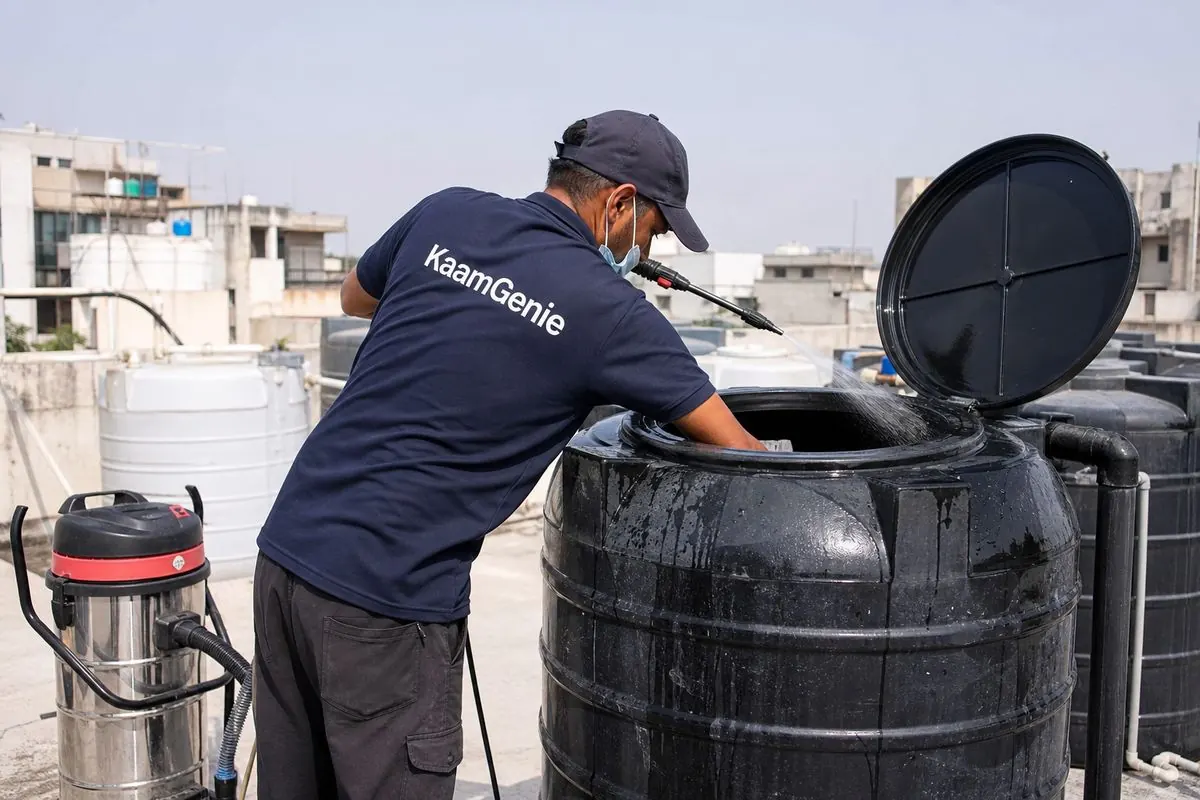
Plastic ages in sunlight, and many Ashok Vihar add-ons date to the early 2000s. Two decades of UV leaves the walls chalky and micro-cracked and — critically — the lids brittle: they crack at the rim, warp out of round, and stop sealing years before anyone replaces them. From that point the tank collects continuously, and on Phase I roofs what it collects includes the metallic fallout drifting over from Wazirpur’s units, a residue that settles into a dark film no household bucket-and-rope cleaning touches.
The society structure hides the problem in plain sight: because the RWA visibly maintains the big RCC tanks, the private add-on above your own terrace feels covered when it is entirely your own. Our clean resets the inside; the condition check tells you what the outside years have cost — whether the lid needs the ₹300 replacement that would do more for your water than anything else, and whether the tank itself has another five years or is due. Phase I tanks under the fallout path do best on a six-month cycle; Phases II-IV can generally hold a yearly one.
No travel charge anywhere in Ashok Vihar. The final price is confirmed on the call before we come — it depends only on tank size and access.
See it done in 45 seconds
Watch our web story on how a tank is really cleaned — drain, de-sludge, jet-wash, disinfect.
We reach every pocket of Ashok Vihar — and there’s no travel charge to any of them:
Every locality in Delhi stores different water, and that decides how fast a tank fouls. This is Ashok Vihar’s profile from The Delhi Water Index, built from our field observations across 250+ localities.
Indicative field characterisation, not a certified lab test. BIS IS 10500: TDS 500 mg/L acceptable, 2,000 permissible. Check any Delhi area →
“How do I know if my old Sintex tank is still usable?” Three tells we check on every visit: chalky powder wiping off the walls, whitening or hairline cracks around fittings and base, and a lid that no longer seats. Chalking alone means age but not failure; cracks or a dead lid mean action. We give you a plain verdict with photos — most old tanks earn a few more years with a new lid.
“Why is our Phase I tank dirtier than my brother’s in Phase III?” Geography. Phase I sits closest to Wazirpur’s industrial units, and their fallout drifts over its roofs and settles through any lid that has stopped sealing — which describes most twenty-year-old lids. Same colony, different air. We suggest six-monthly cleans for Phase I tanks under that path, yearly elsewhere.
“What does the clean cost?” ₹699 for tanks up to 500 litres, ₹899 for 501-1,000 litres — wet-vacuum, plastic-safe jet wash, soft-pad scrub, anti-bacterial disinfectant, photos and dated quality report all included, as is the age-and-lid check. Neighbours booking together in one block get the tanks done in a single visit at a combined rate.
“Does the RWA need to be involved for my terrace tank?” No — your add-on tank is private property and we clean it without touching the society system, so no permissions are needed. If your society wants the shared RCC banks and sumps done too, that is a separate RWA booking through our main Ashok Vihar service, and we can quote both together.
“Can you come the same day to Deep Market side?” Usually — call 95603 66362 before 10 AM and the northwest round can generally take Ashok Vihar in the same day, any phase. We time the drain against your society’s pumping hours so the terrace tank refills on the next cycle.
See our complete water tank cleaning services in Delhi NCR — pricing, process, tank types and full city coverage.
Beyond water tank cleaning, KaamGenie is rolling out a full lineup of home services across Delhi NCR — see our complete list of 12 home services we offer or will be launching through 2026. New to tank cleaning? Read our guide on how to pick the right water tank cleaning service in Delhi — what to look for, what to avoid, and the questions that separate trustworthy crews from quick-job operators.
Rooftop plastic tanks
₹699+ →Kothi sumps & underground tanks
₹1,499+ →Apartments & RWAs
Bulk pricing →FSSAI-compliant cleaning
₹2,500+ →टंकी साफ़ करने वाले
हिन्दी पढ़ें →View all water tank cleaning guides →
All pockets and lanes of Ashok Vihar covered. If your specific block or society isn’t named in the sub-areas above, just call — we almost certainly cover it.
Same crew, same 6-step process, same-day where possible. Pick any locality below for local pricing and the tanks we typically find there.
Book a slot — we can usually fit you in today or tomorrow.