
Tank Cleaning Before Moving In
Raj Babbar · 10 min read
Home › Water Tank Cleaning › Sintex / Plastic Tank Cleaning › Badli
Badli’s industrial units put a fine metal-and-soot dust on every nearby roof, and inside the plastic tanks it settles as a dark film that stains the translucent walls grey. KaamGenie cleans Sintex and plastic tanks across the industrial area, the village and the worker-housing lanes. From ₹699.
Badli is the industrial-village belt on the GT Road corridor — the Badli industrial area’s units, the old village, dense worker-housing lanes and the Yellow Line’s terminus. The units’ soot and metal dust coat the roofs nearest them, and the supply underneath swings between borewell and DJB depending on which side of the belt you stand — harder and rougher on the industrial side, gentler in the village. Worker housing runs small shared tanks across many tenants, and those tanks take the dust and the cycling both.
KaamGenie’s clean strips the whole deposit stack — drain, wet-vacuum the dark sediment, degrease pass where the soot film is oily, plastic-safe jet wash, hand-scrub the stained walls with pads, then anti-bacterial disinfection and before-after photos that show the grey coming off the plastic. We also look at the stand under the tank, since industrial-side moisture rusts the angle-iron frames faster here. Sumps and drums are on water tank cleaning in Badli; this page is for the plastic tanks.
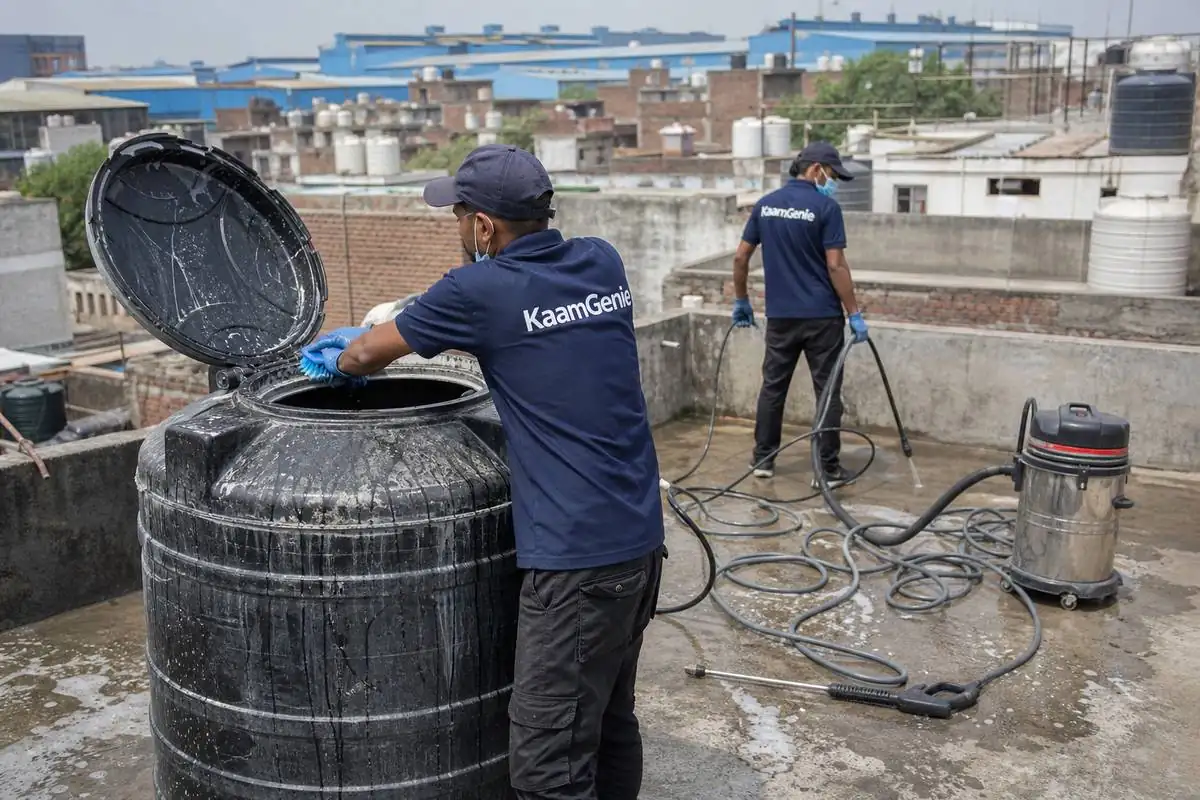
Metal soot behaves differently from street dust in water. It is fine enough to stay suspended through several fills, so it tints the water faintly grey before it finally settles into a dark, slightly oily sediment; on the way down it clings to the translucent walls, and over months the tank visibly darkens from outside. That darkening is not just cosmetic — the film is a bed for biofilm, and it marks every litre stored. A degrease pass before the jet wash is what actually lifts it; plain rinsing smears it into the plastic’s pores.
The worker-housing lanes concentrate the problem the way they do all along this corridor — one small tank over many tenants, cycling constantly, with maintenance belonging to nobody. And under many Badli tanks stands the quiet second issue: a rusting angle-iron stand, corroded by unit-side air and overflow drips, flaking rust onto the roof and slowly weakening under a full tank’s weight. We point out a failing stand every time we see one — a 1000L tank is a tonne of water, and the stand matters as much as the tank.
No travel charge anywhere in Badli. The final price is confirmed on the call before we come — it depends only on tank size and access.
See it done in 45 seconds
Watch our web story on how a tank is really cleaned — drain, de-sludge, jet-wash, disinfect.
We reach every pocket of Badli — and there’s no travel charge to any of them:
Every locality in Delhi stores different water, and that decides how fast a tank fouls. This is Badli’s profile from The Delhi Water Index, built from our field observations across 250+ localities.
Indicative field characterisation, not a certified lab test. BIS IS 10500: TDS 500 mg/L acceptable, 2,000 permissible. Check any Delhi area →
“The inside of our tank looks grey-black. Is the water unsafe?” That colour is almost always settled unit soot and metal dust bound into a film — unpleasant, a biofilm bed, and worth removing promptly, though the danger builds gradually rather than overnight. Our clean includes a degrease pass and anti-bacterial disinfection, and the after photos will show the wall back to its original colour.
“Do you check the stand the tank sits on?” Yes, on every Badli job. The industrial-side air and constant overflow damp rust angle-iron stands faster here than almost anywhere on our routes, and a corroded stand under a full tank is a genuine hazard. We photograph any rust damage we find and tell you plainly whether it needs repainting, bracing or replacement.
“What is the price in Badli?” ₹699 up to 500 litres, ₹899 for 501-1,000L — village, industrial area and worker housing all the same, degrease pass included where needed. Shared worker-housing tanks split across tenants come to very little per family, and same-lane group bookings get a per-tank discount.
“Can units book cleaning for canteen and process tanks?” Yes. We clean drinking-water and process storage inside Badli industrial area units, schedule around shifts, and provide the dated quality report and photo record inspections ask for. Units running multiple tanks get a per-tank quote and can fix a standing half-yearly schedule so it never lapses.
“How soon can you reach a Badli address?” Call before 10 AM on 95603 66362 and same-day is usually on — Badli anchors our GT Road run with Samaipur and Jahangir Puri, so a crew works this corridor most days. Share a landmark — the metro terminus, your unit gate or the village chowk — and your supply timing, and we will slot you in.
See our complete water tank cleaning services in Delhi NCR — pricing, process, tank types and full city coverage.
Beyond water tank cleaning, KaamGenie is rolling out a full lineup of home services across Delhi NCR — see our complete list of 12 home services we offer or will be launching through 2026. New to tank cleaning? Read our guide on how to pick the right water tank cleaning service in Delhi — what to look for, what to avoid, and the questions that separate trustworthy crews from quick-job operators.
Rooftop plastic tanks
₹699+ →Kothi sumps & underground tanks
₹1,499+ →Apartments & RWAs
Bulk pricing →FSSAI-compliant cleaning
₹2,500+ →टंकी साफ़ करने वाले
हिन्दी पढ़ें →View all water tank cleaning guides →
All pockets and lanes of Badli covered. If your specific block or society isn’t named in the sub-areas above, just call — we almost certainly cover it.
Same crew, same 6-step process, same-day where possible. Pick any locality below for local pricing and the tanks we typically find there.
Book a slot — we can usually fit you in today or tomorrow.