
Plastic vs Concrete Tank Cleaning
Raj Babbar · 8 min read
Home › Water Tank Cleaning › Sintex / Plastic Tank Cleaning › Pooth Kalan
On Pooth Kalan’s village roofs, ten-year-old chalky tanks stand next to last month’s glossy new ones — and the rental floors below share whichever tank the landlord put up, cleaned by nobody. KaamGenie cleans old and new plastic tanks alike, on hard borewell water. From ₹699.
Pooth Kalan is the village-core-plus-extensions pocket surrounded by Rohini’s outer sectors — original village plots, working dairies, and rapidly built rental floors housing families priced out of the sectors next door. Supply is borewell-fed and hard. The rooftop scenery tells the story: mixed clusters of plastic tanks in every age and colour, the old ones UV-chalked white and brittle-lidded, the new ones already collecting the same hard-water scale, and many of them serving tenants whose landlord has never once arranged a clean.
KaamGenie treats each tank on its merits — drain, wet-vacuum, scale-softening where the borewell crust has bonded to the ribbed floor, plastic-safe jet wash, gentler handling on aged chalky walls, then anti-bacterial disinfection with photos. Tenants can book directly; the photos and dated quality report also make a persuasive case to a landlord for splitting the cost. For sumps, drums and dairy storage, see water tank cleaning in Pooth Kalan; this page covers the Sintex and plastic tanks.
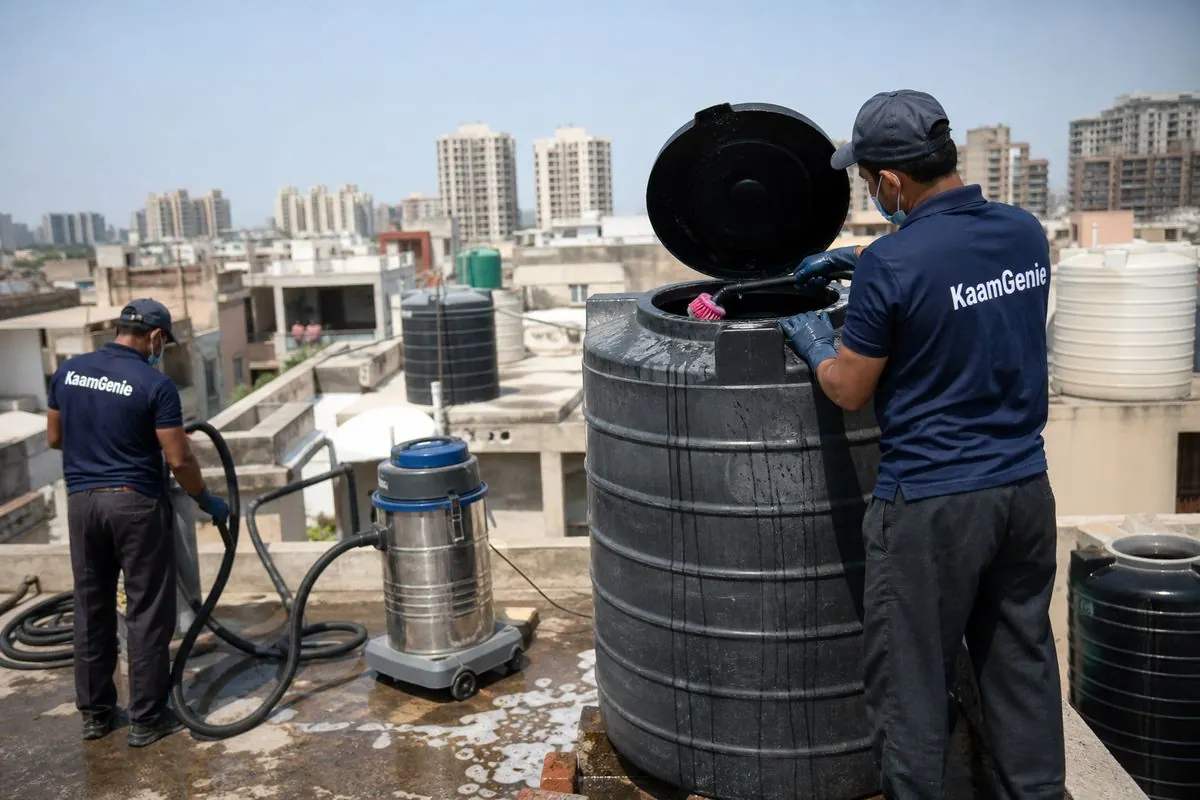
An old plastic tank is not just a dirtier new one. Years of unshaded sun chalk the outer wall into that white powder and slowly stiffen the plastic, so an aged Pooth Kalan tank needs gentler jet pressure and pad-scrubbing rather than aggressive blasting — treated right, it has years left; treated wrong, it cracks at the fittings. Meanwhile its interior carries the deepest scale on the roof, because it has taken the most fills of hard borewell water. New tanks beside it are already on the same path, just earlier.
The rental-floor economics are the second issue. A landlord living elsewhere puts up one tank for three tenant floors; the tenants assume the landlord maintains it, the landlord assumes water is the tenants’ business, and the tank silently accumulates for years. The families drinking from it are the ones with the least say over it. We see this across Pooth Kalan’s extensions, which is why we make direct tenant bookings easy and put everything in photos — evidence travels further than complaints.
No travel charge anywhere in Pooth Kalan. The final price is confirmed on the call before we come — it depends only on tank size and access.
See it done in 45 seconds
Watch our web story on how a tank is really cleaned — drain, de-sludge, jet-wash, disinfect.
We reach every pocket of Pooth Kalan — and there’s no travel charge to any of them:
Every locality in Delhi stores different water, and that decides how fast a tank fouls. This is Pooth Kalan’s profile from The Delhi Water Index, built from our field observations across 250+ localities.
Indicative field characterisation, not a certified lab test. BIS IS 10500: TDS 500 mg/L acceptable, 2,000 permissible. Check any Delhi area →
“We are tenants — can we book without the landlord?” Yes. Whoever uses the water can book the clean; we only need roof access and the motor timing. Many Pooth Kalan tenants split the ₹699-899 between floors sharing the tank, and the before-after photos plus dated quality report often convince the landlord to cover the next one. We are happy to speak to a landlord on the phone if it helps.
“Our tank is old and chalky white outside. Can it still be cleaned safely?” Almost always, yes. The chalking is UV wear on the outer surface; the tank usually remains sound. We adjust for age — gentler jet pressure, pad-scrubbing, care around the fittings where old plastic is stiffest — and we will tell you honestly during the clean if the tank is actually near the end of its life.
“How bad is the borewell scale here, and does it cost extra?” Pooth Kalan’s water is hard, and older tanks carry crust bonded into the ribbed floor grooves. Softening and removing it is part of the standard clean — ₹699 up to 500L, ₹899 for 501-1,000L — not a surcharge. Only genuinely extreme cases get flagged for a revised quote, and always before we start work.
“Do you clean dairy storage as well?” Yes, the village dairies’ plastic storage tanks and troughs get the same hygienic process as household tanks — arguably more important given animals drink straight from them. We can do the household roof cluster and the dairy storage in one visit at a combined per-tank rate.
“Can you come today?” If you call before 10 AM on 95603 66362, usually yes — Pooth Kalan sits on our route between Sultanpuri and the Rohini outer sectors. Tell us roughly how many tanks are on your roof and their sizes, and whether any are the older chalky type, so the crew arrives with the right setup.
See our complete water tank cleaning services in Delhi NCR — pricing, process, tank types and full city coverage.
Beyond water tank cleaning, KaamGenie is rolling out a full lineup of home services across Delhi NCR — see our complete list of 12 home services we offer or will be launching through 2026. New to tank cleaning? Read our guide on how to pick the right water tank cleaning service in Delhi — what to look for, what to avoid, and the questions that separate trustworthy crews from quick-job operators.
Rooftop plastic tanks
₹699+ →Kothi sumps & underground tanks
₹1,499+ →Apartments & RWAs
Bulk pricing →FSSAI-compliant cleaning
₹2,500+ →टंकी साफ़ करने वाले
हिन्दी पढ़ें →View all water tank cleaning guides →
All pockets and lanes of Pooth Kalan covered. If your specific block or society isn’t named in the sub-areas above, just call — we almost certainly cover it.
Same crew, same 6-step process, same-day where possible. Pick any locality below for local pricing and the tanks we typically find there.
Book a slot — we can usually fit you in today or tomorrow.