
Water Tank Disinfection Explained
Raj Babbar · 10 min read
Home › Water Tank Cleaning › Sintex / Plastic Tank Cleaning › Kirari Suleman Nagar
In Kirari, tank cleaning is not cosmetic — every monsoon, waterlogging pushes contaminated groundwater into the shallow borewells most lanes drink from, and the plastic tank on the roof is the last barrier before your family’s glass. KaamGenie cleans and disinfects tanks across the colony’s lanes. From ₹699.
Kirari Suleman Nagar is one of Delhi’s largest unauthorised colonies — a vast grid of narrow lanes off the Nangloi-Kanjhawla road, famous for its monsoon waterlogging. Water is almost entirely borewell and tanker, and most borewells here are shallow. When the lanes flood, that standing water seeps down and reaches the same shallow layers the borewells draw from — which is why tank hygiene in Kirari is a genuine health matter. Most homes run a doubled storage chain, ground drums plus a small plastic roof tank, and both links collect what the borewell sends up.
KaamGenie’s clean is built around disinfection — drain, wet-vacuum the sediment, plastic-safe jet wash, hand-scrub the ribbed floor and corners, then a properly dosed anti-bacterial disinfectant rinse, with photos so you see the difference. We strongly recommend doing the roof tank and the ground drums in the same visit, since a clean tank refilled through a dirty drum is only half a fix. Drums, sumps and the full service are on our water tank cleaning in Kirari Suleman Nagar page; this one is for the plastic tanks.
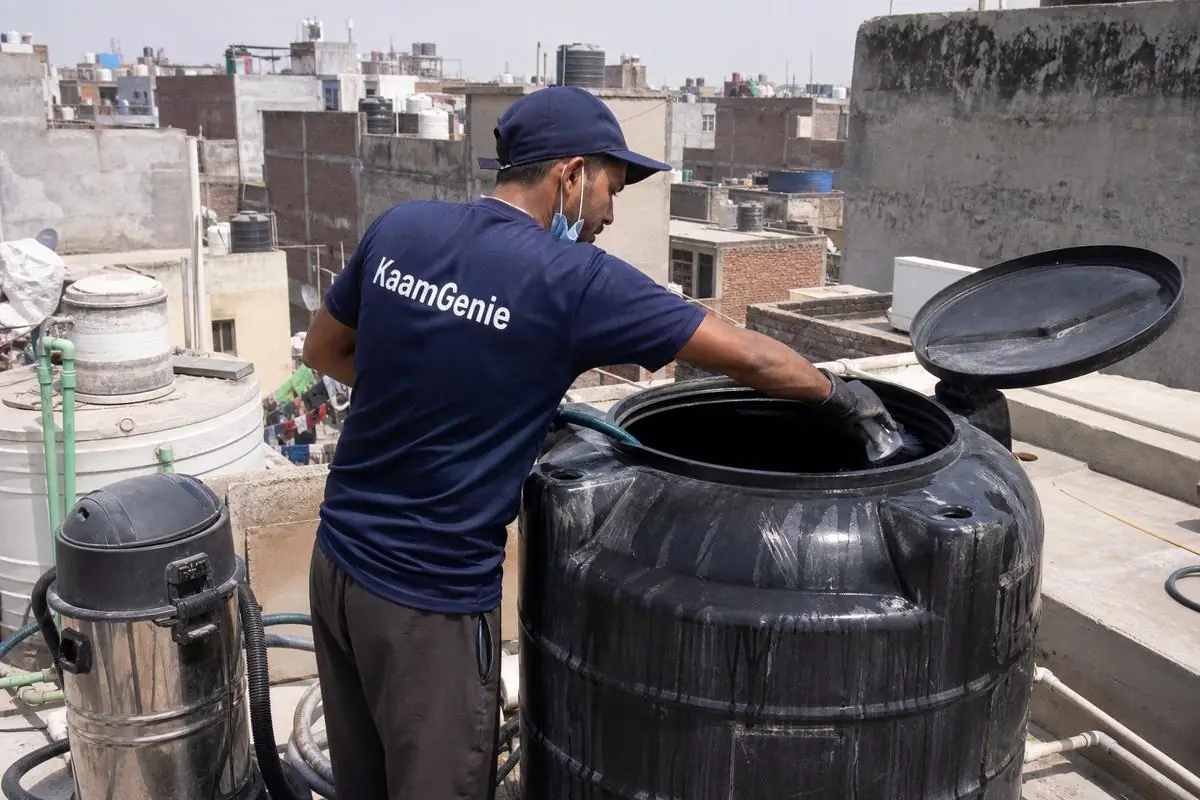
Shallow borewells sit close to whatever the surface sends down. In Kirari’s waterlogging season, flooded lanes stand for days over unsewered ground, and the contamination that seeps down does not announce itself — the water can look normal and still carry bacteria a scale-roughened, biofilm-lined tank will happily host. The plastic tank’s translucent wall makes it worse: sunlight through the plastic keeps the tank warm, and warm plus contaminated is how a film establishes in days rather than months.
The doubled storage chain doubles the exposure. Water sits first in a ground drum — often uncovered — then gets pumped to the roof tank, so every stage adds its own sediment and every transfer stirs the last stage’s. Cleaning only the roof tank and refilling it through a fouled drum undoes the work within a fill or two. Our honest advice for Kirari: both stages cleaned and disinfected together, before the monsoon and once after it recedes.
No travel charge anywhere in Kirari Suleman Nagar. The final price is confirmed on the call before we come — it depends only on tank size and access.
See it done in 45 seconds
Watch our web story on how a tank is really cleaned — drain, de-sludge, jet-wash, disinfect.
We reach every pocket of Kirari Suleman Nagar — and there’s no travel charge to any of them:
Every locality in Delhi stores different water, and that decides how fast a tank fouls. This is Kirari Suleman Nagar’s profile from The Delhi Water Index, built from our field observations across 250+ localities.
Indicative field characterisation, not a certified lab test. BIS IS 10500: TDS 500 mg/L acceptable, 2,000 permissible. Check any Delhi area →
“Is the disinfectant you use safe for drinking water?” Yes — we finish every clean with a anti-bacterial disinfectant made specifically for drinking-water storage, dosed correctly and rinsed so no taste remains. In Kirari, where shallow borewells can pick up monsoon contamination, that disinfection step is the most important part of the job, and we never skip or dilute it.
“Should we clean the tank before or after the monsoon?” Ideally both. A pre-monsoon clean means the tank starts the risky season without an established biofilm for new contamination to feed; a post-monsoon clean flushes out whatever the waterlogged weeks pushed through the borewell. If you can only do one, do the post-monsoon clean — and disinfect the ground drums at the same time.
“What does it cost, and is the drum included?” The roof tank is ₹699 up to 500 litres or ₹899 for 501-1,000L. Ground drums cleaned in the same visit are added at a small per-drum rate we confirm on the phone — far cheaper than a separate visit, and honestly the combination is what actually protects your water in Kirari.
“Can your crew work in Kirari’s narrow lanes?” Yes. Our equipment is carried, not trolleyed — pump, hoses and vacuum all go up staircases by hand, so lane width and tight roof access are not a problem. We work in Kirari’s lanes every week; just give us the block, the nearest chowk or a known landmark and the crew will reach you.
“Do you offer same-day service in Kirari?” Usually yes — call before 10 AM on 95603 66362. If your water has come in smelling or discoloured, tell us on the phone; we treat possible contamination cases as priority bookings and will fit you into the same day’s route wherever possible, cleaning and disinfecting both storage stages in one visit.
See our complete water tank cleaning services in Delhi NCR — pricing, process, tank types and full city coverage.
Beyond water tank cleaning, KaamGenie is rolling out a full lineup of home services across Delhi NCR — see our complete list of 12 home services we offer or will be launching through 2026. New to tank cleaning? Read our guide on how to pick the right water tank cleaning service in Delhi — what to look for, what to avoid, and the questions that separate trustworthy crews from quick-job operators.
Rooftop plastic tanks
₹699+ →Kothi sumps & underground tanks
₹1,499+ →Apartments & RWAs
Bulk pricing →FSSAI-compliant cleaning
₹2,500+ →टंकी साफ़ करने वाले
हिन्दी पढ़ें →View all water tank cleaning guides →
All pockets and lanes of Kirari Suleman Nagar covered. If your specific block or society isn’t named in the sub-areas above, just call — we almost certainly cover it.
Same crew, same 6-step process, same-day where possible. Pick any locality below for local pricing and the tanks we typically find there.
Book a slot — we can usually fit you in today or tomorrow.