
Underground Sump Cleaning: Cost & Safety
Raj Babbar · 9 min read
Home › Water Tank Cleaning › Sintex / Plastic Tank Cleaning › Mayapuri
Mayapuri’s scrap yards and grinding shops throw metal grit that sinks straight to a plastic tank’s floor as a black, abrasive sediment — the heaviest tank fouling in west Delhi. KaamGenie runs its shortest cleaning cycles here. From ₹699.
Mayapuri is Delhi’s scrap-and-industrial hub — Phases 1 and 2 packed with dismantling yards, grinding and fabrication units, with worker housing and older residential pockets pressed right against them. The fallout is unlike anywhere else on our rounds: metal grit and grinding dust that is dense, sharp-edged and fast-sinking. It does not haze the water; it drops straight through and packs into a black sediment on the plastic floor, where every refill scours it against the surface. Tanks here foul in weeks, and factory canteens draw cooking water from the same storage the households use.
KaamGenie cleans Mayapuri’s Sintex and plastic tanks on the area’s own accelerated rhythm — drain, wet-vacuum the black grit layer, plastic-safe jet wash, soft-pad scrub, then a anti-bacterial disinfectant rinse with photos for each visit. For larger industrial storage, sumps or RCC tanks, our main water tank cleaning in Mayapuri page covers the full range; this page is about the plastic tanks specifically.
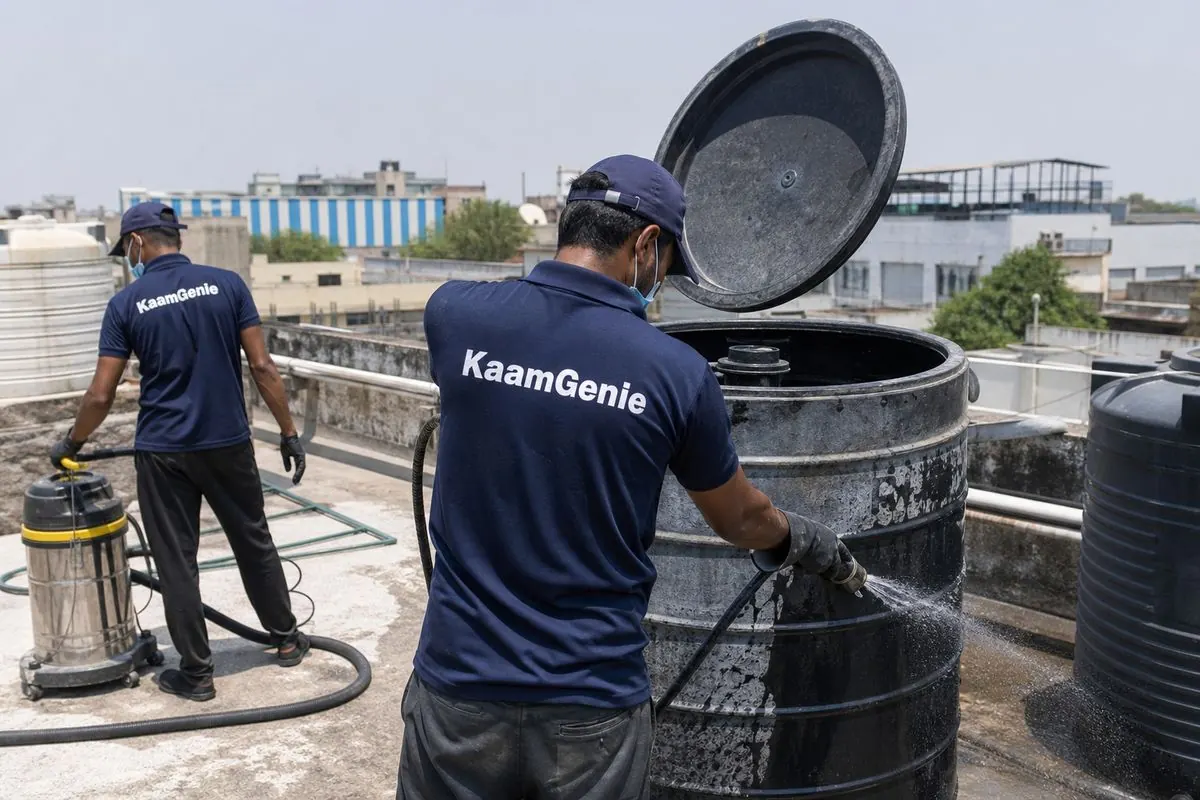
Density is the difference. Sawdust floats, road dust hazes — but metal grit sinks immediately and accumulates fast, and because the particles are hard and angular, the layer works like sandpaper against the plastic floor every time the tank drains low and refills. A roughened floor then holds the next layer more stubbornly and gives biofilm an anchored base. Where a residential colony’s tank might carry a season’s film, a Phase 1 rooftop tank can carry a visible black bed within a month or two.
The human load doubles the urgency. Worker housing shares small tanks across many families, so draw is constant and the settled grit keeps getting stirred back into the take-off. And when a unit’s canteen cooks on water from the same tank, tank hygiene stops being a household nicety and becomes basic food safety for a workforce. For shared residential tanks and any canteen-connected storage we recommend a three-to-four-month cycle — the shortest we prescribe anywhere in west Delhi — with the quality report kept on site.
No travel charge anywhere in Mayapuri. The final price is confirmed on the call before we come — it depends only on tank size and access.
See it done in 45 seconds
Watch our web story on how a tank is really cleaned — drain, de-sludge, jet-wash, disinfect.
We reach every pocket of Mayapuri — and there’s no travel charge to any of them:
Every locality in Delhi stores different water, and that decides how fast a tank fouls. This is Mayapuri’s profile from The Delhi Water Index, built from our field observations across 250+ localities.
Indicative field characterisation, not a certified lab test. BIS IS 10500: TDS 500 mg/L acceptable, 2,000 permissible. Check any Delhi area →
“How often should a tank near the scrap yards be cleaned?” Every three to four months for shared residential tanks close to the units, and the same for any tank feeding a canteen. That sounds frequent, but the black grit layer we lift out of Phase 1 and 2 tanks after ninety days settles the argument. Tanks in the residential pockets further from the units can stretch toward six months.
“Does the metal grit damage the tank itself?” Over time, yes — the angular particles abrade the floor as the tank cycles, and a roughened floor fouls faster and is harder to keep clean. Regular wet-vacuuming before the layer builds is what protects the plastic. During each clean we also check the outlet and float valve, which the grit wears fastest.
“What does a clean cost for worker housing tanks?” ₹699 for tanks up to 500 litres and ₹899 for 501-1,000 litres. Worker-housing tanks are usually small, and where one building has several we quote them as a set, which is how most owners here run it — one visit, every tank done, split across the rooms. Quality report and photos included.
“Our unit’s canteen uses the rooftop tank. Can you document the clean for compliance?” Yes — every clean comes with before-and-after photos on WhatsApp, which units keep on file for labour and food-safety inspections. We can schedule around shift timings so the canteen never loses water during working hours, and set a standing three-monthly reminder so compliance stays automatic.
“Can you come the same day?” Usually — call 95603 66362 before 10 AM and a crew can typically reach either phase the same day, since Mayapuri anchors our industrial-belt round with Naraina. For units, early-morning slots before the shift starts are the standard arrangement.
See our complete water tank cleaning services in Delhi NCR — pricing, process, tank types and full city coverage.
Beyond water tank cleaning, KaamGenie is rolling out a full lineup of home services across Delhi NCR — see our complete list of 12 home services we offer or will be launching through 2026. New to tank cleaning? Read our guide on how to pick the right water tank cleaning service in Delhi — what to look for, what to avoid, and the questions that separate trustworthy crews from quick-job operators.
Rooftop plastic tanks
₹699+ →Kothi sumps & underground tanks
₹1,499+ →Apartments & RWAs
Bulk pricing →FSSAI-compliant cleaning
₹2,500+ →टंकी साफ़ करने वाले
हिन्दी पढ़ें →View all water tank cleaning guides →
All pockets and lanes of Mayapuri covered. If your specific block or society isn’t named in the sub-areas above, just call — we almost certainly cover it.
Same crew, same 6-step process, same-day where possible. Pick any locality below for local pricing and the tanks we typically find there.
Book a slot — we can usually fit you in today or tomorrow.