
How Often Should You Clean Your Water Tank?
Raj Babbar · 7 min read
Home › Water Tank Cleaning › Society / RWA Tank Cleaning › Karawal Nagar
The Karawal Nagar main road threads through the largest unauthorised-colony belt in north-east Delhi, where every three and four storey building carries a cluster of small plastic tanks feeding renters who come and go. Cleaning those shared tanks and dating the visit is what we handle. From ₹1,500 per tank.
Karawal Nagar spreads across the far side of the Wazirabad canal as one of the biggest builder-floor colonies in the city, its spine the long Karawal Nagar main road lined with shops and lanes running deep on either side. Water here is almost entirely private borewell, very hard and iron-tinged, with the DJB network barely reaching the interior. A single roof commonly holds two or three 500 to 1000 litre plastic tanks, each shared by the tenants of a floor stack. The heavy churn of renters means no one stays long enough to take charge of the tank, so it scales and silts unattended. On this water, a fresh tank can crust within a few months.
KaamGenie cleans the shared rooftop tanks these builder floors run, coordinating with the owner or the caretaker who manages the tenancies. We empty each tank, clear the iron-laden deposit, scour the walls, treat with a anti-bacterial disinfectant and leave timestamped before-and-after photos for whoever holds the building. A single tenant wanting their own tank done can visit water tank cleaning in Karawal Nagar. This page is about the shared tanks feeding a whole Karawal Nagar building.
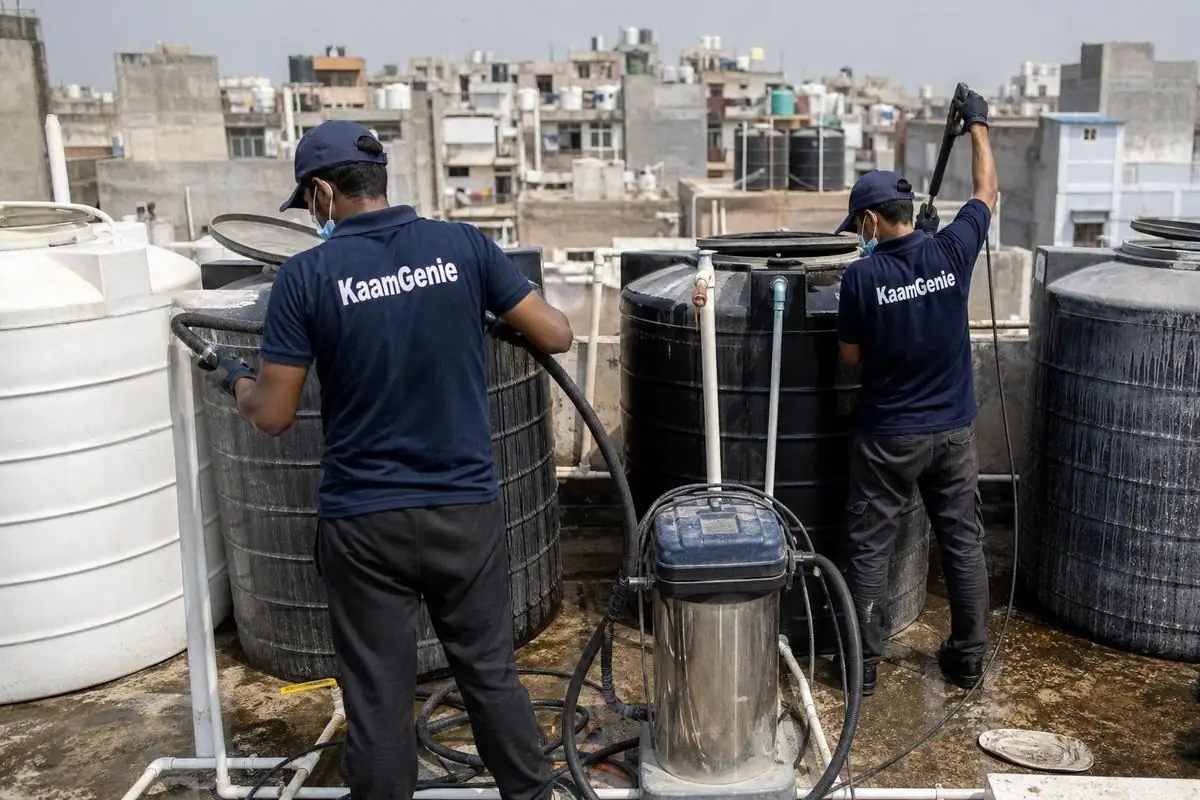
The borewell water under Karawal Nagar is among the hardest and most iron-heavy in the belt, and hard iron water is exactly what crusts a tank fast. When two or three tanks on a roof each feed a floor of renters, they cycle constantly, so mineral and iron deposits arrive with every refill. There is no long-settled sludge phase here so much as a steadily thickening scale on walls and floor alike. A tank left a year on this supply is visibly lined.
That scale and the iron film beneath it hold biofilm and push the metallic taste and yellow tint the borewell already carries, and the renters on each floor notice it in the first draw. Flakes and grit ride into the shared pump and the taps, and on a building with constant tenant turnover those small failures pile up on the owner. Because nobody renting the floor treats the tank as theirs, it is the last thing anyone opens. A clean twice a year on this hard water is the realistic minimum.
No travel charge anywhere in Karawal Nagar. The final price is confirmed on the call before we come — it depends only on tank size and access.
See it done in 45 seconds
Watch our web story on how a tank is really cleaned — drain, de-sludge, jet-wash, disinfect.
We reach every pocket of Karawal Nagar — and there’s no travel charge to any of them:
Every locality in Delhi stores different water, and that decides how fast a tank fouls. This is Karawal Nagar’s profile from The Delhi Water Index, built from our field observations across 250+ localities.
Indicative field characterisation, not a certified lab test. BIS IS 10500: TDS 500 mg/L acceptable, 2,000 permissible. Check any Delhi area →
“Renters keep changing in our building. Who should arrange the tank clean?” The owner or the caretaker who handles the tenancies is best placed, since the rooftop tanks are common to all the floors. Tenants can flag it, but with churn this heavy a standing arrangement with the owner keeps the tanks from being forgotten between lettings.
“We have three tanks on one roof. Do you clean them all in one visit?” Yes. We do the whole cluster in a single visit and quote them together at a bulk rate rather than per tank. Doing them at once also means the building's supply is only interrupted for one short window.
“The borewell water is rust-coloured. Will cleaning help?” Cleaning removes the rust film on the walls and the iron-laden deposit on the floor, which are a real part of the colour you see. The borewell itself stays iron-rich, but a clean tank stops adding to the tint, and the first-draw water runs clearer.
“How much for the shared rooftop tanks on our building?” Each rooftop tank of 500 to 1,000 litres sits at the lower end, from ₹1,500, with larger tanks quoted up. Where a roof holds two or three, we do them all in one visit at a bulk rate.
“How quickly does a tank scale up on Karawal Nagar's water?” On this very hard, iron-heavy borewell a tank can show visible scale within a few months, and a year untouched leaves it clearly lined. That is why we suggest cleaning the shared tanks at least twice a year rather than annually.
See our complete water tank cleaning services in Delhi NCR — pricing, process, tank types and full city coverage.
Beyond water tank cleaning, KaamGenie is rolling out a full lineup of home services across Delhi NCR — see our complete list of 12 home services we offer or will be launching through 2026. New to tank cleaning? Read our guide on how to pick the right water tank cleaning service in Delhi — what to look for, what to avoid, and the questions that separate trustworthy crews from quick-job operators.
Rooftop plastic tanks
₹699+ →Kothi sumps & underground tanks
₹1,499+ →Apartments & RWAs
Bulk pricing →FSSAI-compliant cleaning
₹2,500+ →टंकी साफ़ करने वाले
हिन्दी पढ़ें →View all water tank cleaning guides →
All pockets and lanes of Karawal Nagar covered. If your specific block or society isn’t named in the sub-areas above, just call — we almost certainly cover it.
Same crew, same 6-step process, same-day where possible. Pick any locality below for local pricing and the tanks we typically find there.
Book a slot — we can usually fit you in today or tomorrow.