Water Tank Cleaning Cost in Delhi (2026)
Real Delhi tank cleaning prices, no surge, no hidden charges.
 KaamGenie
Home › Services › Concrete / RCC Tank Cleaning
For Kothis & Older BuildingsThe cast concrete and RCC tanks built into older Delhi kothis and societies hold far more silt and algae than plastic, because their rough walls give sediment somewhere to grip. We scrub them back to the surface, de-silt the base, disinfect and rinse. Fixed, published prices starting at ₹699.
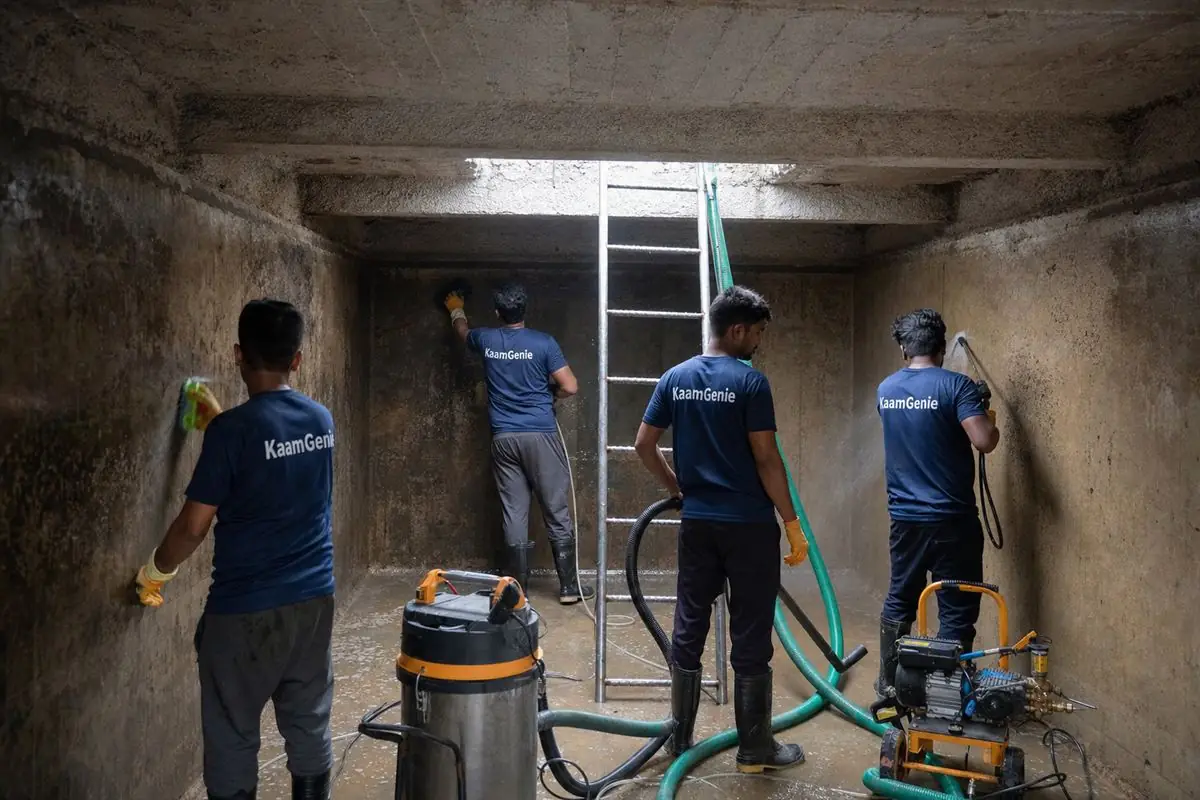
Concrete and RCC tank cleaning is the emptying, heavy scrubbing, de-silting, disinfecting and rinsing of cast-in-place water tanks — the reinforced-concrete tanks built into the roof or basement of older Delhi buildings. Unlike a smooth plastic tank, an RCC wall is porous and slightly rough, so it grips sediment, grows algae in its pores and often carries a mineral crust. That rough surface is exactly why these tanks need a firmer scrub and longer de-silting than a Sintex tank.
It is the right service for older kothis, government-era flats and societies where the builder cast the tank in concrete rather than dropping in a plastic one. These tanks are usually larger — several thousand litres — and are often the underground sump plus a rooftop RCC tank. If your tank has grey concrete walls, a slab lid and maybe a hairline crack or two, this is the service; owners who have never had it opened up are usually shocked at the silt depth at the base.
Same thorough process for every job — no shortcuts.
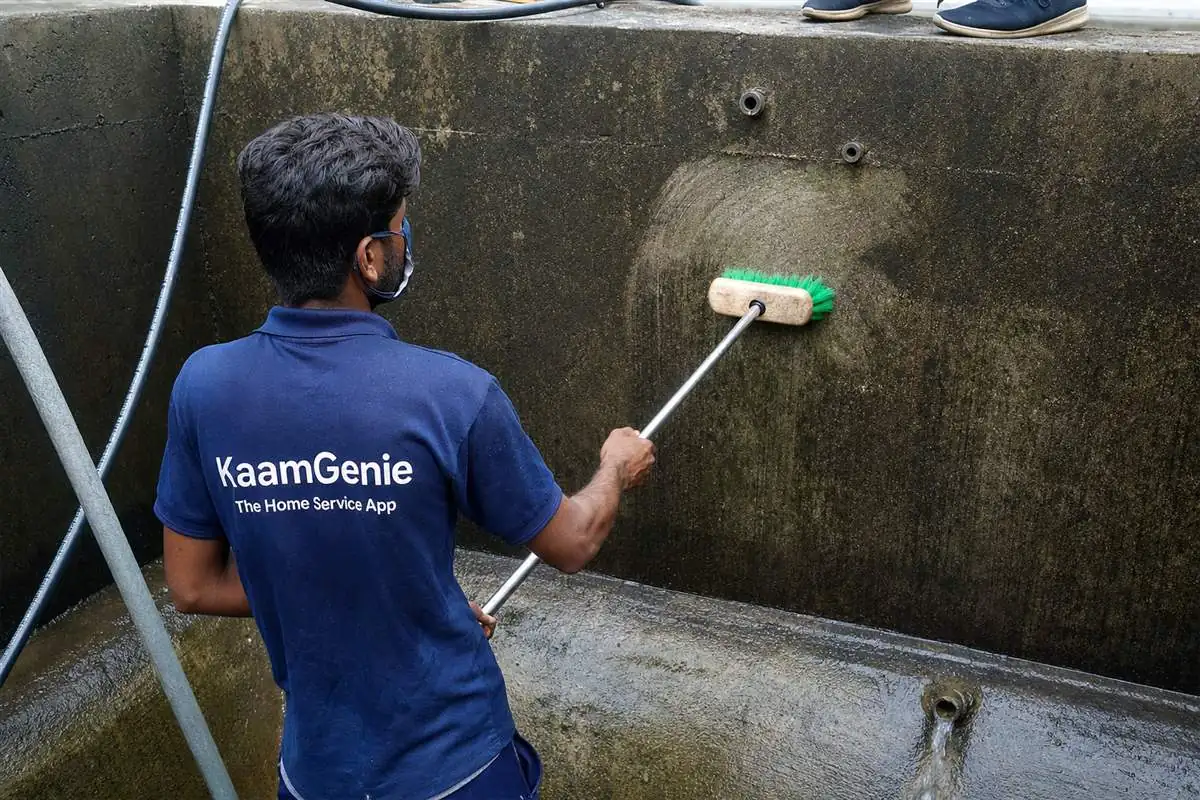
Overhead RCC tanks in the standard home range use our fixed, published per-size pricing. Very large or underground reservoirs are quoted per visit, and the price agreed on the call is what you pay.
| Tank size | Price |
|---|---|
| Up to 500 Litres | ₹699 |
| 501 – 1000 Litres | ₹899 |
| 1001 – 1500 Litres | ₹1,299 |
| 1501 – 2000 Litres | ₹1,499 |
| 2001 – 3000 Litres | ₹1,999 |
| 3001 – 5000 Litres | ₹2,499 |
| 5001 – 10000 Litres | ₹3,999 |
| Above 10,000 Litres | Quoted per visit |
Prices include GST for residential customers; commercial premises get a separate GST invoice. Call 95603 66362 for an exact quote.
Porous walls grip sediment. An RCC wall is microscopically rough, so silt, algae and biofilm anchor into the surface instead of sitting loosely on it. A quick rinse barely touches this — it takes firm scrubbing to break the growth out of the concrete’s pores.
Bigger tanks, deeper silt. Concrete tanks in kothis and societies are usually several thousand litres, and the larger the base, the more Delhi’s monsoon silt and borewell sediment settle at the floor. Many are years overdue and hold four to five inches of packed sludge by the time we open them.
Cracks and seepage change the water. Old RCC can develop hairline cracks and damp patches that let in groundwater and outside contamination, and rough joints around the inlet are perfect algae pockets. Cleaning is also the moment to spot these, which is why we flag any crack or seepage rather than just rinsing over it.
Many Delhi kothis run two concrete tanks: a rooftop RCC tank and an underground concrete sump that the water is pumped up from. The sump usually collects the most silt because the incoming supply lands there first, and it is a confined space with poor light and airflow — so it needs the same de-silting and disinfection plus proper confined-space care. If both are concrete, cleaning them together in one visit is the sensible move.
That is often cheaper as a package than two separate jobs — see our combined sump + overhead cleaning, or read the overhead vs underground guide on which needs attention more often. If your building has switched to a moulded plastic tank instead, the gentler Sintex & plastic tank cleaning is the right fit. We cover all of these across Delhi.
“Why does my concrete tank get dirtier than a plastic one?” Because the RCC surface is porous and rough, silt, algae and biofilm anchor into it instead of sitting loosely, and the larger base collects deeper silt. A rinse barely touches it — it needs firm scrubbing and proper de-silting. That is exactly what our concrete-tank service is built for, from ₹699 for standard sizes.
“Can you clean an underground RCC sump as well?” Yes. Underground concrete sumps are confined spaces with poor light and airflow, so we clean them with proper confined-space care alongside the de-silting and food-grade disinfection. Most kothis have both a sump and an overhead tank — cleaning them together in one visit is usually cheaper than two separate jobs. Call 95603 66362 for a quote.
“My concrete tank has a hairline crack — is that a problem?” It can be. Cracks and damp patches let groundwater and outside contamination seep in and change your water quality. We cannot structurally repair concrete, but we flag every crack and seepage point we find during cleaning so you can get it sealed before it worsens, rather than rinsing over it.
“How often should an RCC tank be cleaned in Delhi?” Every 4–6 months, and toward the shorter end for borewell-fed kothis in areas like Vasant Kunj and Chattarpur, because the rough walls and hard water build mineral crust and silt fast. Many concrete tanks we open are years overdue and hold four to five inches of packed sludge at the base.
“How much does concrete tank cleaning cost?” Standard-range overhead RCC tanks follow our fixed per-size pricing, from ₹699 up to ₹3,999 for a 5000–10,000L tank. Very large tanks and underground reservoirs above 10,000L are quoted per visit, with a bulk discount on annual contracts. The figure agreed on the call is final — no surprises on arrival.
Call +91 95603 66362, WhatsApp here, or use the booking button at the top. Same-day where possible across Delhi NCR.