Water Tank Cleaning Cost in Delhi (2026)
Real Delhi tank cleaning prices, no surge, no hidden charges.
 KaamGenie
Home › Services › Sintex & Plastic Tank Cleaning
Delhi’s Most Common TankBlack, white or triple-layer — the Sintex-style rooftop tank sits on nearly every Delhi roof. We scrub it clean without scratching the food-grade inner wall, then vacuum, disinfect and rinse. Photos on WhatsApp before we leave. Fixed, published prices starting at ₹699.
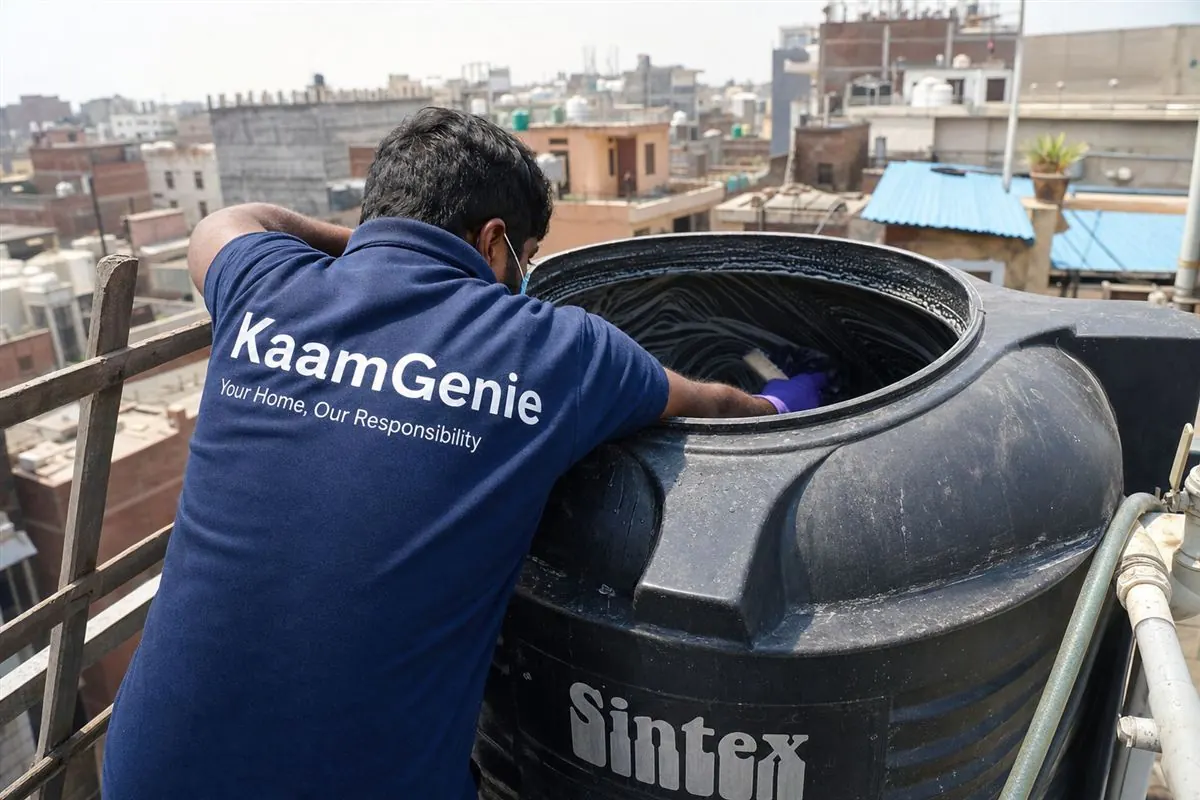
Sintex and plastic tank cleaning is the full emptying, hand-scrubbing, vacuuming, disinfecting and rinsing of the moulded plastic tank on your roof — the black, white or triple-layer “Sintex-type” tank found on the vast majority of Delhi homes. Because the inner layer is food-grade and relatively soft, the whole job hinges on lifting biofilm and sediment without scratching that surface, which is exactly what a rough brush or a wire pad would do.
It is the right service for almost any Delhi household: DDA flats with a 500L flat tank, plot kothis with a 1000L standard tank, and small societies running 2000–5000L rooftop tanks. If your tank is the moulded plastic kind — not concrete, not steel — this is your service. Owners on borewell or tanker supply need it most, because plastic walls in the Delhi sun grow biofilm fast once sediment gives bacteria something to cling to.
Same thorough process for every job — no shortcuts.
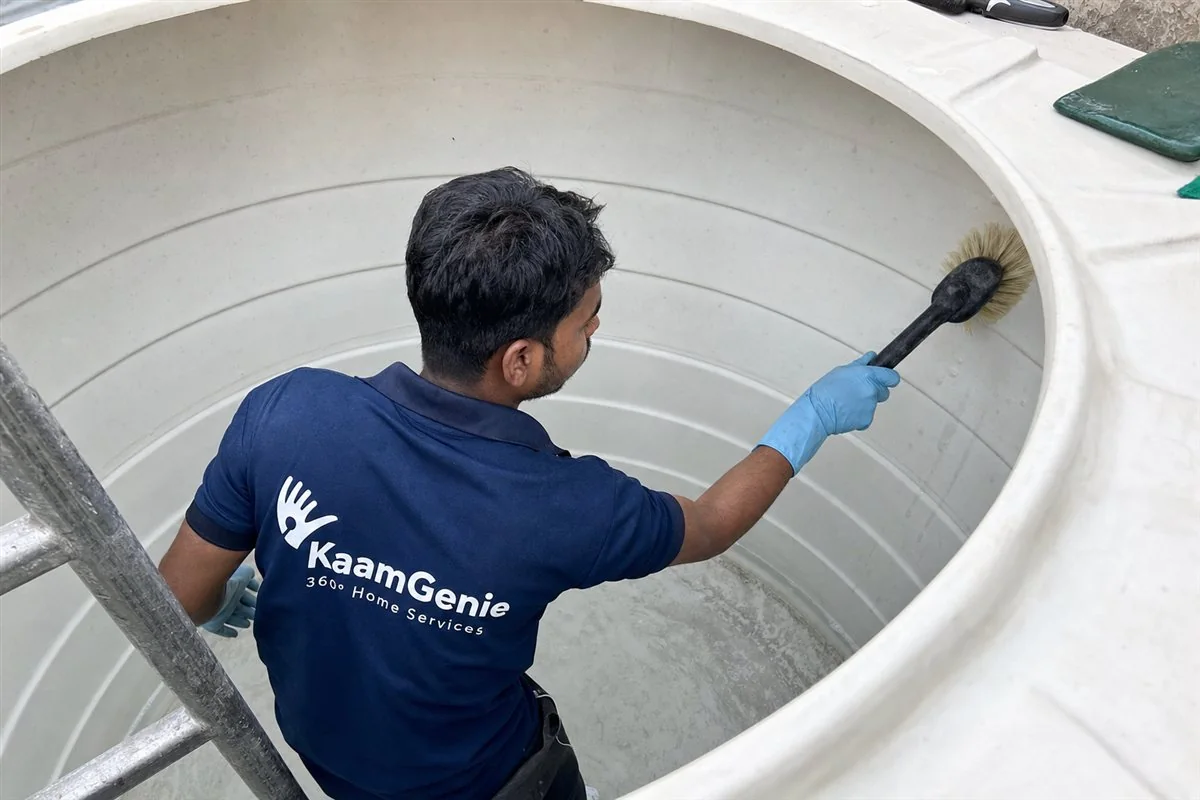
Sintex and plastic tanks are standard home tanks, so they use our fixed, published per-size pricing — the figure quoted on the call is what you pay, with no add-ons when the crew arrives.
| Tank size | Price |
|---|---|
| Up to 500 Litres | ₹699 |
| 501 – 1000 Litres | ₹899 |
| 1001 – 1500 Litres | ₹1,299 |
| 1501 – 2000 Litres | ₹1,499 |
| 2001 – 3000 Litres | ₹1,999 |
| 3001 – 5000 Litres | ₹2,499 |
| 5001 – 10000 Litres | ₹3,999 |
| Above 10,000 Litres | Quoted per visit |
Prices include GST for residential customers; commercial premises get a separate GST invoice. Call 95603 66362 for an exact quote.
Heat drives biofilm. A black Sintex tank on an exposed Delhi roof can cross 40°C inside during summer. That warmth, plus even a thin sediment layer, is ideal for the slimy biofilm that makes water smell “off” long before it looks dirty.
Scratches become traps. Every scratch from a past rough-cleaning becomes a groove that holds sediment and shelters bacteria from disinfectant. This is why we insist on soft brushes only — the goal is to clean the surface without adding new grooves for next time.
Sunlight leak feeds algae. Cracked or ill-fitting lids — common on older white and translucent tanks — let light in, and algae needs nothing more to streak the walls green within weeks. We flag a failing lid and can fit a standard replacement on the spot.
“Sintex” has become the everyday name for any moulded plastic tank, but roofs carry several kinds: single-layer black tanks, opaque white tanks, and triple-layer tanks with a food-grade white inner, a middle insulating layer and a UV-stable outer. The cleaning steps are the same, but triple-layer tanks hold temperature better, so they grow biofilm a little slower than a bare single-layer black tank in full sun.
What never changes is the tooling: soft food-grade brushes, wet vacuum and food-grade disinfectant, never abrasives or harsh acids that damage the plastic. If your tank is concrete or RCC instead, that rougher surface needs a different approach — see our concrete & RCC tank cleaning. For the wider picture, the guide on plastic vs concrete tanks covers which cleans easier and why.
“Will scrubbing scratch or damage my Sintex tank?” No. We use only soft food-grade brushes and pads on the moulded inner wall, never wire brushes or abrasive scourers. Scratches would trap sediment and shelter bacteria, so avoiding them is the whole point. Standard home tanks are cleaned under our fixed pricing from ₹699 — call 95603 66362 to book.
“How often should a plastic rooftop tank be cleaned in Delhi?” Every 6 months for DJB-supplied homes and every 4 months for borewell or tanker-fed homes, because plastic walls in the Delhi sun grow biofilm quickly once sediment settles. Annual cleaning is the bare minimum — below that the water starts to smell and taste off even when it looks clear.
“How much does Sintex tank cleaning cost?” It follows our fixed per-size pricing: from ₹699 for up to 500L, ₹899 for a 1000L standard tank, and up to ₹3,999 for a 5000–10,000L society tank. The price quoted on the call is final — no surprise additions when the crew reaches your roof.
“My tank water smells even though it looks clear — why?” That is almost always biofilm on the inner wall, not the water itself. A warm black plastic tank grows a slimy bacterial film you cannot see, and it is what you smell in the morning fill-up. A proper scrub-and-disinfect removes it, and most customers notice cleaner water within a day or two.
“Do you replace a broken or missing tank lid?” Yes. A cracked or missing lid lets in sunlight, dust and insects, so we carry standard replacement lids for 500L, 1000L and 2000L tanks. Replacement runs ₹500–700 depending on size and is added only if you want it. We will flag a failing lid during the clean.
Looking for Sintex & plastic tank cleaning in your area?
We cover 24 South Delhi localities — Saket, Greater Kailash, Dwarka, Hauz Khas, Lajpat Nagar and more, each with local pricing and details.
Call +91 95603 66362, WhatsApp here, or use the booking button at the top. Same-day where possible across Delhi NCR.