Water Tank Cleaning Cost in Delhi (2026)
Real Delhi tank cleaning prices, no surge, no hidden charges.
 KaamGenie
Home › Services › Hard-Water Tank Descaling
Specialised ServiceBorewell and hard-water tanks build a chalky mineral crust that a normal scrub-and-rinse can’t shift. Descaling uses a controlled food-grade treatment to dissolve calcium and magnesium scale off tank walls, inlets and fittings — the buildup that clogs pipes and kills geysers. Common in the Vasant Kunj and Chattarpur borewell belt. From ₹699, usually added onto a standard clean.
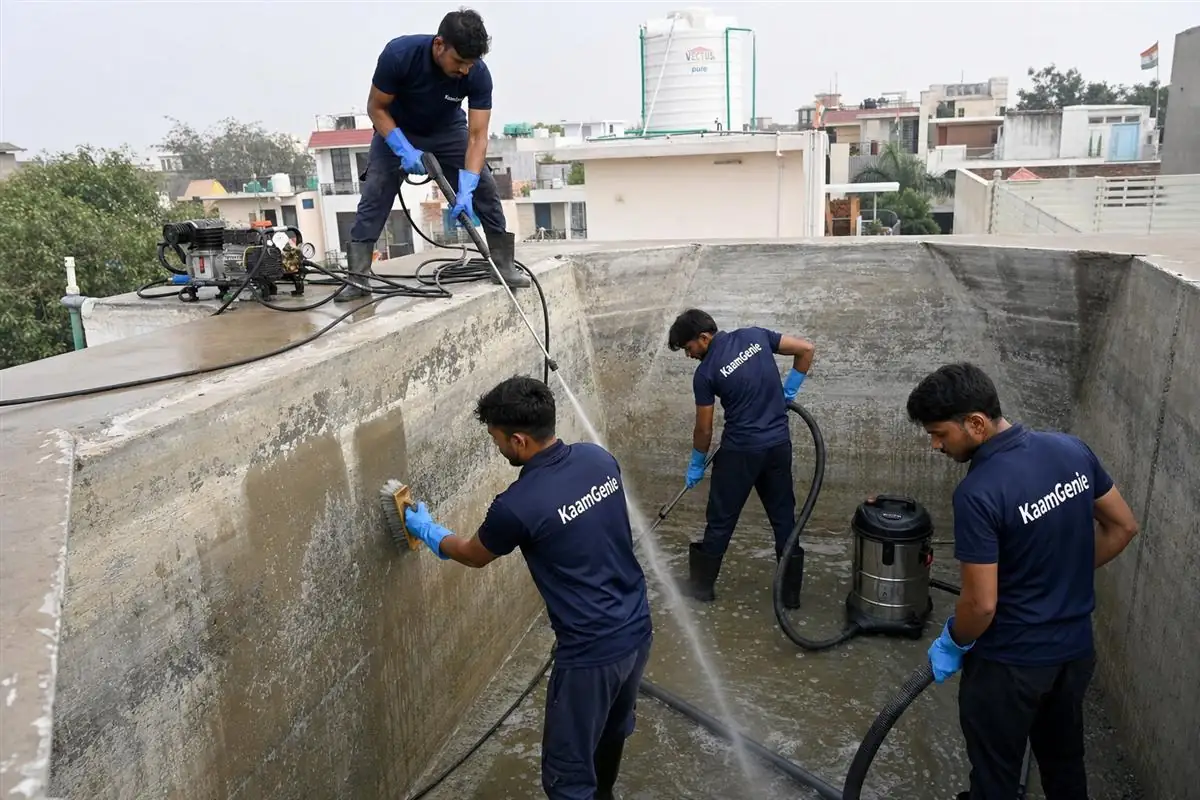
Tank descaling is the removal of hard mineral deposits — the white or grey crust of calcium and magnesium salts that forms wherever hard water sits. Ordinary tank cleaning removes silt, biofilm and algae, but scale is chemically bonded to the surface and a brush alone won’t lift it. Descaling adds a controlled food-grade acidic treatment that dissolves the crust off tank walls, the inlet pipe, the outlet and any fittings, followed by thorough neutralising and rinsing so the water stays safe.
It’s essential for anyone on borewell or hard water — and in Delhi that means a large slice of the city. The Vasant Kunj and Chattarpur borewell belt, older kothis with private wells, and areas with high-TDS supply all see heavy scaling. If your tank walls feel gritty and white, your geyser heats slowly, or your taps and shower heads keep crusting up, the scale in your tank is feeding it. Descaling is usually booked as an add-on to a regular clean rather than on its own.
Same thorough process for every job — no shortcuts.
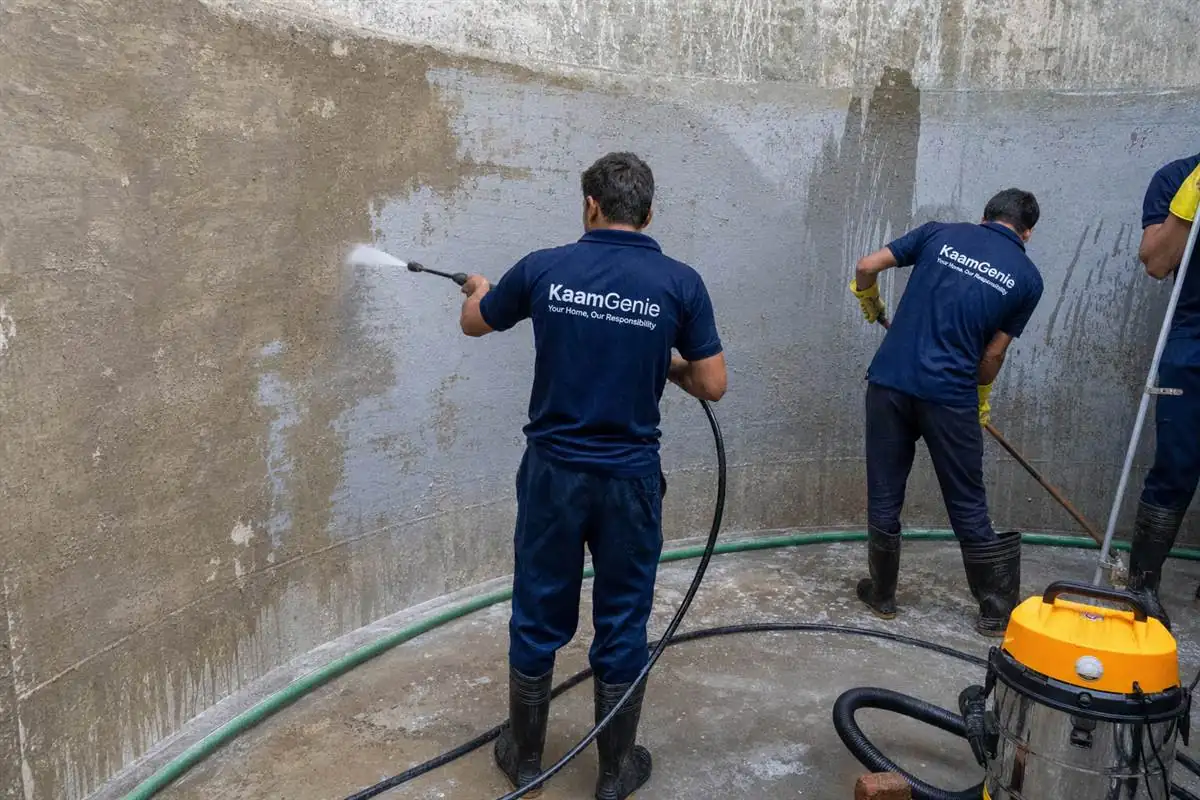
Descaling starts at ₹699 and is almost always priced as an add-on to a standard tank clean, since the tank has to be cleaned first for the treatment to reach the scale. The add-on amount depends on tank size and how heavy the crust is.
| Tank size | Price |
|---|---|
| Up to 500 Litres | ₹699 |
| 501 – 1000 Litres | ₹899 |
| 1001 – 1500 Litres | ₹1,299 |
| 1501 – 2000 Litres | ₹1,499 |
| 2001 – 3000 Litres | ₹1,999 |
| 3001 – 5000 Litres | ₹2,499 |
| 5001 – 10000 Litres | ₹3,999 |
| Above 10,000 Litres | Quoted per visit |
Prices include GST for residential customers; commercial premises get a separate GST invoice. Call 95603 66362 for an exact quote.
Borewell water in South Delhi is genuinely hard. Groundwater across the Vasant Kunj, Chattarpur and kothi belt carries high dissolved calcium and magnesium — high TDS. Every time that water sits and evaporates slightly at the tank surface, it leaves those minerals behind as a solid crust. Over months the walls, inlet and outlet grow a chalky layer that a normal cleaning brush simply skates over.
Scale doesn’t stay in the tank — it travels. The same minerals that crust your tank walls flow on into your plumbing, where they narrow pipes, coat geyser heating elements so they run slow and burn out early, and choke taps, mixers and shower heads. Descaling the tank at source cuts the mineral load feeding all of that downstream damage.
A plain clean can hide the problem. After a standard clean the tank looks tidy, but the bonded scale is still there under the surface film, ready to keep shedding minerals. That’s why hard-water tanks in the borewell belt need descaling on top of a regular overhead tank clean, not instead of it — the clean handles the silt and biofilm, the descaling handles the crust.
It helps to understand the two jobs are different. A standard clean tackles the soft stuff — settled silt, algae and the slimy biofilm on the walls. Descaling tackles the hard stuff — the bonded calcium and magnesium crust that a brush can’t remove. You need the clean done first so the descaling treatment can reach bare scale, which is exactly why we book descaling on top of a regular clean rather than by itself. On borewell tanks it’s worth pairing every second or third clean with a descale.
Because the treatment is acidic, the two steps that matter most are dosing to the scale (not overdoing it) and fully neutralising and rinsing afterwards, so no residue reaches your drinking water. We match strength to your TDS and crust thickness, then disinfect after neutralising. If your whole property runs on hard borewell water, a scheduled AMC that includes periodic descaling keeps scale from ever rebuilding to the point it damages your pipes and geyser.
“How is descaling different from normal tank cleaning?” A normal clean removes soft deposits — silt, algae and biofilm — by draining, scrubbing and vacuuming. Descaling removes the hard white mineral crust of calcium and magnesium that’s chemically bonded to the walls and won’t brush off. It uses a controlled food-grade treatment to dissolve that scale. On borewell tanks you generally need both: the clean, then the descale on top.
“Why is descaling booked as an add-on rather than on its own?” Because the tank has to be cleaned first. Silt and biofilm sit over the scale, so the descaling treatment can’t reach the mineral crust until that soft layer is drained, scrubbed and vacuumed away. That’s why we run the standard clean, then apply descaling to the exposed scale. Descaling starts at ₹699 and is added to the clean’s price based on tank size and crust thickness.
“Which Delhi areas need descaling most?” The borewell and hard-water belt — Vasant Kunj, Chattarpur, and older kothis on private wells — along with any high-TDS supply area. If your tank walls feel gritty and chalky white, your geyser heats slowly, or taps and shower heads keep crusting, that’s hard water and your tank is scaling. Those properties benefit from descaling every second or third clean.
“Is the descaling treatment safe for drinking water?” Yes, when done properly. We use a food-grade descaling solution matched to your water hardness, then fully neutralise any residual acidity, disinfect, and finish with a complete clean-water rinse. Nothing acidic is left in the tank — the walls are smooth and residue-free before we refill. The two safeguards that matter most are correct dosing and thorough rinsing, and both are built into the process.
“Will descaling protect my geyser and pipes?” It helps at the source. The calcium and magnesium that crust your tank flow on into your plumbing, narrowing pipes and coating geyser elements so they run slow and fail early. Descaling the tank cuts the mineral load feeding that downstream buildup. On hard borewell water, pairing periodic descaling with regular cleaning — ideally on an AMC — keeps scale from rebuilding to a damaging level.
Call +91 95603 66362, WhatsApp here, or use the booking button at the top. Same-day where possible across Delhi NCR.