
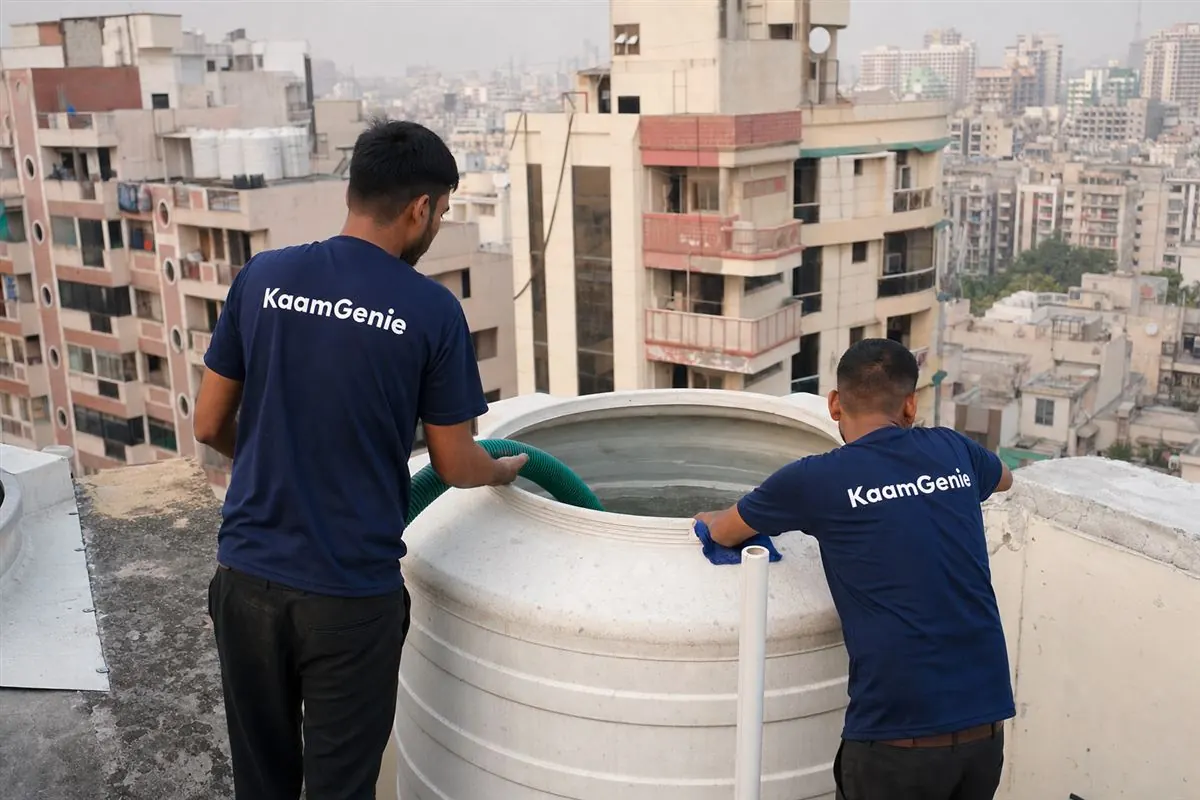
The short version for Dwarka
- Dwarka is mostly CGHS towers — water lands in a basement underground reservoir (UGR), then is pumped up to rooftop tanks. Both have to be cleaned together.
- The basement reservoir is the priority — it feeds every flat, so a dirty UGR re-contaminates every clean tank above it.
- Common tanks are arranged by the society AOA / RWA; private flat tanks can be booked individually.
- Tanker top-ups in summer and hard groundwater are why many Dwarka societies move the reservoir to a quarterly schedule.
- Residential tanks start at ₹699; society / reservoir work is surveyed once and quoted as a fixed price per cycle.
If your society cleans the rooftop tanks but never opens the basement reservoir, you’re only doing half the job.
Dwarka isn’t a typical Delhi neighbourhood of plotted houses and builder floors. It was planned as a sub-city of cooperative group-housing societies — the DDA allotted land to societies that built clusters of towers, sector by sector, from the older Sector 1 to 6 societies out to the dense Sector 7, 10, 11, 12, 13, 18A, 22 and 23 belts. Almost everyone here lives in a flat inside a society, and almost every society shares its water through the same kind of system. That single fact — reservoir below, tanks above, shared by everyone — is what makes tank cleaning in Dwarka different from the rest of the city. If you want the wider picture first, our Delhi area-wise guide maps how the water changes zone by zone.
How water actually reaches your flat in Dwarka
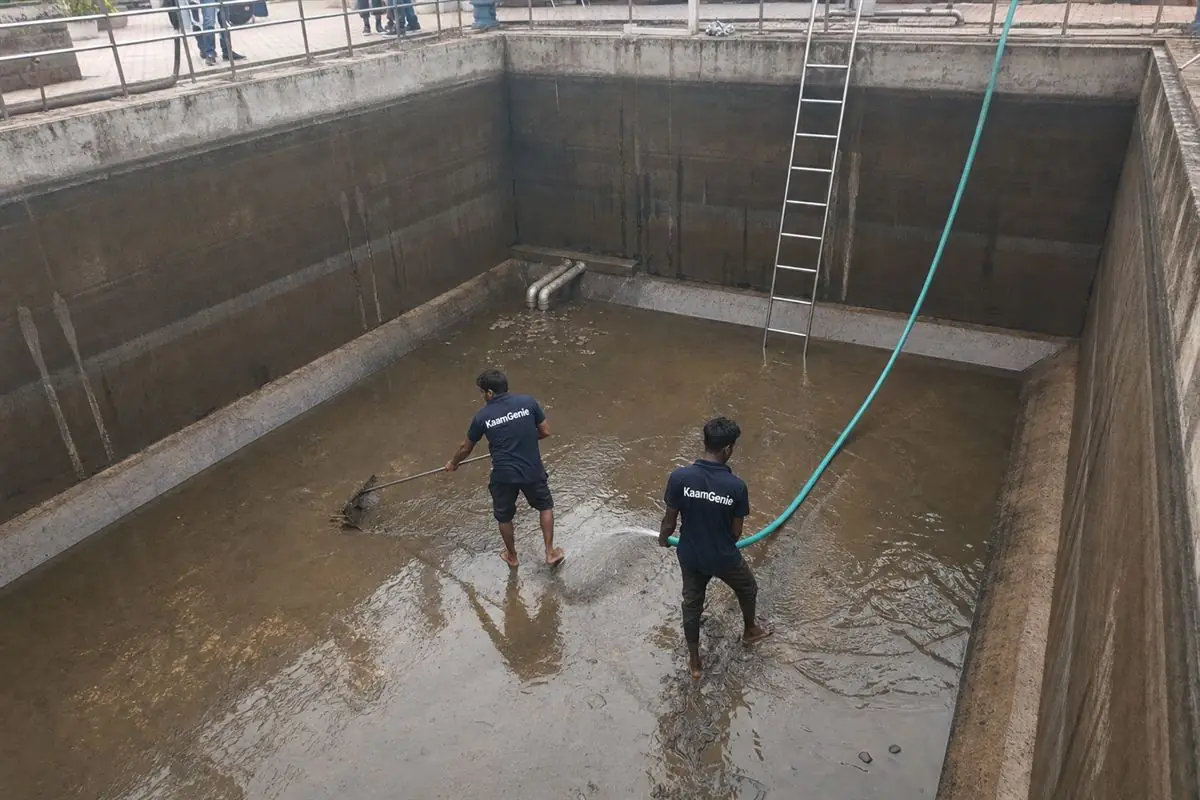
In a Dwarka society, water from the Delhi Jal Board (DJB) piped line — topped up by private water tankers when supply is short — arrives at ground level and fills a large underground reservoir, usually in or under the basement. From there, the society’s pumps lift it up to the overhead tanks on each tower’s roof, and gravity carries it down to your taps. So your drinking water passes through two storage stages before you ever see it: the shared basement UGR, then the tower’s rooftop tank.
That two-stage chain is the whole point. If the rooftop tank is spotless but the basement reservoir has half an inch of silt on the floor, the pumps push that contamination straight up every day. You can clean the rooftop tank perfectly and still have cloudy or smelly water within weeks, because the source it draws from was never touched. A real Dwarka cleaning treats the reservoir and the tower tanks as one connected system — which is also the difference between overhead and underground tank cleaning that many residents don’t realise they need both of.
Why the basement reservoir is the job that matters most
The underground reservoir holds the most water, sits at the lowest point, and feeds everything above it. Sediment, sand, rust off the inlet pipe, and whatever a tanker load brought in all settle to its floor and stay there. Because it’s out of sight in the basement, it’s also the tank most societies forget — residents see the rooftop tanks on the terrace but rarely the reservoir below.
When we survey a Dwarka society, the reservoir is almost always the dirtiest part of the system and the one carrying the real risk. Our crews drain it fully, hand-scoop the settled sludge, scrub the walls and floor, jet-wash the corners and around the inlet and pump suction, vacuum out the residual dirty water, and disinfect with food-grade chlorine before refilling. The detailed step-by-step is the same disciplined sequence we describe in our water tank cleaning process guide — we don’t cut it short just because the reservoir is large and awkward to reach.
| Part of the system | Where it sits | Typical size | Cleaning priority |
|---|---|---|---|
| Underground reservoir (UGR) | Basement / ground level | Large — feeds the whole society | Highest — clean quarterly for big societies |
| Tower rooftop tanks | Each tower’s terrace | One or more per tower | High — at least twice a year |
| Private flat overhead tank | Terrace / service shaft | Small (single flat) | Owner-arranged, twice a year |
| Inlet pipe & pump suction | Reservoir feed | — | Cleaned with the reservoir |
Book a Dwarka society survey
One free survey of your reservoir and tower tanks, then a fixed written quote per cleaning cycle for the AOA. Residential tanks ₹699 onwards.
Tanker water and the Dwarka summer crunch
Dwarka’s water has always been tight in summer. When the DJB piped supply drops through the May and June peak, societies fall back on private water tankers to keep the basement reservoir filled. Tanker water keeps the taps running, but it’s variable — some loads carry noticeably more silt and fine sediment than the piped supply, and in a big reservoir that sediment settles fast and builds up at the bottom over a season.
The practical result is that a society leaning hard on tankers through summer ends up with a dirtier reservoir than one on steady piped water. That’s why we often suggest an extra reservoir cleaning right after the worst of the tanker season — so a summer’s worth of settled sediment isn’t sitting in the sump all through the monsoon, when warmth and any contamination encourage bacterial growth. If your society is heavily tanker-fed, plan the cleaning calendar around that reality rather than a fixed date on paper.
Hard water, scale and what cleaning can and can’t fix
Many Dwarka pockets draw on hard groundwater, and where the water is hard you get mineral scale — the chalky, crusty deposit that builds on tank walls, floors and around fittings. Cleaning removes the existing scale, biofilm and sediment, but it doesn’t soften the water coming in, so scale slowly returns. The honest framing: regular cleaning keeps that scale thin and easy to remove instead of letting it harden into a thick crust that needs aggressive descaling later. We go deeper on this in our hard water tank cleaning guide, which is worth a read if your fittings show white deposits or your geyser scales up quickly.
This is the single biggest reason Dwarka societies move the reservoir to a quarterly schedule rather than twice a year: hard water plus heavy tanker use means scale and sediment accumulate faster than the city average, and staying ahead of it is cheaper and easier than catching up.
Who arranges cleaning — AOA, RWA, or flat owner?
Because Dwarka runs on cooperative group-housing societies, most tanks are common property. The basement reservoir and the shared tower rooftop tanks serve every flat, so they’re arranged by the society’s Apartment Owners Association (AOA) or its RWA / managing committee — not by individual residents. In practice the committee approves a cleaning schedule and the building caretaker coordinates dates and access with our crew. Societies that want a standing arrangement usually set up an annual contract; our note on RWA annual cleaning contracts covers how those are structured and documented.
If you own a flat with its own private overhead tank — separate from the shared supply — you can book that yourself, independently of the society schedule. And if your AOA hasn’t organised a cleaning in a while, a single resident raising it (with the date of the last cleaning, or the lack of one) is often what gets the whole society onto a proper schedule.
Sector coverage across Dwarka
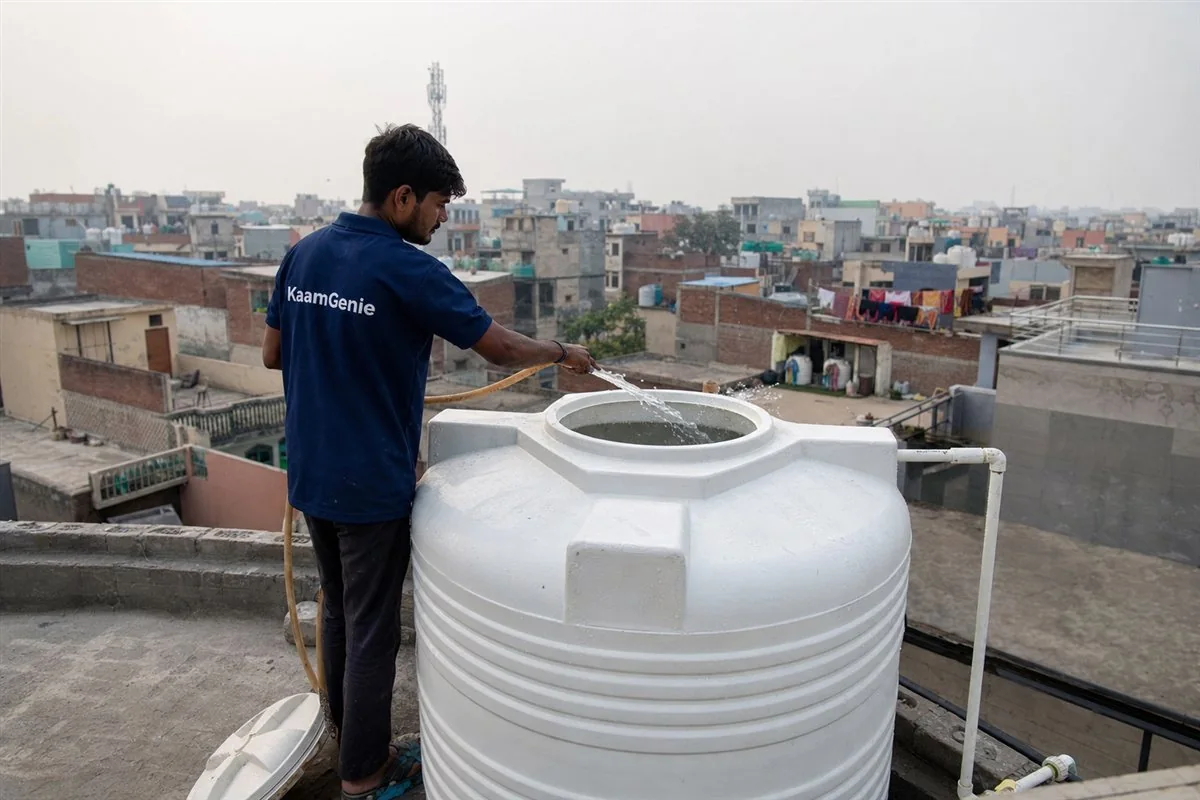
We cover the full spread of Dwarka, sector to sector — the older Sector 1 to 6 societies, the dense Sector 7, 10, 11, 12, 13, 18A, 22 and 23 belts, the pockets around Dwarka Mor, and the connecting stretches toward neighbouring areas. The crew, the method and the fixed pricing are identical wherever you are; only the building type — single tower, multi-tower CGHS, or private flat — changes the quote. You can see the Dwarka service details and book directly on our Dwarka water tank cleaning page.
Dwarka also sits next to several areas we serve on the same routes, so if your society straddles the edge of the sub-city it makes no difference to scheduling — we already run crews through Mahipalpur and out to Najafgarh nearby. For the citywide picture and pricing logic, our main water tank cleaning in Delhi hub and the NCR-wide water tank cleaning services page tie it all together.
What it costs and how often to do it
For a single private overhead tank in a Dwarka flat, residential cleaning starts at ₹699. Society work is quoted per building because the cost drivers are real and specific: the number of tower rooftop tanks, the capacity of the basement reservoir, and how accessible everything is. A single G+ tower with one rooftop tank and a modest sump is a small job; a 12-tower CGHS with one large UGR is a planned, multi-crew job staged across a day or two. We survey once, give the AOA a fixed written quote per cleaning cycle, and there are no surprises on the day. The honest cost logic across the city is laid out in our water tank cleaning cost in Delhi guide.
On frequency, BIS IS 10500 and WHO guidance support cleaning stored-water tanks at least twice a year. For Dwarka we treat that as the floor for tower rooftop tanks, and push the basement reservoir to quarterly for larger societies because of the hard-water and tanker realities above. The aim is simple: keep every link in the reservoir-to-rooftop chain clean at the same time, on a schedule, so the water reaching your tap is genuinely safe and not just stored neatly.
Recommended Dwarka cleaning frequency — cleanings per year
The reservoir runs ahead of the rooftop tanks because it feeds everything and takes the tanker sediment
Minimum twice a year per BIS / WHO guidance; the reservoir runs more often in Dwarka because of hard water and summer tanker top-ups. Exact cadence is set during the survey.
Get your society on a clean-water schedule
Reservoir and tower tanks cleaned together, before/after photos, a dated certificate for your AOA records. Standard residential cleaning ₹699 onwards.
Booking it for your Dwarka home or society
For a private flat tank, booking is the same as anywhere — call, WhatsApp, or use the form, and we confirm a slot. For a society, the first step is a survey: we walk the basement reservoir and the tower terraces, note the tanks and capacities, and hand the AOA a fixed written quote per cleaning cycle. From there the committee approves a schedule, the caretaker holds the access, and we stage the work tower by tower with as little supply disruption as possible. Whether it’s a single flat or a 12-tower CGHS, you get before/after photos and a dated certificate for your records. The full pricing and area detail live on the water tank cleaning in Delhi hub.
Frequently asked questions
How much does water tank cleaning cost in Dwarka?
A single residential overhead tank in a builder floor or DDA flat starts at ₹699. Dwarka society work is quoted per building because the variables are the number of tower tanks, the size of the basement underground reservoir, and access — a single G+ tower with one rooftop tank and a shared sump is very different from a 12-tower CGHS with one large UGR. We survey the society once, then give the AOA a fixed written quote per cleaning cycle with no surprises on the day.
How often should a Dwarka society clean its tanks and reservoir?
BIS and WHO guidance points to cleaning stored-water tanks at least twice a year. In Dwarka we recommend that as a minimum for tower rooftop tanks, and we usually push the big basement reservoir to once a quarter for larger societies — it holds the most water, feeds every flat, and tanker top-ups in summer dump sediment straight into it. Hard groundwater and heavy summer tanker use are the two reasons many Dwarka AOAs move to a quarterly schedule for the UGR.
Do you clean the basement underground reservoir, not just the rooftop tanks?
Yes, and in a Dwarka society the basement UGR is the more important job. Water arrives there first — from the DJB line or a tanker — settles, and is then pumped up to the tower tanks. If the reservoir is dirty, every rooftop tank above it is being re-contaminated continuously. We clean the UGR and the tower tanks as one coordinated job so the whole chain is clean at the same time, not one part while the other re-pollutes it.
Our society runs on tanker water in summer — does that change the cleaning?
It changes the frequency, not the method. Tanker water is variable — some loads carry more silt and sediment than DJB piped supply, and it settles fast in a large reservoir. Societies that rely heavily on tankers through the May–June peak benefit from an extra reservoir cleaning right after the worst of the tanker season, so the season’s accumulated sediment isn’t sitting in the sump all monsoon.
Who arranges tank cleaning in a Dwarka CGHS — the AOA, the RWA, or individual flat owners?
For shared tanks and the common basement reservoir, it is the society’s AOA or RWA / managing committee that arranges it, because those tanks serve every flat and sit on common property. Individual flat owners with their own private overhead tank can book that separately. In practice most Dwarka societies put the common tanks on a maintenance schedule through the AOA and we coordinate dates with the building caretaker.
Which Dwarka sectors do you cover?
All of them — the cleaning crew covers the full spread of Dwarka sectors from the older Sector 1–6 societies through the dense Sector 7, 10, 11, 12, 13, 18A, 22 and 23 belts, plus Dwarka Mor and the connecting pockets toward Najafgarh and Mahipalpur. Coverage and fixed pricing are the same across every sector; only the building type changes the quote.
Will hard-water scale come back right after cleaning?
Cleaning removes the existing scale, biofilm and sediment; it does not change the hardness of the water coming in. Where a society draws hard groundwater, mineral scale will slowly rebuild — which is exactly why a twice-a-year (or quarterly for the reservoir) schedule matters. Regular cleaning keeps scale thin and easy to remove instead of letting it bake into a thick crust that needs aggressive treatment later.
How long does cleaning a full Dwarka society tower take?
A single G+ tower with one rooftop tank takes roughly 90 minutes to two hours. A large basement reservoir takes two to four hours depending on capacity and access. For a multi-tower CGHS we bring more than one crew and stage the work tower by tower over a day or across a couple of days, planned around the society’s water timing so supply disruption is minimal.
Do you provide a cleaning certificate for our AOA audit records?
Yes. Every job comes with before/after photos and a dated cleaning record listing each tank and reservoir cleaned, capacity, the food-grade disinfectant used and the crew. AOAs and managing committees use this for their maintenance audit trail and to show residents the common tanks are genuinely on a schedule — not just on paper.
Sources & references
- Bureau of Indian Standards (BIS) — IS 10500:2012 is the canonical Indian Standard for drinking water specification, defining acceptable limits for physical, chemical, and biological parameters.
- WHO Guidelines for Drinking-water Quality, 4th edition — the global reference for water quality standards, including guidance on storage and disinfection.
- Food Safety and Standards Authority of India (FSSAI) — defines water quality requirements for food businesses, including hygiene standards for stored water and acceptable disinfection chemicals.
- WHO Fact Sheet on Drinking Water — overview of safe drinking water requirements and contamination risks.
- CPHEEO — Manual on Water Supply and Treatment — the Government of India’s engineering manual covering tank design, cleaning protocols, and disinfection practices.
Last verified: 30 June 2026. If you find any of these links broken, please let us know.