
Quick answer
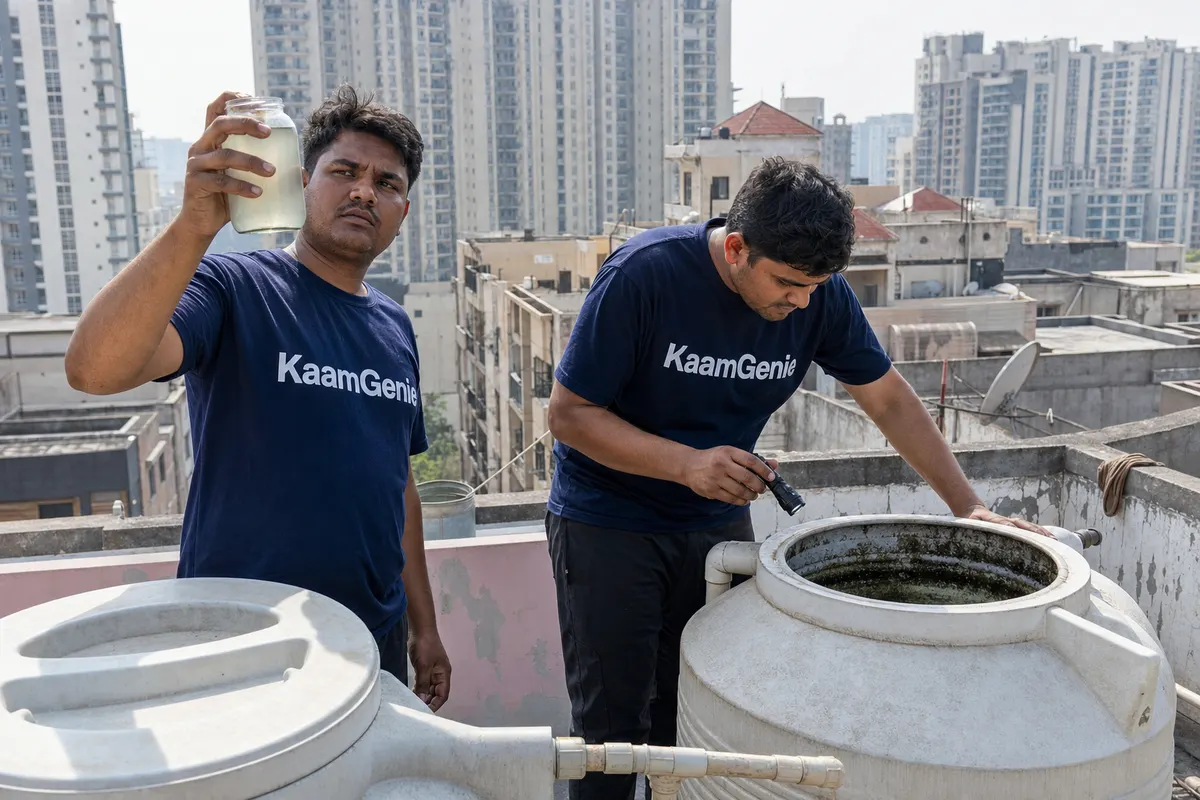
- What the tank holds: water from your building’s sewage treatment plant (STP), piped only to WC cisterns and sometimes gardens. It is meant for flushing, not for drinking, cooking or bathing.
- Why it smells: treated water still carries some organic matter. In a warm, dark tank, a soft sludge and slime build up, and where oxygen runs out bacteria in that layer produce hydrogen sulphide, the rotten-egg gas.
- Why cisterns clog: the same slime and fine sludge travel to your bathroom, coat floats and seals, and slow the fill.
- What fixes it: cleaning the flushing tanks (and the cisterns), plus the facility team checking that the STP is working well. Cleaning alone cannot fix a poorly running plant.
If a drinking-water tap ever smells like the flush, stop using it and tell the facility team at once.
Flush smells of rotten eggs?
We clean flushing and treated-water tanks in Gurgaon towers, slime and sludge out, before and after photos on WhatsApp, and you pay after the job once you have seen them.
Gurgaon’s fresh water is precious, and buildings are increasingly expected to reuse what they can. Haryana adopted a policy on reusing treated wastewater in 2019 that pushes treated water towards non-drinking uses, and many large residential and commercial projects already run an on-site STP whose output goes back into the building for flushing. That means two separate pipe networks in one tower, and two separate families of tanks. This post is about the second family. Our crews clean both kinds as part of water tank cleaning in Gurgaon, and they treat them very differently.
Two pipe systems in one tower
In a dual-plumbed building, the water you drink and the water you flush with never meet. Fresh supply (GMDA water, borewell or tanker) fills the domestic sump and the domestic terrace tanks, which feed kitchens, basins and showers. Sewage from every flat goes to the STP, usually in the basement or a corner of the site. Treated water from the STP is stored in its own underground tank, pumped to its own terrace tank, and piped down to the WC cisterns, and in some projects to garden taps and cooling units.
If you are not sure whether your flat is dual-plumbed, ask the facility office; they will have the plumbing drawings. A hint you can see yourself is a cistern whose water looks faintly yellowish or cloudy compared with your basin tap. Working out which tank feeds which line is a job for the building’s plumber, not something we trace.
Why recycled water fouls a tank faster
Treated water from a well-run STP is clear and close to odourless, but it is not the same as fresh supply. It still carries some dissolved organic matter and nutrients, and small amounts of fine solids that escaped the filters. Put that into a tank that is warm for much of the year, dark inside and rarely opened, and three things happen.
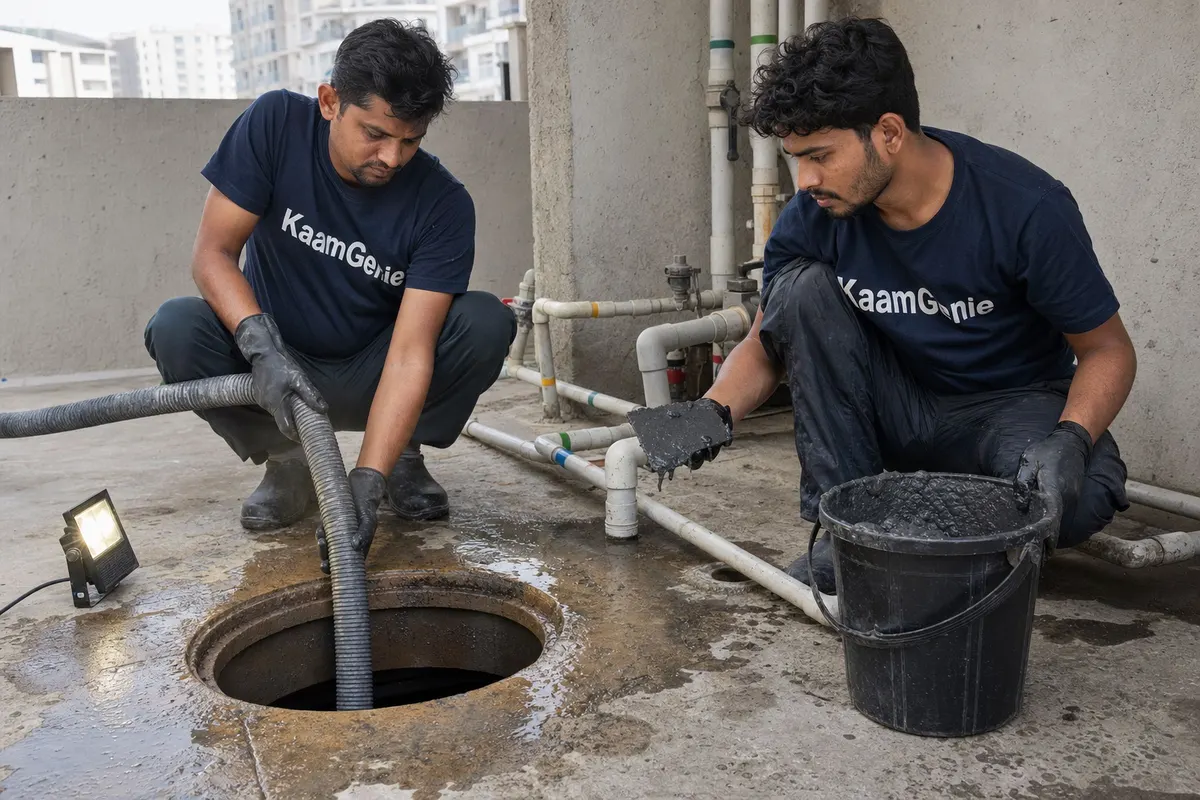
- A soft sludge settles. Fine solids and dead bacterial matter collect on the floor as a dark, loose layer, quite unlike the gritty silt in a fresh-water sump.
- Slime grows on every surface. Biofilm coats the walls, the inlet pipe and the float valve, and pieces break off and travel with the water.
- Oxygen runs out at the bottom. Inside that sludge, bacteria that do not need oxygen take over, and some of them turn sulphate in the water into hydrogen sulphide. That is the rotten-egg smell, and it is released every time water is drawn and a cistern refills.
The general mechanics of that smell are covered in our post on smelly tank water in Gurgaon. In a flushing tank, the difference is the feed: the water arrives with more food for bacteria, so the layer builds up quicker. When our crews open a flushing tank next to a drinking-water tank in the same tower, the flushing tank often holds the darker, slimier deposit, for that reason.
Read the symptom before you call anyone
Not every flush problem is the tank. The table below sorts the common ones by where they really start, so you know whether to call the facility office, a plumber or a cleaning crew.
| What you notice | Most likely source | Who to call |
|---|---|---|
| Rotten-egg smell each time you flush, in many flats | Sludge and slime in the flushing tanks, or STP output below par | Facility team: STP check plus flushing-tank clean |
| Smell only in your flat, neighbours fine | Slime inside your own cisterns, or a dry floor trap | Clean your cisterns; plumber for traps |
| Grey or black slime on the float, flapper or cistern walls | Biofilm carried from the tank, growing on in the cistern | Tank clean, then cistern clean |
| Flush keeps running or dribbles into the pan | Slime or grit stopping the flush valve seal from closing | Plumber to clean or replace the seal |
| Cistern refills very slowly | Fine sludge choking the small inlet valve, or low pressure on the flush line | Plumber; tank clean if the tank is the source |
| Cloudy, yellowish or foamy flush water across the tower | STP not treating well | Facility team and STP operator first |
| Drinking or basin tap smells or looks like flush water | Possible cross-connection between the two systems | Stop use; facility team and plumber urgently |
A five-minute cistern check
This tells you whether slime has reached your bathroom and gives the facility team something concrete to go on. Wear gloves; this is treated sewage water.
- Lift the cistern lid (for a concealed cistern, remove the flush plate; most clip off). Look at the water: it should be clear, not grey or cloudy.
- Wipe the inside wall below the waterline with a white tissue. A slippery grey or black smear is biofilm.
- Look at the float and the flush valve seal. Dark slime or gritty deposits there explain a running flush or a slow fill.
- Flush and time the refill. Note roughly how long it takes, and compare with another bathroom or a neighbour on the same line.
- Sniff twice: once at the cistern as it refills, once at the floor drain. A smell at the cistern points to the water; a smell at a dry floor drain points to the trap, which a mug of water often settles.
- Check a drinking-water tap last. Run the kitchen tap into a clean glass. It must look and smell completely different from the cistern water.
Photograph what you find and send it to the facility office. Several flats reporting the same thing on the same day is the quickest way to get the flushing tanks and the STP looked at together.
The rule that matters most: never cross-connect
Everything above is a nuisance. A cross-connection is a health risk. It means any pipe, hose or valve that lets flushing water reach the drinking-water system, even for a moment. Treated water is fine in a cistern and wrong in a glass, a cooking pot or a bucket used for bathing a child.
How it happens in practice:
- A shortcut during a shortage. When the STP output falls, someone links the fresh line to the flushing line with a valve so cisterns keep working, and later that valve is opened the wrong way or left open under pressure.
- Plumbing changes inside a flat. A renovation joins a basin, health faucet or washing-machine point to the wrong line, because the pipes look identical.
- Backflow through a submerged inlet. A fresh-water top-up pipe that ends below the water level of the flushing tank can, under the wrong pressure conditions, draw flushing water back into the fresh line.
The safe principle is one-way only. Fresh water may top up the flushing tank when the STP is short, but only through a clear air gap: the fresh pipe ends well above the tank’s overflow level and pours in from above, so nothing can be drawn back. Flushing water must never flow towards drinking water by any route. Clearly marking treated-water taps and pipes as not for drinking, if your building has not done it already, helps plumbers and residents keep the two networks apart. If you suspect a cross-connection, stop using the affected taps for drinking, cooking and bathing, tell the facility team, and have a plumber check the lines. When it is fixed, the drinking-water tanks should be cleaned, and that is one of the cases where disinfection, on request, makes sense; see tank disinfection in Gurgaon for when it is worth asking for.
Where you live changes who acts
Flushing tanks are a building system, so who fixes a smell depends on how your building is run.
- Large societies and condominiums with an STP. The AOA or facility team owns both the plant and the flushing tanks. A tower-wide smell is their problem to solve, usually by checking the STP and cleaning the treated-water tanks together. See society tank cleaning in Gurgaon and condominium tank cleaning for how those visits are planned.
- New towers on the expressway corridors. In recently handed-over projects, flushing tanks may still hold construction residue alongside early STP sludge, while the plant is still being run in. Raise it with the developer’s maintenance team. Our Dwarka Expressway post covers the handover stage.
- Offices and commercial buildings. Washroom odour is the first complaint tenants raise, and the same STP-tank-cistern chain applies. Weekend slots make it easier to take the flushing side out of service.
- Builder floors and plotted houses. These are rarely dual-plumbed, so a rotten-egg flush smell there almost always comes from your ordinary tank or the geyser. Start with our smell guide instead.
We work with facility teams across the city, including Sector 83, Sector 106 and Golf Course Extension.
How KaamGenie cleans a flushing tank
The full sequence for any tank is in the Gurgaon cleaning process guide. A treated-water tank changes four parts of it:
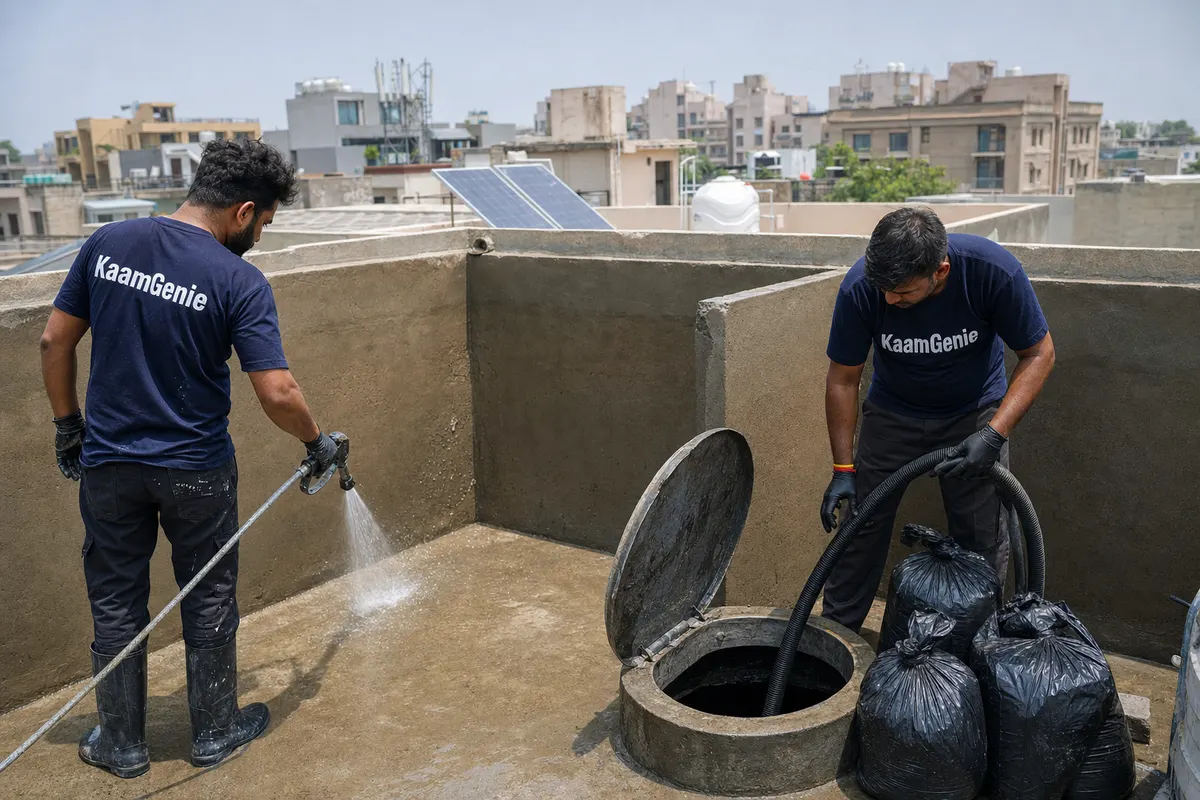
- The drain-out goes where the facility team says. Treated water and sludge are not run onto the road or into a stormwater drain. The water is usually sent back to the building’s sewer line or the STP inlet, and the sludge is scooped and vacuumed out of the tank.
- Slime comes off by hand. Biofilm clings to walls, the inlet pipe and the float valve, so those are scrubbed before the jet wash, then the loosened slime and sludge are wet-vacuumed out.
- Drinking-water tanks first. If both kinds of tank are cleaned on the same visit, the sensible order is drinking-water tanks first and flushing tanks last. Ask for that order when you book.
- No chemicals by default. The smell lives in the sludge, and removing the sludge is what removes it. If your facility policy asks for disinfection of the flushing tank, it is available on request.
Before and after photos of each tank come to you on WhatsApp. For tanks that store drinking water, our recommendation is a clean every 3 months; for flushing tanks, the right timing depends on how well your STP runs, so agree it with the facility team and use our post on how often to clean a tank in Gurgaon as a reference.
What cleaning can and cannot do
- It can remove the sludge and slime that produce the rotten-egg gas, and stop the tank sending fresh biofilm to every cistern.
- It cannot make a struggling STP produce good water. If the plant is overloaded or poorly run, the tank fouls again quickly. That fix sits with the STP operator.
- It cannot clear slime already in your cisterns or replace worn flush valve seals. Clean the cisterns after the tank, and call a plumber for seals and inlet valves.
- It cannot find or fix a cross-connection. That is plumbing work, and it comes first.
Facility team chasing a tower-wide flush odour?
Tell us how many flushing tanks you have and where they sit. Larger treated-water tanks are quoted by size, and the price is fixed before work begins.
What not to do
- Do not use flushing water for anything that touches your body or food. Not for drinking, cooking, brushing, bathing, washing vegetables or rinsing a baby bottle, even if it looks clear.
- Do not link the fresh and flushing lines with a direct pipe or valve, even temporarily. Top-ups go through an air gap only.
- Do not drop strong cleaners, acids or bleach tablets into the flushing tank yourself. They do not remove sludge, and a strong dose can upset the treatment process if it reaches the STP.
- Do not rely on in-cistern fragrance blocks to hide the smell. They mask it for a while, and some can be hard on rubber seals.
- Do not lean into or enter an underground flushing tank. Hydrogen sulphide is heavier than air and can collect in a closed tank; leave the inside to a properly equipped crew.
- Do not ignore a drinking tap that smells like the flush. Treat it as a possible cross-connection until a plumber says otherwise.
Book a flushing-tank clean
For a tower, start with the facility office: share how many treated-water tanks there are, roughly how big, and where they sit, and we quote by size with the figure fixed before any tank is drained. Where a building also wants its domestic tanks done, a single terrace tank is from ₹699 and a small sump from ₹1,499. Payment comes after the cleaning, when you have seen the before and after photos. Sunday and weekend slots are available. See the Gurgaon tank cleaning page for coverage, read the complete guide to water tank cleaning in Gurgaon, or call +91 95603 66362. The other non-drinking tank in most towers, the fire reserve, has its own guide: cleaning fire-fighting tanks in phases.
Frequently asked questions
Why does my flush smell of rotten eggs in a Gurgaon high-rise?
In a dual-plumbed tower, the flush runs on water treated by the building’s own STP. That water still carries some organic matter, and in a warm, dark flushing tank a soft sludge and slime build up. Where oxygen runs out inside that layer, bacteria produce hydrogen sulphide, which smells of rotten eggs and is released as cisterns refill. Cleaning the flushing tanks removes the source; the facility team should also confirm the STP is running well.
Is it safe to use STP flushing water for bathing or cleaning?
Use it only for what it is supplied for, which is flushing and, in some buildings, gardening. Do not drink it, cook with it, brush your teeth with it, bathe with it or use it to wash utensils or vegetables, even when it looks clear. Treated water is not drinking water, and its quality depends on how well the plant is running on any given day.
How do I know if my flat has dual plumbing?
The facility office or developer can confirm it from the plumbing drawings, and most large societies and condominiums with an on-site STP are dual-plumbed. A visible hint is cistern water that looks faintly yellow or cloudy next to water from your basin tap. Working out exactly which pipe feeds which outlet is a job for the building’s plumber; we do not trace or label lines.
Why does my cistern keep running or fill so slowly?
Slime and fine sludge carried from the flushing tank coat the flush valve seal so it cannot close fully, which makes the flush dribble, and they choke the small inlet valve so the cistern fills slowly. Cleaning the flushing tank stops new deposits arriving, but the cistern itself still needs cleaning, and a worn seal or blocked inlet valve should be cleaned or replaced by a plumber.
Can flushing water get into my drinking water?
Only through a fault, which is called a cross-connection: a pipe, valve or hose joining the two systems, a renovation that connected a tap to the wrong line, or a submerged fresh-water top-up pipe inside the flushing tank. Fresh water may top up the flushing tank through an air gap, never the other way. If a drinking tap ever smells or looks like flush water, stop using it and get the facility team and a plumber to check.
Can the smell be removed from a flushing tank without chemicals?
Yes. No chemicals are used by default. The smell comes from the sludge and slime, so the crew scrubs the walls, inlet and float valve, jet washes, and wet-vacuums the loosened deposits out, until the floor is clear of sludge. If your facility policy asks for disinfection of the flushing tank, it is added on request. Dosing the tank yourself is not a good idea, because strong products can reach and upset the STP.
Will cleaning the tank fix the smell for good?
It removes the deposits that are producing the smell now, and the improvement is usually clear once fresh treated water comes through. How long it lasts depends mostly on the STP. A plant that is well run sends cleaner water and the tank fouls slowly; an overloaded or poorly maintained plant sends more organic matter, and the sludge returns sooner. That is why we suggest the STP is checked at the same time.
How much does flushing tank cleaning cost in Gurgaon?
Treated-water tanks in towers vary widely, so they are quoted by size, and the price is agreed before any tank is drained. Where the same visit includes smaller domestic tanks, an overhead tank starts at ₹699 and a small sump at ₹1,499. You pay once the work is finished and you have seen the before and after photos of each tank.
Sources & references
- CPHEEO (Central Public Health and Environmental Engineering Organisation): Government of India manuals on sewerage, sewage treatment and the recycling of treated water.
- Central Pollution Control Board (CPCB): national body that sets discharge standards for treated sewage from STPs.
- WHO Guidelines for Drinking-water Quality, 4th edition: guidance on protecting drinking water, including cross-connections and backflow.
- Government of Haryana: state portal; Haryana adopted its Reuse of Treated Waste Water Policy in 2019 for non-drinking uses of treated water.
Last verified: 23 November 2026. If you find any of these links broken, please let us know.