
Quick answer
- Why it gets dirty: reserve water barely moves, so silt from supply and tanker fills, rust from metal fittings and any dust that gets in settle into a layer on the floor, next to the pump suction.
- Why it matters: that layer can be pulled into suction strainers and foot valves when the pumps start, which is exactly the moment you need full flow.
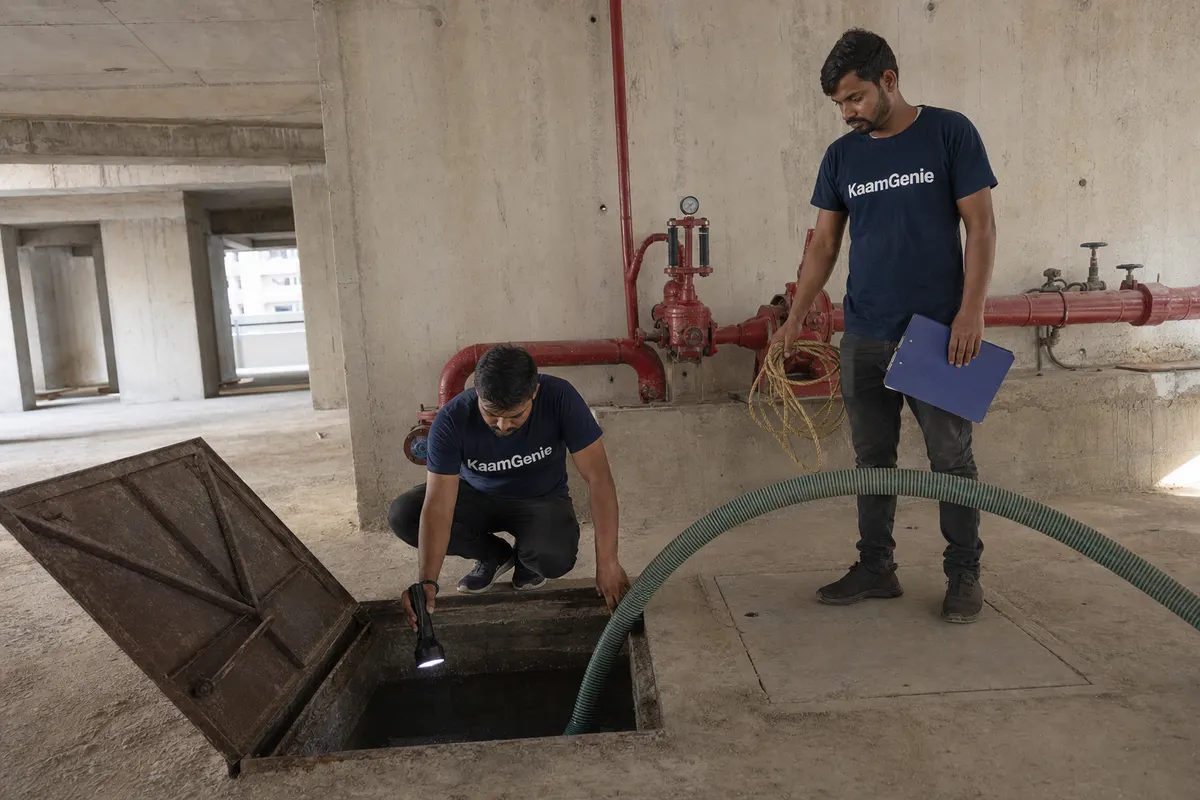
- How to clean it safely: one compartment at a time. The other compartment, or the overhead fire reserve, keeps the system charged while the first is drained, cleaned and refilled.
- Who does what: your fire or pump operator handles valves and pump settings; our crew drains, removes the sludge, scrubs, jet washes, vacuums and refills. No chemicals by default.
Never drain a fire tank without the building’s fire or facility team agreeing the plan first.
Fire reserve not opened in a long while?
We plan a phased clean with your facility team, take the sludge out compartment by compartment, and send before and after photos. Large reserves are quoted by size after a look at the tank.
Most mid-rise and high-rise buildings in Gurgaon keep a dedicated store of water for fire fighting, usually a compartment of the underground reservoir and often a reserved portion of the terrace tank. It feeds the hydrants, wet riser, sprinklers and hose reels through the fire pumps, and because it must be there on the day of a fire, it is left alone the rest of the year. Our crews already handle water tank cleaning across Gurgaon, and fire reserves are part of that work, cleaned in phases so cover is never lost.
How a fire reserve differs from your domestic tank
The domestic sump and the fire sump often sit side by side under the same podium, filled from the same supply. What happens inside them is very different.
| Point | Domestic sump or tank | Fire-fighting reserve |
|---|---|---|
| How often the water turns over | Daily, as residents use it | Rarely; mainly during pump tests, drills and top-ups |
| What it is connected to | Transfer pumps feeding the terrace tanks | Jockey pump, main fire pump and standby pump, then hydrants, risers and sprinklers |
| Who notices a problem | Residents, through colour, smell or pressure | Often nobody, until a test or an emergency |
| Who controls it | Facility or maintenance team | Fire officer, pump operator or fire contractor, under the approved fire scheme |
| Biggest cleaning constraint | Keeping residents supplied | Keeping the fire system charged and ready the whole time |
What collects in water that never moves
Still water is simply water where everything heavier than it has had time to sink. The floor of a long-standing fire reserve usually carries a mix of:
- Supply and tanker silt. Every fill brings a little fine clay, and buildings that still take tanker water top up with whatever the tanker carries.
- Rust. Fire pipework is mostly steel, and the suction pipes, foot valves, ladders and manhole frames in and around the tank can corrode. Flakes drop and stay. Our guide to rusting tank fittings covers how to spot corroded hardware.
- Construction leftovers. In recently handed-over towers, cement slurry and grit can stay in a reserve that was charged once and never reopened.
- Dust, leaves and insects. Vents without mesh and loose covers let them in, and still water can breed mosquitoes, covered in our post on worms and larvae in tanks.
On the domestic side, daily draw-off carries some of the fine material away with the water. On the fire side it just accumulates. When our crews open a reservoir where both sides are due, the fire compartment often holds the softer, deeper layer, for exactly that reason.
Why sludge is a fire-readiness issue, not just a hygiene one
Nobody drinks fire water, so it is tempting to treat a dirty reserve as cosmetic. The concern is mechanical. When the main fire pump starts, it pulls hard through a suction pipe that ends near the tank floor, usually through a strainer or foot valve. Loose sludge right beside that inlet is the first thing to move.
- Strainers and foot valves can partly choke, which reduces flow or lets air in, and a foot valve that does not seat properly can let the suction line drain back.
- The jockey pump keeps the system pressurised and starts often in small bursts. Grit is hard on any pump that cycles frequently, and your fire contractor will want to know if the water feeding it is dirty.
- Sprinkler and hydrant lines carry whatever the pumps push into them. Fine debris that reaches the far ends of the network tends to stay there.
A clean tank does not replace pump servicing or system testing. It removes the material the pumps would otherwise swallow at the worst possible moment.
A 10-minute look at your fire reserve (from outside the tank)
You do not need to drain anything to know whether the reserve is due. Pick a time when the fire team is on site, take a strong torch, and work from the manhole opening only. Never lean in, climb down or put your head inside an underground tank: closed tanks can hold stale air with too little oxygen.
- Check the cover. Is the manhole lid in place, closing flush and locked, clamped or strapped? A cover resting loose, or held with a brick, means dust and insects have had a way in.
- Check the vents. Look for mesh on the air vent and overflow. Missing or torn mesh is an open door.
- Look at the surface, then the floor. A floating film, dead insects or leaves are a bad sign. In clear water the torch shows whether the floor is bare concrete or a soft brown layer; if you cannot see the floor at all, the water itself is cloudy. Green slime near the manhole means light is getting in.
- Ask the pump operator two questions. When were the suction strainers last opened, and what was in them? When was this compartment last drained?
- Check the records. If nobody can find the date of the last cleaning, treat that as your answer.
If two or more of these point the wrong way, plan a clean. Our underground sump and reservoir guide explains how the domestic side is handled.
Cleaning in phases: the building stays fire-ready
The aim is simple: at no point should the fire system be without a charged source of water. How that is done depends on how your reserve was built.
Two or more compartments
Many fire reserves are divided into two compartments that both connect to the pump suction header. That layout exists so one side can be taken out for maintenance. The sequence we follow with the fire team is:
- Joint walk-through. We look at the manholes, access and drain-out route with the facility manager and the pump operator, and agree which compartment goes first.
- The fire team isolates compartment A. Their operator closes its suction valve and confirms the pumps are drawing from compartment B, which is full. We do not operate fire valves or change pump settings.
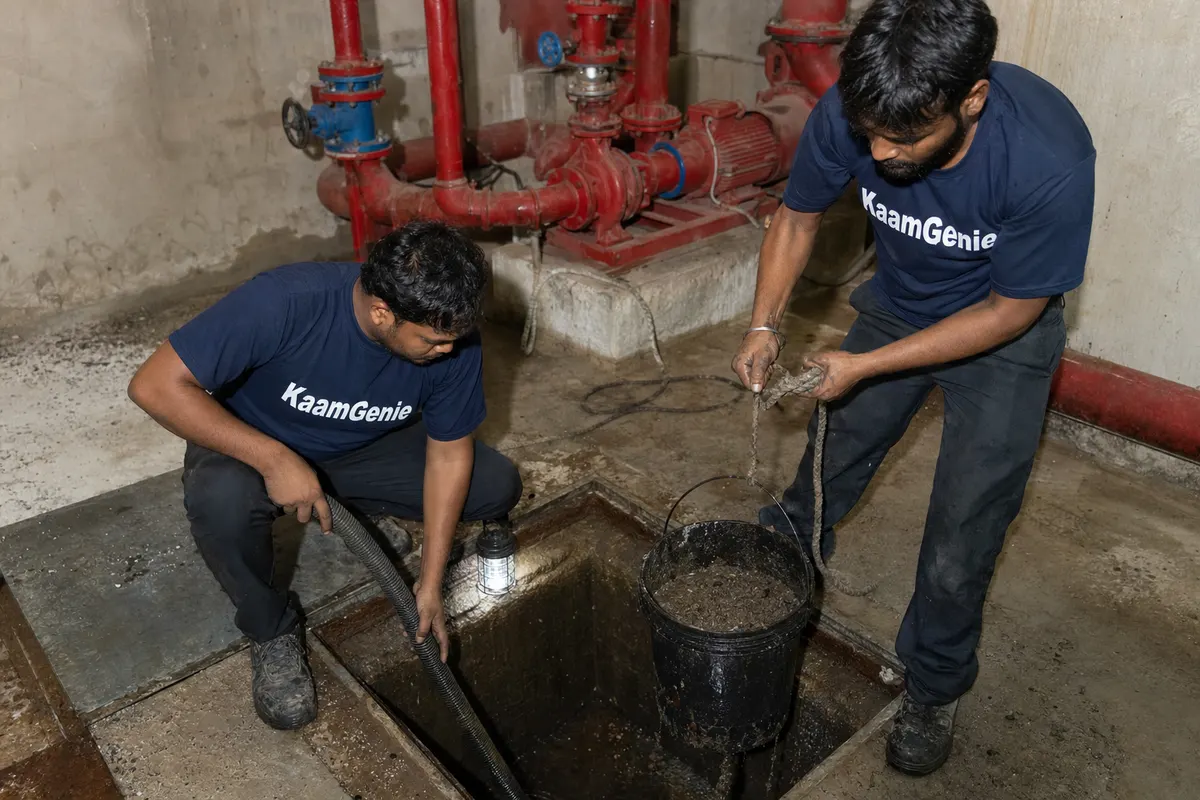
- Drain and de-sludge A. The clear water is pumped out, then the sludge is scooped and wet-vacuumed out of the compartment, down to the bare floor.
- Scrub, jet wash, rinse. Walls and floor are scrubbed, jet washed and rinsed with fresh water, and the last of the dirty water is vacuumed out.
- Refill and hand back. Compartment A is refilled, and the fire team reopens its valve and runs whatever check they normally do after maintenance.
- Then compartment B. Only once A is full and back in service does B come out, on the same day if supply allows, otherwise on a second visit.
A single compartment
Some older or smaller buildings have one undivided fire tank. It can still be cleaned, but the plan has to be agreed with your fire officer or fire contractor, because for a few hours the reserve will be partly or fully out. Common approaches are keeping the terrace fire reserve full, picking the shortest practical window, and lining up water so refilling starts at once. The fire team decides what temporary arrangements the building needs; we fit our work around their decision.
Who does what on cleaning day
| Task | Handled by | Notes |
|---|---|---|
| Approving the plan and timing | Facility manager, AOA, fire officer | Agreed before any draining |
| Fire valves and pump settings | Building pump operator or fire contractor | Never the cleaning crew |
| Draining, de-sludging, scrubbing, jet washing, vacuuming | KaamGenie crew | One compartment at a time |
| Opening and clearing suction strainers | Fire contractor or pump operator | Same day, while the compartment is empty, saves a second shutdown |
| Refilling | KaamGenie crew with the facility team | Depends on supply or tanker availability |
| Post-clean pump or system check | Fire contractor or pump operator | Before the next compartment comes out |
| Pipe, valve, crack or leak repair | Your plumber, mason or fire contractor | We photograph what we see and tell you |
The terrace tank: fire water hiding under domestic water
In many Gurgaon towers the terrace tank is shared. The domestic outlet is set some way above the floor, and the water below that outlet is reserved for the fire risers. Residents only ever draw the top portion, so the bottom portion, the fire share, is the stillest water in the building and collects the most sediment.
So cleaning the terrace tank properly is also a fire-reserve clean, and the fire team should know before it is drained below the domestic outlet. For how terrace and basement tanks compare more generally, see high-rise versus plotted tank cleaning in Gurgaon.
Which Gurgaon buildings this applies to
The basic job is the same everywhere, but the planning changes with the building.
- Residential societies and condominiums. The AOA or facility team decides. Pairing the fire reserve with the domestic clean means one notice and one coordinated day. Our guide to society water tank cleaning in Gurgaon covers the domestic side, and condominium tank cleaning covers large managed complexes.
- Offices and commercial towers. In districts such as Cyber City and Golf Course Road, weekends are the natural window. See commercial tank cleaning in Gurgaon.
- Industrial and warehouse buildings. Sites in Udyog Vihar can have large reserves and heavier dust, and shift patterns drive the plan; our industrial tank cleaning post goes into that.
- Newly handed-over towers. Ask whether the fire reserve has been opened since construction; if not, a first clean removes build-stage grit. Our Dwarka Expressway post covers that stage for domestic tanks.
Fire rules: what we can and cannot tell you
Fire water storage in Indian buildings is governed by the National Building Code of India, whose fire and life safety part sets out requirements for fire-fighting installations, and in Haryana by the state’s fire service law and the fire department that approves fire-fighting schemes and issues fire NOCs for many buildings. The size of your reserve, how it is split, and how the pumps are tested are set by your approved scheme and your fire consultant. We do not quote capacities or test intervals, and we do not certify fire systems.
What a cleaning does give you is a record. You get before and after photos of each compartment on WhatsApp, which are useful for your maintenance file and for anyone who asks when the tank was last opened. A cleaning certificate is available on request. For the drinking-water standards that apply to your domestic tanks, see tank cleaning rules and norms in Gurgaon.
What cleaning can and cannot do for a fire tank
- It can remove settled silt, rust flakes and debris from each compartment, clear wall slime, and show you in photos the state of ladders, frames and visible pipework.
- It cannot service pumps, replace foot valves or flush the hydrant and sprinkler network. That is fire-contractor work.
- It cannot fix leaks, cracks or seepage, or keep dirt out if the cover and vents are faulty. We flag what we see so your contractor can act.
How KaamGenie handles the fire side
The full sequence for any tank is in the Gurgaon cleaning process guide. On a fire reserve, three things get particular attention:
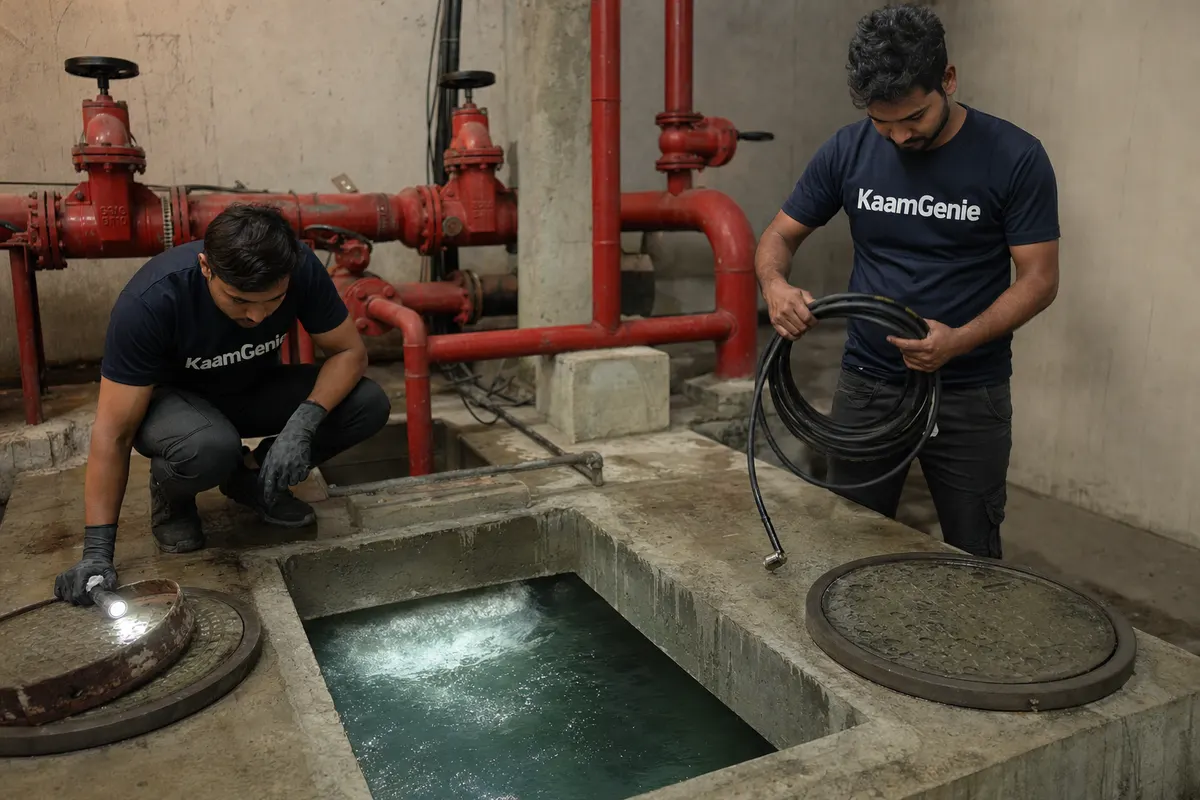
- The area around the suction pipe. This is where the sludge matters most, so it is cleared by hand and vacuumed rather than jetted, which would only push silt towards the inlet of the neighbouring compartment.
- Sludge comes out completely. It is scooped and wet-vacuumed out of every compartment down to the bare floor, so none is left to settle back or reach the fire pump’s suction.
- No chemicals by default. Fire water is not for drinking, and a mechanical clean is what removes sludge. If your facility policy asks for disinfection of the compartment, tell us and it is added on request.
Our standing recommendation is a clean every 3 months for tanks that supply homes and offices. For the fire reserve, agree the schedule with your fire officer and facility team; many buildings simply line it up with the domestic cleaning so both happen together. Our post on how often to clean a tank in Gurgaon explains the reasoning behind our domestic recommendation.
Planning the fire tank clean for a weekend?
Sunday and weekend slots are available, which suits offices and busy towers. Share your reservoir layout on WhatsApp and we will suggest a compartment order with your fire team.
What not to do
- Do not drain a fire tank without telling the fire team. Even a terrace tank drained below its domestic outlet takes fire water out of service.
- Do not take every compartment out at once to save time. The whole point of the phased plan is that something stays charged.
- Do not let a compartment run dry while pumps still draw from it. The pump operator changes the valve setup before draining starts, not after.
- Do not pour bleach or other chemicals into the reserve yourself. They do nothing for the sludge, and a large reserve makes it easy to get the dose badly wrong.
- Do not pump the sludge out through a hydrant or drain valve. That sends it through the very pipework you are trying to protect.
- Do not refit a loose or broken cover. Replace it and clamp, strap or lock it; a cover held down with weights invites the next layer of dust.
The other non-drinking store in many newer towers is the treated-water flushing tank, which fouls in a very different way; see flushing and recycled water tanks.
Book a phased fire-reserve clean
Send us the basics on WhatsApp: how many compartments, roughly how big, and where the manholes are. Fire reserves and other large tanks are quoted by size, usually after a quick look, and the price is fixed before any water is drained. For smaller buildings, a domestic terrace tank costs from ₹699 and a small sump from ₹1,499. You pay once the cleaning is done and you have seen the before and after photos of each compartment. We work with facility teams across the city, including Sector 49 and Golf Course Extension; see the Gurgaon tank cleaning page for coverage, read the complete guide to water tank cleaning in Gurgaon for the wider picture, or call +91 95603 66362.
Frequently asked questions
Do you clean fire-fighting water tanks in Gurgaon?
Yes. We clean underground fire reserves and terrace tanks that hold a fire share, in societies, condominiums, offices and commercial buildings. The work is planned with the building’s facility or fire team so that one compartment is cleaned at a time while another keeps the fire system charged. Our crew drains, de-sludges, scrubs, jet washes, vacuums and refills; valve and pump operation stays with your pump operator or fire contractor.
Will the building lose fire protection while the tank is cleaned?
It should not, if the reserve has two or more compartments. Your pump operator isolates one compartment and confirms the pumps are drawing from the other, which stays full. We clean and refill the first before the second is touched. If your building has a single undivided fire tank, the plan, including any temporary arrangements and the timing, is decided by your fire officer or contractor, and we fit around it.
Why does a fire tank get dirty if nobody uses the water?
Because nobody uses it. Water that barely moves lets everything heavier than it sink: silt from supply and tanker fills, rust from steel fittings, dust through loose covers and vents, and in newer towers sometimes grit from construction. On the domestic side some of that leaves with the daily draw-off. On the fire side it stays on the floor, close to where the pump suction pipe sits.
Can sludge in the fire tank affect the pumps?
It can. The fire pumps draw through a suction pipe near the tank floor, usually via a strainer or foot valve. Loose sludge beside that inlet can be pulled in when the pumps start, partly choking strainers or stopping a foot valve from seating. Cleaning the tank removes that material, but it does not replace pump servicing; ask your fire contractor to open the strainers while the compartment is drained.
Is a fire reserve cleaned without chemicals?
No, not by default. The sludge that matters for fire readiness is removed mechanically: scooped and wet-vacuumed out, then the walls and floor are scrubbed, jet washed and rinsed. If your facility policy or fire consultant asks for disinfection of the compartment, tell us when you book and it is added on request. Please do not dose a reserve yourself, because a large tank makes the amount easy to get wrong.
How much does fire tank cleaning cost in Gurgaon?
Fire reserves vary a great deal in size, so they are quoted by size, usually after a short look at the reservoir, and the figure is fixed before work starts. Small domestic tanks on the same visit follow our usual rates, from ₹699 for an overhead tank and from ₹1,499 for a small sump. You pay after the work is complete and you have seen the before and after photos.
Can you give us a record of the cleaning for our fire file?
You receive before and after photos of each compartment on WhatsApp, which most facility teams keep with their maintenance records. A cleaning certificate is available on request. We do not inspect or certify fire systems, pumps or capacities; those remain with your fire consultant, fire contractor and the fire department under your approved fire-fighting scheme.
Can the fire tank be cleaned on a weekend?
Yes, Sunday and weekend slots are available, and for offices and commercial towers the weekend is often the easiest time to take a compartment out with the fire team on hand. Refilling depends on your supply or tanker arrangements, so it helps to confirm water availability for the day before we start draining. Tell us the compartment layout when you book so we can plan the order.
Sources & references
- Bureau of Indian Standards (BIS): publisher of the National Building Code of India, whose fire and life safety part covers fire-fighting installations and water storage.
- Government of Haryana: state portal for Haryana departments, including fire and emergency services, which approve fire-fighting schemes and issue fire NOCs.
- CPHEEO Manual on Water Supply and Treatment: the Government of India engineering manual covering storage reservoirs and their upkeep.
- Gurugram Metropolitan Development Authority (GMDA): the agency responsible for bulk water supply in Gurugram, the usual source that fills building reservoirs.
Last verified: 23 November 2026. If you find any of these links broken, please let us know.