
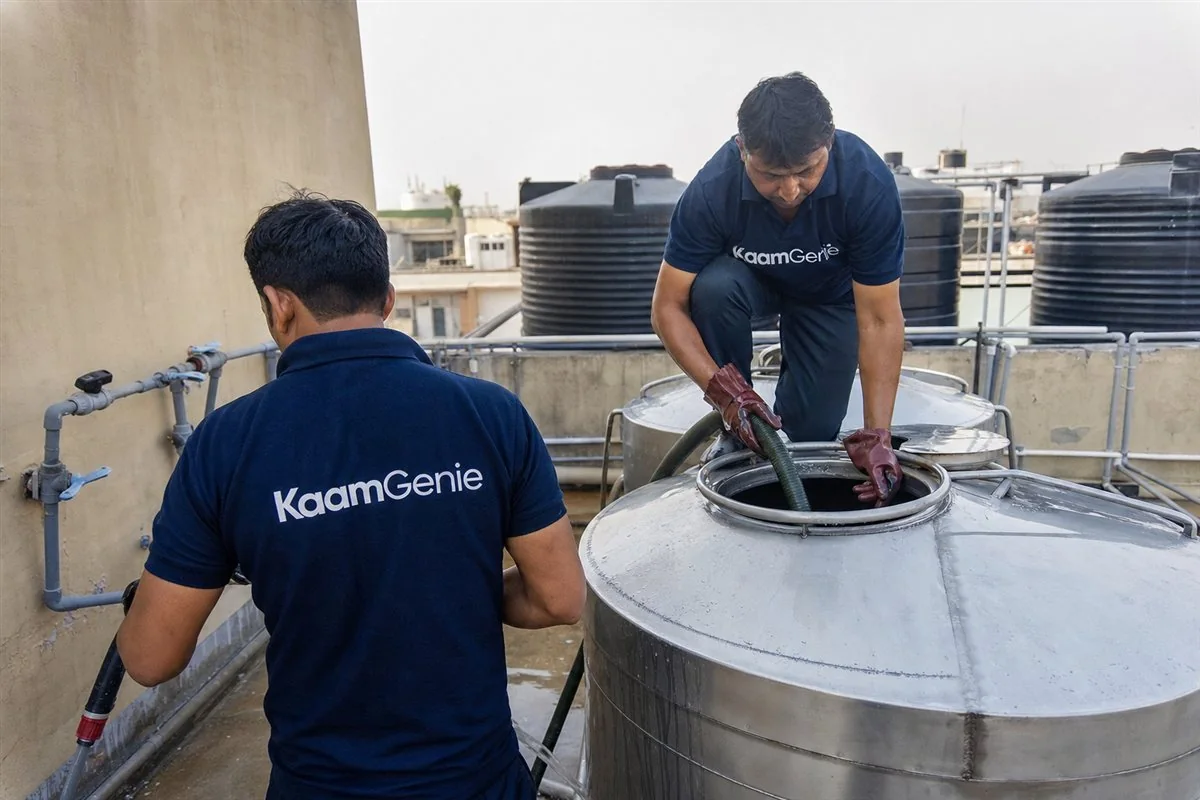
The short version for busy F&B managers
- Food businesses need a tighter schedule — quarterly cleaning is the sensible baseline; FSSAI auditors expect a maintained, documented system.
- Scale is bigger — hotels and banquet halls run large underground reservoirs (UGRs) plus rooftop tanks, so the job needs trained crew, bigger kit and several hours.
- We work around your service — after-hours and low-occupancy scheduling so the kitchen, bar and rooms aren’t disrupted.
- You get a certificate — dated record, tank IDs, chemicals, crew and before/after photos for FSSAI and MCD health inspections.
- AMC keeps it continuous — locked schedule, unbroken paper trail, reminders before every due visit.
This is the service angle. For the compliance detail — exact FSSAI clauses and what an auditor checks — see our companion guide on FSSAI water tank requirements for Delhi restaurants.
| Property type | Typical storage | Suggested interval | Key concern |
|---|---|---|---|
| Standalone restaurant / cafe | Rooftop tanks + small sump, 2,000–10,000L | Every 3 months | Kitchen & ice water, FSSAI record |
| Cloud kitchen / QSR cluster | Shared rooftop + soft-water feed | Every 2–3 months | High throughput, RO feed hygiene |
| Banquet hall / marriage venue | Large UGR 20,000–50,000L+ | Every 2–3 months (peak season) | Event-day surge, post-function cleaning |
| Hotel (mid to luxury) | Multi-chamber UGR + rooftop + RO tanks | Quarterly, often AMC | Guest health, brand reputation |
| Tanker-fed property (summer) | Any of the above on tanker top-up | Shorten interval | Sediment, variable water quality |
Book a commercial tank cleaning
Hotels, restaurants, banquet halls and cloud kitchens across Delhi. After-hours scheduling, FSSAI-ready certificate. Residential from ₹699 onwards; commercial quoted on site.
Why a Delhi food business can’t treat tank cleaning as optional
A home tank serves one family. A hotel or restaurant tank serves hundreds of meals a day, the ice in every drink, the water that washes every plate, and the RO line that fills your kitchen jugs. The moment stored water touches food, the stakes change — one bad batch of water behind a busy kitchen can put dozens of guests at risk and your licence under question.
Delhi makes this harder than most cities. The supply itself is inconsistent: Delhi Jal Board (DJB) piped water in the established belts, heavy borewell groundwater in outer pockets, and private water tankers everywhere during the summer crunch. Every one of those sources drops sediment, scale and organic load into your storage. In a large reservoir that water can sit for days, and sediment settles to the floor exactly where the outlet draws from. Without a regular cleaning cycle, you’re serving the bottom of the tank.
This is why we built our commercial offering around the realities of hospitality rather than just scaling up a home job. If you want the full menu and pricing structure, our water tank cleaning services page lays out how residential, society and commercial work differ. The rest of this guide is specifically about hotels, restaurants, banquet halls and cloud kitchens.
The food-safety stakes — FSSAI and health-department scrutiny
Under the Food Safety and Standards Authority of India (FSSAI) framework, water used in a food business has to be potable and the systems that store it have to be maintained and documented. An auditor doesn’t just want to see a clean tank on the day — they want evidence of a system: a schedule, records, and chemicals appropriate for potable water. A spotless reservoir with no paperwork behind it still reads as a gap.
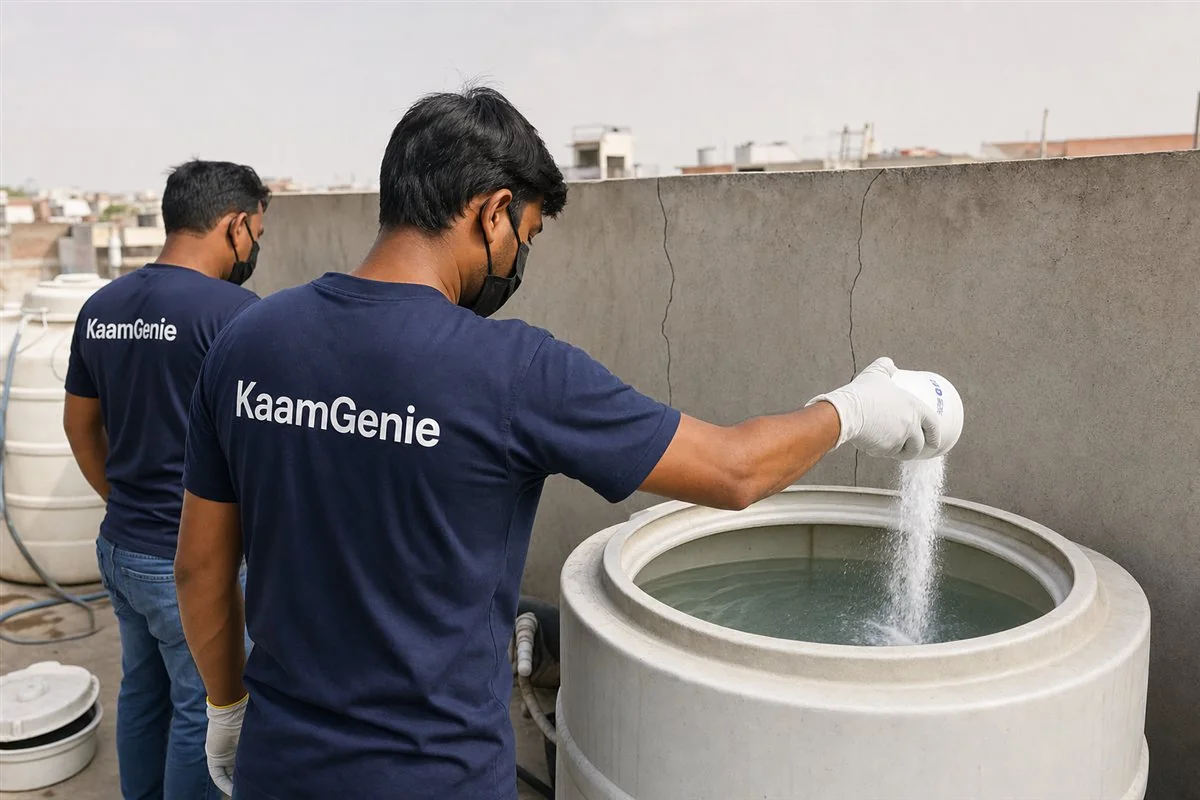
That’s the difference between a cleaning that ticks a box and one that protects you. We disinfect every food-business tank with food-grade sodium hypochlorite at the correct concentration — the same class of disinfectant used in municipal water treatment and acceptable for potable systems — never industrial bleach or hardware-shop chemicals that leave residue. We don’t go into the legal clauses here on purpose; the full compliance breakdown lives in our dedicated post on FSSAI water tank requirements for Delhi restaurants, and it pairs with this service guide.
Beyond the inspector, there’s your name. A single review mentioning a stomach upset, or a guest complaint about cloudy bathroom water at a wedding, travels fast. For a hotel near the airport competing on TripAdvisor ratings, or a Connaught Place restaurant living on repeat custom, clean stored water is quietly part of the brand.
After-hours and low-occupancy cleaning — we work around your service
The biggest practical worry F&B managers raise is downtime. You can’t shut a kitchen mid-service or leave guest rooms without water at check-in. So we don’t ask you to. Commercial cleaning is scheduled into the quiet window that fits your property:
- Restaurants and bars — late night after the last cover, or the mid-afternoon gap between lunch and dinner.
- Banquet halls and marriage venues — the post-function clean-down window, before the next event is loaded in.
- Hotels — the early-morning lull, or staggered tank-by-tank so part of the supply always stays live.
- Cloud kitchens — between the lunch and dinner delivery peaks, or on a weekly off-day.
For larger sites we bring two crews and clean in stages, so we’re never draining your entire supply at once. We coordinate with your facility or F&B manager on exactly when the water goes down and when it’s back, and we make sure the fresh fill has settled before your next service period begins. The airport-hotel belt around Mahipalpur and Aerocity is a good example — those properties run round-the-clock, so we time the work to the genuine occupancy trough rather than a fixed clock.
Why food-business tanks foul faster — relative sediment load by supply source
Tanker-fed and borewell supply settle more residue, especially in summer
Indicative comparison, not lab figures — the point is that a high-volume Delhi kitchen on tanker or borewell supply needs a shorter cleaning interval than a home on treated piped water.
The tanks a hotel or banquet hall actually has
A home usually has one or two rooftop tanks and maybe a small sump. A hospitality property is a different animal, and the cleaning plan has to map every vessel:
- Underground reservoirs (UGRs) — the big RCC concrete tanks, often multi-chamber, holding 20,000 to over 100,000 litres. These are confined spaces and need trained crew, gas checks, bigger pumps and industrial wet vacuums. This is where most of the sediment ends up.
- Rooftop / overhead tanks — the storage that gravity-feeds rooms and the kitchen. Often several, sometimes a mix of Sintex plastic and concrete.
- Soft-water and RO feed tanks — many kitchens run a separate treated-water line for cooking and drinking. These are smaller but the most sensitive, because they sit closest to food.
- Kitchen and pantry day-tanks — intermediate storage that turns over fast and is easy to forget on a schedule.
We document each one, give it a tank ID, and put it on the cleaning record so nothing slips through. The principle is the same one behind our standard 8-step cleaning process — inspect, drain, de-sludge, scrub, jet-wash, vacuum, disinfect, refill and certify — just scaled to large reservoirs and run on confined-space safety protocols.
Tanker water, summer, and why hospitality feels it first
When Delhi’s summer water crisis bites, hotels and banquet halls are among the heaviest users of private tankers. A wedding for 800 guests, or a full hotel in peak season, burns through storage fast, and the top-up tanker water is variable in quality and heavier in sediment than DJB supply. Pour that into a large UGR and the residue settles to the floor within weeks, right where the outlet pulls from.
For properties on tanker top-up we shorten the interval and pay particular attention to vacuuming the reservoir base and disinfecting before the next big fill. It’s the same logic homeowners face, just at scale — and it’s exactly why a tank that looked fine in March can be running murky by peak May.
Certificates, documentation and the audit trail
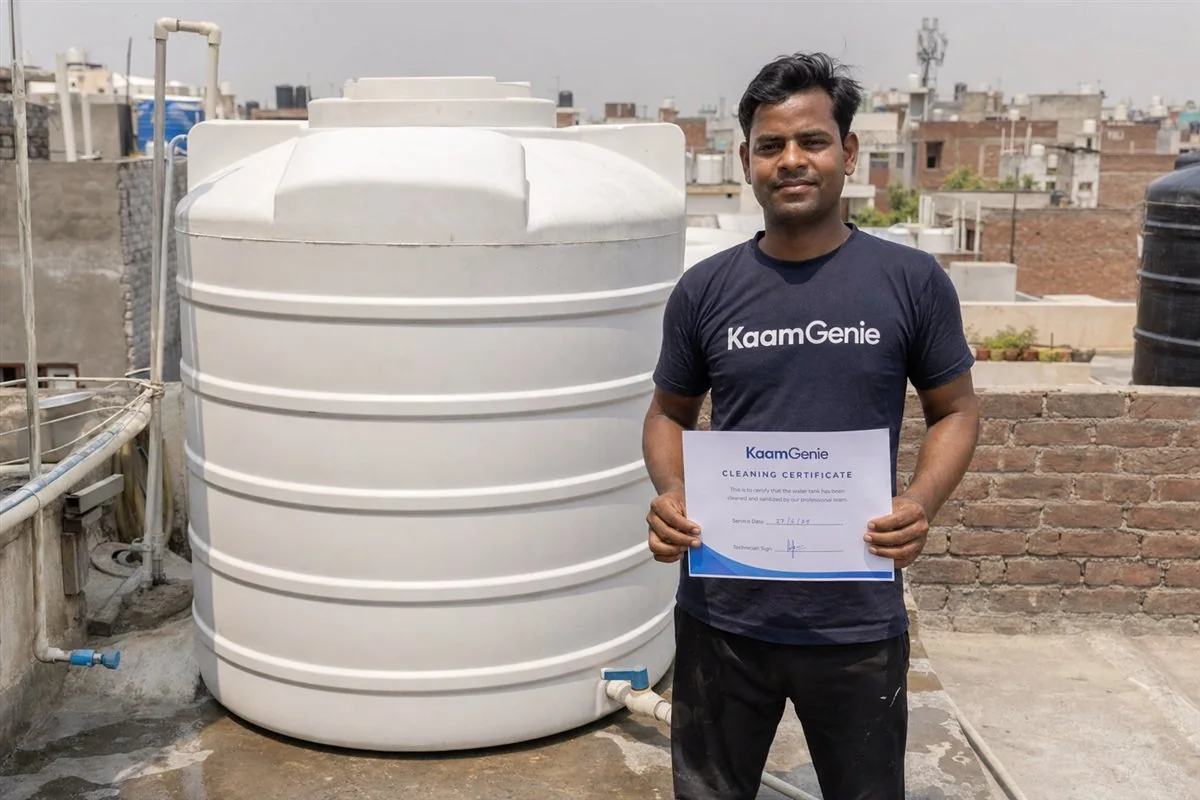
Every commercial job closes with a dated cleaning certificate. It lists the property, each tank’s ID and capacity, the chemicals and concentrations used, the crew, the date and time, and before/after photographs. That is precisely the evidence an FSSAI auditor or a Municipal Corporation of Delhi (MCD) health inspector looks for when they check how your stored water is maintained.
We keep a copy on file as well, so if a printout goes missing the week before an inspection, we resend it. For multi-property groups we can maintain a running log across sites. The documentation isn’t an add-on — for a food business it’s half the value of the cleaning.
AMC — the sensible setup for any food business
Ad-hoc bookings are fine for a one-off, but most hotels, restaurants and cloud kitchens are better served by an annual maintenance contract. An AMC locks the quarterly schedule, keeps an unbroken paper trail for FSSAI, and usually costs less per visit than calling us out each time. We send a reminder before every due cleaning so a visit never quietly slips past the season when you’re busiest.
We tailor the contract to your number and size of tanks and to your service calendar — a banquet venue might want extra cleans through wedding season, a cloud kitchen a steady two-monthly cycle. If you want to compare structures, our guides on water tank cleaning AMC plans in Delhi and on annual cleaning contracts walk through how the maths works, and the same logic applies to commercial properties. Diplomatic-zone and luxury hotels around Chanakyapuri and the banquet pockets near Karam Pura are typical AMC sites for us.
Set up a commercial AMC
Quarterly schedule, certificates every visit, after-hours crews. Tell us your tanks and service calendar and we’ll quote a plan.
Book commercial tank cleaning across Delhi
Whether you run a single restaurant in Khan Market, a banquet hall in West Delhi, a cloud-kitchen cluster, or a full hotel near the airport, we clean food-business tanks to potable standard, after hours, with the certificate to back it up. Browse coverage, pricing and how to book on our water tank cleaning in Delhi hub, or call us and describe your tanks — we’ll plan a clean that fits around your service.
To book, call +91 95603 66362 or use the booking form on this site — we’ll confirm a time that suits your kitchen.
Frequently asked questions
How is hotel and restaurant water tank cleaning different from a home cleaning in Delhi?
Scale and stakes. A hotel or banquet hall often runs one or more underground reservoirs (UGRs) of 10,000 to 100,000 litres plus rooftop tanks, so the job needs confined-space-trained crew, bigger pumps and vacuums, and several hours rather than 90 minutes. The water also touches food, ice, RO feed and guest bathrooms, so disinfection and documentation are non-negotiable. We treat every food-business tank to potable, FSSAI-acceptable standards and hand over a dated certificate.
Can you clean our tanks after hours so the kitchen and rooms aren’t disrupted?
Yes — this is how most of our hospitality jobs run. We schedule for the low-occupancy window: late night for restaurants and bars after the last cover, the post-event gap for banquet halls, or the early-morning lull before check-in rush at hotels. We coordinate with your facility or F&B manager so the water supply is restored before service resumes, and we never leave a tank empty going into a meal period.
Do you provide a cleaning certificate we can show an FSSAI or health inspector?
Every commercial job ends with a dated cleaning certificate listing the property, tank IDs and capacities, the chemicals used, the crew, and before/after photos. This is exactly the record an FSSAI auditor or MCD health inspector asks for when they check how your stored water is maintained. We keep it on file too, so if you misplace a copy we can resend it.
How often should a Delhi restaurant or hotel get its water tanks cleaned?
For food businesses we recommend every three months — quarterly — and many FSSAI auditors expect to see at least that cadence. High-volume kitchens, banquet venues during wedding season, and any property running on tanker water in summer should consider every two months. Homes can stretch to twice a year, but a commercial kitchen’s contamination load and liability are far higher, so the schedule is tighter.
Our hotel runs on tanker water in summer — does that change anything?
It raises the priority. Private tanker water during Delhi’s summer crisis is variable in quality and often carries more sediment and bacteria than Delhi Jal Board piped supply, and it settles fast in a large UGR. Properties that top up from tankers see sludge build at the reservoir floor within weeks, so we usually shorten the interval and pay extra attention to vacuuming the reservoir base and disinfecting before the next fill.
What size and type of tanks can you handle for a hotel or banquet hall?
Everything from a single rooftop Sintex on a small restaurant terrace to multi-chamber concrete underground reservoirs feeding a full hotel. We clean overhead tanks, RCC underground sumps and reservoirs, stainless and plastic storage tanks, and the separate soft-water or RO feed tanks many kitchens run. For very large or multi-tank sites we deploy two crews and stagger the work so part of the supply stays live.
Do you offer an AMC for hotels, restaurants and cloud kitchens?
Yes. An annual maintenance contract is the sensible route for any food business — it locks in the quarterly schedule, keeps a continuous paper trail for FSSAI, and usually works out cheaper per visit than ad-hoc bookings. We tailor the AMC to the number and size of tanks and to your service calendar, and we send a reminder before each due visit so a cleaning never slips.
Will the water be safe for the kitchen immediately after cleaning?
After the disinfection contact time and final rinse, water drawn from the refilled tank is safe for washing, cleaning and bathing right away. For drinking, ice and direct food contact, allow the fresh fill to settle and run it through your existing RO/UV as normal — give it two to three hours. We plan the schedule so this settling window falls outside your service hours.
Which Delhi areas do you cover for commercial food-business tank cleaning?
All of Delhi. We regularly serve the airport hotel belt around Mahipalpur and Aerocity, the diplomatic and luxury-hotel zone of Chanakyapuri, restaurant clusters in Connaught Place and Khan Market, and the banquet and industrial-kitchen pockets around Karam Pura and West Delhi. Wherever your hotel, restaurant, banquet hall or cloud kitchen sits, we can reach it.
Sources & references
- Bureau of Indian Standards (BIS) — IS 10500:2012 is the canonical Indian Standard for drinking water specification, defining acceptable limits for physical, chemical, and biological parameters.
- WHO Guidelines for Drinking-water Quality, 4th edition — the global reference for water quality standards, including guidance on storage and disinfection.
- Food Safety and Standards Authority of India (FSSAI) — defines water quality requirements for food businesses, including hygiene standards for stored water and acceptable disinfection chemicals.
- WHO Fact Sheet on Drinking Water — overview of safe drinking water requirements and contamination risks.
- CPHEEO — Manual on Water Supply and Treatment — the Government of India’s engineering manual covering tank design, cleaning protocols, and disinfection practices.
Last verified: 30 June 2026. If you find any of these links broken, please let us know.