
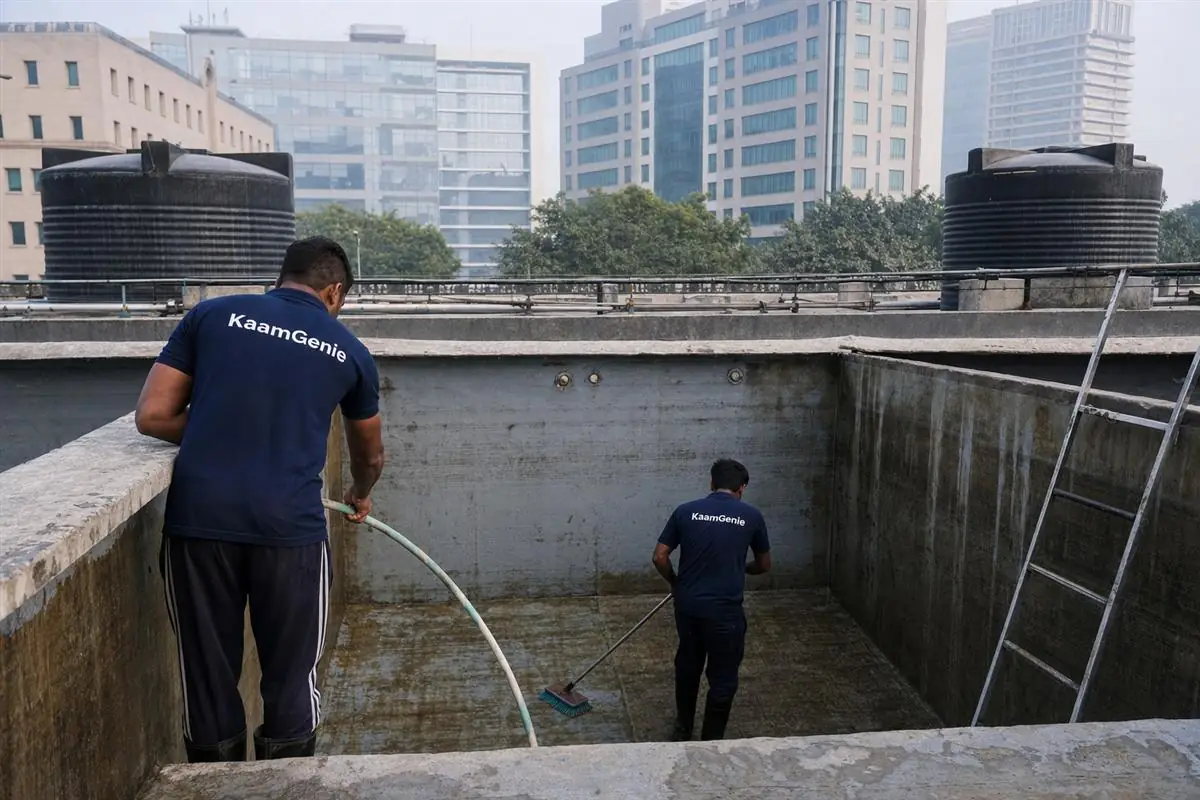
Quick answer — office water tank cleaning in Delhi
- Who it’s for: corporate offices, PSUs and government buildings, BPOs and IT offices across Connaught Place, Nehru Place, Okhla / Jasola, Chanakyapuri, Lodi Road and R.K. Puram.
- Why it’s different: high daytime turnover, multi-tank architecture (rooftop tanks + basement UGR + fire-hydrant reservoir), strict overnight windows, and facility-manager documentation.
- Scheduling: after-hours and weekend slots so no employee loses water and operations don’t pause.
- Documentation: GST invoice, per-tank before/after photos, signed checklist, chemicals list, optional NABL water-test report.
- Contracts: quarterly or annual AMC, or one-time. Residential cleaning from ₹699 onwards; offices are custom-quoted after a site survey.
| Office type | Typical tanks | Best window | Frequency |
|---|---|---|---|
| Small office (1 floor) | 1–2 overhead (1,000–2,000L) | Evening / Sunday | Every 4–6 months |
| Multi-floor corporate | Rooftop cluster + basement UGR | Overnight 8 PM–6 AM | Quarterly |
| BPO / 24x7 support | Overhead + sump + intermediate | Lowest-occupancy shift | Quarterly |
| Govt / PSU block | Large UGR + multiple OHTs | Weekend | Quarterly / biannual |
| Fire-hydrant reservoir | Stagnant 50,000L+ concrete | Planned weekend | Annual minimum |
Book an office site survey — no obligation
We’ll map every tank in your building (including the fire-hydrant one), confirm the after-hours window, and send a fixed, itemised quote. Residential cleaning ₹699 onwards; offices custom-quoted.
Why an office tank is a different job from a home tank
People assume office tank cleaning is just “same job, bigger tank.” It isn’t. The moment you move from a flat in Lajpat Nagar to a corporate floor in Nehru Place, four things change — and each one changes the equipment, the crew, the timing, and the paperwork. This is why our water tank cleaning services are scoped differently for offices than for a standard home, and why we never quote an office building over the phone.
1. The water feeds people, not just taps. An office’s stored water goes to drinking-water dispensers, handwash basins, and often a pantry or cafeteria. A contaminated supply doesn’t inconvenience one family — it hits two hundred employees at once, and the complaint reaches the facility manager’s inbox within the hour. The stakes are collective.
2. Daytime turnover is heavy, so biofilm builds fast. A 150-person office burns through far more water during working hours than a home does in a day, then sits near-empty all night and weekend. That cycle of heavy churn and stagnation is exactly what biofilm and sediment thrive on, which is why offices need cleaning every three to six months rather than annually.
3. The architecture is multi-tank. A typical Delhi corporate building has rooftop overhead tanks (often several in parallel), a large basement underground reservoir (UGR), sometimes an intermediate pressure tank in the pump room, and a fire-hydrant reservoir that almost nobody remembers. The real skill is sequencing all of them in one overnight window so the building wakes up to clean water everywhere.
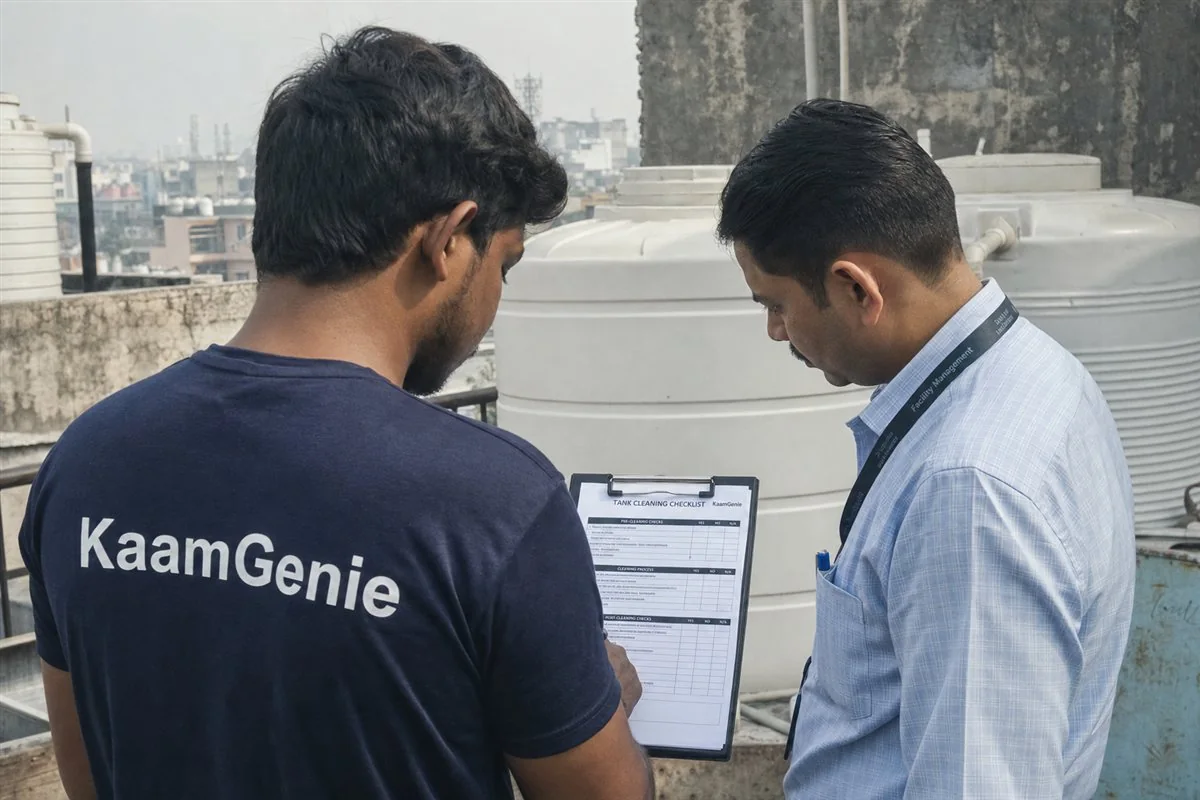
4. Documentation is mandatory. A homeowner pays ₹699 and signs a WhatsApp invoice. A corporate facility or admin team needs a GST invoice, a per-tank photo set, a signed cleaning checklist, the chemicals list, and often a lab water-test report for the audit file. Skip any of it and the invoice stalls in accounts for weeks.
After-hours cleaning: how we keep the office running
The single most important thing about office work is that nobody can lose water during business hours. So the cleaning happens when the building is empty. For most Delhi offices that means an overnight window of 8 PM to 6 AM, or a full weekend for larger buildings with several tank systems. For 24x7 operations like BPOs and support centres, we plan the water-shutdown around the lowest-occupancy shift and coordinate the resident communication with your facility manager in advance.
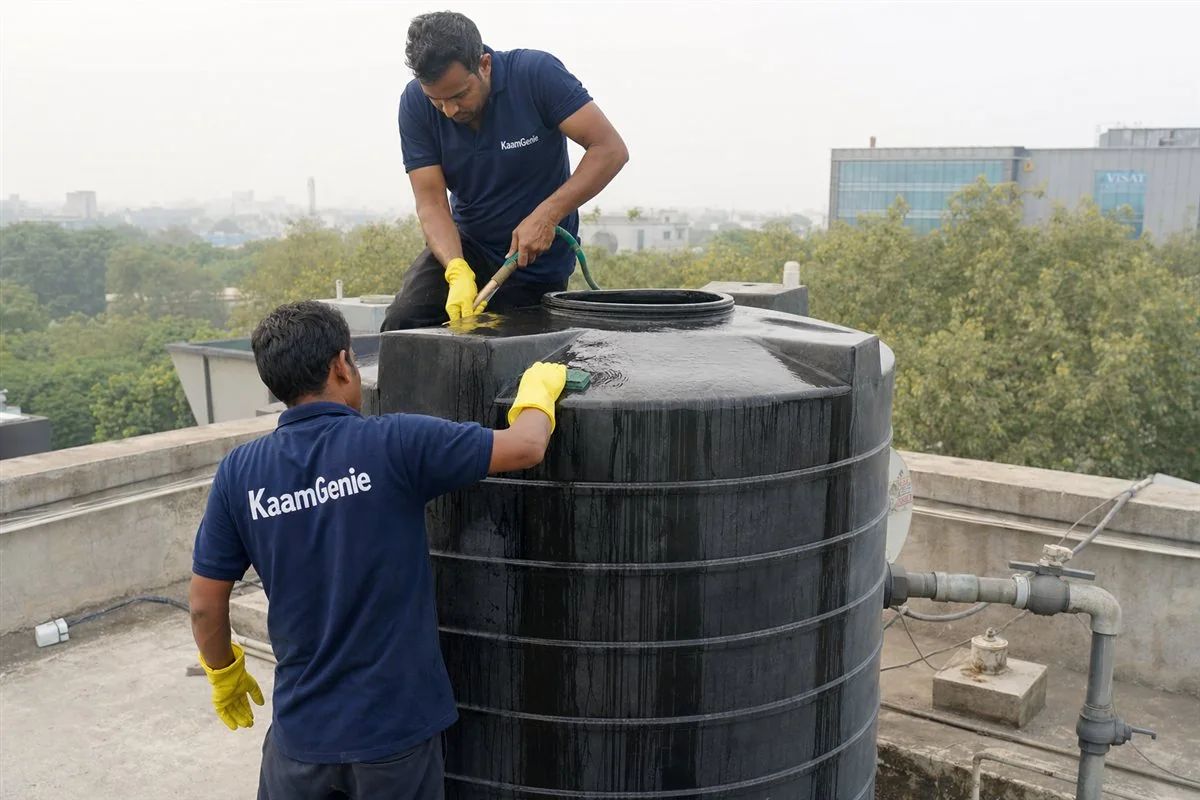
On the night itself, the crew arrives, signs the gate-pass register, and moves equipment in through the service lift. We sequence the tanks so that no system is down longer than it needs to be: typically the basement UGR first, then the rooftop overhead tanks, with refill timed so every washroom and pantry has water back before the first staff card in. Each tank gets its own before/after photo set and checklist as we go, so the morning handover is complete the moment the last lid closes.
This is the part corner-cutting operators get wrong. A residential operator who cleans an office reservoir during shift hours leaves 200 people without washroom and pantry water for four to six hours — and the ₹3,000 they saved you on the quote becomes a half-day of lost productivity and a flood of complaints. After-hours scheduling is not a premium in office work. It is the only correct way to do the job.
The Delhi office belts we work in
Different parts of Delhi have very different office tank profiles. Here’s what the job actually looks like across the main commercial and government districts.
Connaught Place & Barakhamba Road. Older 1960s–1990s buildings with smaller overhead tanks scattered across rooftops in unintuitive layouts, plus basement sumps. Access is service-lift only and the tanks are often more numerous but individually smaller, so the time budget is dominated by equipment portage and locating every tank.
Nehru Place & Bhikaji Cama Place. Dense commercial towers, multi-tenant, with a shared basement UGR feeding rooftop tanks. The booking almost always has to route through building management because the tanks are common infrastructure. High footfall means quarterly cleaning is the sensible default.
Okhla & Jasola commercial. A mix of corporate offices, IT units, and back-office floors. Borewell-blended supply in parts of Okhla runs hard, so scale build-up on inlet and outlet walls is heavier and descaling is part of the job, not an add-on.
Chanakyapuri. The diplomatic and government enclave — embassies, ministries, and institutional offices with large reservoirs and strict access and security clearance. These almost always run on a weekend window with documentation requirements that exceed a normal corporate office. We handle water tank cleaning in Chanakyapuri as scheduled, cleared, documented work.
Lodi Road & the central-government belt. Government office blocks and institutional buildings with big underground reservoirs and multiple overhead tanks. Procurement-grade paperwork matters most here. Our Lodi Road tank cleaning work is built around audit-ready records and planned shutdown windows.
R.K. Puram. PSU headquarters and central-government residential-cum-office blocks with very large UGRs and clustered overhead tanks. Volumes are high and the after-hours window has to be confirmed with the estate office. We cover tank cleaning in R.K. Puram on a quarterly or biannual schedule for most buildings.
Large underground reservoirs (UGRs) — the confined-space reality
The basement reservoir is where office work gets serious. A corporate UGR is typically a 20,000 to 60,000-litre concrete tank, and entering it is a confined-space activity under Indian factory and safety norms. Oxygen levels inside can drop below the safe 19.5% threshold, and hydrogen sulphide can pool from sludge breakdown at the bottom. A single worker sent in alone with no standby will not get out if anything goes wrong.
Our protocol for any UGR entry: a calibrated multi-gas monitor checks oxygen and H₂S before anyone goes in; a powered blower runs continuous forced ventilation; the entrant wears a full-body harness with a retractable lifeline anchored above the entry; and there is always a minimum of one supervisor plus two crew, with one person as the standby at the entry point. If a vendor offers to clean your basement reservoir with one labourer and a bucket, that job is illegal under safety norms and uninsurable — and the liability for any incident on your premises sits with the building.
The cleaning itself follows the same disciplined sequence as any professional job — inspect, drain, remove sludge, scrub, jet-wash, vacuum, disinfect with food-grade chlorine, refill — just scaled up and sequenced across multiple tanks. If you want the step-by-step detail, our guide to the full water tank cleaning scope walks through exactly what is and isn’t included.
Where the night goes — a mid-size Delhi office building, single overnight clean
The basement UGR and refill dominate; sequencing keeps any one system from being down too long
Indicative for a building with one 30,000L UGR plus 3–4 rooftop tanks. Larger buildings or extra systems (fire-hydrant reservoir) push the job to a second night or a weekend.
Documentation a facility manager can actually file
For an office, the paperwork is not an afterthought — it’s half the value. The standard office pack we hand over includes a GST invoice, a per-tank before/after photo set, a signed cleaning checklist for each tank, the list of food-grade chemicals used, and the crew identity details for your security records. For corporate clients who need it, we arrange a water-test report from a NABL-accredited lab and a one-page facility-manager summary that can be forwarded to building management, an ISO health-and-safety file, or an annual audit.
This matters because a facility manager’s job is to prove the building is maintained, not just to maintain it. When an auditor, a tenant, or senior management asks “when was the water supply last cleaned and certified,” the photo set and dated checklist are the answer. A vendor who leaves no documentation leaves you with no record and no recourse. If your office runs a cafeteria or food court, the same logic applies under food-safety rules — see our note on FSSAI water tank requirements for the food-side detail.
AMC vs one-time for office buildings
For a home, the AMC question is about convenience. For an office it’s about cost, audit-readiness, and admin overhead. If your building needs more than two cleanings a year — and most occupied offices do — a quarterly AMC almost always wins. You get a single annual contract and one PO instead of four, predictable scheduled dates, a continuous documentation trail that’s audit-ready without extra effort, and a typical 15–25% saving on per-visit cost because we commit crew and equipment slots in advance.
One-time booking still makes sense for spot situations: commissioning a new office fit-out, taking over leased premises, or recovering from a contamination incident. But for an established building with steady headcount, the AMC is the cheaper and cleaner route. We size the visit count to your occupancy and tank setup — the full options are laid out in our Delhi AMC plans, and if your building is run by an RWA or estate office, the RWA annual contract guide covers how those are structured.
Get a fixed-scope office quote
Send us your building type, tank setup, and location. We survey within working hours and quote within 24 hours — after-hours and weekend slots available, documentation included.
Employee health is the real reason this matters
It’s easy to treat tank cleaning as a maintenance line item, but for an office it’s a duty-of-care question. Staff drink from dispensers, wash their hands, and eat from a pantry fed by the building’s stored water. A neglected tank grows biofilm and harbours bacteria that cause stomach trouble; a stagnant fire-hydrant reservoir that hasn’t been touched in years carries a real legionella risk. When the supply goes bad in an office, many people are affected at once — and the reputational and productivity cost dwarfs the price of a clean.
Book office water tank cleaning through our Delhi service hub for water tank cleaning in Delhi, and tell us it’s a corporate building so we scope it for an after-hours window and a facility-manager documentation pack from the first call. We’ll survey the building, map every tank including the one your maintenance team forgot, and give you a fixed, itemised quote you can take straight to procurement.
Frequently asked questions
Can you clean our office water tanks after hours so work isn’t disrupted?
Yes — after-hours scheduling is the default for office work, not an add-on. Typical windows are 8 PM to 6 AM on weeknights, or full weekends for larger buildings. We coordinate with your facility manager and building security so equipment moves in via the service lift, the work is sequenced to finish before the first staff arrive, and washrooms and pantries are back on water by the morning shift.
How much does office water tank cleaning cost in Delhi?
Residential cleaning starts at ₹699 onwards, but office buildings are quoted custom because the scope is larger — multiple overhead tanks, a basement UGR, an intermediate tank, and often a forgotten fire-hydrant reservoir. A small single-floor office with one 1,000L tank may be a few thousand rupees; a multi-floor corporate building with a 30,000-60,000L sump runs into tens of thousands. We site-survey first and give a fixed, itemised quote per tank — no blind phone numbers.
Do you provide documentation our facility and audit teams can file?
Yes. The standard office pack includes a GST invoice, a per-tank before/after photo set, a signed cleaning checklist, the list of food-grade chemicals used, and crew identity details. For corporate offices that need it we arrange a NABL-accredited lab water-test report and a one-page facility-manager summary that can be forwarded to building management or an ISO/health-and-safety audit file.
We’re a tenant in a multi-tenant building — can we still book?
It depends on the tank setup. If your floor or office has its own dedicated overhead tank, we can clean just that. But in most Delhi office towers the overhead tanks and basement UGR are shared and controlled by building management or the RWA, so the booking has to come through the facility manager. We’re happy to send a scope and quote your admin team can forward to building management to get approval.
How often should an office building clean its water tanks?
For an occupied office, every 3 to 6 months. Offices have high daytime water turnover through washrooms, pantries, and water dispensers, which builds biofilm faster than a typical home. Buildings with a cafeteria or a high headcount are better off on a quarterly schedule. The fire-hydrant reservoir, which sits stagnant, should be cleaned at least once a year — it is the tank most facility teams forget.
Will employees be without water during the cleaning?
No, if we schedule it right. Because the work happens overnight or over a weekend, the planned water-shutdown window falls when the building is empty. We sequence the tanks so that supply is restored and tanks are refilled before staff arrive. For buildings that run 24x7 (BPOs, support centres), we plan the shutdown around the lowest-occupancy shift and coordinate the resident communication with your facility manager.
Do you handle large underground reservoirs (UGRs) in office basements?
Yes — basement UGRs are core to office work. These are usually 20,000-60,000L concrete reservoirs and count as confined-space entry under Indian safety norms. Our crew uses harness, lifeline, a calibrated gas monitor (oxygen and H₂S check before entry), forced ventilation, and a minimum of one supervisor plus two crew with a standby at the entry. Any operator who sends one person into a basement reservoir with a bucket is unsafe and uninsurable.
Are AMC contracts available for office buildings?
Yes, and for most office buildings a quarterly AMC works out cheaper than booking visits one at a time. You get a single annual contract and PO instead of four, predictable scheduled dates, a continuous documentation trail that is audit-ready without extra effort, and a typical 15-25% saving on per-visit cost. We tailor the visit count to your headcount and tank setup.
Why does office water tank cleaning matter for employee health?
Staff drink from dispensers, wash hands, and often eat from a pantry or cafeteria fed by the building’s stored water. A neglected tank grows biofilm and harbours bacteria that can cause stomach trouble and, in rare stagnant cases like an unused fire reservoir, legionella risk. One contaminated supply means many people affected at once and an immediate complaint storm. Clean, disinfected, documented tanks are basic duty-of-care for any employer.
Which Delhi office and government districts do you cover?
We cover office and corporate buildings right across Delhi — Connaught Place, Nehru Place, Bhikaji Cama Place, Okhla and Jasola commercial, Chanakyapuri’s diplomatic and government offices, the Lodi Road government belt, R.K. Puram’s PSU and central-government buildings, Saket, and Aerocity. If your office is outside this list, send us the address and tank details and we’ll confirm coverage.
Sources & references
- Bureau of Indian Standards (BIS) — IS 10500:2012 is the canonical Indian Standard for drinking water specification, defining acceptable limits for physical, chemical, and biological parameters.
- WHO Guidelines for Drinking-water Quality, 4th edition — the global reference for water quality standards, including guidance on storage and disinfection.
- Food Safety and Standards Authority of India (FSSAI) — defines water quality requirements for food businesses, including hygiene standards for stored water and acceptable disinfection chemicals.
- WHO Fact Sheet on Drinking Water — overview of safe drinking water requirements and contamination risks.
- CPHEEO — Manual on Water Supply and Treatment — the Government of India’s engineering manual covering tank design, cleaning protocols, and disinfection practices.
Last verified: 30 June 2026. If you find any of these links broken, please let us know.