
Quick answer for the committee
- Send three messages: a first alert about a week ahead, a reminder the evening before, and a “water is back” message once each tower is refilled. All three are below, ready to copy.
- Pin one circular on the notice board and in the lifts, with towers, dates, the hours taps will be off and a contact number for the day.
- Give residents a short checklist: store water the night before, switch off geysers and the RO during the shutdown, and run taps for a minute when water returns.
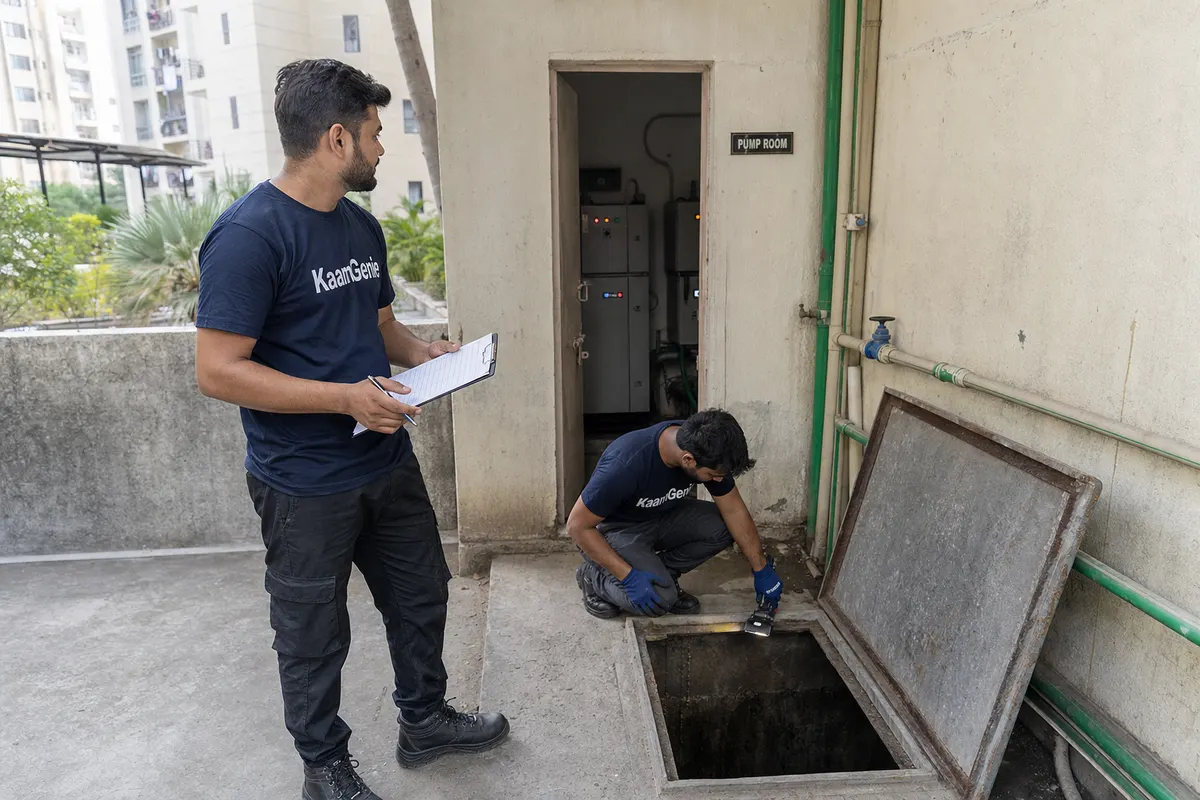
- On the day, the order matters: fill the overhead tanks the night before, switch off the transfer and booster pumps before the reservoir is drained, clean the reservoir, let the fresh fill settle, then clean the tower tanks one at a time.
- Pick the slot that suits your residents: a weekday late morning disturbs fewer people at home; Sunday and weekend slots are available when residents want to be present.
Need a date before you send the notice?
Share your tower list and the reservoir size on WhatsApp. We will suggest a sequence and a slot, so the dates in your circular are ones the crew can actually keep.
Most Gurgaon societies, whether a large condominium or a cluster of mid-rise towers, store water in one or two underground reservoirs fed by GMDA supply, tankers or a borewell, and lift it to overhead tanks on each tower. Cleaning that system means switching water off in stages, and the committee, the facility manager and the residents all need the same picture of what happens when. Our society and high-rise tank guide explains why a society cleans in stages; this post is the paperwork for the day. Change the words in square brackets, delete what does not apply, and send. For the cleaning itself, see our Gurgaon tank cleaning service.
The timeline, from one week out to the evening after
Work back from the cleaning date. The times in the right-hand column are examples for a society cleaning its reservoir and two towers in one day; your crew lead will confirm the real sequence when you book.
| When | Who | What happens |
|---|---|---|
| 7 to 10 days before | Committee | Confirm the date and the tower order with the cleaning team. Send the first WhatsApp alert and pin the circular. |
| 3 to 4 days before | Facility manager | Check that the reservoir hatch opens, the pump panel is labelled, and no tanker delivery is booked for cleaning day. Tell the guards and housekeeping. |
| Evening before | Facility team, residents | Pump every overhead tank to full. Send the reminder message. Residents store drinking and cooking water. |
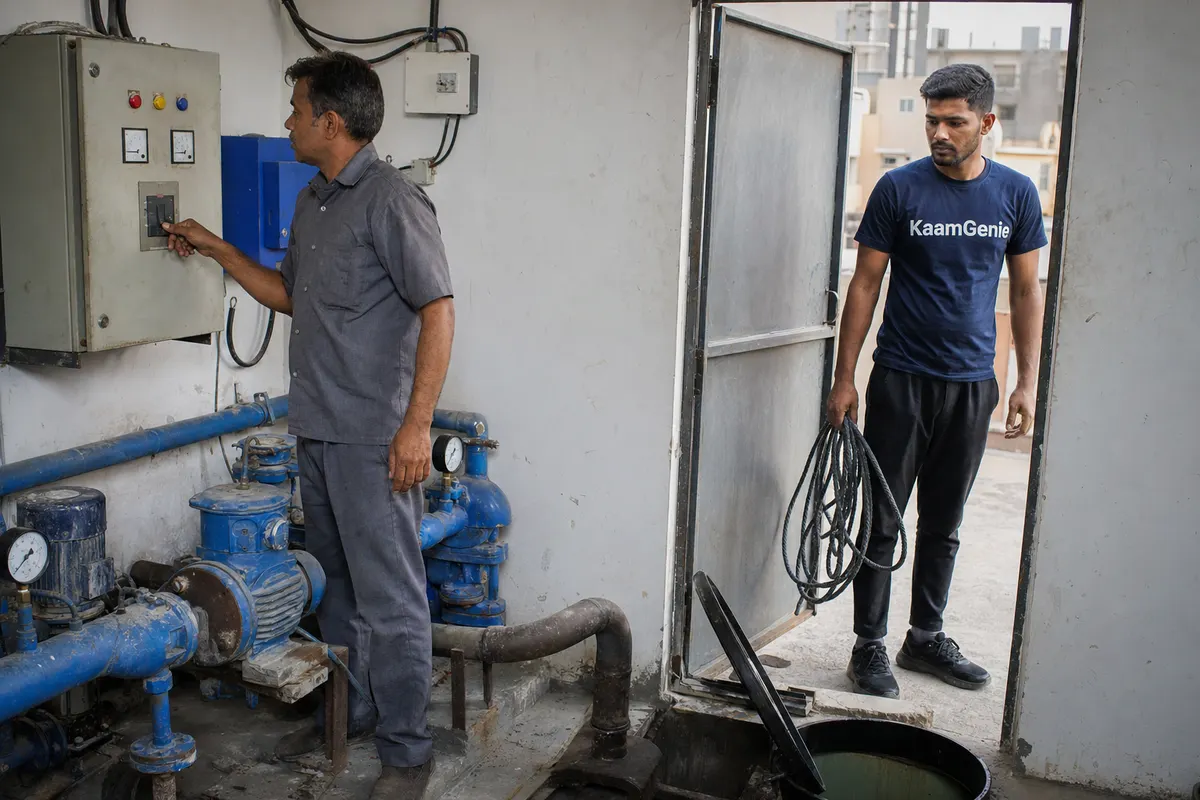
| Day, start (e.g. [9:00 am]) | Facility team, crew | Switch off and tag the transfer and booster pumps at the panel. Close the reservoir inlet. Towers keep running on their full overhead tanks. |
| Day, reservoir clean | Crew | Reservoir drained, de-sludged and rinsed; sludge carried out. Before and after photos sent to the committee. |
| Day, refill and settle | Facility team | Reopen the inlet. Let the fresh fill stand before pumping: about an hour after a routine tanker fill, longer if the mains has just returned after a shutdown. |
| Day, tower by tower (e.g. [12:30 pm] onwards) | Crew, tower representative | One tower’s overhead tanks cleaned at a time and refilled from the clean reservoir. Only that tower’s taps are off. |
| As each tower refills | Committee | Restart that tower’s supply and send the “water is back” message with its photos. |
| Evening after | Facility manager | Note any complaints about air in the lines or cloudy taps, and log the date, tanks cleaned and photos for the records. |
Two details catch committees out. A pump left armed on an empty reservoir can run dry, so it is switched off and tagged before anything is drained (more in the run sheet below). And a tanker that arrives mid-clean has nowhere to go, so move it to after the refill.
Template 1: the WhatsApp alerts
Three short messages beat one long one.
First alert, about a week ahead
Water tank cleaning: [Society name]

Date: [Sunday, 14 December]
Underground reservoir: [9:00 am to 12:30 pm]. Your taps stay ON (overhead tanks will be full).
Tower tanks, one tower at a time:
  [Tower A]: about [12:30 to 2:30 pm]
  [Tower B]: about [2:30 to 4:30 pm]
Only your own tower’s taps are off during its slot.

Please store drinking and cooking water the night before.
Timings may move a little on the day; we will update this group.

Questions: [name, flat, phone]
- [RWA / AOA / Facility office]
Reminder, the evening before
Reminder: tank cleaning TOMORROW, [Sunday, 14 December].

Tonight please:
1. Fill a few buckets and bottles for drinking and cooking.
2. Run any washing machine or dishwasher load tonight.
3. Note your tower’s slot: [Tower A about 12:30 to 2:30 pm].

During your tower’s slot, please switch off your geyser and the RO.
We will message here as soon as your tower’s water is back.
Water is back, sent tower by tower
[Tower A]: tank cleaning done, water is back.

Before and after photos of your tower’s tanks are attached.

Please run each tap for a minute before use. If a tap sputters or is weak, open the taps on the top floors first and work downwards; trapped air usually clears in a few minutes.
Switch the geyser and RO back on once water runs clear.

Cloudy water after 30 minutes? Tell [name, phone].
Thank you for your patience.
Template 2: the notice-board circular
The circular is for the notice board, the lifts and the residents who are not on WhatsApp, often older members and domestic staff who run the kitchen. Keep it on one page, print it large, and put it up at least a week ahead.
[SOCIETY NAME] RESIDENTS WELFARE ASSOCIATION / APARTMENT OWNERS ASSOCIATION
Circular No. [__]                                   Date: [__ / __ / 20__]

SUBJECT: CLEANING OF UNDERGROUND RESERVOIR AND OVERHEAD WATER TANKS

Dear Residents,

As part of the society’s regular maintenance, the underground water reservoir and the overhead tanks of all towers will be cleaned on [DAY, DATE].

SCHEDULE
- Underground reservoir: [time to time]. Water supply to flats will continue from the overhead tanks during this period.
- [Tower A]: water off approx. [time to time]
- [Tower B]: water off approx. [time to time]
- [Tower C]: water off approx. [time to time]
Timings are approximate and depend on refilling.

WE REQUEST RESIDENTS TO
1. Store sufficient water for drinking, cooking and toilets the previous night.
2. Switch off geysers, RO purifiers and any personal booster pumps during their tower’s slot.
3. Keep taps closed during the shutdown, so water is not wasted when supply resumes.
4. Run taps for a minute after supply is restored, before drinking or cooking.

The tanks will be cleaned without chemicals. Before and after photos of each tank will be shared on the society WhatsApp groups.

For any difficulty on the day, contact: [Name], [Flat], [Phone]
Facility office: [Phone]

By order of the Managing Committee
[Name, Designation]
A circular number and signature show the decision came from the committee and leave a dated record. If anyone asks how the clean is paid for and split, that belongs in a separate note; our guide to splitting tank cleaning costs fairly covers the methods and the maths.
Template 3: the resident pre-cleaning checklist
Print this below the circular, or send it as a second WhatsApp message. It is written for whoever runs the household on the day, which is often not the person who reads the group.
BEFORE TANK CLEANING DAY: RESIDENT CHECKLIST

THE NIGHT BEFORE
[ ] Drinking and cooking water stored in clean, covered containers
[ ] A bucket or two filled for toilets and washing
[ ] Washing machine and dishwasher loads run tonight
[ ] Your tower’s slot noted: ____________

DURING YOUR TOWER’S SLOT
[ ] Geyser switched off (it should not heat with no water coming in)
[ ] RO purifier switched off
[ ] Any personal booster pump in the flat switched off
[ ] All taps closed

WHEN WATER RETURNS
[ ] Wait for the “water is back” message for your tower
[ ] Run kitchen and bathroom taps for about a minute
[ ] Weak or sputtering taps: top floors open first, then lower floors
[ ] Geyser and RO back on once the water runs clear
[ ] Cloudy water after 30 minutes? Report it to: ____________

INFORM YOUR STAFF
[ ] Cook, maid and driver told about the timing
Weekday or weekend: choosing the slot
Sunday and weekend slots are available, and many societies prefer them because the committee members who organise the clean are free to be there. The trade-off is that more families are at home using water. The table helps you choose.
| Your society | Better slot | What to plan for |
|---|---|---|
| Mostly working couples, committee busy on weekdays | Sunday or Saturday | More people at home; ask residents to store a little more water than usual |
| Many senior residents or home-based families | Weekday, late morning | The school and office rush has drawn its water; older residents may need a knock on the door as well as the circular |
| Many towers, one reservoir | Weekend for the reservoir, weekdays for towers | Spread tower cleans over several days so each tower is off only once |
| Society relies on tankers | Any day without a booked delivery | Move the tanker to after the reservoir clean |
| Festival week or exam season | Move the date | Residents forgive a shutdown more easily outside those weeks |
Put the day and the date in every message. For timing across the year, see how often a Gurgaon tank should be cleaned; we recommend every 3 months, which means the same templates come round four times a year, so save them.
Want the photos ready to forward, tower by tower?
We send before and after photos of each tank on WhatsApp, named by tower, so the committee can post them in each group the same day.
The facility team’s run sheet
This is the operational version for the facility manager, pump operator and guard. Go through it together a few days before.
- Know your valves. The reservoir inlet, the outlet to the transfer pump, and the inlet valve to each tower’s overhead tanks. If the labels have worn off, ask your plumber to mark them before the day; we do not trace or label lines.
- Fill every overhead tank the night before, then switch the transfer pump off at the panel in the morning and tag it. If the society runs a booster or hydropneumatic system on the supply side, switch that off too, so it does not hunt for pressure from an empty source.
- Keep the reservoir hatch clear. Cars, planters and stacked material on top of the hatch are a common delay. Our crews often find reservoir hatches under parked cars in basements and podiums, simply because the slab is used as parking, so ask residents to move them the evening before.
- Hold the inlet shut until the crew says so, then refill and give the water time to settle before pumping to the towers. A clean tower tank filled from a freshly stirred reservoir is cloudy again by evening.
- Restart one tower at a time, matching the order in the circular, and tell the committee as each one goes live so the right message goes to the right group.
For what happens inside the reservoir, and why the crew never enters without a second person at the hatch, see our underground reservoir cleaning guide. If taps are still spluttering or brown after the refill, our post on muddy water after supply returns covers clearing the lines.
How KaamGenie fits into your plan
The complete method is in our step-by-step cleaning process. For a society’s communication plan, the parts that matter are these:
- The reservoir floor is de-sludged, with the sludge scooped and vacuumed out down to the bare floor so none is left to reach the tower tanks.
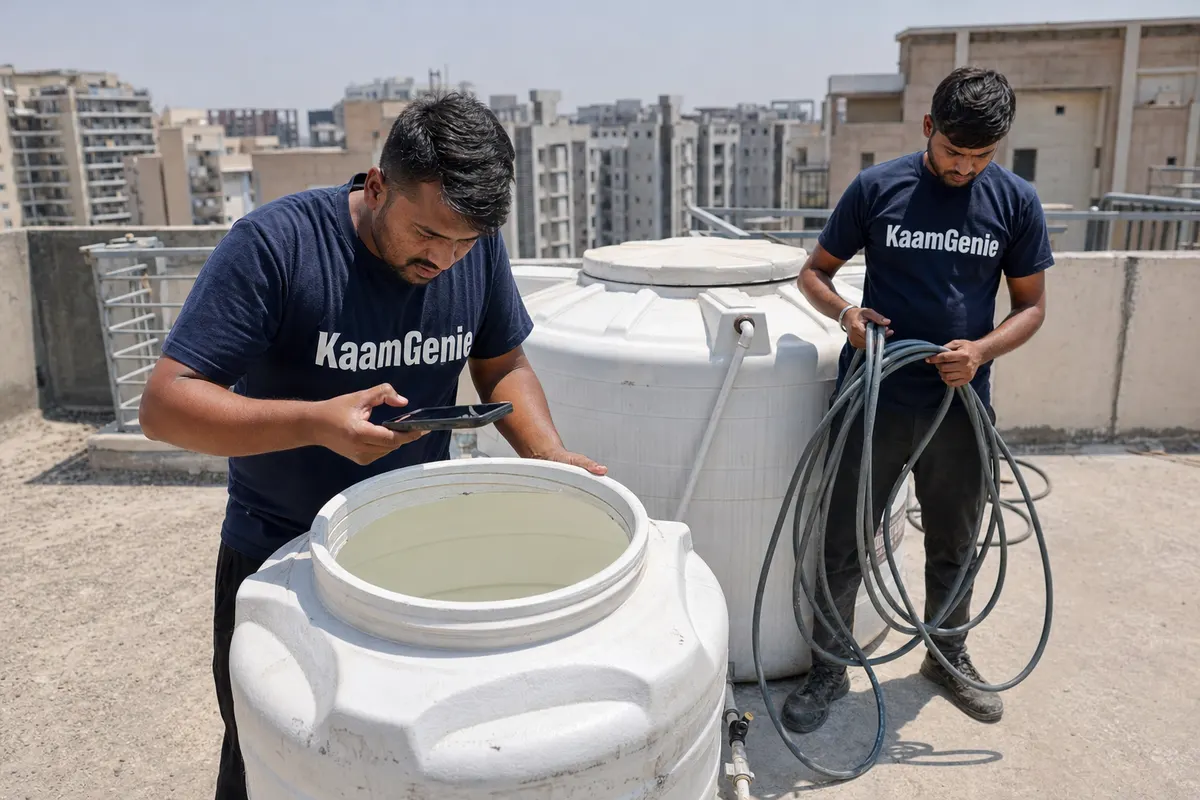
- Tower tanks are done one tower at a time, so your circular only ever has one tower off at once. A single overhead tank generally takes the crew an hour to an hour and a half, while refilling time depends on the supply; how long a whole society takes depends on the number and size of tanks, which our guide to cleaning time explains.
- Photos come to the committee as each tank is finished, named by tower, so the third message can go out with proof attached.
The clean is physical: drain, scrub, jet wash, wet-vacuum and rinse, without chemicals. If a lab report for the society shows bacteria, disinfection can be added on request, and the circular should then say so. A cleaning certificate is also available on request if your committee wants one for its records. We work with societies across Gurgaon, including Nirvana Country, Sector 56, Malibu Towne and New Gurgaon.
What the notice can and cannot promise
- It can promise the date, the tower order and approximate windows. Write “approx.” and mean it; refilling depends on supply.
- It should not promise an exact minute that water returns, or that the water will taste different. A clean removes sludge and slime; it does not change the hardness or TDS of the source.
- It should not promise pipe or leak repairs during the shutdown unless your plumber has been booked for them separately.
What not to do
- Do not send the notice the night before. Families with elderly members, infants or night-shift workers need days, not hours, to plan around a shutdown.
- Do not drain the reservoir with the pumps still armed. One person switching a pump back on to “check” can run it dry.
- Do not switch off every tower at once to finish early. It makes the society go dry together and leaves no clean reservoir water to refill from in stages.
- Do not write “tanks will be disinfected” in the circular unless the committee has actually asked for it. A standard clean uses no chemicals, and residents deserve an accurate notice.
- Do not forget the third message. Residents who are never told the water is back keep their taps closed and call the guard all afternoon.
Fix the date, then send the notices
Before the first alert goes out, message us the reservoir size, the number of towers and overhead tanks, and the days you are considering, weekday or weekend. We reply with a sequence you can paste into the timeline above and a fixed quote: each overhead tank from ₹699, a small sump from ₹1,499, and a larger society reservoir priced by its size. The society settles the bill after the work, once the committee has the photos for every tank. You can also see the services and areas on our Gurgaon page, read the full Gurgaon tank cleaning guide, or call +91 95603 66362. Committees that want a standing annual arrangement can read our RWA contract guide.
Frequently asked questions
How many days before the tank cleaning should a society inform residents?
About a week ahead is a good minimum for the first message, with the circular pinned at the same time and a reminder the evening before. Seven days lets families with elderly members, infants or night-shift workers plan, and gives the facility team time to reschedule tankers and check valves. For a weekend slot, send the first alert early in the week before, so it is not lost under the weekend’s other messages.
Will residents have water while the underground reservoir is cleaned?
Usually yes, if the overhead tanks are pumped full the night before. Flats keep drawing from their tower tanks while the reservoir is drained, cleaned and refilled, so the circular can honestly say taps stay on during that part. Water goes off for a tower only when its own overhead tanks are being cleaned, which is why the tower slots, not the reservoir slot, are what residents need to plan around.
Why should the booster pump be switched off before cleaning?
A transfer or booster pump drawing from an empty reservoir can run dry, which can damage it. Switching it off at the panel and hanging a tag on the switch stops anyone turning it back on by habit while the crew is working. If the society has a hydropneumatic system on the supply side, switch that off too. The facility team restarts the pumps only after the reservoir has been refilled and the water has settled.
Is it better to clean society tanks on a Sunday?
It depends on your residents. Sunday and weekend slots are available and suit societies where most residents and committee members work on weekdays, since organisers can be present. More people are home using water, though, so ask residents to store a bit more. Societies with many senior or home-based residents often find a weekday late morning, after the school and office rush, disturbs fewer people.
What should residents do when the water comes back?
Run each tap for about a minute before drinking or cooking, so the first water clears out of the pipes. If taps sputter or feel weak, open the top-floor taps first and work down the building, which lets trapped air escape. Switch the geyser and RO purifier back on once the water runs clear. If it is still cloudy after half an hour, tell the contact named in the circular.
Should the circular mention disinfection, or only if we ask for it?
Only if it is true. A standard KaamGenie clean is physical: draining, de-sludging, scrubbing, jet washing, vacuuming and rinsing, with no chemicals. Disinfection is added only when the committee asks for it, for example after a lab test of the society’s water finds bacteria. If you have requested it, say so in the circular; if not, the accurate line is that tanks will be cleaned without chemicals.
Can the same notice templates be reused for every cleaning?
Yes, and it saves the committee time. Keep the three WhatsApp messages, the circular and the checklist in one shared document, and change only the date, the tower order and the contact for the day. Because we recommend cleaning every 3 months, a society uses them four times a year, and residents who see the same format each time learn what to expect.
Sources & references
- Gurugram Metropolitan Development Authority (GMDA): the agency responsible for bulk water supply in Gurugram.
- CPHEEO Manual on Water Supply and Treatment: Government of India guidance on storage reservoirs, pumping and distribution.
- Bureau of Indian Standards (BIS): IS 10500:2012, the Indian Standard for drinking water.
Last verified: 23 November 2026. If you find any of these links broken, please let us know.