
Quick answer
- Before the motor runs: stop the muddy first water from going straight up to the rooftop tank. Switch the pump to manual or off.
- First flow: let it run to waste from a tap on the direct line until it looks clear in a white bucket.
- The sump: let it sit still for a few hours, ideally overnight, so the mud drops to the floor before you pump. That is longer than the hour a routine tanker fill needs.
- Sputtering taps: that is air trapped in the pipes. Open the highest tap first and let it spit until the flow is steady, then work down floor by floor.
- Still brown after two days of normal use, or grit at the taps: the mud has joined the sludge on the tank floor, and the tank needs cleaning.
Do not drink or cook with the cloudy water until it has cleared and settled.
Mud got into the tank anyway? We will take it out
Restart mud comes out of an overhead tank from a fixed ₹699 and out of a sump from ₹1,499. Silt carried away, not flushed; you pay once the before and after photos are in.
Gurgaon’s piped supply comes from GMDA’s bulk network, which is shut down from time to time for pipeline repairs, new connections or reservoir work, and runs short in peak summer. When water is switched back on, the first rush through the mains is rarely clean. If your water is tinted all the time rather than just after a restart, start with our guide to yellow or brown tank water in Gurgaon instead, which covers colour diagnosis in detail.
Why the first water after a shutdown is muddy
Fine silt, rust and a soft film settle in the low points of the mains during normal running. When supply restarts, a fast surge scours them loose and carries them as one brown slug to the first homes that draw water. Four things usually arrive together:
- Loosened pipe sediment: fine grey or brown silt that was lying in the mains and your own service line.
- Soil from repair work: earth from the trench that entered while the pipe was open.
- Rust scale: in the older plotted sectors, the pressure change can knock flakes off the inside of ageing galvanised iron service pipes.
- Air: trapped in pipes that drained during the outage.
The aim is to stop that slug reaching your overhead tank, where it sits long after the mains run clear. For a wider picture of how GMDA water, borewells and tankers each reach your tank, see Gurgaon’s water supply explained.
Will it clear on its own? A quick decision table
Most restart mud is temporary. What you see over two days tells you where it went.
| What you see | What it usually means | What to do |
|---|---|---|
| Brown at the direct tap, clears within 10–20 minutes of running | A normal first slug from the mains | Run to waste, then carry on as usual |
| Direct tap clear, but tank-fed taps still cloudy | The slug was pumped up before it cleared | Leave the tank still for a few hours; taps draw from the bottom outlet, so use other water meanwhile |
| Sump water clears from the top down after a few hours | Mud is settling on the sump floor | Pump up only once the top layer is clear |
| Taps spit air, then run normally | Airlock from pipes that drained | Bleed air from the highest tap |
| Still brown after two days of normal use | Mud has mixed into the sludge on the tank floor | Tank cleaning; sump too if it was filled muddy |
| Fine grit in tap aerators and the geyser drain | Sediment has travelled through the house pipes | Clean aerators now, and the tank before it settles further |
The first 24 hours: a routine that keeps the mud out of your tank
The order matters more than any single step. Do this whenever you know a shutdown is happening, or as soon as you notice supply has returned.
- Before supply returns, take the pump off automatic. A motor on a float switch or timer starts the moment the sump fills. Switch it to manual so the muddy water stays downstairs to settle.
- If your overhead tank fills straight from the line, close its inlet valve. Where line pressure pushes water directly to the roof, close the rooftop gate valve for the first hour or so, then reopen it.
- Run the first water to waste. Open a tap on the direct line, usually the outside tap, the garden tap or the ground-floor kitchen tap, and catch the flow in a white bucket. Use it for washing outdoors, and stop when a fresh bucket looks clear.
- Let the sump sit still. Once the sump has taken in the muddy water, leave it alone for a few hours, overnight if you can. The slug after a shutdown carries far more, finer sediment than a routine tanker fill, so it needs longer. Silt settles only in still water; every time the pump runs, it stirs the floor and lifts the mud back up.
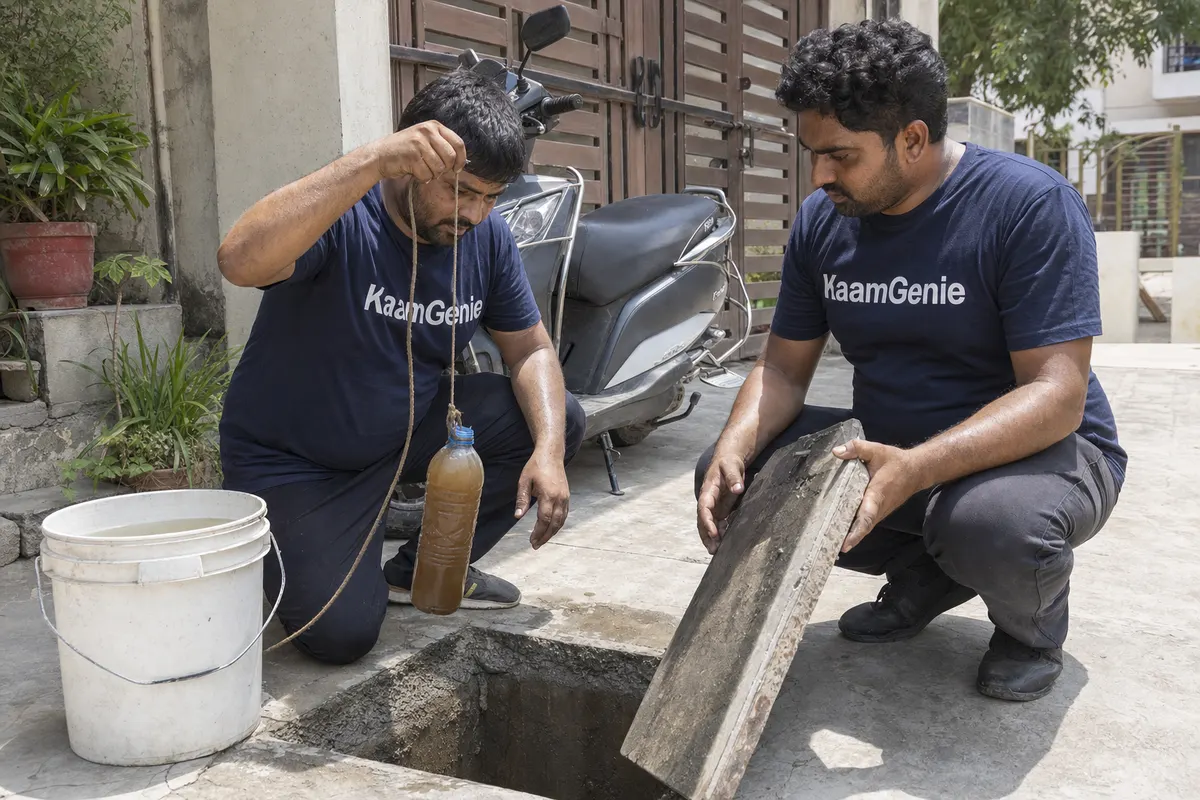
- Do the two-depth bottle check (described below) before you pump anything up.
- Pump up in short runs. When the top layer is clear, run the motor for a short spell, then check a tank-fed tap. If it turns cloudy, the sump level is too low and the pump is pulling from near the sludge. Stop and let it rest.
- Open taps from the top floor down. Start with the highest tank-fed tap, let it run until it stops spitting, then work down floor by floor. The airlock section below explains why.
- Rinse tap aerators and shower heads, which catch restart grit.
The two-depth bottle check
This tells you whether the water you are about to pump up is clearer than the water at the bottom. The catch is that an open bottle fills on the way down, so a bottle lowered to the floor uncapped just gives you a mix of every layer. You need two clean transparent bottles with corks or loose stoppers, a stone and two lengths of string.
- Top sample: hold the first bottle just under the surface, about 30 centimetres down, let it fill and lift it out.
- Floor sample: tie the stone to the second bottle so it sinks, push its cork in loosely, and tie the second string to the cork. Lower it on the first string until it nearly touches the floor, then give the cork string a sharp tug to pull the cork out. The bottle fills at that depth. Wait a few seconds and lift it out steadily.
Safety first: never lean into or climb down into a sump or underground tank, even a shallow one. Gases can build up in a closed sump, and people have collapsed in them. Do the whole check from above, at arm’s length from the manhole, or leave it to the crew.
- Both bottles clear: the mud has settled into a thin layer. Pump normally.
- Top bottle clear, floor bottle cloudy: the sediment is settling but still loose. Pump only while the sump is well filled, and stop before the level drops close to the floor.
- Both bottles cloudy: the water has not settled yet. Wait a few more hours and repeat.
- Floor bottle comes up with dark sludge or a smell: this is old sludge, not just today’s mud. The sump needs cleaning, and pumping will keep sending it upstairs.
Hold both against white paper in daylight and compare them with the results below.

Airlocks after a long outage
If the supply was off long enough for your pipes to drain, air takes the place of the water. When the supply returns, that air gets trapped at high points and bends, and it shows up as taps that cough, spit and then run in bursts, or a tank that is full but a bathroom that gets only a trickle.
- Open the highest tank-fed tap in the house fully and leave it until the spitting stops and the flow turns smooth.
- Then open the other taps one floor at a time, from the top down, letting each one run until it is steady.
- Do not run a booster or suction pump dry. If your pump has an air problem on its suction side, it may hum without pushing water. Switch it off and have a plumber prime it; running it empty can damage the seal.
- One tap still weak? Check its aerator for grit.
Low flow that persists once the air is out can mean the tank’s outlet is buried in fresh silt. Our post on low water pressure from a dirty tank shows how to tell a silted outlet from a pipe or pump problem.
For societies: pause the transfer pump until the reservoir settles
Most Gurgaon societies and condominiums take GMDA and tanker water into a large underground reservoir (UGR) and lift it to rooftop tanks with transfer pumps on level controllers. When bulk supply resumes, the UGR can fill with one muddy charge, and pumps left on automatic send it to every tower within minutes.
A simple protocol for facility managers and maintenance staff:
- Switch the transfer pumps to manual as soon as you know supply is about to resume, or the moment you see the inlet chamber running brown.
- If the UGR has separate compartments, let the first water enter one compartment and keep the other isolated, so residents can be served from the cleaner side.
- Let the reservoir stand for several hours and do the two-depth bottle check from the access manhole using long strings, with nobody entering the reservoir.
- Tell residents on the society WhatsApp group when water will be normal again.
- Restart pumping tower by tower, keeping the UGR level well above the floor, and check a tap on the top floor of each tower before moving on.
- Log the date. If the floor sample keeps coming up dark, the UGR has a sludge layer to clean before the tower tanks.
Our guide to underground sump and reservoir cleaning in Gurgaon explains how large UGRs can be cleaned compartment by compartment so towers are not left dry, and RWA society tank cleaning covers planning it with residents.
When muddy water has become a tank problem
Beyond the decision table above, two signs settle it: the water looks fine in the morning but turns cloudy after every pump run, or a torch shows a soft brown carpet on the tank floor. Fresh silt on old sludge gives bacteria a sheltered place to grow, so remove it rather than wait. Our list of signs your Gurgaon tank needs cleaning covers the other warning signs, and for how timing fits into your year, see how often to clean a water tank in Gurgaon.
Builder floors, kothis and tanker homes: who has the switch
In smaller buildings the question is who controls the valve or the motor when water returns, and whether anyone is home. For each property type, see the complete guide to water tank cleaning in Gurgaon.
- Builder floor with tanks filled by line pressure: there may be no sump to settle the mud at all, so the rooftop gate valve is your only defence. Agree with the other floors who closes it when a shutdown is announced, because one open valve fills a shared tank with the slug.
- Plotted house or kothi with its own sump: the motor switch is yours. Motor off, sump left overnight, bottle check, then pump in short runs. Older service pipes here can also add rust flakes to the first flow; our post on rust in tank water in Gurgaon explains how to tell pipe rust from tank rust.
- Tanker- or borewell-heavy home: avoid taking a tanker on the same day the mains return. Two loads of silt arriving together never settle well. In newer tanker-fed sectors such as Sector 82, our crews often find restart mud lying on an older, packed bed of tanker silt.
How KaamGenie cleans a tank after restart mud
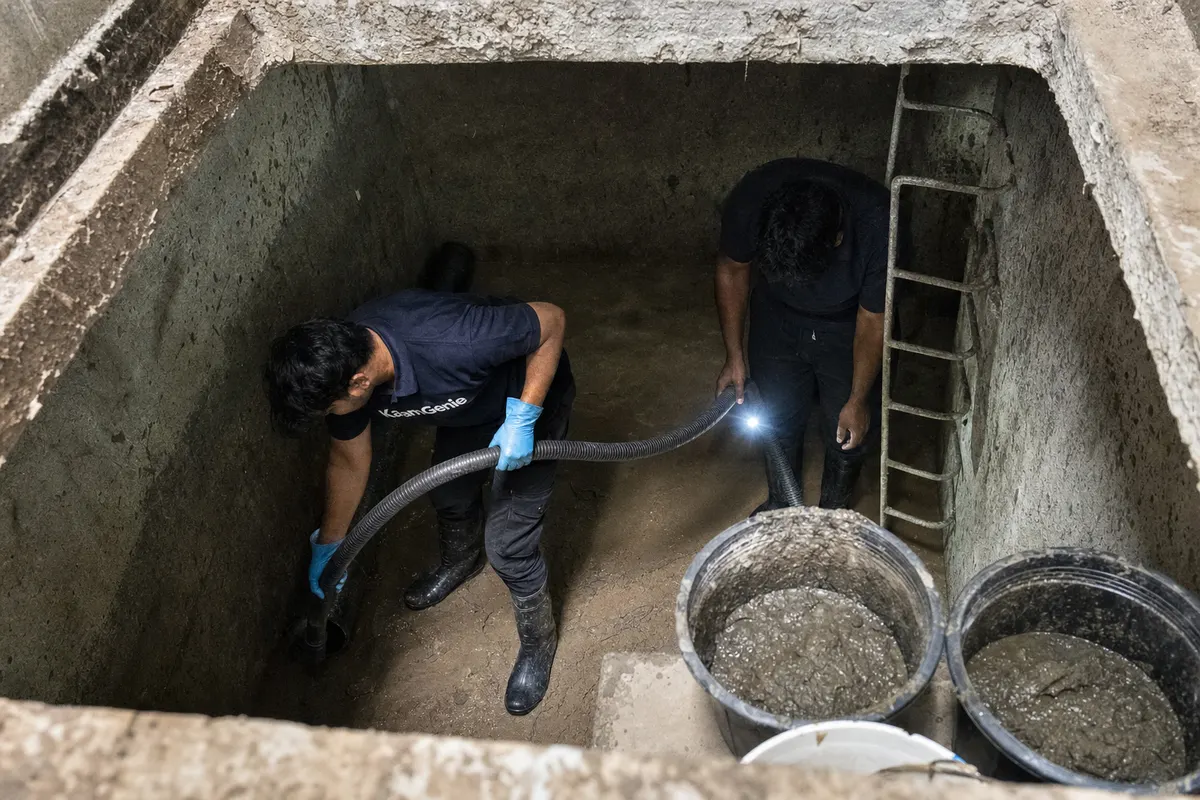
Settled restart mud must be lifted out without stirring it back into the pipes. The full step-by-step is in the Gurgaon cleaning process guide. For this problem, three things decide the result:
- De-sludging the sump first. If both are affected, the sump is drained, its silt scooped and wet-vacuumed out and carried away, and only then is the rooftop tank done, so a clean overhead tank is never refilled from a muddy sump.
- Keeping the house outlet shut throughout. With the inlet and the outlet to the house both closed, the thick bottom layer cannot run into your pipes and geyser while the crew works.
- Clearing the outlet corner. Silt banks up around the outlet pipe, which is also what starves the taps of pressure. That corner is scrubbed and vacuumed clear before the jet wash and fresh-water rinse.
Lifting out restart silt needs no chemicals, so none are used by default; ask for disinfection only if the muddy water also smelt bad or the tank stood empty for long. Photos come on WhatsApp. See also overhead vs underground tank cleaning.
Not sure if it will clear on its own?
Send us a photo of the settled bottle or the tank floor on WhatsApp. We will tell you honestly whether to wait a day or book a clean.
What not to do
- Do not let the motor run on automatic during a restart. It is the most common way restart mud ends up on the roof.
- Do not pump a sump down to the floor to “get rid of” the mud. You will only send the thickest part upstairs.
- Do not add alum, bleach or other powders to the tank yourself to make the mud settle faster. Dosing is easy to get wrong, and the silt still stays in the tank.
- Do not lean into or climb down into a sump to look at the floor or fetch a sample. Gases can build up in a closed sump.
- Do not drain a muddy sump into the street drain. Use the water outdoors, or have the silt removed properly.
Mud stayed in the tank? Book a clean
If two days of normal use have not cleared it, the silt is sitting on your tank floor and will not leave by itself. Restart-mud removal starts at ₹699 for an overhead tank and ₹1,499 for an underground sump, fixed before work begins, and you pay after the job once the photos show a clear floor; society reservoirs are quoted by size. After-shutdown visits reach Palam Vihar, Sector 56 and New Gurgaon; the rest is on our Gurgaon water tank cleaning page, or call +91 95603 66362. If you rely on tankers between GMDA supplies, also read tanker water and your Gurgaon tank.
Frequently asked questions
Why does water come muddy after a GMDA shutdown in Gurgaon?
When the mains are switched back on, the rush of water scours off silt, rust and soft deposits that had settled inside the pipes while they were still or empty. If the shutdown was for a repair, a little soil from the excavation can also get in before the line is fully flushed. That loosened material travels as one brown slug to the first homes that draw water, which is why it usually looks worst in the first minutes after supply returns.
How long should I run the tap before the water is usable?
There is no fixed time, because it depends on how far you are from the repair point and how long the line was off. The practical test is a white bucket: keep filling and emptying it from a direct-line tap until a fresh bucketful looks clear against the plastic. Use the waste water for washing outdoors or flushing. Then let the sump or tank settle before you treat its water as normal.
Should I switch off the motor when supply comes back?
Yes, if your motor starts automatically from a float switch or timer. The first water into the sump is the muddiest, and an automatic motor sends it straight up to the overhead tank before it has had any chance to settle. Switch the pump to manual, leave the sump still for a few hours, check that the top layer is clear, and then pump up in short runs while the sump level is still high.
Is muddy water after a supply restart safe to bathe in?
Clear, settled water is generally fine for bathing once the first slug has run through. Very cloudy water is best avoided for bathing small children and for anyone with skin problems, because the same sediment can carry bacteria. Never drink or cook with it until it has cleared and settled. If anyone in the family develops stomach trouble or a skin reaction after a restart, see a doctor and mention the water.
My taps are spitting air after the supply came back. What do I do?
That is an airlock caused by pipes that drained during the outage. Open the highest tank-fed tap in the house fully and leave it until the flow turns smooth, then open the other taps one floor at a time from the top down. If your pump hums but does not push water, switch it off and call a plumber to prime it, because running a pump without water can damage it.
How do I know if the mud has settled in my tank and needs cleaning?
The clearest sign is that the direct tap has been running clear for a day or more but the tank-fed taps are still cloudy, or they turn cloudy every time the pump runs. A torch will often show a soft brown layer on the tank floor that lifts in a cloud when disturbed. Grit that keeps clogging tap aerators and an earthy smell a few days later are also strong signs that a cleaning is due.
Our society UGR turned muddy after supply resumed. Should only the rooftop tanks be cleaned?
No. If the muddy water entered the underground reservoir and was pumped up, both are affected, and cleaning only the rooftop tanks means they are refilled from a reservoir that still holds the silt. The reservoir should be cleaned first, compartment by compartment so towers keep some water, and the rooftop tanks after it. A society reservoir is priced by its size and capacity, agreed with the facility team before the crew begins.
How much does it cost to clean a tank after muddy supply water in Gurgaon?
Mud removal after a supply restart costs from ₹699 for an overhead tank and from ₹1,499 for an underground sump. Fresh restart silt is soft and lifts out easily, while older sludge beneath it takes longer, but the quote is fixed before anyone starts and you pay only after the clean, once your own before and after photos have arrived. Muddy-water jobs use no chemicals unless you request disinfection.
Sources & references
- Gurugram Metropolitan Development Authority (GMDA): the agency responsible for bulk water supply in Gurugram, including planned shutdowns.
- Bureau of Indian Standards (BIS): IS 10500:2012 sets the drinking-water turbidity limit at 1 NTU acceptable and 5 NTU permissible.
- CPHEEO Manual on Water Supply and Treatment: the Government of India engineering manual covering distribution mains, flushing and storage reservoirs.
- WHO Guidelines for Drinking-water Quality, 4th edition: guidance on turbidity and on intermittent supply as a risk to stored water.
Last verified: 22 November 2026. If you find any of these links broken, please let us know.