
Quick answer: who pays what
- The shared sump is everyone’s bill. Every floor it feeds pays a share, occupied or empty, because every rooftop tank refills from it.
- A rooftop tank that serves one floor is that floor’s bill. Where a tank is shared by two or more floors, those floors split it.
- When each floor has exactly one tank, an equal split and a “your tank plus a quarter of the sump” split give the same figure, so just divide the total by four.
- When tank counts differ, charge each floor for its own tanks and divide only the sump. That is the split least likely to cause an argument.
- Settle vacant and rented floors in writing before the visit, not after the crew has left.
- One neighbour books for the building. The quote is fixed before work starts (₹699 per overhead tank, ₹1,499 for the sump), and the bill is paid after the cleaning, once everyone has seen the before and after photos.
This is practical guidance between neighbours, not legal advice. Your sale deed, rent agreement or RWA rules may already say who pays.
Cleaning the whole building, sump included?
Send the number of rooftop tanks and the sump on WhatsApp. You get one fixed quote, listed tank by tank, so the split is easy to share with the other floors.
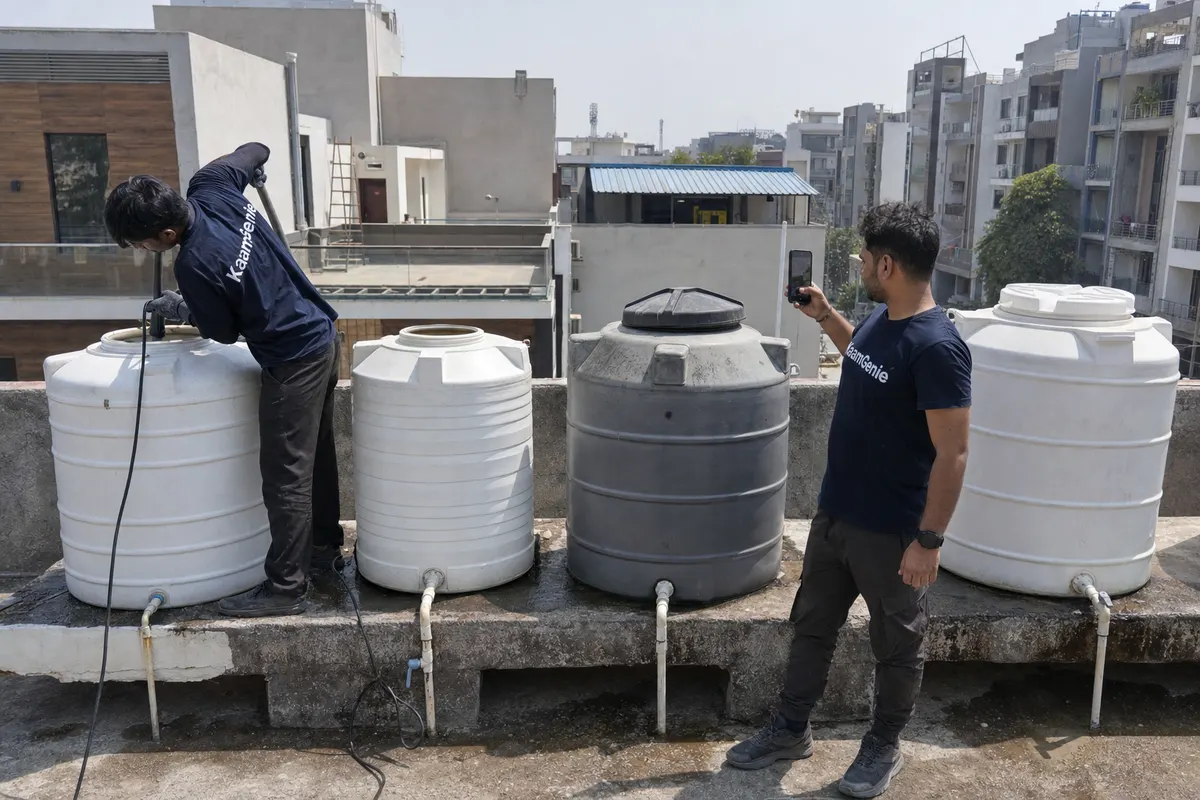
Many Gurgaon plots are now stilt-plus-four builder floors: parking at ground level, four flats above, often a different owner on each. Typically GMDA supply, a borewell or a tanker fills one underground sump below the stilt, a pump lifts it to the roof, and each floor draws from its own overhead tank or from a tank it shares with a neighbour. Our builder-floor tank guide explains how these buildings are plumbed; this post is only about the money and how to divide it without falling out. For the service itself, see tank cleaning across Gurgaon.
First, list what is shared and what is yours
Before anyone talks about rupees, walk the building with whoever knows the plumbing. Count the sump, count every rooftop tank, and write down which floor each tank feeds. If nobody is sure which tank feeds which flat, ask your plumber to check by closing one tank’s outlet valve at a time. KaamGenie does not trace lines, so get this sorted before the visit.
| Tank | Who uses it | Fair payer | Note |
|---|---|---|---|
| Underground sump below the stilt | Every floor, through the shared pump | All floors it feeds, in agreed shares | Every rooftop tank refills from here |
| Rooftop tank serving one floor | That floor only | That floor’s owner, or the tenant if the rent agreement says so | Best cleaned on the same visit as the sump |
| Rooftop tank shared by two floors | Both floors | Those two floors, half each | Common where a builder fitted fewer, larger tanks |
| Extra terrace tank used by the top floor | Top floor only | Top floor | Often added later for a terrace garden or a second kitchen |
| Small tank for the stilt tap or guard room | Car washing, the guard, the common tap | All floors, like the sump | Easy to forget, and often the dustiest tank in the building |
Four fair ways to split the bill
Each is fair in the right building. Pick one before the visit and keep it, so nobody suspects it was chosen to suit one floor.
1. Equal share per floor
Add up the whole quote and divide by the number of floors. It is the simplest method, it needs no list of tanks, and it works well when every floor has one tank of similar size. It starts to feel unfair the moment one floor has two tanks and the others have one.
2. Your own tank, plus an equal slice of the sump
Each floor pays the full price of the tank or tanks that serve it, and the sump is divided equally between all floors. This is the method we suggest to most builder floors, because it maps exactly onto the table above: private tanks are private costs, shared storage is a shared cost.
3. By tank count across the whole bill
Count how many tanks each floor uses (a shared tank counts as half for each floor using it), then split the entire bill in that ratio, sump included. It suits buildings where the floors have very different tank counts and the owners prefer one ratio for everything.
4. By people or water use
Split the sump by how many people live on each floor, since a family of six draws more than a single tenant. Few builder floors have separate meters, so it rests on an agreed headcount, and it is the method most likely to start a debate. Use it only if the pump’s electricity is already split that way.
| Your building | Best method | Why |
|---|---|---|
| Four floors, one rooftop tank each, all occupied | Equal share per floor | Gives the same result as method 2, with less arithmetic |
| One floor has an extra terrace or second tank | Own tank plus sump slice | The extra tank’s cost stays with the floor that uses it |
| Floors differ a lot in family size, pump power already split by headcount | Sump by people, tanks by owner | Matches a rule the building already accepts |
| One floor empty or used only occasionally | Own tank plus sump slice, with a vacancy rule agreed first | Separates the shared cost from the optional one |
Worked examples you can check on a calculator
These use only our two fixed prices: ₹699 for each overhead tank and ₹1,499 for the underground sump. Round to the nearest rupee when you collect; the paise are not worth a group argument.
Example A: stilt plus four, one tank per floor. Four rooftop tanks come to ₹2,796, and with the sump the building pays ₹4,295. Split equally, that is about ₹1,074 per floor. Split as “own tank plus a quarter of the sump”, it is ₹699 plus about ₹375, which is also about ₹1,074. In this building the two methods are identical, so the simple one wins.
Example B: the top floor has a second terrace tank. Five tanks come to ₹3,495, and the total is ₹4,994. An equal split asks every floor for about ₹1,249. With method 2, the first three floors pay about ₹1,074 each and the top floor pays ₹1,398 for its two tanks plus about ₹375 of the sump, roughly ₹1,773. Under the equal split, each lower floor would quietly be paying about ₹175 towards a tank it never uses.
Example C: two large rooftop tanks shared by all four floors. Two tanks plus the sump come to ₹2,897, which is about ₹724 per floor. With nothing private to separate, split it equally.
Example D: only the sump, after a muddy supply. When the mains returns full of silt, some buildings clean the sump on its own first. ₹1,499 divided by four is about ₹375 per floor. If muddy water is your trigger, read what to do when supply comes back muddy before you book.
The yearly view. We recommend cleaning every 3 months. In Example A that is four visits a year, so each floor’s yearly share comes to ₹4,295, exactly what the whole building pays for a single visit, or roughly ₹358 a month per floor. For why that timing suits Gurgaon water, see how often to clean a tank in Gurgaon, and for what moves a quote in general, our Gurgaon tank cleaning cost guide.
Vacant, rented and part-time floors
Most money arguments start with a floor that is not lived in like the others. Agree the rule in the group before you book.
- An empty floor still pays its sump share. The flat will need the sump the day it is let or sold, and a neglected sump affects the occupied floors either way.
- An empty floor’s own tank is the owner’s choice, with one condition: if it is skipped, its outlet valve stays shut so stale water does not mix into a shared line, and it is cleaned before anyone moves in. Our move-in tank guide covers that first clean.
- A rented floor follows the rent agreement. Wording varies, so read yours. Our guide for tenants explains how to raise it politely. Whoever pays, the building only needs one name per floor.
- An owner abroad or slow to reply should not hold up the sump. Clean on the agreed date, post the photos and their share, and let a family member settle it locally if needed.
Who books, who pays, and how to keep it friendly
Use one coordinator per visit, rotating floor by floor. The coordinator sends us the tank list, shares the fixed quote, fixes the date and takes the crew’s call on the day. Nobody pays in advance: the building pays after the cleaning, once the before and after photos are in, so the coordinator can forward each floor its own photos and collect shares then.
A few habits keep it calm:
- Post the quote itself, with each floor’s amount, in one pinned message. A screenshot ends most questions before they start.
- Collect after the photos, not before. People pay faster for work they have just seen.
- Keep a one-line record: date, tanks cleaned, total, the method used and who has paid. The next coordinator starts from it.
Want the photos sorted floor by floor?
Tell us which tank belongs to which floor when you book. Each owner then sees their own tank’s before and after photos, and the bill is settled once everyone has seen them.
Copy and paste: the group message and poll
Edit the parts in square brackets and paste this into the building group.
Hello everyone, it is time for the building’s tank cleaning.

What gets cleaned: the shared sump + [4] rooftop tanks
Quote (fixed before work): sump ₹1,499 + [4] x ₹699 = ₹[4,295]
Proposed date: [Sunday, 7 December], morning

How we split it: each floor pays for its own tank(s) + an equal share of the sump
Floor 1: ₹[1,074]   Floor 2: ₹[1,074]
Floor 3: ₹[1,074]   Floor 4: ₹[1,074]

Payment is due only after the cleaning, once the before/after photos are posted here. I will share each floor’s photos and collect then.

Please store some water the night before. Reply or vote below by [Thursday].
Then add a WhatsApp poll so the decision is recorded, not argued in replies:
Poll: Tank cleaning on [Sunday, 7 December]. Split = own tank + equal sump share

Option 1: Yes, go ahead on this date
Option 2: Yes, but a different date please
Option 3: My floor is vacant, sump share only (my tank stays valved off)
Option 4: I would like a different split method, let us discuss
Sunday and weekend slots are available, handy when owners work different days. If you are organising for a larger society and need a formal notice-board circular, a timeline and a resident checklist, use our society tank cleaning notice templates.
Small societies: the same logic on a bigger sheet
A few low-rise blocks around one reservoir work the same way at a larger scale. The reservoir is priced by its size and each block’s overhead tanks per tank. Split the reservoir per flat, since every flat draws from it, and each block’s tanks across that block’s flats. If the association already collects maintenance, paying from that fund avoids a separate collection. Larger set-ups are covered in our society and high-rise tank guide.
What a cleaning can settle, and what it cannot
- It can remove the sludge, slime and loose scale from the sump and every rooftop tank, and give each floor photo proof of its own tank.
- It cannot fix a leaking pipe, a failing pump or a cracked sump wall. Those need your plumber or mason, and how to divide that cost is a separate conversation from cleaning.
- It cannot make one floor’s water clean if the shared sump is skipped. A tank cleaned alone refills from whatever is in the sump.
- It does not add chemicals unless you ask. A standard clean uses no chemicals; disinfection is added only if a floor or the building asks for it, for example after a lab report shows bacteria.
How KaamGenie handles a shared building

The full method is in our Gurgaon cleaning process guide. In a building where several owners are paying, three parts of it matter most:
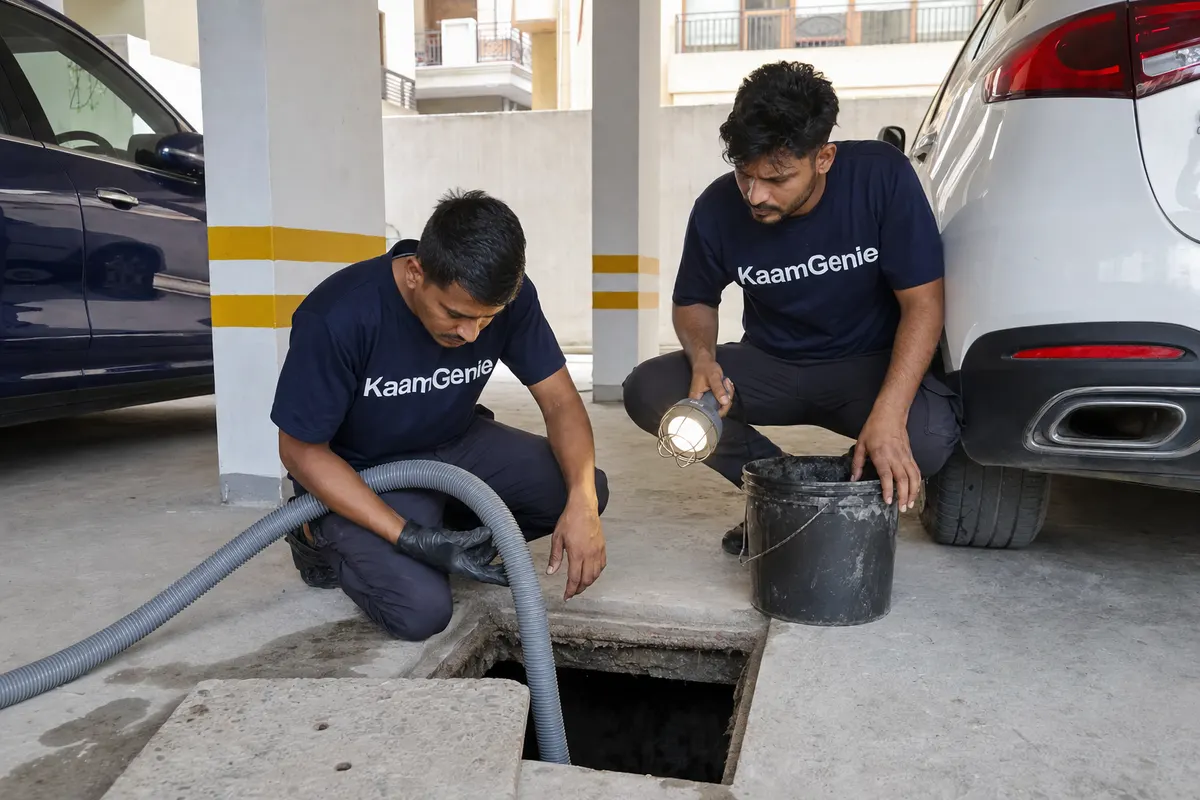
- Sump first, while the rooftop tanks are still full. The building keeps water while the sump is shut off, drained, de-sludged and rinsed, with the sludge vacuumed out down to the bare floor.
- One tank at a time on the roof, so only one floor is without water at any moment. The work on a single overhead tank usually runs to about an hour or an hour and a half; how soon it refills depends on your supply.
- Photos named by floor. Tell us at booking which tank is whose, and the before and after photos come back labelled that way on WhatsApp, ready for the coordinator to forward.
The price you agree covers the cleaning itself with nothing added on the day; parts such as a new lid or mesh are quoted separately if you want them. In stilt buildings our crews often find the sump hatch under a parked car or hidden beneath floor tiles, because the stilt doubles as parking, so ask whoever parks there to move the car before the visit. We work across builder-floor neighbourhoods including DLF Phase 3, Sushant Lok, South City and Palam Vihar. For a wider look at how the city’s tanks are cleaned, see the complete Gurgaon water tank cleaning guide.
What not to do
- Do not clean your own rooftop tank and leave the sump. It is the most common false economy in shared buildings: your tank refills with the same silt within days.
- Do not change the split method after the bill arrives. Agree it before the date; changing it afterwards always looks like someone gaming it.
- Do not let the floor that booked carry the whole cost “for now”. Shares that are not collected within a week usually are not collected at all.
- Do not ask the pump plumber to tip bleach into the sump to save a visit. The dose is guesswork, the smell reaches every floor, and the sludge stays where it was.
Book the building once, split it fairly
WhatsApp us the sump and rooftop tank count, say which floor uses which tank, and pick a weekday or a Sunday. The group gets a tank-by-tank figure to check first, and floor-labelled photos before anyone pays. To book, message us or call +91 95603 66362.
Frequently asked questions
Should a vacant floor pay for the sump cleaning?
In most buildings, yes. The sump stores water for every floor, including the empty one the day it is let or sold, and a neglected sump affects the occupied floors regardless. A fair compromise is that the vacant floor pays its share of the sump but chooses whether to clean its own rooftop tank. If it skips its tank, its outlet valve should stay shut and the tank should be cleaned before anyone moves in, so stale water never reaches a shared pipe.
Is it fair to split everything equally between four floors?
It is fair when each floor has one rooftop tank of similar size, because then an equal split and a per-tank split give the same figure. It becomes unfair when one floor has an extra terrace tank or two floors share one tank. In those buildings, charge each floor for the tanks that serve it and divide only the sump equally. Agree the method in the group before the visit and keep it for future visits.
Who should pay in a rented builder floor, the owner or the tenant?
Check the rent agreement first. Many agreements put routine upkeep on the tenant and larger repairs on the landlord, but the wording differs from one agreement to the next. Whoever pays, the other floors only need one name per floor for the share. If the agreement is silent, a short message between tenant and landlord before the cleaning date avoids a dispute later. This is general guidance, not legal advice.
Do we have to pay before the crew starts?
No. The quote is fixed before the work begins, so everyone knows their share in advance, but the bill is paid after the cleaning, once the before and after photos have been shared. For a shared building that works well: the coordinator can forward each floor its own photos and collect the shares afterwards, instead of chasing money for work nobody has seen yet.
Can only one floor book its own tank cleaning?
Yes. Any owner or tenant can book a single rooftop tank, at ₹699 per tank. The catch is the sump: if it is not cleaned at the same time, the rooftop tank refills from whatever is lying on the sump floor. If the other floors will not join, it is still worth asking them to share the sump alone, which works out to a small amount per floor in a stilt-plus-four building.
How do we split costs when two floors share one rooftop tank?
Treat the shared tank as half a tank for each of the two floors using it. Those two floors split its ₹699 between them, each floor with its own tank pays that tank in full, and the sump is divided equally across every floor. Write down which tank feeds which floor before the visit; if nobody is sure, your plumber can check by closing one outlet valve at a time.
What happens if one owner refuses to pay their share?
Clean the shared parts anyway on the agreed date, because a skipped sump affects everyone. Post the photos and that floor’s share in the group, and keep the record. Most delays are about timing, not refusal, and a pinned message with the quote and photos usually settles it. If your building has an RWA or a written maintenance agreement, follow what it says; we cannot advise on recovering money from a neighbour.
Can our building get a weekend slot so all owners can be present?
Yes, Sunday and weekend slots are available, which suits builder floors where owners work different days. Book a little ahead, since weekends fill up. Not every owner needs to be there: one coordinator can let the crew in, and the photos labelled by floor go to them on WhatsApp for forwarding to the rest of the building.
Sources & references
- Gurugram Metropolitan Development Authority (GMDA): the agency responsible for bulk water supply in Gurugram.
- Bureau of Indian Standards (BIS): IS 10500:2012, the Indian Standard for drinking water.
- CPHEEO Manual on Water Supply and Treatment: Government of India guidance on water storage and distribution.
Last verified: 23 November 2026. If you find any of these links broken, please let us know.