
Quick answer
- In the first five years: under Haryana’s Affordable Housing Policy 2013, the coloniser (developer) maintains the colony free of cost for five years from the date of the occupation certificate. Ask the developer’s maintenance office, in writing, to arrange and pay for tank cleaning.
- After those five years, maintenance passes to the arrangement set out in the policy and your allotment terms, usually the residents’ association. From then on the society plans and budgets the cleaning itself.
- Clean in order: underground reservoir first, then one tower at a time, so no tower is ever without water for long.
- Split the cost by flat, not by tower, unless towers differ a lot in size or tank count. Publish the fixed quote so residents can see the maths.
- Give residents notice a few days ahead, with the exact tower and time window, and ask them to store water the night before.
For an affordable housing society, each tower tank starts at ₹699 and a small sump at ₹1,499, while the main reservoir is priced by its size, all in one quote fixed before any work.
Planning a society-wide clean on a tight budget?
Share your tower count and tank list on WhatsApp. We will send a fixed quote for the whole society, tank by tank, that you can put in front of residents. No chemicals unless you ask.
Under Haryana’s Affordable Housing Policy of 2013, a large number of group-housing projects with smaller flats have come up across Gurgaon, many of them in the newer sectors. They make homes possible for families who would never afford a condominium on Golf Course Road. They also create a particular kind of water problem: many households sharing the same storage, a maintenance budget that has to stretch a long way once residents take it over, and a handover point when nobody is quite sure who is in charge. This guide is for the residents, RWA members and volunteers who end up sorting it out. For the hands-on cleaning itself, our crews handle water tank cleaning across Gurgaon.
How the water is stored in these societies
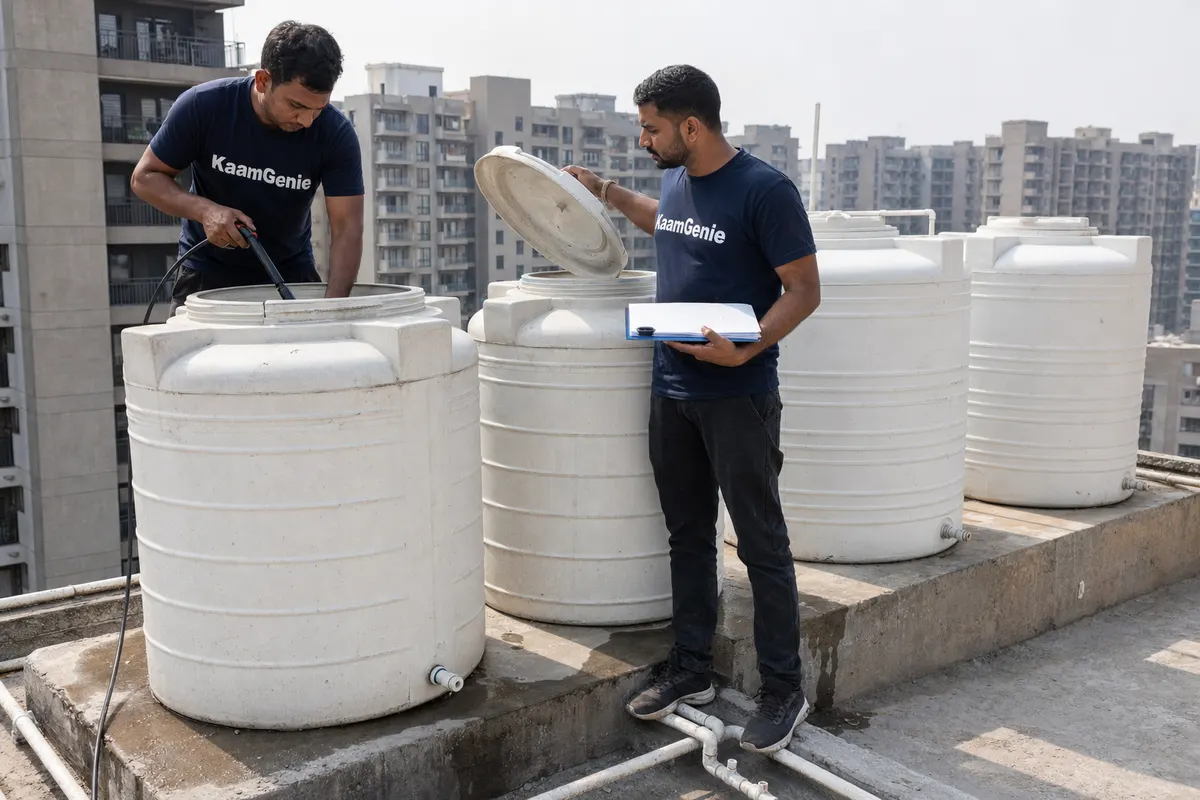
The typical layout is simple. Water from GMDA supply where it is connected, from tankers, or from a borewell where permitted, goes into a large underground reservoir (UGR). Pumps lift it to overhead tanks on the roof of each tower, and gravity feeds the flats below. Some towers have a single large tank; others have a row of smaller ones. Our general society and high-rise tank guide explains this setup in detail.
What changes in an affordable project is the density. Because the flats are smaller and more numerous, each tower tank is turned over quickly, the UGR works hard, and a problem in one tank reaches a lot of kitchens at once. When the reservoir level drops in a summer shortage, the sediment on its floor is pulled up into every tower. A sudden complaint from one wing about cloudy water usually means the whole society needs looking at; our guide to muddy water after the supply comes back explains what to do on the day it happens.
Developer or residents: who is responsible, and when
A common question from these societies is not “how much?” but “whose job is this?”. For projects under Haryana’s Affordable Housing Policy 2013, there is a clear starting point. The policy places the maintenance of the colony on the coloniser, free of cost, for five years from the date of the occupation certificate. During that period, the common water storage (the underground reservoir and the tower tanks) is part of what the developer maintains, so tank cleaning is something to ask the developer’s maintenance office to arrange and pay for, not something residents should be collecting money for.
After the five years, maintenance passes to the arrangement set out in the policy and in your allotment terms, which usually means the residents’ association. We are not lawyers and this is not legal advice: read the policy text on the Department of Town and Country Planning, Haryana website and your own allotment letter before you rely on it, because projects and amendments differ. The PMAY (Urban) portal covers the national affordable-housing mission if your project is also linked to it.
| Where your society is | Who maintains the common tanks | What residents should do |
|---|---|---|
| You do not know the occupation certificate date | Cannot tell yet | Ask the developer’s office for the date in writing; it decides everything below |
| Within five years of the occupation certificate | The developer, free of cost | Request a cleaning date for the reservoir and every tower tank, with before and after photos, and keep the reply |
| Final months of the five years | Still the developer | Ask for the cleaning record to be handed over, and for one documented clean before the handover date |
| After five years, handover in progress | Often unclear while papers move | Agree an interim arrangement in writing so the tanks are not skipped during the gap |
| After five years, association running maintenance | Usually the residents’ association, per the policy and allotment terms | Put tank cleaning into the yearly maintenance plan and budget |
Two moments are where tanks get forgotten: the first months after possession, when few families have moved in, and the handover, when each side waits for the other. A new association often discovers the tanks have not been opened since the building was finished, and the construction dust, cement slurry and debris are still inside. If that is your society, our guide to the first clean after possession covers what to expect from that first job.
The tower-by-tower plan: step by step
The aim is simple: no family goes without water for more than a few hours, and no clean tank is refilled from a dirty one. This is the sequence we suggest to RWAs.
- List every tank. One line per tank: the UGR (and any second sump), then each tower’s overhead tanks with a rough size. Count the flats each tower serves.
- Get a fixed quote for the whole list. A tank-by-tank quote lets residents, or the developer’s office during the five free years, see exactly what is being paid for.
- Pick the days. A weekday late morning, after the school and office rush has drawn its water, usually disturbs the fewest families. Avoid festival weeks and the peak of summer shortages if you can.
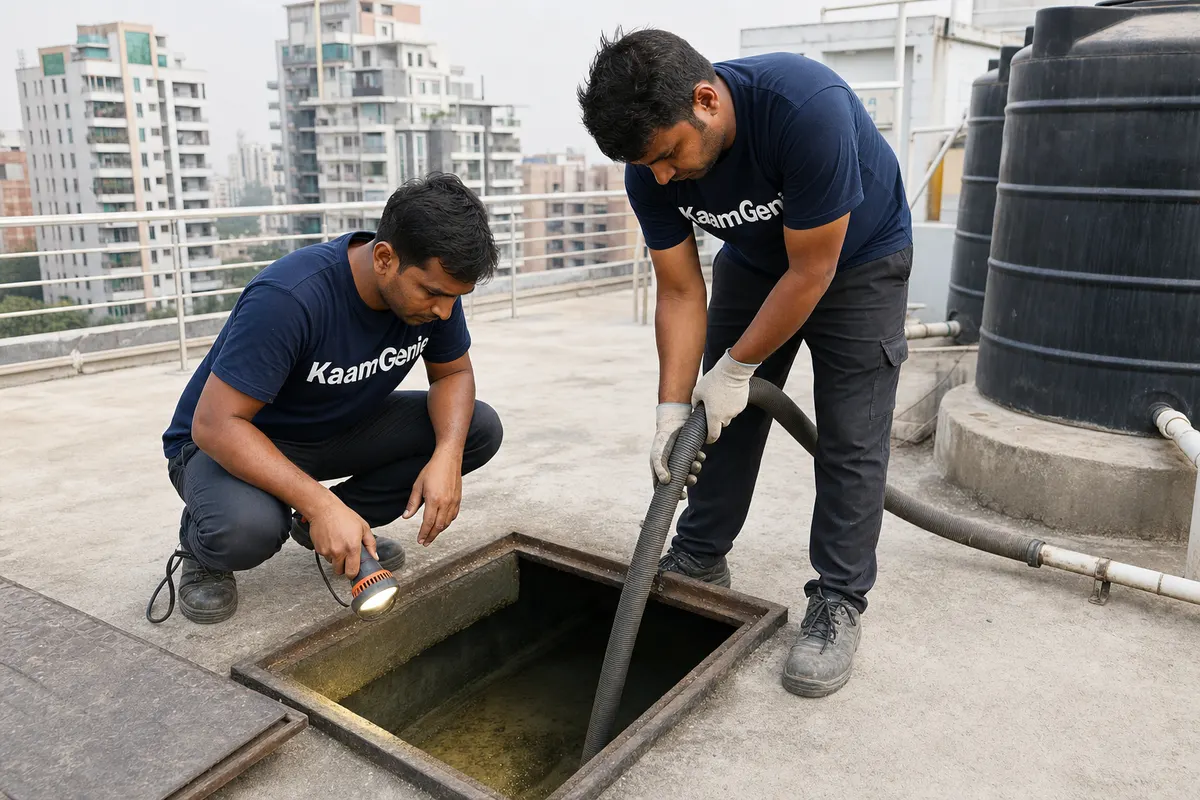
- Day one: the underground reservoir. Fill all tower tanks to the top the night before so residents have water while the UGR is drained, cleaned and refilled.
- Then one tower at a time. Each tower’s tank is drained, cleaned and refilled from the clean UGR once its fresh fill has settled (about an hour after a routine tanker fill; longer if the mains has just come back after a shutdown). Residents of that tower store a bucket or two in the morning; other towers are not affected.
- Post photos tower by tower. Before and after photos of each tank go to the RWA on WhatsApp, and can be forwarded to that tower’s residents group the same day.
- Close the job with a simple record. Date, tank, what was found. It helps the next committee, and settles the “when was it last done?” question for good.
For timing between cleans, see how often to clean a tank in Gurgaon. Societies that would rather not organise this from scratch each time often move to an annual arrangement; our tank cleaning AMC guide explains how that works.
Sharing the cost fairly
This section applies once the developer’s five free years are over and residents are paying. On a tight maintenance budget, how the bill is split matters as much as the bill. Three approaches work, and the right one depends on how similar your towers are.
| Method | How it works | Best for | Watch out for |
|---|---|---|---|
| Equal share per flat | Total fixed quote divided by the number of flats | Societies where flats and towers are broadly similar | Simple and transparent, but owners of the smallest flats may feel it is uneven |
| Per tower, then per flat | Each tower pays for its own tanks plus a share of the UGR | Towers with very different tank counts | More arithmetic; publish the working |
| From the maintenance fund | Paid from the existing monthly maintenance, no new collection | RWAs that budget for it in advance | Needs to be planned in the annual budget, not found mid-year |
Whichever you choose, put the fixed quote, the number of flats and the per-flat figure on one page in the notice. Residents rarely object to a cost they can check. They object to surprises. The UGR is a shared asset, so even towers that feel their own tank is fine should share in it.
The notice to residents
Keep it short and specific. A good notice says which tower, which date, the time window when that tower’s taps will be off, a request to store water the night before, and a contact number for the day. Pin it on the notice board, in the lift and in each tower’s WhatsApp group a few days ahead, and repeat it the evening before. In many affordable societies, families include elderly members and night-shift workers; a reminder the evening before saves a lot of frustrated calls.
Want a tower-by-tower schedule you can pin on the notice board?
Send us your tower list and preferred days. We will propose a sequence with time windows per tower, and the society gets the full figure in writing before day one.
One resident, not the committee: what you can do
You do not have to be on a committee to get the tanks looked at. For how other kinds of Gurgaon building are handled, see the complete guide to water tank cleaning in Gurgaon; in an affordable society, three situations come up again and again.
- You live on a top floor. Your flat gets the warmest water and is first to show sediment after a refill. Photograph a glass of the water, note the date, and ask your tower representative to raise it with the developer’s office or the association.
- You rent the flat. You have no vote on maintenance, but your landlord does. Send them the photos and ask them to raise it; our guide for tenants covers how to put that request.
- Your society runs on tankers or a borewell. Silt and hardness settle in the reservoir quickly, so push for the reservoir to be included every time, and for a water test of the source; our note on tanker water and storage tanks explains why.
In the newer sectors of New Gurgaon, our crews often find a soft bed of tanker silt on the reservoir floor of these societies, because many still lean on tanker deliveries while the mains supply catches up. Committees also call us from Sector 102, Sector 37D and Sohna Road. Societies on the expressway may also want our Dwarka Expressway tank guide.
How KaamGenie cleans a society
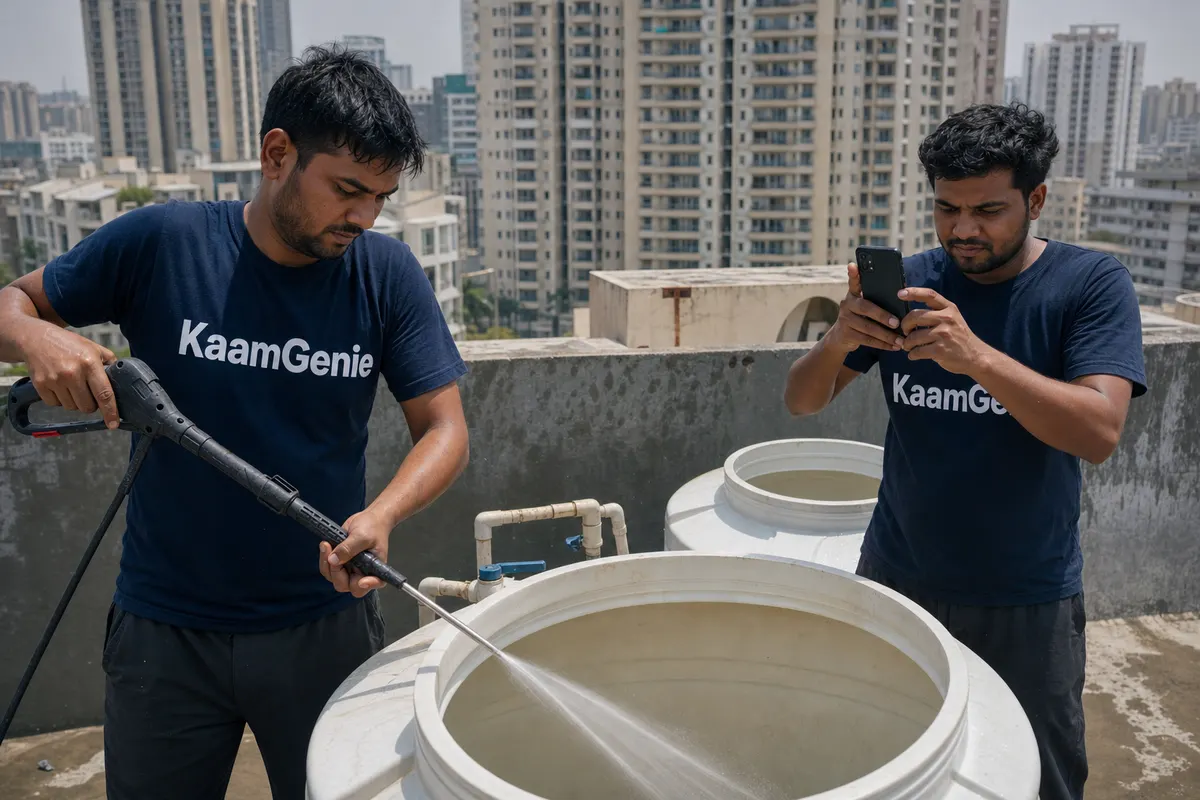
Our standard clean (inlet shut, drain, de-sludge, scrub, jet wash, wet-vacuum, fresh-water rinse, before/after photos on WhatsApp) is set out in full in the Gurgaon cleaning process guide. In a dense society, three parts of it matter most:
- The reservoir floor. The sediment layer in the UGR is what reaches every tower when the level drops, so it is scooped and vacuumed out of the UGR completely, down to the bare floor.
- The last murky layer of each tower tank. It is drained to waste at the tank, not sent down into residents’ lines, so a tower’s taps do not run brown the evening after its clean.
- Photos labelled by tower. Each tank’s before and after photos go to the developer’s office or the association on WhatsApp, ready to forward to that tower’s group.
Residents’ water is cleaned without chemicals unless the committee asks for more: if a society water test finds bacteria, disinfection can be requested and is added only then. The large UGR is entered only with a second crew member at the hatch; our underground reservoir guide explains why.
What not to do
- Do not clean the tower tanks and skip the UGR to save money. The tower tanks refill from the reservoir, and the sediment comes straight back.
- Do not let the guard or plumber pour bleach into the reservoir. It is a common budget shortcut. The dose is a guess, residents complain about the smell, and the sludge stays put.
- Do not start a resident collection during the developer’s five free years. Ask the developer first, in writing. Paying privately can blur who is responsible and make it harder to raise problems later.
- Do not clean all towers on the same day. It leaves the whole society short of water at once and makes refilling from a clean UGR impossible.
- Do not skip the notice. One unannounced shutdown costs the committee more goodwill than the clean is worth.
What to send for a society quote
Whether the request comes from the developer’s maintenance office or the association, the quote starts with the same list: the reservoir and any second sump, each tower’s overhead tanks with a rough size, and the days you prefer. Back comes a tank-by-tank sheet you can pin up for residents, with each tower tank from ₹699, a small sump from ₹1,499 and the reservoir priced by its size, settled before any work begins; the society pays after the cleaning, once the photos for every tower are in. If your committee also needs help with formal contracts, see our RWA contract guide. Committees can confirm their sector on our Gurgaon tank cleaning page, or the secretary can ring +91 95603 66362 directly.
Frequently asked questions
Who pays for tank cleaning in the first five years?
Under Haryana’s Affordable Housing Policy 2013, the coloniser maintains the colony free of cost for five years from the date of the occupation certificate, so during that period residents should ask the developer’s maintenance office to arrange and pay for cleaning the reservoir and tower tanks. Put the request in writing, keep the reply and ask for photos. Check the policy text and your allotment terms for your project; this is not legal advice, and a lawyer or the department can confirm specifics.
Can our RWA clean one tower at a time?
Yes, and it is the best way. Clean the underground reservoir first, with all tower tanks filled the night before so nobody runs dry. Then clean each tower’s overhead tanks in turn, refilling each from the clean reservoir. Only one tower is affected at a time, usually for a few hours, and each tower gets its own photos the same day.
How do we split the cost between flats?
The simplest fair method is the total fixed quote divided by the number of flats. If towers differ a lot in the number or size of tanks, charge each tower for its own tanks and split the reservoir cost across all flats. Whichever you choose, publish the quote and the working in the notice. Once the association is running maintenance, many avoid a separate collection by budgeting for it in the yearly plan.
Our society is new. Have the tanks ever been cleaned?
Often not. Tanks in new towers frequently still hold cement dust, slurry and debris from construction, and the reservoir may have been filled straight from tankers. Ask the developer whether a post-construction clean was done and whether they have photos. If there is no record, ask them to arrange the first clean, since it falls within their five free maintenance years, before or soon after most families move in.
Is it safe to use water during the society tank cleaning?
During the hours your tower’s tank is being cleaned, the taps in that tower will be off, so store a bucket or two in the morning. Once the tank is refilled, run your taps for a minute before using the water. Families in other towers are not affected. If residents were told the time window in advance, the day usually passes without complaint.
Can a society reservoir be cleaned without chemicals?
Yes. A proper clean removes the sludge, scale and slime physically by draining, de-sludging, scrubbing, jet washing and rinsing. We do not use chemicals in a standard clean. Disinfection is added only if your association or developer asks for it, for example after a water test finds bacteria or a tank has been unused for a long time. Never let staff pour bleach in by guesswork.
What does society tank cleaning cost in Gurgaon?
In a budget society, every tower tank is from ₹699 and a small sump from ₹1,499, with the big reservoir priced by size. We quote every tank on your list together, and the figure is settled before any work starts, which makes it easy to calculate a per-flat share and present it to residents. You receive before and after photos for each tank, named by tower, and the society pays after it has seen them.
Sources & references
- Department of Town and Country Planning, Haryana: the department that administers Haryana’s Affordable Housing Policy and group-housing licences.
- Pradhan Mantri Awas Yojana (Urban): the Government of India portal for the urban affordable-housing mission.
- Bureau of Indian Standards (BIS): IS 10500:2012, the Indian Standard for drinking water.
- Gurugram Metropolitan Development Authority (GMDA): the agency responsible for bulk water supply in Gurugram.
Last verified: 22 November 2026. If you find any of these links broken, please let us know.