
The short version
- Plan on roughly 135 litres per person per day — the standard Indian norm for a fully plumbed home.
- Keep the overhead tank small (about one day’s use) so it empties and refills daily; hold the bulk in a ground sump.
- A family of four in a Delhi 2BHK is well served by a 750–1000 L overhead tank plus a 1000–2000 L sump.
- An oversized tank is not a safety margin — water sits, chlorine fades, and it needs cleaning more often, not less.
- Cleaning time and cost scale with capacity and access; clean any home tank at least twice a year.
Most people pick a tank size once — whenever the house was built or the last drum cracked — and never think about it again. But capacity quietly decides two things you do care about: whether your taps run dry during a Delhi summer, and how clean the water staying in that tank actually is. This guide ties the two together. If you only want the cleaning service itself, our water tank cleaning in Delhi page has pricing and booking; this article is about getting the sizing right in the first place.
| Household | Daily use (approx.) | Overhead tank | Ground sump / reserve |
|---|---|---|---|
| 1–2 people (1BHK / studio) | 250–300 L | 500 L | 500–1000 L |
| 3–4 people (2BHK) | 500–550 L | 750–1000 L | 1000–2000 L |
| 5–6 people (3BHK) | 700–850 L | 1000–1500 L | 2000–3000 L |
| Full builder floor (3–4 floors) | 1500–2200 L | 1500–2000 L (often split into drums) | 3000–5000 L |
| Small society (8–12 flats) | 4000–6500 L | 5000 L+ (per wing/stack) | 10,000–20,000 L reservoir |
Treat these as starting points, not gospel — a household with a garden, a car to wash, or an RO unit that rejects two litres for every litre it purifies will trend higher. The principle stays the same: store enough to ride out a supply gap, but no more than you can turn over in a day or two.
Not sure what you’ve got up there?
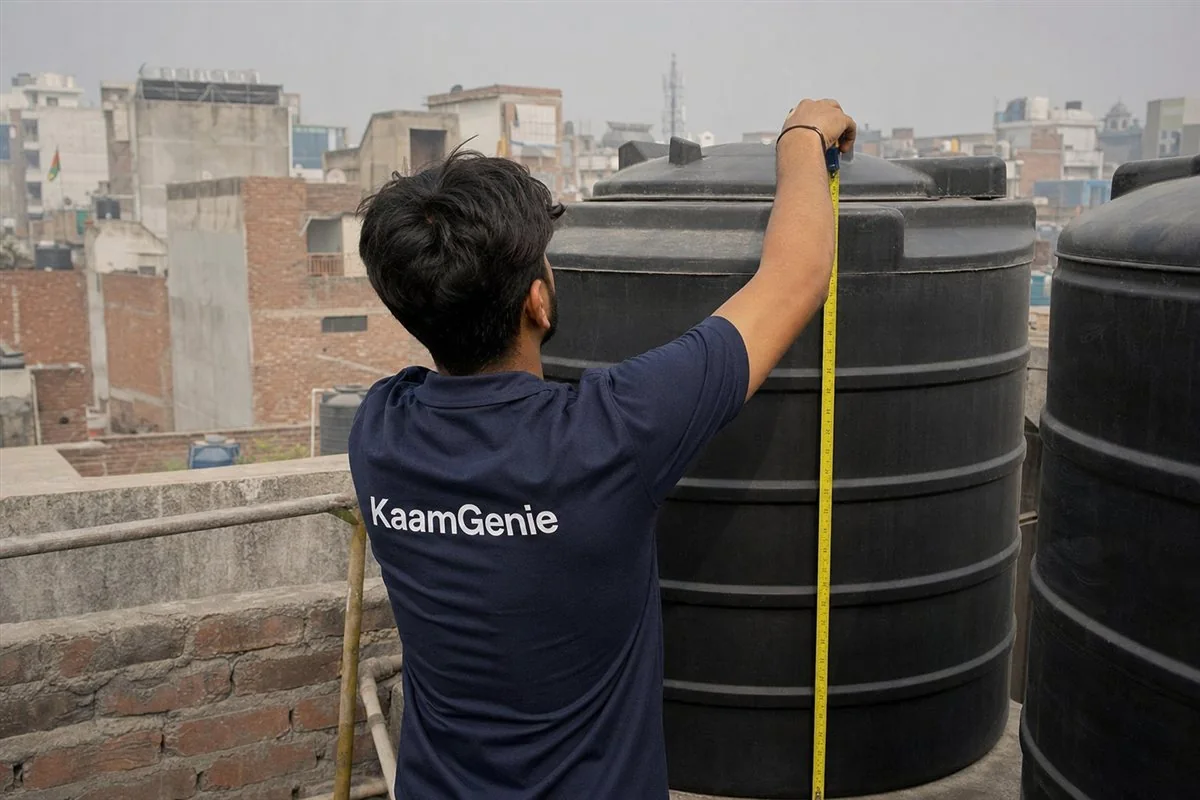
Our crew measures your tank, tells you the real capacity, and cleans it the same visit. Standard residential cleaning ₹699 onwards.
Start with litres per person, not tank brochures
The honest way to size a tank is to start from how much water your household actually uses, then pick a tank around that. Indian planning norms — the figures CPHEEO uses in the national water-supply manual, and the basis BIS works from — put domestic demand at roughly 135 litres per person per day for a home with full plumbing, flushing toilets, and bathing. That covers cooking, drinking, bathing, laundry, cleaning, and flushing together.
So a four-person family needs about 540 litres a day. The instinct is to buy a 2000-litre tank “to be safe.” But that 2000 litres now represents nearly four days of water sitting on your roof. We’ll come back to why that’s a problem — the short version is that water is not wine, and it does not improve with age in a plastic tank under the Delhi sun.
Two adjustments to the 135-litre figure that matter in Delhi specifically:
- RO purifiers waste water. A typical domestic RO rejects one to three litres for every litre it cleans, and in Delhi’s hard-water pockets that ratio is at the higher end. If that reject water goes down the drain rather than to a bucket, your real consumption is higher than the norm suggests.
- Gardens, cars, and pets add up. A small lawn in a South Delhi bungalow or a couple of cars being washed daily can add 100–200 litres a day on their own.
The right split: small overhead tank, bigger ground reserve
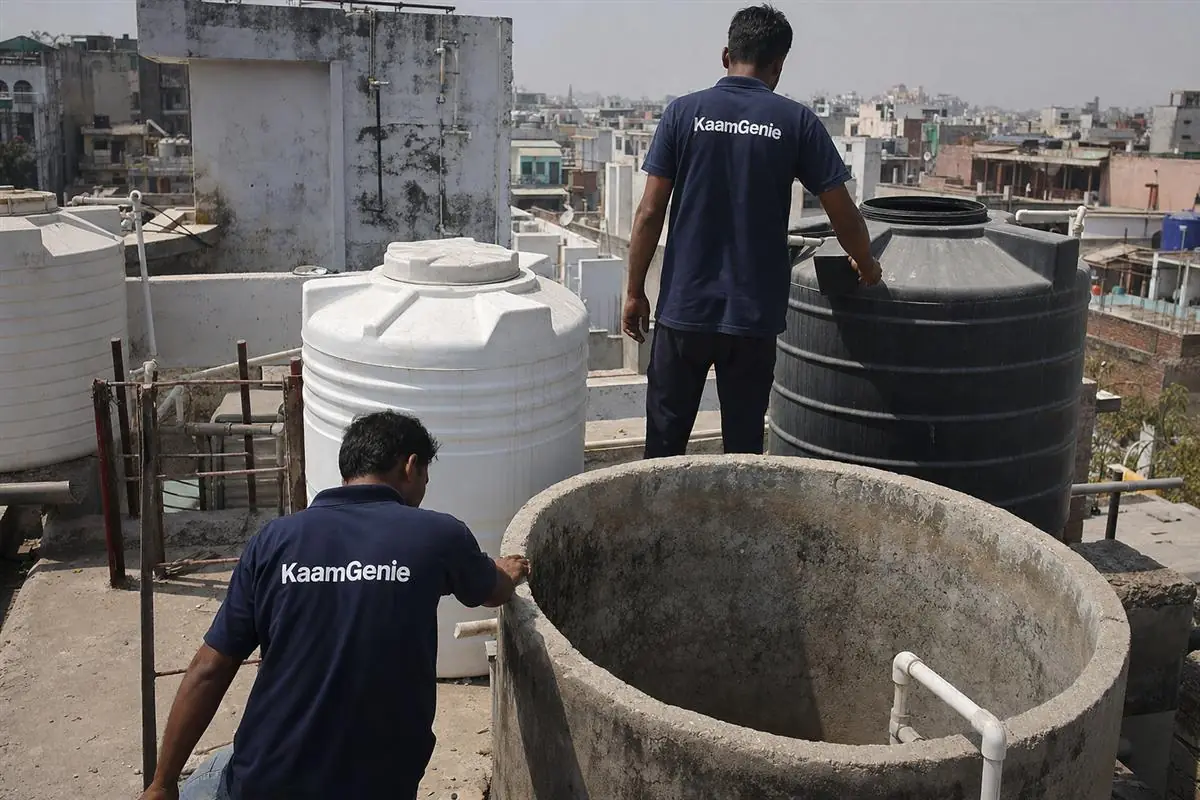
Almost every Delhi home runs a two-stage system, and the reason is the way the city supplies water. Delhi Jal Board piped supply arrives for a few hours a day, often at low pressure that can’t push water up to a rooftop tank on its own. Tankers and borewell pumps deliver at ground level. So the practical design is:
- A ground-level sump or underground reservoir that fills directly from the DJB line, a tanker, or a borewell, and holds the bulk of your reserve.
- A smaller overhead tank that a pump fills from the sump, and that gravity-feeds your taps.
Get the split right and the overhead tank should empty and refill close to every day — which keeps the water on your roof fresh. Size the overhead tank for roughly one day of use; let the sump carry the buffer for supply gaps. If you want to go deeper on how the two tank types differ to clean, we’ve covered that in overhead vs underground tank cleaning and, for the sump specifically, sump cleaning cost and safety.
This split also reflects where people live. In high-rise group-housing societies around Dwarka, a large underground reservoir feeds a pump that lifts water to per-stack overhead tanks. In plotted and builder-floor neighbourhoods like Preet Vihar, you more often see a modest ground tank and a cluster of individual drums on the terrace, one per floor.
Sizing by home type
The household table above is a baseline. How you apply it depends on the kind of home:
DDA flats and small 2BHKs. Demand is steady and modest. A 750–1000 litre overhead tank is usually plenty, with a 1000-litre ground tank if DJB timing is unreliable in your block. Don’t over-buy here — a 2000-litre overhead tank on a two-person flat is the classic stagnation trap.
Builder floors. Delhi’s builder floors are the awkward case: one plot, three or four independent households stacked vertically, often with a separate drum per floor on a shared terrace and one shared ground tank. Each drum is small (500–1000 L), which is good for turnover but means more tanks to clean. If you own or rent one floor, your tank is just that one drum — size and clean it for your household alone.
South Delhi bungalows and farmhouses. In South Delhi — the Chattarpur and Sainik Farms belt especially — plots are larger, gardens and multiple bathrooms push demand up, and borewell or tanker supply is common. Here a bigger underground reservoir genuinely makes sense, because the buffer is doing real work. The discipline is to clean that large reservoir on schedule so the extra capacity doesn’t become a sediment trap.
Cooperative group-housing and RWAs. Societies design around per-stack or per-wing tanks fed from a central reservoir. Sizing is an engineering decision made at construction, but the RWA still owns the cleaning schedule — and bigger reservoirs need it more, not less.
Why an oversized tank needs more cleaning
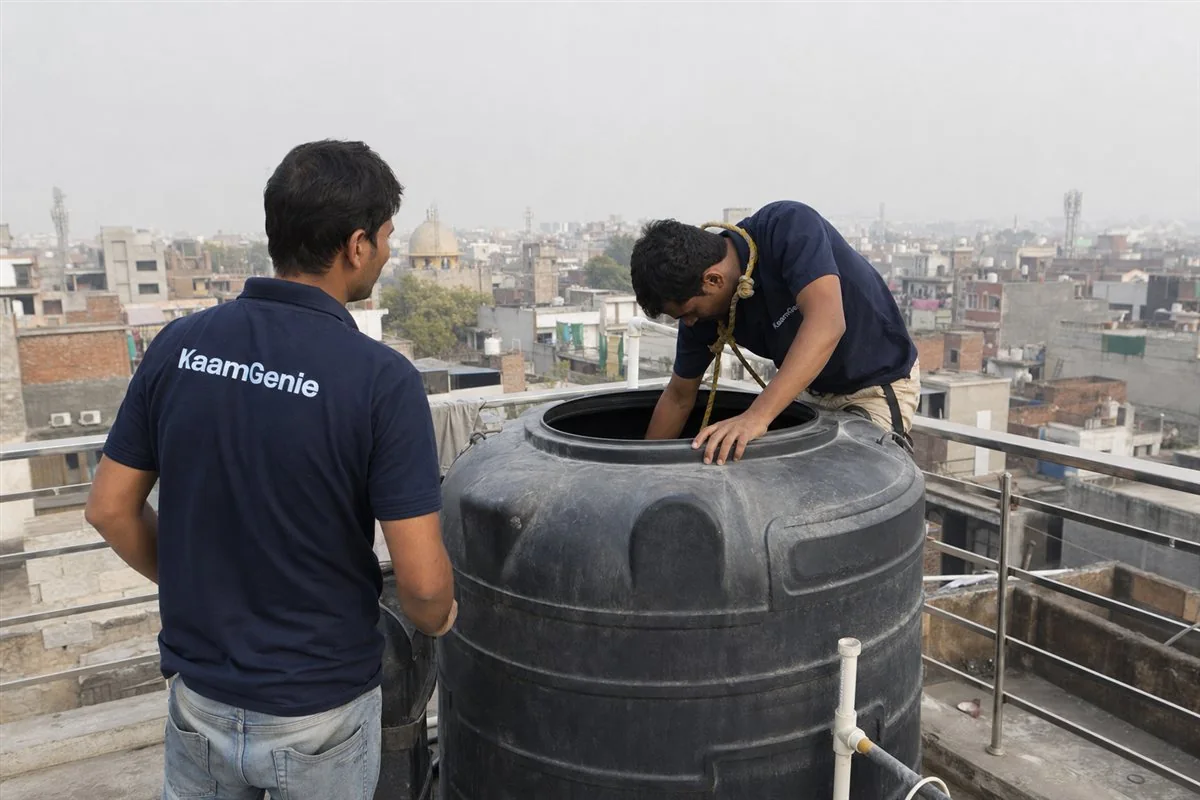
This is the part people get backwards. A bigger tank feels like a comfort buffer, but for water hygiene it usually works against you. Three things happen when capacity outruns consumption:
- Chlorine dies and bacteria move in. The residual chlorine in DJB supply is what keeps stored water safe for a while. It dissipates within roughly a day or two. In a tank that holds four days of water, the back half of that water is sitting with no disinfectant left — lukewarm, often under direct sun, which is exactly what bacteria and algae want.
- Sediment gets time to settle and harden. Every Delhi supply — piped, borewell, or tanker — carries some fine sediment. In a fast-turnover tank a lot of it gets drawn off before it settles. In a slow, oversized tank it has days of stillness to drop to the floor and bond into scale, which is far harder to remove later.
- Biofilm establishes. The slimy film on tank walls needs undisturbed time and standing water to colonise. Stagnation gives it both.
So the oversized tank that was supposed to be your safety margin quietly becomes a reservoir of stale water that needs cleaning every three to four months instead of twice a year. If you’re weighing how the calendar should look for your tank, how often to clean a water tank in Delhi breaks the schedule down by water source and tank type.
How capacity changes cleaning time and cost
When the crew arrives, capacity is the single biggest factor in how long the job takes — because the steps that grow with volume are the ones you can’t rush. Draining scales with litres. Sludge removal scales with floor area. And the disinfection contact time — the 15–30 minutes the food-grade chlorine has to sit on the surfaces to actually kill bacteria — is non-negotiable on a tank of any size.
Typical cleaning time by tank capacity
Draining, scrubbing and disinfection contact time all grow with volume — there’s no shortcut
Indicative durations including setup and pack-up. Access — rooftop ladders, confined sumps, narrow lids — can add time on top of capacity.
Cost follows the same logic. A standard residential overhead tank starts at ₹699 onwards. From there, price reflects capacity, the number of tanks, and access — a deep underground sump needing confined-space safety gear, or a society reservoir, is quoted on what the job actually involves rather than a flat rate. For the full breakdown across NCR you can also see our water tank cleaning services page. The takeaway for sizing: every extra litre of capacity you don’t need is a litre you’ll pay to scrub and disinfect on every single cleaning, forever.
A simple rule to settle the sizing debate
If you remember one thing, make it this: size the overhead tank for one day, size the ground reserve for your worst realistic supply gap. For most Delhi homes on reasonably regular DJB supply, a one-day overhead tank plus a one-to-two-day sump is the sweet spot. If you’re on tankers or an unreliable borewell — common in the outer-Delhi and summer-crisis pockets — push the ground reserve up to two or three days, but keep the overhead tank small so the water you actually drink stays fresh.
And whatever capacity you land on, build the cleaning into the calendar. The right-sized tank rewards you with fresher water between cleanings; the oversized one punishes you with more of them. Either way, twice a year is the floor.
Right tank, wrong schedule? Let’s fix the schedule.
Whatever size your tank, a real clean every few months keeps the water safe. Photos before and after, certificate at the end. ₹699 onwards.
Book the right-sized clean for your tank
Whether you’ve got a single drum on a builder-floor terrace or a 20,000-litre society reservoir, the crew sizes the job to the tank — the same careful, documented clean, priced to what’s actually involved. See areas we cover and book on the water tank cleaning in Delhi hub, or call us and we’ll confirm.
To book, call +91 95603 66362 or use the booking form on this site — we’ll confirm shortly.
Frequently asked questions
How big should my water tank be for a family of four in Delhi?
A family of four uses roughly 500–550 litres a day at the standard 135 litres-per-person-per-day norm. For a typical Delhi 2BHK, a 750–1000 litre overhead tank covers a full day plus a buffer, backed by a 1000–2000 litre underground sump if your supply is erratic or tanker-dependent. Storing about one-and-a-half days of water is the sweet spot — enough to ride out a supply gap, small enough that the water keeps turning over.
What is the standard water requirement per person per day in Delhi?
Indian planning norms (CPHEEO and BIS) use about 135 litres per person per day for a home with full plumbing and flushing. In practice many Delhi households land between 100 and 150 litres depending on whether they have a garden, car washing, or RO units that reject water. Use 135 as your planning figure and round the tank size up to the nearest standard tank, not down.
Should I store more water in the overhead tank or the underground sump?
In Delhi the usual split is: a modest overhead tank sized for about a day of use, and a larger underground sump or ground tank that holds the bulk — because Delhi Jal Board supply comes at low pressure for a few hours, and tankers can only fill a ground-level tank. The overhead tank is filled from the sump by a pump. Keep the overhead tank small enough to empty and refill daily so the water never sits stale on the roof.
Does a bigger water tank need cleaning more often?
Often, yes — relative to how much water you actually use. A tank that is far larger than your daily consumption holds water for days, so chlorine dissipates, sediment settles, and biofilm gets time to grow before the water is used. A right-sized tank that empties and refills daily stays fresher between cleanings. We still recommend cleaning every tank at least twice a year regardless of size.
Why does an oversized tank get dirty faster even if I use less water?
Because cleanliness depends on turnover, not just usage. In an oversized tank, the same water can sit for three or four days. Residual chlorine from Delhi Jal Board supply breaks down within a day or two, after which bacteria and algae have a stagnant, lukewarm, often sunlit reservoir to grow in. Sediment also has more undisturbed time to settle and harden into scale. So the tank looks ample but the water quality quietly drops.
How does tank capacity affect the cleaning cost?
Cost scales with capacity, access, and how much sludge has to be removed — not with a flat per-tank rate. A standard residential overhead tank starts at ₹699 onwards. Larger underground sumps, multiple drums on a builder floor, and society reservoirs are quoted on capacity and access because they take longer, use more disinfectant, and sometimes need confined-space safety gear. Bigger tank, more litres of surface to scrub and disinfect.
How long does it take to clean a large-capacity tank or sump?
A 500–1000 litre overhead tank takes about 60–90 minutes. A 2000–5000 litre underground sump takes 2–2.5 hours because draining, sludge removal, and the disinfection contact time all scale with volume. A 10,000 litre-plus society reservoir runs 3–4 hours, sometimes a half-day with two crew. The manual scrubbing and the chemical contact phases are what grow with capacity — there is no shortcut around either.
What size tank do I need if I depend on water tankers in Delhi?
If you rely on private tankers — common in parts of Dwarka, Najafgarh, and unauthorised colonies during the summer crisis — size your ground storage to hold at least two to three days of use so one tanker trip lasts. That usually means a larger underground reservoir. The trade-off is that tanker water often arrives with sediment, so a bigger buffer tank needs disciplined twice-yearly cleaning to stop that sediment building up.
Is one big tank better than two smaller tanks?
Two smaller tanks give you flexibility: you can isolate one for cleaning or repair while the other keeps the house running, and water turns over faster in each. One big tank is simpler and cheaper to install but means a total shutdown during cleaning and slower turnover. For most Delhi homes, a right-sized overhead tank plus a separate ground sump is the practical answer rather than a single oversized tank.
How often should a Delhi home tank be cleaned regardless of size?
At least twice a year for any domestic tank — once before summer and once after the monsoon are the natural points. Homes on borewell or tanker water, hard-water pockets, and oversized tanks with slow turnover should move to every three to four months. Size changes how fast a tank gets dirty, but it never removes the need for a scheduled clean.
Sources & references
- Bureau of Indian Standards (BIS) — IS 10500:2012 is the canonical Indian Standard for drinking water specification, defining acceptable limits for physical, chemical, and biological parameters.
- WHO Guidelines for Drinking-water Quality, 4th edition — the global reference for water quality standards, including guidance on storage and disinfection.
- Food Safety and Standards Authority of India (FSSAI) — defines water quality requirements for food businesses, including hygiene standards for stored water and acceptable disinfection chemicals.
- WHO Fact Sheet on Drinking Water — overview of safe drinking water requirements and contamination risks.
- CPHEEO — Manual on Water Supply and Treatment — the Government of India’s engineering manual covering per-capita demand norms, tank design, cleaning protocols, and disinfection practices.
Last verified: 30 June 2026. If you find any of these links broken, please let us know.