
Tank Cleaning Before Moving In
Raj Babbar · 10 min read
Home › Water Tank Cleaning › Sintex / Plastic Tank Cleaning › Peeragarhi
At the Peeragarhi junction, diesel soot off two highways settles as an oily grey film on every rooftop — and inside any plastic tank it reaches, it smears rather than rinses. KaamGenie strips that greasy waterline ring properly. From ₹699.
Peeragarhi is where Rohtak Road meets the Outer Ring Road — a village core, DDA relocation flats, and a working belt of transport businesses, godowns and the bus depot around the metro station. The junction’s truck traffic defines the rooftops: diesel soot is not dry dust but a fine, oily carbon that bonds to what it lands on. In a translucent plastic tank it collects as a grey-black ring at the waterline and a smeary film on the walls — a deposit that ordinary rinsing spreads around instead of removing, while the borewell supply on the outer lanes adds hard-water scale beneath it.
KaamGenie cleans Peeragarhi’s plastic tanks with the soot in mind — drain, wet-vacuum, a plastic-safe jet wash, then deliberate soft-pad work on the waterline ring and wall film, finished with a anti-bacterial disinfectant rinse, photos. For godown buildings, RCC storage or sumps, see our main water tank cleaning in Peeragarhi page; this one covers the Sintex and plastic tanks specifically.
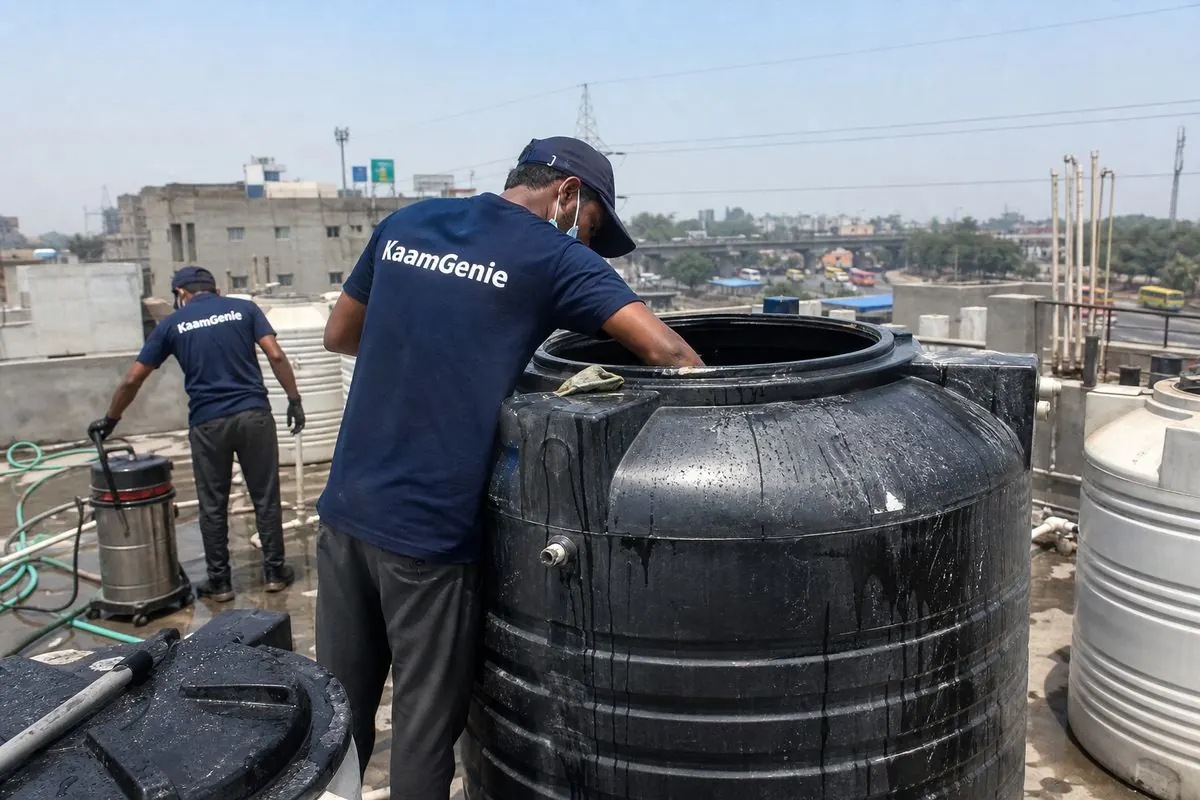
Soot behaves like grease because it partly is grease — unburnt diesel residue rides on the carbon particles. Splash a hose at it and it smears into a wider film; that is why so many locally “cleaned” tanks here still show a grey shadow on the walls. Lifting it takes contact scrubbing with pads, panel by panel, before the disinfectant stage means anything. On the translucent wall the film also blocks and scatters light unevenly, so owners often notice their tank looking dirty from outside before the water tastes of anything.
The junction’s building mix adds an ownership gap. Mixed-use buildings put one tank over a godown, an office and a rented floor at once, and none of the three considers the tank theirs — so it is cleaned when someone finally complains. The outer lanes’ hard borewell supply lays scale under the soot film, giving two layers to remove in the right order. For working buildings at the junction we recommend a six-month cycle; the village core and DDA flats can typically hold a yearly one.
No travel charge anywhere in Peeragarhi. The final price is confirmed on the call before we come — it depends only on tank size and access.
See it done in 45 seconds
Watch our web story on how a tank is really cleaned — drain, de-sludge, jet-wash, disinfect.
We reach every pocket of Peeragarhi — and there’s no travel charge to any of them:
Every locality in Delhi stores different water, and that decides how fast a tank fouls. This is Peeragarhi’s profile from The Delhi Water Index, built from our field observations across 250+ localities.
Indicative field characterisation, not a certified lab test. BIS IS 10500: TDS 500 mg/L acceptable, 2,000 permissible. Check any Delhi area →
“Our tank walls look grey even after a plumber washed it. Why?” Because diesel soot smears instead of rinsing — a hose spreads the oily film wider. It needs contact scrubbing with pads, panel by panel, which is exactly what our crew does before the disinfectant rinse. The before-and-after photos make the difference obvious, especially on a translucent wall you can check from outside.
“What is the price at the junction?” ₹699 up to 500 litres and ₹899 for 501-1,000 litres, including the waterline-ring scrub, wet-vacuum, anti-bacterial disinfectant and dated quality report. Mixed-use buildings with a larger shared tank above the godown get a quote before we start, and multiple tanks on one building are priced together.
“Who should book the clean in a building shared by a godown and tenants?” Whoever calls first, honestly — the tank serves everyone and nobody, which is why it goes uncleaned for years. In practice the property owner usually books and splits the cost across the units. We provide the dated quality report and photos, which also helps the godown’s own compliance and tenant relations.
“Is the borewell water making things worse?” On the outer lanes, yes — it lays hard-water scale underneath the soot film, so the tank carries two layers. We remove them in order: scrub the oily film, descale the floor and outlet, then disinfect. Doing only one layer is why quick cleans here never last.
“Can you reach us the same day?” Usually — call 95603 66362 before 10 AM and the crew can come off the Rohtak Road corridor the same day. For working buildings we can also set early slots before the godowns open, so the tank is refilled before the day’s draw starts.
See our complete water tank cleaning services in Delhi NCR — pricing, process, tank types and full city coverage.
Beyond water tank cleaning, KaamGenie is rolling out a full lineup of home services across Delhi NCR — see our complete list of 12 home services we offer or will be launching through 2026. New to tank cleaning? Read our guide on how to pick the right water tank cleaning service in Delhi — what to look for, what to avoid, and the questions that separate trustworthy crews from quick-job operators.
Rooftop plastic tanks
₹699+ →Kothi sumps & underground tanks
₹1,499+ →Apartments & RWAs
Bulk pricing →FSSAI-compliant cleaning
₹2,500+ →टंकी साफ़ करने वाले
हिन्दी पढ़ें →View all water tank cleaning guides →
All pockets and lanes of Peeragarhi covered. If your specific block or society isn’t named in the sub-areas above, just call — we almost certainly cover it.
Same crew, same 6-step process, same-day where possible. Pick any locality below for local pricing and the tanks we typically find there.
Book a slot — we can usually fit you in today or tomorrow.