
Water Tank Cleaning AMC Plans
Raj Babbar · 8 min read
Home › Water Tank Cleaning › Society / RWA Tank Cleaning › Anand Parbat
Society and RWA tank cleaning in Anand Parbat — hilltop buildings with booster-fed oversized tanks, workshop lanes and worker housing, pooled by building and lane at rates the ridge can carry. From ₹1,500 per tank.
Anand Parbat climbs the rocky ridge behind Karol Bagh — small manufacturing units, worker housing and steep lanes where mains pressure dies before it reaches the top. Uphill homes survive on booster pumps and oversized storage; tanks sit on uneven rocky roofs at odd angles; and the metal-workshop dust that hangs over the lanes settles into all of them. Add the sediment that weak, pressure-starved supply churns up, and these are, frankly, some of the dirtiest tanks our crews open anywhere in Delhi.
KaamGenie works the ridge with formats matched to it: whole-building visits that take every tank on a roof in one go — important where oversized and paired tanks are the norm; lane poolings where neighbours share a date and the climb-related setup costs; and landlord bookings for the worker-housing buildings whose single shared tank serves the most people with the least voice. Steep access and rough roofs are our crews’ daily work here, not an obstacle. For one tank, see water tank cleaning in Anand Parbat; this page is for whole-building, lane and landlord work.
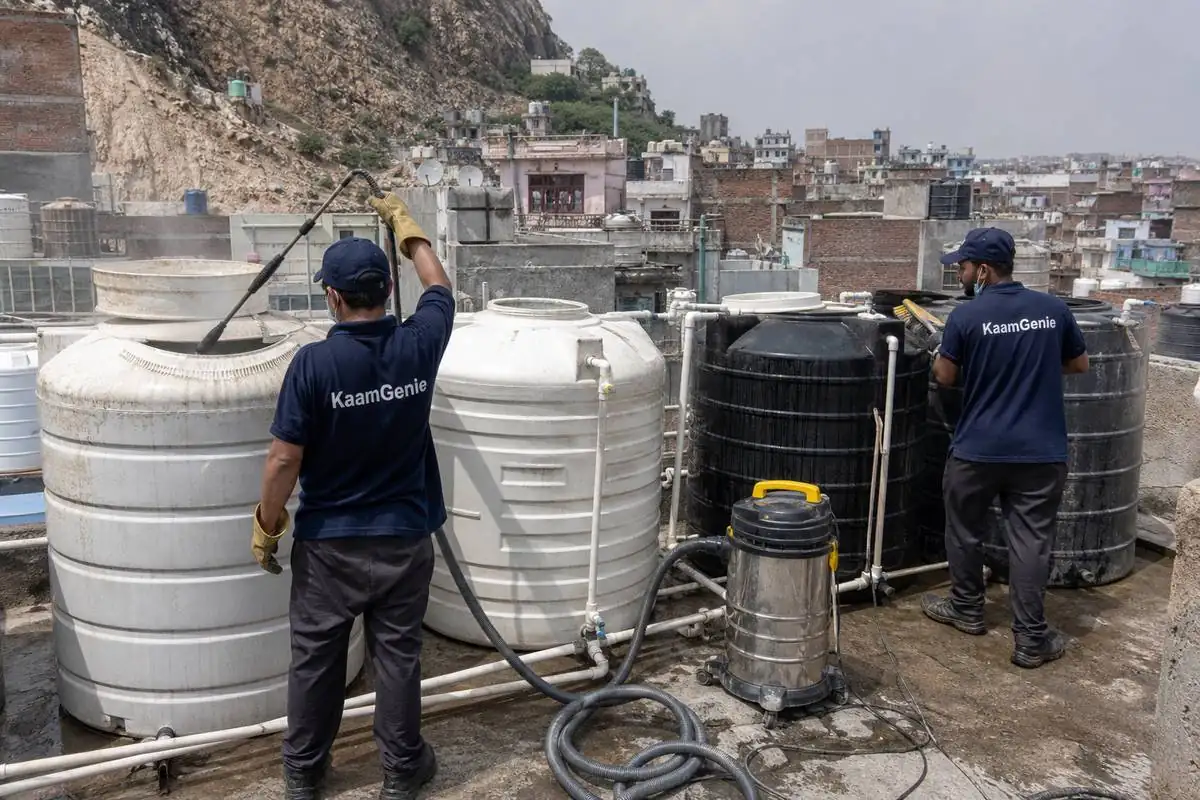
Everything conspires uphill. Weak pressure means the supply arrives slow and silt-heavy, and the booster then churns that silt through the storage. Oversized tanks — kept big precisely because supply is unreliable — hold water longer, giving sediment time to settle and biofilm time to grow. Workshop dust falls constantly on lids that sit askew on uneven rocky roofs. A hilltop tank can carry more sludge in six months than a well-supplied colony tank gathers in two years, and the households drawing from it usually have no idea.
The answer has to be affordable to work here, which is why pooling matters more on the ridge than anywhere. A lane sharing one date splits the setup across six buildings; a landlord’s worker-housing tanks book at collective rates; and a whole-roof visit costs less than the two half-jobs it replaces. We also do the small things that matter disproportionately uphill — seating lids properly against the dust, checking that booster foot-valves are not sitting in the sludge they stir, and photographing everything so the owner downhill sees exactly what the building uphill was drinking.
No travel charge anywhere in Anand Parbat. The final price is confirmed on the call before we come — it depends only on tank size and access.
See it done in 45 seconds
Watch our web story on how a tank is really cleaned — drain, de-sludge, jet-wash, disinfect.
We reach every pocket of Anand Parbat — and there’s no travel charge to any of them:
Every locality in Delhi stores different water, and that decides how fast a tank fouls. This is Anand Parbat’s profile from The Delhi Water Index, built from our field observations across 250+ localities.
Indicative field characterisation, not a certified lab test. BIS IS 10500: TDS 500 mg/L acceptable, 2,000 permissible. Check any Delhi area →
“Can your crew actually reach tanks on our steep lane and rough roof?” Yes — the ridge is regular territory for us. Crews carry portable pumps and rope-secured ladders, and uneven rocky roofs with tanks at odd angles are the standard Anand Parbat job, not the exception. At survey we confirm a safe drain path downhill; that is usually the only planning the lane needs.
“Our tank is oversized because supply is unreliable. Does that cost more?” Larger tanks take longer, and genuinely oversized ones are quoted by size at survey rather than sprung on you later — the base from ₹1,500 covers the standard sizes. One honest note: oversized tanks on weak supply hold water longest, so they need the cycle more, not less.
“What does a landlord pay to clean worker-housing tanks across two buildings?” A collective booking — both buildings, every shared tank, one date — prices below separate visits, and quarterly standing dates bring it lower still. Given how many households draw from each tank here, it is some of the highest-impact cleaning money in west Delhi give you something to show tenants.
“The booster stirs up dirt every time it runs. Will cleaning even last?” Cleaning removes what the booster has been redistributing, which is the bulk of the problem, and a properly seated lid cuts what returns from above. What we will not promise is that weak-pressure churn disappears — it does not, which is why we recommend six-monthly on the ridge and quarterly for heavy-draw shared tanks.
“How quickly can you come for a foul-smelling shared tank?” Call 95603 66362 before 10 AM and we can usually reach the ridge the same day — and a foul tank serving multiple households gets priority. We drain, scrub, disinfect hygienic, and check the lid and booster intake in the same visit so the fix holds.
See our complete water tank cleaning services in Delhi NCR — pricing, process, tank types and full city coverage.
Beyond water tank cleaning, KaamGenie is rolling out a full lineup of home services across Delhi NCR — see our complete list of 12 home services we offer or will be launching through 2026. New to tank cleaning? Read our guide on how to pick the right water tank cleaning service in Delhi — what to look for, what to avoid, and the questions that separate trustworthy crews from quick-job operators.
Rooftop plastic tanks
₹699+ →Kothi sumps & underground tanks
₹1,499+ →Apartments & RWAs
Bulk pricing →FSSAI-compliant cleaning
₹2,500+ →टंकी साफ़ करने वाले
हिन्दी पढ़ें →View all water tank cleaning guides →
All pockets and lanes of Anand Parbat covered. If your specific block or society isn’t named in the sub-areas above, just call — we almost certainly cover it.
Same crew, same 6-step process, same-day where possible. Pick any locality below for local pricing and the tanks we typically find there.
Book a slot — we can usually fit you in today or tomorrow.