
What’s Included in a Water Tank Cleaning Service?
Raj Babbar · 8 min read
Home › Water Tank Cleaning › Society / RWA Tank Cleaning › Seemapuri
On the very edge of Delhi at the UP border, Seemapuri's resettlement blocks store what the tankers and borewells bring in shared rooftop tanks that a whole EWS building leans on. This service opens and clears that storage and puts the visit on record. From ₹1,500 per tank.
Seemapuri sits right on the Delhi-UP boundary, a resettlement colony of DDA EWS blocks and self-built floors laid out on tight lanes. Piped DJB is limited this far out, so buildings depend on borewell and on tanker deliveries, and the water they store is hard and carries a lot of suspended silt. A single rooftop plastic tank usually holds the supply for several families in a block, making it shared storage that no one household maintains. With the water already silt-heavy and the tank turnover slow, a settled layer forms quickly at the bottom. In a colony where every drop is stored carefully, the tank that holds it is the one thing rarely opened.
KaamGenie clears these shared resettlement tanks for the resident group or the block's caretaker, timed so a delivery is not wasted. We draw the tank down, scoop the settled silt, scrub the interior by hand, disinfect to a hygienic standard and leave a dated photo record for the families. Anyone wanting only their own line done can see water tank cleaning in Seemapuri. This page covers the shared building tank an EWS block relies on.
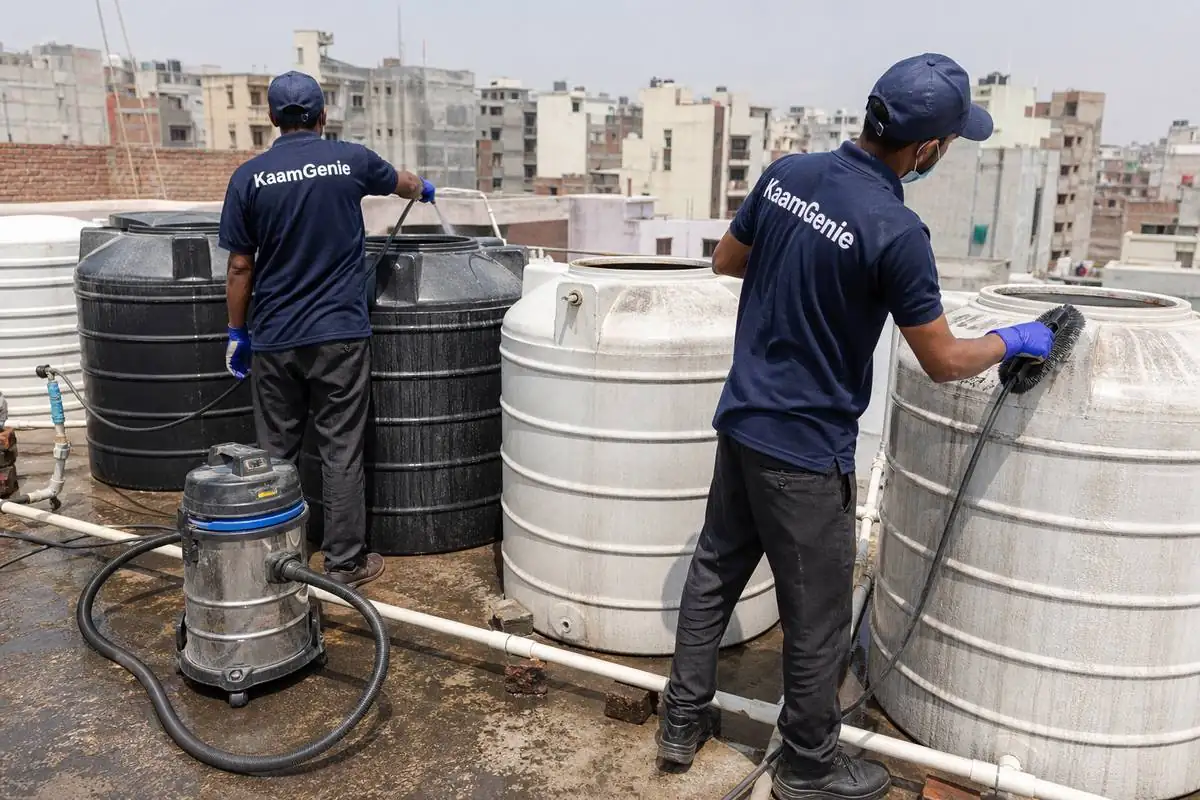
Tanker and borewell water is the raw reality in Seemapuri, and both are heavier with suspended silt than a treated pipeline supply. When that water sits in a shared block tank, the solids drop out and build a bed on the floor, and because the tank is often filled to the brim from a delivery and drawn down slowly, there is plenty of still time for settling. The harder the water, the more mineral matter joins the silt. Within months a resettlement tank can hold a distinct layer the families never see.
That silt bed is where bacteria and biofilm establish, and in a block sharing one tank the effect is felt across every flat as cloudy water and a flat, stale taste. The same particles reach the shared pump and the taps, and grit-worn fittings are an added cost a stretched household does not need. Where water is precious and tank-delivered, keeping the storage clean matters more, not less. A regular scrub-out protects the supply a whole Seemapuri block has paid to fill.
No travel charge anywhere in Seemapuri. The final price is confirmed on the call before we come — it depends only on tank size and access.
See it done in 45 seconds
Watch our web story on how a tank is really cleaned — drain, de-sludge, jet-wash, disinfect.
We reach every pocket of Seemapuri — and there’s no travel charge to any of them:
Every locality in Delhi stores different water, and that decides how fast a tank fouls. This is Seemapuri’s profile from The Delhi Water Index, built from our field observations across 250+ localities.
Indicative field characterisation, not a certified lab test. BIS IS 10500: TDS 500 mg/L acceptable, 2,000 permissible. Check any Delhi area →
“We fill our tank from tankers. Should we clean it before or after a delivery?” Best when the tank is near empty, just before a delivery, so we can drain the last of the old water and settled silt without wasting a full load. We coordinate the timing with your caretaker so the clean and the next fill line up.
“The block shares one tank between several families. Who arranges the clean?” Usually the block's caretaker or a senior resident calls it in on behalf of everyone, since the tank is common. Any of the families can start it, and we leave one dated record for the group regardless of who booked.
“What does it cost for a shared block tank in Seemapuri?” A shared block tank runs ₹1,500 to ₹2,000 by size. There is no extra charge for not being a registered society, and buildings with more than one tank get a bulk rate for a single visit.
“Our water is hard and leaves silt. Will a clean keep it clear for long?” A clean resets it, but on tanker and hard-borewell water the silt starts settling again within a few months. For a Seemapuri block, cleaning two or three times a year keeps the bottom layer from building back to where the whole block tastes it.
“Is the same record given even though we are not a registered society?” Yes. Every clean ends with the same dated photo record and job note whether you are a formal society or an informal block sharing one tank. Many residents keep it as proof the shared storage was maintained.
See our complete water tank cleaning services in Delhi NCR — pricing, process, tank types and full city coverage.
Beyond water tank cleaning, KaamGenie is rolling out a full lineup of home services across Delhi NCR — see our complete list of 12 home services we offer or will be launching through 2026. New to tank cleaning? Read our guide on how to pick the right water tank cleaning service in Delhi — what to look for, what to avoid, and the questions that separate trustworthy crews from quick-job operators.
Rooftop plastic tanks
₹699+ →Kothi sumps & underground tanks
₹1,499+ →Apartments & RWAs
Bulk pricing →FSSAI-compliant cleaning
₹2,500+ →टंकी साफ़ करने वाले
हिन्दी पढ़ें →View all water tank cleaning guides →
All pockets and lanes of Seemapuri covered. If your specific block or society isn’t named in the sub-areas above, just call — we almost certainly cover it.
Same crew, same 6-step process, same-day where possible. Pick any locality below for local pricing and the tanks we typically find there.
Book a slot — we can usually fit you in today or tomorrow.